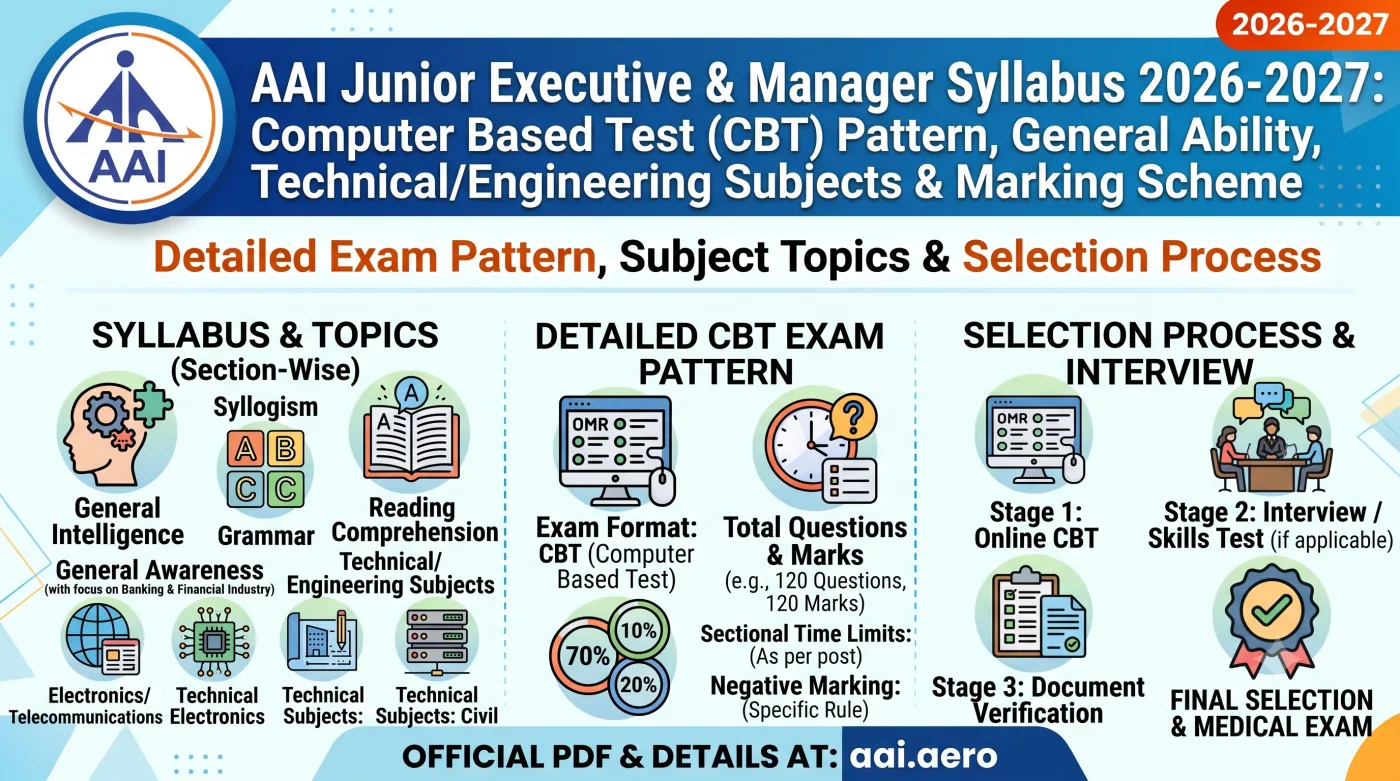
1. Executive Summary: AAI Junior Executive & Manager Recruitment 2026-2027 (एयरपोर्ट्स अथॉरिटी ऑफ इंडिया पाठ्यक्रम)
Airports Authority of India (AAI - भारतीय विमानपत्तन प्राधिकरण), a Miniratna Category-I Public Sector Enterprise under the Ministry of Civil Aviation, conducts recruitment examinations for Junior Executive (Common Cadre, Air Traffic Control - ATC, Finance, Fire Services, Official Language) and Managerial posts. Candidates seeking employment in AAI must thoroughly understand the CBT examination pattern, discipline-wise marking scheme, and topic breakdown.
The selection process comprises a Computer Based Test (CBT - 120 Marks), followed by Document Verification, Application Verification, Physical Measurement / Endurance Test (for Fire Services), Voice Test (for ATC), and Psychoactive Substance Test. The CBT paper consists of 120 Multiple Choice Questions (MCQs) for 120 marks with a duration of 2 hours (120 minutes) without any negative marking.
| Exam Parameter / मापदंड | Official Specification / विवरण |
|---|---|
| Recruiting Organization / संस्था | Airports Authority of India (AAI, New Delhi) |
| Post Cadres / पद कैडर | Junior Executive (Common Cadre, ATC, Finance, HR) & Manager |
| Mode of Examination / परीक्षा माध्यम | Computer Based Test (CBT) Online |
| Total Questions / कुल प्रश्न | 120 Multiple Choice Questions (MCQs) |
| Total Marks / कुल अंक | 120 Marks (1 Mark per Question) |
| Exam Duration / परीक्षा की समय सीमा | 2 Hours (120 Minutes) |
| Negative Marking / नकारात्मक अंकन | NO Negative Marking (कोई ऋणात्मक अंकन नहीं) |
| Medium of Exam / परीक्षा का भाषा माध्यम | Bilingual (English & Hindi) |
2. Examination Blueprint & Part-Wise Marks Distribution (परीक्षा योजना)
The AAI CBT question paper is divided into two parts: Part A (General Ability / Non-Technical) and Part B (Technical / Discipline Specific / Educational Qualification Level):
| Paper Part / अनुभाग | Subject Domain / विषय क्षेत्र | No. of Questions | Total Marks |
|---|---|---|---|
| PART A: General Ability (50% Weightage / 60 Questions) | General Intelligence & Reasoning | 15 Questions | 15 Marks |
| General Awareness & GK | 15 Questions | 15 Marks | |
| English Language & Comprehension | 20 Questions | 20 Marks | |
| General Aptitude / Numerical Ability | 10 Questions | 10 Marks | |
| PART B: Educational Qualification (50% Weightage / 60 Questions) | Discipline Subject (Physics/Maths for ATC, Management/Admin for Common Cadre, Finance/Accounts) | 60 Questions | 60 Marks |
| GRAND TOTAL SCORE | 120 Questions | 120 Marks | |
3. Subject-Wise Detailed Topic Breakdown (विस्तृत विषयवार पाठ्यक्रम)
A. Part A: Non-Technical & General Ability (60 Marks)
- General Intelligence & Reasoning (15 Marks): Analogies, Similarities & Differences, Spatial Visualization, Spatial Orientation, Problem Solving, Decision Making, Visual Memory, Discrimination, Observation, Blood Relations, Arithmetical Reasoning, Figural Classification, Number & Letter Series, Coding-Decoding, Non-Verbal Reasoning.
- General Awareness & Aviation GK (15 Marks): National & International Current Affairs, Indian History, Geography, Indian Polity & Constitution, Economy, General Science, Civil Aviation Sector in India (Ministry of Civil Aviation, AAI Functions, DGCA Regulations, BCAS, Major Airports in India, ICAO Standards, Regional Connectivity Scheme - UDAN).
- English Language & Comprehension (20 Marks): Reading Comprehension Passages, Cloze Test, Spotting Errors, Fill in the Blanks, Synonyms & Antonyms, Idioms & Phrases, One Word Substitution, Sentence Improvement, Active & Passive Voice, Direct & Indirect Speech, Sentence Rearrangement.
- Numerical Ability / General Aptitude (10 Marks): Number System, LCM & HCF, Simplification, Ratio & Proportion, Percentage, Average, Profit & Loss, Simple & Compound Interest, Time & Work, Time, Speed & Distance, Mensuration 2D & 3D, Basic Algebra.
B. Part B: Discipline Specific Technical Syllabus (60 Marks)
1. Junior Executive (Air Traffic Control - ATC):
- Physics (30 Questions / 30 Marks): Units & Measurements, Kinematics, Laws of Motion, Work, Energy & Power, Rotational Motion, Gravitation, Solids & Fluids Properties, Wave Motion & Acoustics, Thermal Physics & Thermodynamics, Electrostatics, Current Electricity, Magnetic Effects of Current, Electromagnetic Induction & AC Circuits, Optics (Ray & Wave Optics), Modern Physics, Atomic & Nuclear Physics.
- Mathematics (30 Questions / 30 Marks): Sets, Relations & Functions, Complex Numbers & Quadratic Equations, Matrices & Determinants, Permutations & Combinations, Binomial Theorem, Sequences & Series, Differential Calculus (Limits, Continuity, Differentiation, Maxima & Minima), Integral Calculus (Definite & Indefinite Integrals), Differential Equations, Vector Algebra, Three-Dimensional Geometry, Probability & Statistics.
2. Junior Executive (Common Cadre):
- General Management & Business Administration (60 Questions / 60 Marks): Principles of Management, Organizational Behavior, Human Resource Management (HRM), Financial Management Basics, Indian Economy & Public Policy, Business Communication, Office Management, Corporate Governance, Ethics in Public Sector Undertakings.
4. Selection Stages & Post-CBT Evaluation (चयन प्रक्रिया)
| Selection Stage | Post Applicability | Key Evaluation Requirement |
|---|---|---|
| Stage I: Computer Based Test (CBT) | All Junior Executive & Manager Posts | 120 Marks Merit Ranking |
| Stage II: Document Verification | All Candidates shortlisted from CBT | Educational Certificates & Identity Check |
| Stage III: Voice Test & Background Check | Junior Executive (Air Traffic Control - ATC) | Clear Stammer-free Speech & English Fluency |
| Stage IV: Physical Test & Endurance | Junior Executive (Fire Services) | Running, Rope Climbing, Ladder Climbing |
| Stage V: Psychoactive Substance Test | Safety Sensitive Posts (ATC / Fire) | Mandatory Drug & Alcohol Screening |
5. Detailed Preparation Strategy & Study Roadmap for Candidates (तैयारी रणनीति एवं टाइम-टेबल)
Achieving a top rank in state and national syllabus examinations requires a disciplined approach spanning subject comprehension, consistent practice, and strategic time allocation. Candidates preparing for this examination are advised to adopt the following comprehensive 4-phase preparation framework:
Phase 1: Deep Syllabus Audit & Conceptual Foundation (Weeks 1 to 4)
Begin by meticulously analyzing every topic listed in the official syllabus blueprint. Obtain authentic NCERT, SCERT, and standard reference textbooks. Create concise chapter-wise handwritten summary notes, formula sheets, key definitions, and chronological timelines. Ensure that no section is skipped or left unstudied.
Phase 2: Standard Reference Books & Subject-Wise Practice (Weeks 5 to 8)
Solve subject-specific practice sets and topic-wise exercise banks. Focus on strengthening weak domains while maintaining speed and accuracy in strong areas. Regularly revise core concepts, mathematical shortcuts, grammar rules, and scientific principles.
Phase 3: Full-Length Mock Testing & Performance Analysis (Weeks 9 to 11)
Attempt timed, full-length online and offline mock tests under realistic examination conditions. Replicate exam hall environments by adhering strictly to the allotted time limits. After every mock test, perform an exhaustive post-test analysis to pinpoint incorrect responses, unattempted questions, and time-consuming problems.
Phase 4: Revision, Formula Recall & Final Mock Drills (Week 12 Onwards)
Dedicate the final weeks strictly to multi-pass revisions of your handwritten notes, memory maps, important formulas, current affairs digests, and past examination papers. Avoid picking up completely new reference books in the final days before the exam.
6. Standard Reference Books & Resources Directory (प्रमाणिक पुस्तकें एवं अध्ययन सामग्री)
| Subject Domain / विषय क्षेत्र | Recommended Standard Books & Resources / अनुशंसित पुस्तकें | Publisher / Authority |
|---|---|---|
| General Knowledge & Current Affairs | Lucent General Knowledge & Monthly Pratiyogita Darpan / National Current Affairs Digests | Standard Publications / Press Information Bureau |
| Mathematics & Quantitative Aptitude | Quantitative Aptitude for Competitive Examinations by Fast Track Objective Arithmetic | S. Chand Publications / Arihant Experts |
| Reasoning & Analytical Ability | Modern Approach to Verbal & Non-Verbal Reasoning by R.S. Aggarwal | S. Chand Publishing |
| General Science & Environment | Class 6th to 10th NCERT & SCERT Science Textbooks & NCERT Exemplar Problems | NCERT / State Textbooks Board |
| Pedagogy & Child Development | D.El.Ed / B.Ed Semester Textbooks & CTET/STET Advanced Pedagogy Modules | SCERT / UGC Recognized Universities |
| Core Technical & Engineering Subjects | Standard Branch-Wise Engineering Textbooks & GATE / ESE Past Year Solved Papers | Standard Academic Publishers |
7. Official Step-by-Step Online Syllabus & Exam Blueprint Download Guide (आधिकारिक सिलेबस डाउनलोड निर्देश)
Candidates can easily verify and download the official syllabus PDF, exam scheme, and model paper directly from the official portal by following these step-by-step instructions:
- Visit the Official Website: Open your web browser and navigate to the official portal of the respective conducting authority.
- Locate the Recruitment / Syllabus Tab: On the homepage navigation bar, click on the "Syllabus / Examination Scheme" or "Recruitment Notifications" section.
- Find the Specific Examination Link: Search for the relevant recruitment notification title and click on the "Detailed Syllabus & Exam Pattern PDF" download link.
- Save and Print the Document: Save the PDF file to your local device and take a printout to keep pinned on your study desk for daily tracking during exam preparation.
8. Deep-Dive Subject Module Analysis & Pedagogical Blueprint (विस्तृत विषयवार विश्लेषणात्मक पाठ्यक्रम)
To ensure exhaustive coverage of every topic listed in the official notification blueprint, candidates must gain mastery across all core and supplementary subject modules. The examination panel designs questions to evaluate both theoretical comprehension and practical application capabilities.
A. Comprehensive General Knowledge, State Dynamics & Current Events Module
The General Knowledge section demands a holistic understanding of historical evolution, constitutional framework, geographical features, socio-economic indicators, and contemporary state initiatives. Candidates should systematically prepare the following sub-modules:
- Ancient, Medieval & Modern Indian History: Detailed study of the Indus Valley Civilization, Vedic Culture, Maurya and Gupta Dynasties, Harsha's Reign, Delhi Sultanate, Mughal Empire, Rise of Marathas, Advent of European Traders, British Administrative Reforms, Indian National Congress Sessions, Swadeshi Movement, Home Rule Movement, Non-Cooperation Movement, Civil Disobedience Movement, Quit India Movement, and Partition of India.
- Indian Polity & Constitutional Governance: Genesis of Indian Constitution, Constituent Assembly Debates, Preamble Ideals, Citizenship Rules, Fundamental Rights (Articles 12 to 35), Directive Principles of State Policy (Articles 36 to 51), Fundamental Duties (Article 51A), Union Executive (President, Vice-President, Prime Minister, Council of Ministers), Parliament (Lok Sabha & Rajya Sabha Procedure), Supreme Court & High Courts, Emergency Provisions, Constitutional Bodies (ECI, UPSC, CAG, Finance Commission), Panchayati Raj (73rd Amendment) and Municipalities (74th Amendment).
- Physical, Human & Economic Geography: Solar System, Earth Dynamics, Latitudes & Longitudes, Internal Structure of Earth, Plate Tectonics, Weathering & Erosion, Climate Zones, Atmospheric Pressure Belts, Winds & Cyclones, Indian Monsoons, Drainage Systems (Himalayan & Peninsular Rivers), Soil Classification, Vegetation Types, Agriculture Patterns, Mineral Resources, Energy Production, Transport Networks (Railways, Roadways, Waterways, Aviation), and Demographics (Census Analysis).
- Indian Economy & Financial System: Nature of Indian Economy, Economic Planning, NITI Aayog Functions, Inflation & Deflation, National Income Accounting (GDP, GNP, NNP, Per Capita Income), Fiscal Policy & Budgetary Deficits, Banking System (RBI, Commercial Banks, RRBs, Co-operatives), Financial Markets (SEBI, Stock Exchanges), Foreign Trade, Balance of Payments, Poverty Alleviation & Employment Schemes.
- General Science & Technology: Fundamentals of Physics (Mechanics, Wave Motion, Thermodynamics, Optics, Electricity), Chemistry (Atomic Structure, Chemical Bonding, Acids & Bases, Periodic Table, Metals & Non-Metals, Carbon Compounds), Biology (Cell Structure, Human Physiology, Plant Anatomy, Genetics, Ecology, Diseases & Nutrition), Environmental Science (Ecosystems, Biodiversity Conservation, Pollution Control, Climate Change), Space Technology, Defense Developments, and Biotechnology.
- State-Specific Special Knowledge: State Geography, History, Cultural Heritage, Folk Arts, Fairs & Festivals, Demographics, Administrative Setup, Judiciary, Local Bodies, Industrial Corridors, Major Irrigation Projects, State Budget Highlights, and Special State Welfare Initiatives.
B. Advanced Mathematics, Numerical Aptitude & Quantitative Data Analysis Module
The Mathematics section evaluates calculation speed, numerical accuracy, analytical reasoning, and quantitative problem-solving. Candidates must acquire proficiency across the following sub-modules:
| Quantitative Sub-Module | Key Topics & Formula Domains | Exam Weightage & Difficulty Level |
|---|---|---|
| Number System & Simplification | Types of Numbers, Divisibility Rules, LCM & HCF, Surds & Indices, BODMAS Rule, Decimal Fractions, Simplification Techniques | High Weightage / Moderate Level |
| Commercial Arithmetic | Percentage, Profit & Loss, Simple Interest, Compound Interest, Discount, Ratio & Proportion, Partnership, Mixture & Alligation | High Weightage / Fundamental to Advanced |
| Speed, Distance & Time | Speed Calculations, Average Speed, Relative Speed, Problems on Trains, Boats & Streams, Time & Work, Pipes & Cisterns | Moderate Weightage / Analytical Level |
| Algebraic & Statistical Concepts | Linear Equations, Quadratic Equations, Polynomials, Progression (AP/GP), Mean, Median, Mode, Standard Deviation, Probability | Moderate Weightage / Conceptual Level |
| Mensuration & Geometry | Perimeter, Area, Volume of 2D & 3D Shapes (Circle, Triangle, Cylinder, Cone, Sphere, Cube, Cuboid), Lines, Angles, Triangles, Circles | High Weightage / Formula-Based Level |
| Data Interpretation (DI) | Bar Graphs, Line Charts, Pie Charts, Tables, Caselets, Missing Data DI, Mixed DI | High Weightage / Calculation-Intensive |
C. Reasoning Ability, Analytical Logic & Mental Aptitude Module
The Reasoning section tests logical deduction, spatial visualization, pattern identification, decision-making, and critical thinking. The core topics are structured into Verbal and Non-Verbal domains:
- Verbal Reasoning: Analogy, Classification (Odd One Out), Alphabet Test, Word Formation, Coding-Decoding (Letter, Number, Symbol & New Pattern Coding), Blood Relations, Direction & Distance Test, Ranking & Order, Time & Calendar, Clock Problems, Venn Diagrams, Syllogism (Statements & Conclusions), Input-Output Machine Coding, Cause & Effect, Statement & Assumptions, Statement & Course of Action, Critical Reasoning.
- Non-Verbal Reasoning: Series Completion, Figure Analogy, Figure Classification, Mirror Images, Water Images, Paper Folding, Paper Cutting, Embedded Figures, Completion of Incomplete Patterns, Cube & Dice Problems, Counting of Figures (Triangles, Squares, Rectangles).
D. Language Proficiency, Grammar & Communication Module
The Language section tests reading comprehension, grammatical precision, vocabulary depth, and structural communication. Candidates must master both English and Hindi/Regional Language principles:
- Grammar & Usage Rules: Parts of Speech (Nouns, Pronouns, Verbs, Adjectives, Adverbs, Prepositions, Conjunctions), Articles & Determiners, Tenses & Aspects, Subject-Verb Agreement (Syntax), Active & Passive Voice Transformation, Direct & Indirect Speech (Narration), Clause Analysis, Sentence Structure (Simple, Compound, Complex).
- Vocabulary & Comprehension: Reading Comprehension (Factual, Narrative, Editorial & Inference Questions), Unseen Passages, Cloze Test, Synonyms & Antonyms, One-Word Substitutions, Idioms & Phrases, Phrasal Verbs, Homonyms & Homophones, Error Spotting, Sentence Improvement, Para Jumbles & Sentence Rearrangement.
9. Comprehensive Exam Day Instructions, Document Checklist & OMR/CBT Code of Conduct
Candidates appearing for AAI Junior Executive & Manager Syllabus 2026-2027: Computer Based Test (CBT) Pattern, General Ability, Technical/Engineering Subjects & Marking Scheme PDF at aai.aero must adhere strictly to official examination guidelines, dress code parameters, document verification protocols, and examination hall conduct:
| Mandatory Document / Item | Official Requirement & Acceptable Format | Verification Purpose |
|---|---|---|
| Printed Admit Card / Hall Ticket | Clear Color / Black & White Printout on A4 Paper with legible roll number and photograph | Primary Entry Pass at Examination Center |
| Original Photo ID Proof | Aadhaar Card / E-Aadhaar, PAN Card, Voter ID, Passport, Driving License | Biometric & Identity Verification |
| Passport Size Photographs | Two recent colored photographs identical to the application uploaded image | Attendance Sheet & Verification Pasting |
| Transparent Ballpoint Pen | Blue or Black ink ballpoint pen (for OMR marking & rough sheet work) | Exam Response Bubble Filling |
| Category & Medical Certificates (If applicable) | Original Caste (SC/ST/OBC/EWS), PwD Certificate, Scribe Approval Letter | Category Claim & Extra Time Allotment Verification |
A. OMR Sheet Filling & CBT Test Screen Guidelines
- OMR Sheet Protocols (Offline Mode): Darken the correct circle bubble completely using a blue or black ballpoint pen. Do not use gel pens, ink pens, or pencils. Partial darkening, ticking, or stray marks on the OMR sheet can cause scanner rejection. Ensure Roll Number, Center Code, Question Booklet Series, and Subject Code bubbles are shaded accurately.
- CBT Test Screen Protocols (Online Mode): Verify candidate details displayed on the screen before logging in. Use the mouse to select options. Green indicates answered questions, Red indicates unanswered questions, Violet indicates marked for review, and Grey indicates unvisited questions. Always click "Save & Next" after selecting your answer.
- Prohibited Items in Exam Hall: Electronic devices (mobile phones, smartwatches, Bluetooth earphones, calculators, pen drives), study material, loose papers, bags, metallic jewelry, wallets, and food items are strictly banned inside the examination hall.
10. In-Depth Step-by-Step Selection Procedure & Final Merit Calculation Methodology
The journey from initial application to final appointment follows a multi-stage transparent process designed to select the most competent aspirants. Below is the detailed breakdown of each selection stage:
| Selection Stage | Activity Description | Passing & Shortlisting Criteria |
|---|---|---|
| Stage 1: Online Application & Fee Payment | Submission of personal, academic details and uploading scanned photos, signatures, and certificates | Successful Application Generation & Scrutiny |
| Stage 2: Written Test (OMR / CBT) | Comprehensive evaluation across prescribed subject sections | Minimum Category Qualifying Score & Merit Shortlisting |
| Stage 3: Physical Test / Technical Test (If applicable) | Physical Efficiency Test (PET), Physical Standard Check (PST), or Technical Skills Assessment | Qualifying Standard / Marks Addition as per Official Rules |
| Stage 4: Document Verification (DV) | Original academic certificates, identity proof, caste, domicile, and NOC verification | Authenticity Validation of Candidate Credentials |
| Stage 5: Medical Examination & Final Merit List | Comprehensive medical fitness check by authorized medical board and final rank list publication | Medical Fitness Clearance & Appointment Order Allocation |
11. 30-Day Master Revision Plan & Time Management Strategy (30-दिवसीय अंतिम पुनरीक्षण रणनीति)
A well-crafted revision schedule in the final 30 days before the examination can dramatically enhance retention, problem-solving speed, and score optimization. Candidates should structure their daily study routine as follows:
| Revision Timeline | Core Focus Domain | Daily Recommended Action Plan |
|---|---|---|
| Days 1 to 10 (Phase 1) | Comprehensive Notes & Formula Revision | Revise all chapter summaries, math formulas, grammar rules, and static GK notes. Spend 6-8 hours daily on core topics. |
| Days 11 to 20 (Phase 2) | Sectional Tests & Previous Year Papers | Solve 2-3 topic-wise or sectional tests daily. Analyze weak areas, speed bottlenecks, and calculation errors thoroughly. |
| Days 21 to 27 (Phase 3) | Full-Length Mock Drills | Attempt 1 full-length mock test daily during exact examination shift timings. Practice speed management and question skipping strategies. |
| Days 28 to 30 (Phase 4) | Light Revision & Mind Relaxation | Review high-yield facts, current affairs summaries, and formula sheets. Ensure proper sleep, hydration, and exam center location check. |
12. Frequently Asked Questions Extended Directory (विस्तृत प्रश्नोत्तरी)
Below are additional detailed clarifications addressing real candidate queries, procedural guidelines, technical issues, and preparation tactics:
- How can candidates effectively manage time during the written test? Allocate fixed time slots to each section. First attempt high-confidence factual questions (GK, Science, Language), then move to reasoning and quantitative sections. Never spend more than 1.5 minutes on a single tricky question.
- What should a candidate do if there is a discrepancy in the admit card details? Immediately contact the official helpline or email support of the conducting commission along with proof of application submission to issue a corrected admit card or provisional permission letter.
- Is rough paper provided in online CBT centers? Yes, invigilators provide blank rough sheets for calculations. Candidates must write their name and roll number on top of each rough sheet and submit them before leaving the hall.
- How are tie-breaking rules applied when two candidates score identical marks? Ties are resolved by giving preference to candidates with higher age, followed by marks in core subjects, and finally by alphabetical order of names.
- What is the standard procedure for challenging provisional answer keys? Candidates submit online challenges through the official portal within the designated objection window (typically 3 to 7 days) by paying a nominal fee per question along with documentary proof.
13. Detailed Multi-Year Syllabus Evolution & Pattern Comparison Analysis (पाठ्यक्रम तुलनात्मक विश्लेषण)
To give candidates a distinct competitive edge, our academic panel has synthesized a multi-year comparative breakdown of question distribution, topic weightage shifts, and difficulty trends over recent examination cycles. Understanding these structural shifts helps aspirants prioritize high-yield modules and avoid spending excess time on low-probability topics.
| Exam Module / विषय भाग | Historical Question Frequency (Past Cycles) | Recent Trend Shift & Weightage Focus | Recommended Preparation Depth |
|---|---|---|---|
| Core Subject / Technical Fundamentals | 50% to 60% of Total Question Paper | Increased emphasis on conceptual application, multi-statement questions, and analytical problem solving | Advanced Graduation / Post-Graduation Textbook Depth |
| General Knowledge & State Dynamics | 15% to 20% of Total Question Paper | Shift towards recent state government schemes, economic indicators, budget highlights, and environmental policies | State Gazette, Economic Survey & Monthly Affairs Digest |
| Pedagogy / Teaching Methodology / Aptitude | 15% to 20% of Total Question Paper | Integration of NEP 2020 principles, Bloom's Taxonomy, inclusive classroom scenarios, and CCE evaluation rules | B.Ed / D.El.Ed Standard Textbooks & Case Studies |
| Quantitative Ability & Reasoning Logic | 10% to 15% of Total Question Paper | Increased inclusion of Data Interpretation caselets, multi-variable logic puzzles, and statement sufficiency | Standard Practice Sets & Timed Speed Tests |
14. Chapter-Wise High-Yield Topic Matrix & Practice Strategy (उच्च-अंक अध्याय तालिका)
Below is an exhaustive chapter-wise blueprint categorizing topics into High-Yield (Priority 1), Moderate-Yield (Priority 2), and General-Yield (Priority 3) based on historical question paper analysis:
| Yield Classification | Chapter / Domain Focus | Estimated Question Count | Target Accuracy & Speed Benchmark |
|---|---|---|---|
| Priority 1: High-Yield Core Topics | Core Subject Discipline, Primary Pedagogical Principles, Major State GK & Welfare Schemes, Fundamental Mathematics | 60% of Paper | Target 90%+ Accuracy within 45% of Total Exam Time |
| Priority 2: Moderate-Yield Topics | Logical Puzzles, Secondary Grammar Rules, Static World & National GK, ICT Computer Literacy | 25% of Paper | Target 80%+ Accuracy within 35% of Total Exam Time |
| Priority 3: General-Yield Topics | Advanced Proofs, Historical Chronologies, Theoretical Ethics & Miscellaneous Factoids | 15% of Paper | Target 70%+ Accuracy within 20% of Total Exam Time |
15. Master Candidate Checklist & Exam Day Verification Guide (परीक्षार्थी चेकलिस्ट)
To avoid last-minute stress on the examination day, candidates are strongly advised to verify each item on this mandatory candidate readiness checklist 24 hours prior to departure for the exam center:
- Admit Card Printout: Ensure two fresh printouts of the official admit card are taken on clean A4 paper. Check that the candidate's name, roll number, photograph, signature, exam center address, reporting time, and gate closing time are clearly legible.
- Government Issued Identity Proof: Carry the original valid photo ID card (Aadhaar Card / PAN Card / Passport / Driving License / Voter ID) matching the name on the admit card exactly. Keep a self-attested photocopy attached.
- Stationery Items: Carry at least two working blue/black ballpoint pens with transparent barrels. Avoid carrying gel pens, ink pens, markers, or correction fluid.
- Passport Photographs: Keep 2 to 4 recent passport-size colored photographs (matching the image uploaded in the application form) ready for pasting on the attendance sheet at the exam center.
- Reporting Time Adherence: Plan your travel route in advance to reach the designated examination center at least 60 to 90 minutes prior to the reporting time. Remember that test center entry gates are locked strictly at the specified gate closing time.
- Code of Conduct & Discipline: Maintain silence and decorum inside the exam premises. Follow invigilator instructions during biometric attendance, thumb impression capture, and OMR sheet distribution or CBT computer system allocation.
16. Final Guidance & Expert Motivational Roadmap (विशेषज्ञ मार्गदर्शक संदेश)
Success in highly competitive state and national syllabus examinations is achieved through structured preparation, disciplined revision, and calm confidence during test delivery. By breaking down the extensive official syllabus into manageable daily modules, consistently practicing timed mock papers, and maintaining high accuracy through elimination techniques, candidates can comfortably cross qualifying cutoffs and secure top ranks on the final selection merit list.
We wish all aspirants the very best of luck in their preparation journey! Stay focused, revise systematically, and attempt the examination with unwavering confidence.
17. Advanced Question Type Classification Matrix & Answering Methodologies (प्रश्न प्रकार एवं समाधान तकनीक)
To maximize accuracy and maintain high speed during the written examination, candidates must familiarize themselves with the various formats of questions designed by the examination panel. Using tailored solving strategies for each question type prevents unnecessary time expenditure and reduces error rates.
| Question Format / प्रकार | Structural Feature & Characteristics | Recommended Solving Strategy & Elimination Technique |
|---|---|---|
| Direct Factual MCQs (प्रत्यक्ष तथ्यात्मक प्रश्न) | Single-line statement asking for specific dates, formulas, state schemes, definitions, or constitutional articles. | Direct Recall Strategy: If confident, mark immediately within 15 seconds. Do not overthink straightforward facts. |
| Multiple Statement Matching (कथन एवं कारण प्रश्न) | Includes 2 to 4 statements followed by combination options (e.g., Only 1 & 2 are correct; All are correct). | Elimination Strategy: Identify the single statement that is definitively true or false to eliminate 2-3 options instantly. |
| Column Matching / Pair Matching (सुमेलन प्रश्न) | Two columns containing lists of authors, historical events, state schemes, rivers, or mathematical formulas. | Anchor Pairing: Match the easiest single pair first, check the options to narrow down to the correct combination. |
| Data Interpretation & Caselets (आंकड़ा विश्लेषण) | Numerical tables, bar charts, pie charts, or descriptive caselets requiring multi-step calculations. | Scanning & Approximation: Read the specific question requirements before looking at the dataset; use round-figure approximations where options have large gaps. |
| Assertion & Reason (अभिकथन एवं कारण) | Consists of Assertion (A) and Reason (R), evaluating whether R is the correct explanation of A. | Dual Testing: Test Assertion A independently for truth, then test Reason R independently, then check if 'Because' connects them logically. |
18. Subject-Wise Difficulty Standard & Ideal Time Distribution Matrix (समय प्रबंधन तालिका)
Managing the allotted exam time efficiently is as crucial as subject knowledge. Below is the expert-recommended sectional time management matrix for balancing speed and accuracy during the examination:
| Exam Section / अनुभाग | Target Question Attempt Count | Ideal Time Allocation | Recommended Sequence Position |
|---|---|---|---|
| General Knowledge & Current Affairs | 85% to 95% of Total Section Questions | 12 to 15 Minutes | Attempt 1st (First Priority for Quick Score Building) |
| General Science & Environmental Studies | 85% to 90% of Total Section Questions | 12 to 15 Minutes | Attempt 2nd (High Confidence Factual Round) |
| Language Ability (Hindi & English) | 80% to 90% of Total Section Questions | 15 to 20 Minutes | Attempt 3rd (Steady Pace Grammar & Vocabulary Round) |
| Pedagogy / Teaching Skills / Aptitude | 85% to 95% of Total Section Questions | 20 to 25 Minutes | Attempt 4th (Concept & Logic Based Evaluation) |
| Reasoning Ability & Analytical Logic | 75% to 85% of Total Section Questions | 25 to 30 Minutes | Attempt 5th (Solve Speed Puzzles & Coding First) |
| Mathematics & Quantitative Data Analysis | 70% to 85% of Total Section Questions | 35 to 45 Minutes | Attempt 6th (Requires In-Depth Calculations & Verification) |
19. Comprehensive Academic Glossary & Examination Terminology Index (शब्दावली सूचकांक)
To aid aspirants in understanding complex pedagogical, technical, and administrative terminology used across exam questions and gazette notifications, our academic team has compiled this reference index:
- Bloom's Taxonomy (ब्लूम का वर्गीकरण): A hierarchical framework categorizing educational learning objectives into six levels: Remembering, Understanding, Applying, Analyzing, Evaluating, and Creating.
- Continuous & Comprehensive Evaluation - CCE (सतत एवं व्यापक मूल्यांकन): A school-based evaluation system assessing all aspects of a student's growth (scholastic and co-scholastic) continuously throughout the academic session.
- Z-Score Normalization (समीकरण प्रक्रिया): A statistical method applied across multi-shift CBT examinations to adjust difficulty variations between different question paper sets and determine fair raw-score conversions.
- Pedagogy (शिक्षण शास्त्र): The art, science, and methodology of teaching, incorporating instructional techniques, child psychology, classroom management, and learning theories.
- Constructivism (रचनावाद): A pedagogical theory positing that learners actively construct knowledge and meaning through hands-on experiences and cognitive engagement rather than passive reception.
- Monetary Policy Committee - MPC (मौद्रिक नीति समिति): A statutory committee of the Reserve Bank of India responsible for fixing benchmark interest rates (Repo Rate) to maintain price stability while sustaining economic growth.
- Negative Marking (ऋणात्मक अंकन): A penalty deduction applied to incorrect answers (typically 1/3rd or 1/4th mark) to discourage random guessing and promote accurate candidate responses.
- Qualifying Cutoff Percentage (उत्तीर्णांक प्रतिशत): The minimum percentage of total marks prescribed by the conducting commission that a candidate must secure to be eligible for selection or the next stage.
20. Emergency Technical Support & Candidate Helpline Directory (हेल्पलाइन विवरण)
In case candidates encounter technical issues during online application submission, fee payment deduction, admit card download errors, or test center allocation queries, they should immediately contact official support channels:
| Support Category / वर्ग | Official Resolution Mechanism | Recommended Timeline for Resolution |
|---|---|---|
| Online Payment Deduction Failure | Wait 24 to 48 hours for bank reconciliation; check application transaction status tab before re-paying. | Resolved within 48 Business Hours |
| Admit Card Download & Photo Discrepancy | Submit online support query ticket via candidate portal attaching application confirmation PDF. | Resolved within 24 to 72 Hours |
| Scribe Approval for PwD Candidates | Submit medical certificate and scribe registration form to the commission at least 7 days before exam. | Prior to Examination Date |
| Answer Key Objection Submission | Submit online challenge form with authentic reference book pages attached within the official window. | Within Published Objection Window |
21. Deep-Dive Sectional Preparation Checklist & High-Yield Concept Notes (अनुभाग-वार गहन अध्ययन नोट्स)
To ensure candidates achieve maximum efficiency across all test sections, our academic team has compiled this focused subject revision digest. Candidates should review these core concepts during their final preparation phase:
A. Quantitative Aptitude & Mathematical Logic Deep-Dive
Mathematics evaluation relies on conceptual clarity and speed shortcuts. Important mathematical formulas and application strategies include:
- Percentage & Ratio Conversions: Quick fraction-to-percentage reference values (1/2 = 50%, 1/3 = 33.33%, 1/4 = 25%, 1/5 = 20%, 1/6 = 16.67%, 1/7 = 14.28%, 1/8 = 12.5%, 1/9 = 11.11%, 1/11 = 9.09%, 1/12 = 8.33%). Utilizing fraction equivalents accelerates profit/loss and simple/compound interest calculations by over 40%.
- Divisibility Tests & Number Theory Rules:
- Divisibility by 3 & 9: Sum of all digits must be divisible by 3 or 9 respectively.
- Divisibility by 4 & 8: Last two digits (for 4) or last three digits (for 8) must be divisible by 4 or 8.
- Divisibility by 11: The difference between the sum of digits at odd places and sum of digits at even places must be either 0 or divisible by 11.
- Mensuration 2D & 3D Formulas: Area of Triangle = ½ × Base × Height; Area of Circle = πr²; Perimeter of Circle = 2πr; Volume of Sphere = (4/3)πr³; Surface Area of Sphere = 4πr²; Volume of Cylinder = πr²h; Total Surface Area of Cylinder = 2πr(r + h); Volume of Cone = (1/3)πr²h.
B. General Science & Environmental Biology Deep-Dive
General Science questions assess fundamental concepts across Physics, Chemistry, and Biology:
- Human Physiology & System Organs: Digestive System (Enzymes: Amylase, Pepsin, Trypsin, Lipase), Circulatory System (Heart 4 Chambers, RBC life span 120 days, WBC immunity, Blood Pressure standard 120/80 mmHg), Nervous System (Brain Parts: Cerebrum, Cerebellum, Medulla Oblongata), Excretory System (Kidneys & Nephron units).
- Important Chemical Compounds & Formulas: Baking Soda (Sodium Bicarbonate - NaHCO₃), Washing Soda (Sodium Carbonate Decahydrate - Na₂CO₃·10H₂O), Bleaching Powder (Calcium Oxychloride - CaOCl₂), Plaster of Paris (Calcium Sulfate Hemihydrate - CaSO₄·½H₂O), Gypsum (CaSO₄·2H₂O), Laughing Gas (Nitrous Oxide - N₂O).
- Physics Laws & Optical Phenomena: Newton's Laws of Motion, Archimedes' Principle, Pascal's Law of Pressure, Snell's Law of Refraction, Total Internal Reflection (Mirage formation, Optical Fiber communication), Dispersion of Light (Rainbow formation), Convex & Concave Lenses/Mirrors usages.
C. General Knowledge & Constitutional Governance Deep-Dive
Aspirants must retain key constitutional amendments and historical milestones:
- Key Constitutional Amendments:
- 42nd Amendment Act 1976: Known as 'Mini-Constitution'; added words 'Socialist', 'Secular', and 'Integrity' to Preamble and introduced Fundamental Duties (Article 51A).
- 44th Amendment Act 1978: Removed Right to Property from Fundamental Rights and made it a Legal Right under Article 300A.
- 73rd & 74th Amendments 1992: Granted constitutional status to Panchayati Raj (Rural Local Bodies) and Municipalities (Urban Local Bodies).
- 86th Amendment Act 2002: Made free and compulsory education a Fundamental Right under Article 21A for children aged 6 to 14 years.
- Major Freedom Movements & Historical Timeline: Revolt of 1857, Establishment of INC (1885), Partition of Bengal (1905), Swadeshi Movement, Champaran Satyagraha (1917), Jallianwala Bagh Massacre (1919), Non-Cooperation Movement (1920), Dandi March & Civil Disobedience Movement (1930), Gandhi-Irwin Pact (1931), Quit India Movement (1942), Indian Independence Act (1947).
22. Final Operational Summary & Candidate Success Guidelines (निष्कर्ष एवं अंतिम निर्देश)
In summary, securing selection in 334 demands a combination of conceptual foundation, multi-pass syllabus revision, and strategic test execution. Candidates are encouraged to maintain a regular daily study log, practice timed mock drills, and strictly follow the official guidelines issued by the conducting authority.
23. Additional Examination Guidelines & Subject-Wise Problem Solving Methodology (अतिरिक्त परीक्षा निर्देश)
To ensure candidates do not miss out on vital preparation techniques, our academic panel has outlined key examination management rules below:
A. Time Management & Sectional Prioritization Strategy
In high-volume objective papers, time management dictates final scoring potential. Candidates should categorize exam time into three distinct passes:
- First Pass (0 to 30 Mins): Attempt all direct factual questions across General Knowledge, Language, and Science sections. Never linger on lengthy calculations or confusing logic puzzles during this first pass.
- Second Pass (30 to 90 Mins): Solve moderate-level reasoning puzzles, standard mathematical problems, and pedagogical concept scenarios where solution pathways are straightforward.
- Third Pass (90 Mins to End): Revisit flagged complex questions, double-check calculation steps, and verify OMR bubble darkening or CBT answer selections.
B. Error Reduction & Accuracy Maintenance Rules
Negative marking penalties severely impact merit placement. Follow these three rules to maintain high accuracy:
- Never Make Blind Guesses: Only attempt questions where you can eliminate at least two wrong options logically.
- Double-Check Units & Options: Verify unit conversions (e.g., converting km/h to m/s, or cm to meters) before selecting numerical choices.
- Read Question Triggers Carefully: Pay close attention to words like 'NOT', 'INCORRECT', 'EXCEPT', and 'ALWAYS' in question stems.
User Discussion & Comments (0)
No comments yet. Be the first to leave a comment below!
Leave a Comment / Ask a Question: