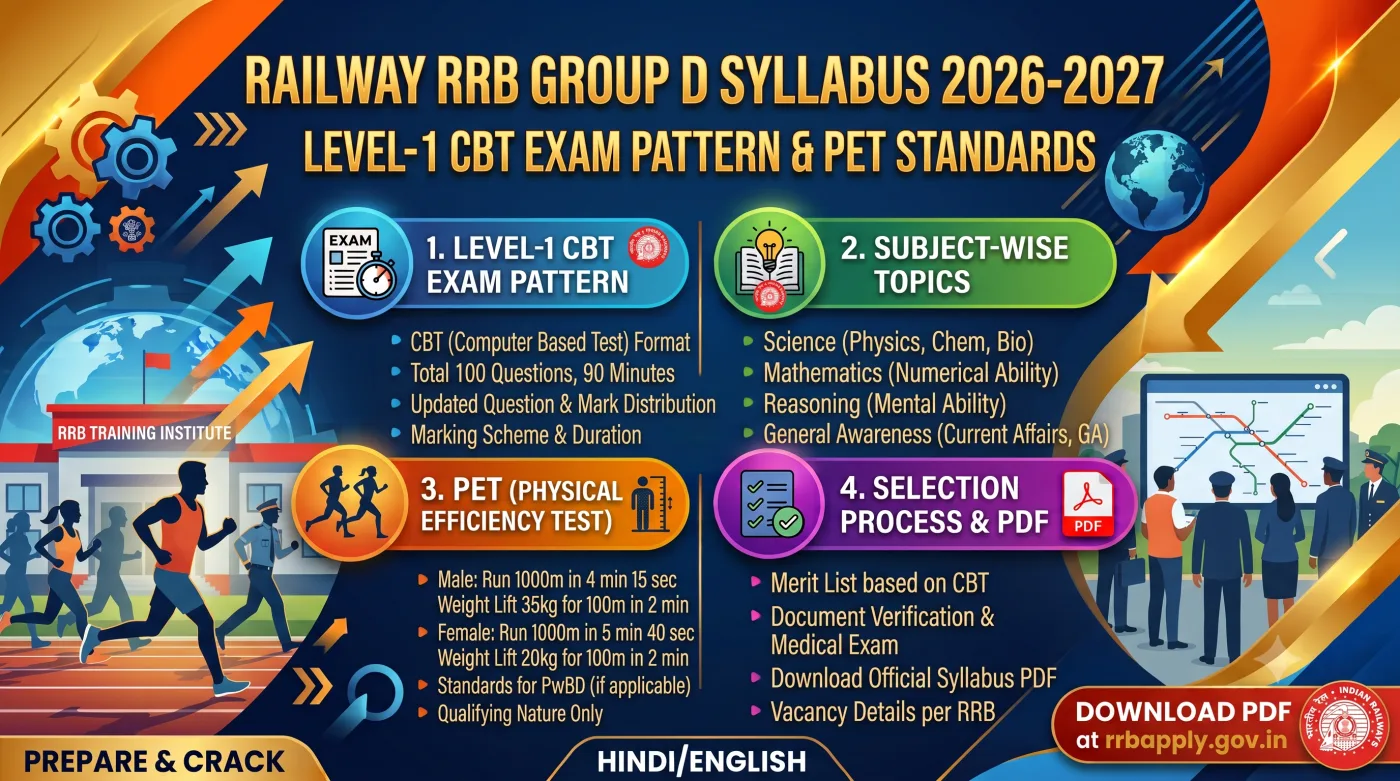
1. Executive Overview: Railway RRB Group D (Level-1) Selection Architecture
The Railway Recruitment Control Board (RRB) and Railway Recruitment Cells (RRC) conduct the massive nationwide recruitment for Level-1 personnel in Indian Railways. These frontline operational and technical positions form the foundational backbone of railway maintenance, train operations, track safety, and workshop manufacturing. The recruitment procedure follows a rigorous four-stage pipeline:
- Stage 1: Single-Stage Computer Based Test (CBT - 100 Marks): A 90-minute online examination testing Class 10 NCERT General Science, Mathematics, Reasoning, and General Awareness. Marks obtained in this stage serve as the sole numerical criteria for the final appointment merit list.
- Stage 2: Physical Efficiency Test (PET - Qualifying): Mandatory field endurance testing involving weight lifting and carrying (35 kg for males, 20 kg for females for 100 meters) and a timed 1,000-meter run. Passing both events in a single attempt is compulsory.
- Stage 3: Document Verification (DV): Strict scrutiny of original Class 10/ITI certificates, NCVT apprenticeship credentials, community certificates, and Aadhaar biometric verification in a 1:1 ratio.
- Stage 4: Comprehensive Railway Medical Examination (RME): Detailed clinical examination at Railway Divisional Hospitals evaluating visual acuity (distant/near vision, night vision, color blindness) and general physical health according to prescribed medical categories (A-2, A-3, B-1, B-2, C-1).
| Recruitment Dimension | Official Specification & Examination Details |
|---|---|
| Exam Conducting Authority | Railway Recruitment Control Board (RRB) / Railway Recruitment Cells (RRC) |
| Pay Scale & Cadre | 7th CPC Pay Level-1 (Basic Pay ₹18,000 + Allowances; Gross ₹28,000 - ₹35,000) |
| Key Notified Posts | Track Maintainer Grade IV, Assistant Pointsman, Assistant Workshop, Assistant S&T, Assistant Depot |
| Educational Qualification | 10th Pass (Matriculation) from Recognized Board OR ITI / NCVT National Apprenticeship Certificate |
| Mode of Examination | Computer Based Test (CBT - ऑनलाइन कंप्यूटर आधारित परीक्षा) |
| Total Questions & Marks | 100 Questions carrying 100 Marks (1 Mark per correct answer) |
| Exam Duration | 90 Minutes (1.5 Hours / 120 Minutes for PwBD Candidates with Scribes) |
| Negative Marking Penalty | 1/3rd (0.33) Marks Deducted per incorrect response |
| Normalization Methodology | Percentile-Based Normalization Method (पर्सेंटाइल स्कोर प्रणाली) |
| PET Status | Strictly Qualifying (No marks; failure leads to immediate disqualification) |
| Official Application Portal | rrbapply.gov.in |
2. Comprehensive CBT Exam Pattern & Subject-Wise Marks Weightage
The single-stage CBT tests speed, accuracy, and foundational conceptual mastery. Candidates must attempt 100 questions within 90 minutes. With 1/3rd negative marking, avoiding uncalculated guesses is essential:
| Subject Domain / Section | Standard & Level | Total Questions | Maximum Marks | Recommended Time Budget |
|---|---|---|---|---|
| 1. General Science (सामान्य विज्ञान) | Class 10th CBSE / NCERT Standard (Physics, Chemistry, Life Sciences) | 25 Questions | 25 Marks | 18 - 20 Minutes |
| 2. Mathematics (गणित) | Class 10th Arithmetic, Algebra, Geometry & Mensuration | 25 Questions | 25 Marks | 28 - 32 Minutes |
| 3. General Intelligence & Reasoning (तार्किक क्षमता) | Verbal, Non-Verbal, Analytical & Logic | 30 Questions | 30 Marks | 28 - 30 Minutes |
| 4. General Awareness & Current Affairs (सामान्य जागरूकता) | Science & Tech, Sports, Culture, Personalities, Economics, Politics | 20 Questions | 20 Marks | 10 - 12 Minutes |
| Total Composite Test | All 4 Subject Domains Combined | 100 Questions | 100 Marks | 90 Minutes (1.5 Hours) |
3. Deep Subject-Wise Micro-Syllabus Breakdown
Section 1: General Science (सामान्य विज्ञान - 25 Questions, 25 Marks)
The syllabus under this section covers Physics, Chemistry, and Life Sciences of the 10th standard level (CBSE/NCERT). Questions are conceptual, practical, and frequently include numerical problems:
Part (A): Physics (भौतिक विज्ञान):
- Units & Measurement: SI and CGS units of physical quantities (Force, Work, Power, Pressure, Energy, Electric Current, Resistance, Frequency), Dimensional formulas, Measuring instruments.
- Motion, Force & Laws of Motion: Equations of uniformly accelerated motion ($v = u + at$, $s = ut + \frac{1}{2}at^2$, $v^2 = u^2 + 2as$), Newton's three laws of motion, Inertia, Momentum, Conservation of Linear Momentum ($m_1u_1 + m_2u_2 = m_1v_1 + m_2v_2$), Friction and its types.
- Work, Energy & Power: Definition and formulas of Work ($W = F \cdot d \cdot \cos\theta$), Kinetic Energy ($KE = \frac{1}{2}mv^2$), Gravitational Potential Energy ($PE = mgh$), Law of Conservation of Energy, Electric Power ($P = VI = I^2R = V^2/R$), Commercial unit of electrical energy (Kilowatt-hour / Board of Trade Unit).
- Gravitation: Newton's Universal Law of Gravitation ($F = G\frac{m_1m_2}{r^2}$), Acceleration due to gravity ($g$), Variation of $g$ with height, depth, and latitude, Mass vs Weight, Free fall, Escape velocity.
- Sound & Waves: Nature of sound waves, Speed of sound in various media (solids, liquids, gases), Longitudinal vs Transverse waves, Auditory range of humans (20 Hz to 20,000 Hz), Infrasonic and Ultrasonic waves, Reflection of sound, Echo calculation ($2d = v \times t$), Sonar and Ultrasound applications.
- Optics (Light): Laws of reflection and refraction, Mirror formula ($\frac{1}{f} = \frac{1}{v} + \frac{1}{u}$), Magnification, Refraction through rectangular glass slab, Refractive index, Lens formula ($\frac{1}{f} = \frac{1}{v} - \frac{1}{u}$), Power of a lens ($P = 1/f$ in meters, Dioptre), Human eye anatomy, Defects of vision (Myopia, Hypermetropia, Presbyopia) and corrective lenses, Dispersion of light through prism, Atmospheric refraction (twinkling of stars), Scattering of light (Tyndall effect, blue color of sky).
- Electricity & Magnetism: Electric current, Potential difference, Ohm's law ($V = IR$), Factors on which the resistance of a conductor depends ($R = \rho \frac{l}{A}$), Series and parallel combinations of resistors, Heating effect of electric current (Joule's law: $H = I^2Rt$), Electric fuse, Magnetic field and field lines, Fleming's Left-Hand and Right-Hand Rules, Electromagnetic induction, Electric generator and motor principles.
- Sources of Energy: Conventional and non-conventional energy sources, Fossil fuels, Thermal, Hydro, Solar, Biomass, Wind, Nuclear energy, Nuclear fission and fusion.
Part (B): Chemistry (रसायन विज्ञान):
- Chemical Reactions & Equations: Balancing chemical equations, Types of reactions: Combination, Decomposition, Displacement, Double displacement, Precipitation, Neutralization, Oxidation and Reduction (Redox reactions), Corrosion and Rancidity prevention.
- Acids, Bases & Salts: Arrhenius definition, Indicators (litmus, phenolphthalein, methyl orange, olfactory indicators), Chemical properties of acids and bases, pH scale ($pH = -\log[H^+]$), Importance of pH in everyday life (soil pH, tooth decay, digestive acid), Common salts: Preparation, properties, chemical formulas, and industrial uses of Bleaching Powder ($CaOCl_2$), Baking Soda ($NaHCO_3$), Washing Soda ($Na_2CO_3 \cdot 10H_2O$), and Plaster of Paris ($CaSO_4 \cdot \frac{1}{2}H_2O$).
- Metals & Non-Metals: Physical and chemical properties, Reactivity series of metals, Reaction with air, water, and acids, Ionic and covalent compounds and their properties, Metallurgy: Extraction of metals from ores, Roasting, Calcination, Refining, Alloys (Brass, Bronze, Solder, Amalgam) and rusting prevention.
- Carbon & Its Compounds: Covalent bonding in carbon compounds, Versatile nature of carbon (Catenation, Tetravalency), Allotropes of carbon (Diamond, Graphite, Buckminsterfullerene), Saturated and unsaturated hydrocarbons (Alkanes, Alkenes, Alkynes), Functional groups (Alcohol, Aldehyde, Ketone, Carboxylic acid), Nomenclature rules, Combustion, Oxidation, Addition and substitution reactions, Soaps and Detergents (micelle mechanism).
- Periodic Classification of Elements: Early attempts: Dobereiner's Triads, Newlands' Law of Octaves, Mendeleev's Periodic Table (merits and limitations), Modern Periodic Table (Moseley's Law), Periodic trends across periods and down groups: Atomic radius, Valency, Metallic and non-metallic character, Electronegativity, Ionization energy.
Part (C): Life Sciences / Biology (जीव विज्ञान):
- Life Processes:
- Nutrition: Autotrophic (Photosynthesis light and dark reactions) and Heterotrophic nutrition (Amoeba and human digestive system, digestive enzymes).
- Respiration: Aerobic vs Anaerobic respiration, Glycolysis, Krebs cycle, Human respiratory system, Mechanism of breathing, Gas exchange in alveoli.
- Transportation: Human circulatory system, Structure of heart, Double circulation, Blood composition (RBC, WBC, Platelets, Plasma), Blood pressure (Systolic 120 / Diastolic 80 mm Hg), Lymph, Transport in plants (Xylem water conduction, Phloem translocation).
- Excretion: Human excretory system, Structure and working of Nephron, Dialysis (Artificial kidney), Excretion in plants.
- Control & Coordination: Nervous system, Structure of neuron, Reflex arc, Parts of human brain (Forebrain, Midbrain, Hindbrain - functions of Cerebrum, Cerebellum, Medulla Oblongata), Endocrine system: Hormones and their functions (Pituitary Growth Hormone, Thyroid Thyroxine, Pancreas Insulin & Glucagon, Adrenal Adrenaline, Testes Testosterone, Ovary Estrogen), Plant hormones (Auxins, Gibberellins, Cytokinins, Abscisic acid).
- Reproduction & Heredity: Asexual reproduction (Fission, Fragmentation, Regeneration, Budding, Vegetative propagation, Spore formation), Sexual reproduction in flowering plants, Human reproductive system, Menstrual cycle, Reproductive health and contraceptive methods, Heredity: Mendel's laws of inheritance, Monohybrid and Dihybrid cross ratios, Sex determination in humans ($XX$ and $XY$).
- Environment & Ecology: Ecosystem components, Food chains and Food webs, Biomagnification, 10% Energy Transfer Law (Lindeman's rule), Ozone layer depletion (CFCs), Waste management (biodegradable and non-biodegradable waste).
Section 2: Mathematics (गणित - 25 Questions, 25 Marks)
Testing computation speed, arithmetic problem solving, and basic geometric reasoning:
- Number System & Simplification: Types of numbers (Natural, Whole, Integers, Rational, Irrational, Real, Prime), Divisibility tests (2 through 13), Unit digit calculation, Number of zeros at the end of a product, Remainder theorem, BODMAS rule, Nested brackets, Decimals, Fractions, Surds and Indices.
- HCF & LCM: Factorization and division methods, Relationship: $Product\ of\ Numbers = HCF \times LCM$, Word problems on traffic lights, bells, and circular tracks.
- Ratio, Proportion & Partnership: Continued proportion, Mean proportion ($b = \sqrt{ac}$), Third and fourth proportions, Partnership investments based on capital and time period, Dividing sum among partners.
- Percentages: Conversions between fractions and percentages, Population increase/decrease problems, Voting and election problems, Examination pass/fail percentage calculations.
- Profit, Loss & Discount: Cost Price (CP), Selling Price (SP), Profit/Loss percentage calculations, Marked Price (MP), Successive discounts formula ($D_{net} = d_1 + d_2 - \frac{d_1 d_2}{100}$), Dishonest shopkeeper and faulty weight problems.
- Simple & Compound Interest: Simple interest formula ($SI = \frac{PTR}{100}$), Compound interest compounded annually and half-yearly ($A = P(1 + \frac{R}{100})^n$), Difference between CI and SI for 2 years ($D = P(\frac{R}{100})^2$) and 3 years.
- Time & Work & Pipes-Cisterns: Unitary method, Total work LCM method, Man-Days formula ($M_1 D_1 H_1 W_2 = M_2 D_2 H_2 W_1$), Alternate day working, Pipes filling and emptying cisterns, Leaking tank problems.
- Speed, Time & Distance: Speed conversions (km/h to m/s by multiplying with $5/18$), Average speed formula ($\frac{2xy}{x+y}$), Relative speed (same direction: $x-y$; opposite direction: $x+y$), Trains crossing stationary objects, platforms, and moving persons, Boats and streams (upstream: $u-v$; downstream: $u+v$).
- Mensuration (2D & 3D):
- 2D Shapes: Perimeter and Area of Triangle (Hero's formula: $\sqrt{s(s-a)(s-b)(s-c)}$), Equilateral triangle, Rectangle, Square, Rhombus, Trapezium, Circle, Sector and Segment of circle.
- 3D Solids: Surface area and Volume of Cube, Cuboid, Right circular Cylinder ($V = \pi r^2 h$), Cone ($V = \frac{1}{3}\pi r^2 h$), Sphere ($V = \frac{4}{3}\pi r^3$), Hemispheres.
- Algebra & Polynomials: Algebraic identities ($(a+b)^2$, $(a-b)^2$, $a^2-b^2$, $(a+b+c)^2$, $a^3+b^3+c^3 - 3abc$), Linear equations in one and two variables, Quadratic equations ($ax^2 + bx + c = 0$, discriminant $D = b^2 - 4ac$).
- Geometry & Trigonometry: Lines and angles, Complementary and supplementary angles, Properties of triangles, Congruence and similarity, Pythagoras theorem, Circles, Chords and tangents, Trigonometric ratios ($\sin, \cos, \tan, \cot, \sec, \csc$), Trigonometric identities, Angles of elevation and depression (simple heights and distances).
- Elementary Statistics: Mean, Median, Mode, Range, Mean deviation, Variance, Standard deviation, Bar charts, Histograms, Frequency polygons, Pie charts.
- Miscellaneous Arithmetic: Square root and cube root shortcuts, Age-related word problems, Calendar concepts (odd days, leap years), Clock problems (angle between hands $\theta = |30H - \frac{11}{2}M|$).
Section 3: General Intelligence & Reasoning (30 Questions, 30 Marks)
The highest-weightage section in the CBT, testing logical deduction, spatial patterns, and mental agility:
- Analogies (सादृश्यता): Word analogy, Letter analogy, Number analogy, Semantic relationship identification.
- Classification & Odd Man Out (वर्गीकरण): Identifying the dissimilar word, pair of numbers, or geometrical figure among given choices.
- Series Completion (श्रृंखला): Number series (prime numbers, squares, cubes, alternating differences), Alphabetical letter series, Alpha-numeric mixed series.
- Coding-Decoding (कूटलेखन - कूटवाचन): Letter shifting coding, Number coding, Symbol substitution coding, Matrix coding, Deciphering message word codes.
- Mathematical Operations (गणितीय संक्रियाएं): Symbol interchange problems ($+$ means $\times$, $-$ means $\div$), Balancing mathematical equations.
- Relationships (रक्त संबंध): Direct relationships, Coded blood relations, Deciphering family trees and pointing-based statements.
- Syllogism (न्याय निगमन): Venn diagram method for statements like 'All A are B', 'Some B are C', 'No C is D', Definite vs Possibility conclusions.
- Venn Diagrams (वेन आरेख): Geometrical Venn diagrams, Word-group relationship classification (e.g., Doctors, Surgeons, Females).
- Direction & Distance Test (दिशा एवं दूरी): Cardinal directions (N, S, E, W) and sub-cardinal directions (NE, NW, SE, SW), Turns, Pythagorean displacement calculations, Shadow-based sunrise/sunset problems.
- Data Interpretation & Data Sufficiency (आंकड़ों की पर्याप्तता): Determining whether given statements are sufficient to answer a specific question.
- Analytical Reasoning & Seating Arrangements: Linear arrangement (facing North/South), Circular arrangement (facing center/outside), Day-wise scheduling, Floor puzzles.
- Decision Making & Logical Deductions: Statement and Arguments (Strong vs Weak arguments), Statement and Assumptions, Statement and Conclusions, Course of Action.
- Non-Verbal Reasoning: Mirror images, Water images, Paper folding and cutting, Completion of incomplete patterns, Embedded figures, Cubes and Dice (unfolded dice analysis).
Section 4: General Awareness & Current Affairs (20 Questions, 20 Marks)
Covering current events and foundational static awareness with a practical focus on Indian Railways:
- Current Affairs (National & International): Important government schemes, National digital initiatives, Summits and conferences (G20, BRICS, ASEAN, SCO), International treaties, Science and Space exploration (ISRO Chandrayaan, Gaganyaan, Aditya-L1 missions), Defense exercises, Index reports (Human Development Index, Hunger Index).
- Sports & Games: Olympic Games, Commonwealth Games, Asian Games, ICC Cricket World Cup, FIFA World Cup, Grand Slam Tennis tournaments, Khelo India Youth Games, National Sports Awards (Khel Ratna, Arjuna, Dronacharya awards).
- Culture, Personalities & Heritage: Classical dance forms of India (Bharatnatyam, Kathakali, Kathak, Odissi, Kuchipudi, Manipuri, Mohiniyattam, Sattriya), Folk dances, Music instruments and famous maestros, UNESCO World Heritage Sites in India, Fairs and festivals of Indian states.
- Economics & Policy: Basics of Indian Economy, Union Budget, Five Year Plans vs NITI Aayog, GST framework, Banking terminologies (Repo, Reverse Repo, Inflation, Monetary policy).
- Indian Polity & Constitution: Making of the Constitution, Fundamental Rights and Duties, Directive Principles of State Policy, President, Parliament, Judiciary, Important Constitutional Amendments (42nd, 44th, 73rd, 86th, 101st GST amendment).
- Indian Railways Knowledge: History of Indian Railways (first train 1853 from Bombay to Thane), Railway Zones and their Headquarters, Vande Bharat Express, Dedicated Freight Corridors (DFC), Kavach Automatic Train Protection (ATP) system.
4. Physical Efficiency Test (PET) Standards & Step-by-Step Protocol
Candidates equal to 3 times the community-wise vacancies are shortlisted for the PET based on CBT merit. Passing the PET is mandatory, and failure in either event results in immediate disqualification:
| Physical Test Event | Male Candidate Benchmark | Female Candidate Benchmark | Evaluation Protocol |
|---|---|---|---|
| Event 1: Weight Lifting & Carrying | Lift and carry 35 Kilograms of weight for 100 Meters in 2 Minutes | Lift and carry 20 Kilograms of weight for 100 Meters in 2 Minutes | Strict Rule: Must be completed in ONE single chance without setting the sandbag down on the ground. |
| Event 2: Endurance Running | Run for 1,000 Meters (1 km) in 4 Minutes and 15 Seconds | Run for 1,000 Meters (1 km) in 5 Minutes and 40 Seconds | Tracked electronically using RFID ankle chips across a standard 400m / 250m circuit. Only ONE attempt allowed. |
PET Execution Guidelines & Crucial Warnings:
- Weight Carrying Sandbag Handling: The sandbag is placed on a table/bench at waist height. Candidates must hoist the bag onto their shoulder or hold it tightly against their chest. If the bag slips or touches the ground before the 100-meter electronic timing finish line, the candidate is declared FAILED instantly.
- Running Track Mat Sensors: Candidates wear an RFID chip tied securely to their shoe/ankle. Ensure your foot steps firmly on the starting RFID rubber sensor mat and crossing mats at every lap to record precise split timings.
- PwBD Exemption: PwBD candidates are 100% exempt from the PET. They are evaluated directly for document verification based on their CBT performance.
5. Railway Medical Fitness Categories (A-2 to C-1) Detailed Matrix
Railway medical standards are among the most stringent in government service due to passenger safety requirements. Different Level-1 posts have distinct medical classifications:
| Medical Category | Key Level-1 Posts Mapped | Distant Visual Acuity Standard | Near Vision Standard | Specialized Eye Tests Compulsory |
|---|---|---|---|---|
| A-2 Standard | Assistant Pointsman, Shunting Staff | 6/9, 6/9 without glasses (Strictly No Glasses Permitted) | Sn: 0.6, 0.6 without glasses | Passing test for Color Vision, Binocular Vision, Field of Vision & Night Vision is mandatory. |
| A-3 Standard | Track Maintainer Grade-IV, Assistant Track Machine | 6/9, 6/9 with or without glasses (Power of lenses not to exceed 2D) | Sn: 0.6, 0.6 with or without glasses | Must pass test for Color Vision, Binocular Vision, Field of Vision & Night Vision. |
| B-1 Standard | Assistant Loco Shed (Diesel/Elect), Assistant S&T, Assistant Workshop | 6/9, 6/12 with or without glasses (Power not to exceed 4D) | Sn: 0.6, 0.6 with or without glasses | Must pass test for Color Vision, Binocular Vision, Field of Vision & Night Vision. |
| B-2 Standard | Assistant Bridge, Assistant Depot (Stores) | 6/9, 6/12 with or without glasses (Power not to exceed 4D) | Sn: 0.6, 0.6 with or without glasses | Must pass test for Binocular Vision. Color vision test not required. |
| C-1 Standard | Hospital Assistant, Medical Attendant | 6/12, 6/18 with or without glasses | Sn: 0.6 with or without glasses | Basic distant and near vision only. |
चेतावनी (Critical Warning on LASIK): Indian Railways strictly disqualifies candidates who have undergone LASIK or refractive surgical procedures for A-2, A-3, and B-1 medical categories. All candidates undergo slit-lamp microscopic examination during the Railway Medical Board evaluation.
6. Post-Wise Classification & Career Promotion Ladder
| Designation / Post Name | Railway Department | Primary Duties & Operational Scope | Next Promotional Milestone |
|---|---|---|---|
| Track Maintainer Grade-IV | Civil Engineering | Inspection, patrolling, packing, and maintenance of railway tracks, fishplates, and sleepers under all weather conditions. | Track Maintainer Gr-III → Gr-II → Track Maintainer Gr-I (Level-5, GP 2800) |
| Assistant Pointsman | Operating / Traffic | Operating track switches, shunting locomotives, securing train points, displaying flags/hand signals to passing trains. | Pointsman 'A' → Shunting Master → Guard / Station Master (via GDCE Exam) |
| Assistant Workshop | Mechanical / Carriage & Wagon | Overhauling, routine repair, painting, and maintenance of passenger coaches, freight wagons, and wheel bogies in railway workshops. | Technician Grade-III (Level-2) → Technician Gr-I → Junior Engineer (JE Level-6) |
| Assistant Signal & Telecom (S&T) | Signal & Telecommunication | Maintenance of color light signals, track circuits, point machines, axle counters, and station telecom equipment. | Technician Grade-III (S&T) → Junior Engineer (Signal/Telecom) |
| Hospital Assistant | Medical Department | Assisting nursing staff, patient transportation, dispensing assistance, hygiene and sanitization in Railway Divisional Hospitals. | Dresser → OT Assistant → Hospital Superintendent |
7. Standard Reference Books & Subject-Wise Study Resources
| Subject Domain | Standard Recommended Books | Author / Publication | Preparation Utility |
|---|---|---|---|
| General Science | NCERT Class 9th & 10th Science Textbooks + Speedy Railway Samanya Vigyan | NCERT / Speedy Publications | Line-by-line concept mastery in Physics, Chemistry, Biology, and PYQ compilation |
| Mathematics | Railway Ganit (Chapterwise Solved Papers) / Quantitative Aptitude | Youth Competition Times (YCT) / Dr. R.S. Aggarwal | Comprehensive coverage of arithmetic, mensuration, algebra, and geometry shortcuts |
| Reasoning | Railway Tarkshakti (Reasoning Chapterwise Solved) | Youth Competition Times (YCT) / Pinnacle | Extensive practice of coding-decoding, series, syllogism, and non-verbal reasoning |
| General Awareness | Lucent Samanya Gyan + Speedy Railway Samanya Adhyayan | Lucent / Speedy Publications | Concise static GK, Indian Polity, Geography, and dedicated Railway trivia |
| Previous Year Papers | RRB Group D Previous Years Solved Papers with Detailed Solutions | Platform (Rukmini Prakashan) / YCT | Practicing real exam shift papers under 90-minute timed conditions |
8. 100-Day Scientific Study & Physical Fitness Routine
- Phase 1: Academic Foundation & Topic Mastery (Days 1 to 50):
- Devote 2.5 hours every morning to NCERT Class 9-10 Science: Study one chapter every two days and solve all back-of-the-chapter numerical problems.
- Devote 2 hours daily to Mathematics: Focus on speed calculation, percentages, ratio, profit-loss, time & work, and basic algebra.
- Devote 1.5 hours daily to Reasoning: Practice 40 questions daily across coding-decoding, analogies, and syllogisms.
- Spend 1 hour on daily current affairs and Indian Railway general awareness.
- Evening physical activity: Start gentle jogging (2 km) to build baseline lung capacity and cardiovascular fitness.
- Phase 2: Sectional Practice & Mock CBT Tests (Days 51 to 80):
- Attempt one full-length 100-question CBT mock test every alternate day on a computer or smartphone in 80 minutes.
- Review all negative marking mistakes carefully. Maintain a notebook for recurring physics formulas and math calculations.
- Begin light weight lifting: Practice carrying a 25-30 kg bag for 100 meters once a week to condition shoulder and back muscles.
- Phase 3: Real PET Simulation & Final CBT Revision (Days 81 to 100):
- Complete timed 1,000-meter track runs twice a week. Aim to consistently finish the run within 3 minutes 55 seconds (for males) or 5 minutes 15 seconds (for females) to create a safe buffer.
- Practice lifting and carrying a full 35 kg sandbag (20 kg for females) for 100 meters on flat ground within 90 seconds.
- Stop reading new topics. Revise scientific formulas, periodic table groups, constitutional articles, and mock test error notebooks exclusively.
9. Zone-Wise Competition & Historical Cut-Off Benchmark Analysis
Because candidates apply to a single Railway Zone (RRC), cut-offs vary considerably across zones depending on vacancy density and applicant volume. Below is an authoritative breakdown of recent normalized/percentile cut-off trends across key railway zones:
| Railway Zone & Headquarters | General / UR Cut-Off Range | OBC (Non-Creamy) Cut-Off | EWS Category Cut-Off | SC Category Cut-Off | ST Category Cut-Off |
|---|---|---|---|---|---|
| Northern Railway (NR / New Delhi) | 72 - 76 Marks | 66 - 70 Marks | 60 - 64 Marks | 60 - 64 Marks | 52 - 56 Marks |
| Eastern Railway (ER / Kolkata) | 70 - 74 Marks | 65 - 69 Marks | 58 - 62 Marks | 58 - 62 Marks | 50 - 54 Marks |
| North Central Railway (NCR / Prayagraj) | 73 - 77 Marks | 68 - 72 Marks | 62 - 66 Marks | 61 - 65 Marks | 53 - 57 Marks |
| Western Railway (WR / Mumbai) | 66 - 70 Marks | 60 - 64 Marks | 54 - 58 Marks | 54 - 58 Marks | 48 - 52 Marks |
| Central Railway (CR / Mumbai) | 68 - 72 Marks | 62 - 66 Marks | 56 - 60 Marks | 56 - 60 Marks | 50 - 54 Marks |
| South Western Railway (SWR / Hubballi) | 64 - 68 Marks | 58 - 62 Marks | 52 - 56 Marks | 52 - 56 Marks | 46 - 50 Marks |
| East Central Railway (ECR / Hajipur) | 72 - 76 Marks | 67 - 71 Marks | 61 - 65 Marks | 59 - 63 Marks | 52 - 56 Marks |
| Southern Railway (SR / Chennai) | 63 - 67 Marks | 57 - 61 Marks | 50 - 54 Marks | 51 - 55 Marks | 45 - 49 Marks |
10. Special Provisions for Course Completed Act Apprentices (CCAA)
Candidates who have completed their Apprenticeship Training in Railway establishments under the Apprentices Act, 1961, and possess the National Apprenticeship Certificate (NAC) issued by NCVT are entitled to landmark statutory benefits under Ministry of Railways policy:
- 20% Horizontal Reservation: 20% of all notified Level-1 vacancies in each railway zone are earmarked exclusively for CCAA candidates.
- 100% Exemption from Physical Efficiency Test (PET): CCAA candidates are completely exempted from weight lifting and running tests. They advance straight to Document Verification upon qualifying in the CBT.
- One-Third (1/3rd) NCVT Weightage Formula: In the preparation of the final merit list, candidates receive two-thirds (2/3rd) weightage from their normalized CBT marks and one-third (1/3rd) weightage from their NCVT marks:
$$\text{Final Merit Score} = \left(\frac{2}{3} \times \text{Normalized CBT Score}\right) + \left(\frac{1}{3} \times \text{NCVT Marks Percentage}\right)$$ - Age Relaxation: CCAA applicants receive age relaxation equal to the period of apprenticeship training undergone in railway establishments, subject to prescribed board ceilings.
11. Document Verification (DV) Checklist & Certificate Formats
During Stage 3 Document Verification, candidates must bring original certificates along with two sets of self-attested photocopies in A4 size. Missing or non-standard documents lead to summary rejection:
- Matriculation / High School Examination Certificate & Marksheet: Compulsory for proof of date of birth (DOB) and candidate's father/mother names.
- National Apprenticeship Certificate (NAC) / National Trade Certificate (NTC): Mandatory for candidates applying under ITI / Apprenticeship qualification streams.
- OBC-NCL Certificate in Central Government Format: Must be issued strictly in accordance with Annexure-II of the official CEN notification by a Revenue Officer or SDO within the current financial year. State government OBC formats stating "for state employment only" are rejected.
- SC/ST Caste Certificate: Standard central government format (Annexure-I) without expiration date.
- Income & Asset Certificate for EWS: Valid for the recruitment financial year certifying family income under Rs 8.00 Lakh.
- Income Certificate for Economically Backward Class (EBC) Examination Fee Concession: Mandatory for candidates who availed fee concession (Rs 250 instead of Rs 500) during online registration. Failure to produce this certificate results in immediate cancellation.
- Aadhaar Card & Passport Photographs: Original Aadhaar card for biometric authentication and 6 color photographs matching the online application upload.
12. Concluding Strategic Guidance for Railway Level-1 Aspirants
Railway Level-1 recruitment offers the most stable and dependable entry into the prestigious Indian Railways with lifetime job security, comprehensive medical benefits for the entire family, railway travel passes, and rapid promotional prospects through General Departmental Competitive Examinations (GDCE). Your success is rooted in rigorous mastery over Class 10 NCERT Science, disciplined math problem-solving speed, and consistent physical conditioning for the weight carrying and running test. Step into the examination hall with absolute confidence and claim your proud career in the lifeline of the nation! (भारतीय रेल में सेवा का अवसर आपकी कड़ी मेहनत और अटूट लगन से ही प्राप्त होगा। पूरे उत्साह और अनुशासन के साथ तैयारी करें और अपने सपनों को साकार करें!)
User Discussion & Comments (0)
No comments yet. Be the first to leave a comment below!
Leave a Comment / Ask a Question: