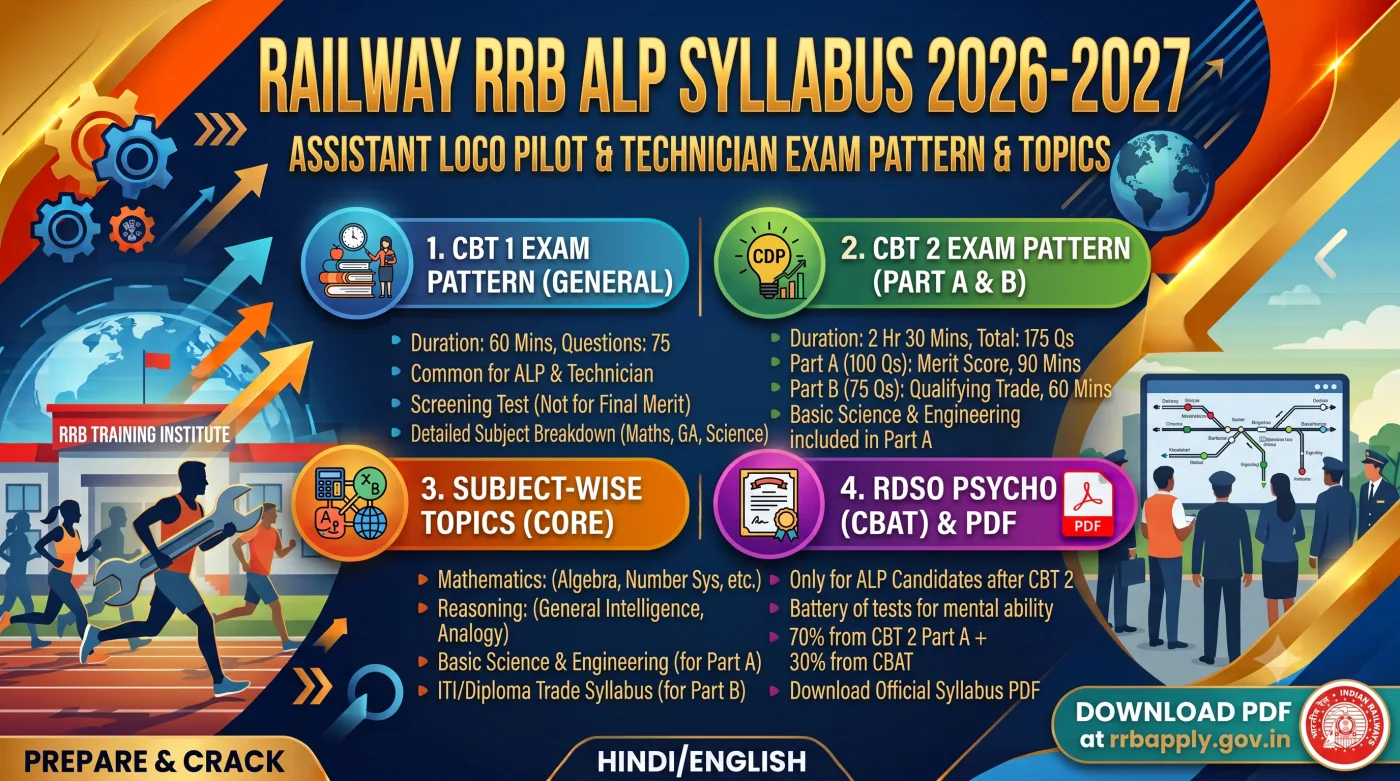
1. Executive Overview: Railway RRB ALP & Technician Recruitment Architecture
The Railway Recruitment Control Board (RRB) conducts the centralized recruitment for Assistant Loco Pilots (ALP) and Technicians across all 21 Railway Zones of Indian Railways. The Assistant Loco Pilot is an essential safety category post responsible for co-piloting passenger, express, and freight trains, monitoring line signals, verifying brake-pipe pressure, and ensuring fail-safe railway operations. The selection pipeline is renowned for its technical rigor and comprehensive medical standards:
- Stage 1: First Stage CBT (CBT-1: Screening Test - 75 Marks): A 60-minute objective examination covering Mathematics, Reasoning, General Science, and Current Affairs. Used exclusively to shortlist candidates for Stage 2 (15 times the vacancies).
- Stage 2: Second Stage CBT (CBT-2: Part A Merit & Part B Trade):
- Part A (100 Marks, 90 Mins): Mathematics, Reasoning, Basic Science & Engineering, and General Awareness. Marks scored here determine 100% of the candidate's academic merit.
- Part B (75 Marks, 60 Mins): DGT / NCVT syllabus of the candidate's designated ITI engineering trade. Must secure a mandatory qualifying score of 35% across all communities.
- Stage 3: Computer Based Aptitude Test (CBAT / Psycho Test - ALP Only): Administered to candidates equal to 8 times the ALP vacancies. Comprises 5 distinct psychological test batteries developed by RDSO Lucknow. Candidates must secure a minimum T-score of 42 in every battery.
- Stage 4: Document Verification (DV) & Biometric Matching: Scrutiny of matriculation, ITI/Diploma/Degree certificates, NCVT records, and community certificates in a 1:1 ratio.
- Stage 5: Comprehensive Medical Examination (A-1 Standard for ALP): Clinical testing evaluating distant vision (6/6 without glasses), near vision, night vision, color vision, and absence of LASIK surgery at Railway Divisional Hospitals.
| Recruitment Dimension | Official Specification & Examination Details |
|---|---|
| Exam Conducting Authority | Railway Recruitment Control Board (RRB / भारतीय रेलवे) |
| Cadre Posts | Assistant Loco Pilot (ALP / सहायक लोको पायलट) & Technician Grade-III |
| Educational Qualification | 10th Pass + ITI (NCVT/SCVT) OR 3-Year Engineering Diploma OR B.E. / B.Tech |
| Mode of Examination | Computer Based Test (CBT - ऑनलाइन कंप्यूटर आधारित परीक्षा) |
| CBT-1 Nature & Duration | Screening Only (75 Questions / 75 Marks / 60 Minutes) |
| CBT-2 Total Duration | 2 Hours 30 Minutes (Part A: 90 Mins + Part B: 60 Mins) |
| Negative Marking Penalty | 1/3rd (0.33) Marks Deducted per incorrect response in CBT 1 & CBT 2 |
| Part B Qualifying Benchmark | Mandatory 35% Marks (26.25/75) for ALL categories without relaxation |
| Final ALP Merit Weightage | 70% of CBT-2 Part A Marks + 30% of CBAT Psycho Score |
| Final Technician Merit Basis | 100% Based on CBT-2 Part A Marks (No CBAT required) |
| Official Application Portal | rrbapply.gov.in |
2. Stage-Wise Examination Blueprint & Sectional Breakdown
A. First Stage CBT (CBT-1: 75 Questions, 60 Minutes)
CBT-1 serves as the common screening examination for both ALP and Technician aspirants. Securing high normalized marks is necessary to make the top 15x shortlist for Stage 2:
| Subject Domain / Section | Curriculum Standard | Number of Questions | Maximum Marks | Ideal Time Allocation |
|---|---|---|---|---|
| 1. Mathematics (गणित) | Class 10th CBSE / Matriculation Level | 20 Questions | 20 Marks | 18 - 20 Minutes |
| 2. Mental Ability & Reasoning (तार्किक क्षमता) | Verbal, Non-Verbal & Analytical Reasoning | 25 Questions | 25 Marks | 22 - 24 Minutes |
| 3. General Science (सामान्य विज्ञान) | Class 10th NCERT Physics, Chemistry & Life Sciences | 20 Questions | 20 Marks | 12 - 14 Minutes |
| 4. General Awareness on Current Affairs | Science & Tech, Sports, Culture, Personalities, Economics | 10 Questions | 10 Marks | 5 - 6 Minutes |
| Total CBT-1 Paper | Composite 75 Questions | 75 Questions | 75 Marks | 60 Minutes (1 Hour) |
B. Second Stage CBT (CBT-2: Part A & Part B - 175 Questions, 150 Minutes)
CBT-2 is conducted in a continuous single-shift session:
| CBT-2 Component | Subject Domains Included | Questions | Marks | Duration | Evaluation Status |
|---|---|---|---|---|---|
| Part A (Merit Deciding) |
Mathematics | 25 Questions | 25 Marks | 90 Minutes (1.5 Hours) |
Merit Deciding: Determines 70% weightage for ALP and 100% for Technicians. Minimum passing: UR 40%, OBC/SC 30%, ST 25%. |
| General Intelligence & Reasoning | 25 Questions | 25 Marks | |||
| Basic Science & Engineering | 40 Questions | 40 Marks | |||
| General Awareness on Current Affairs | 10 Questions | 10 Marks | |||
| Part B (Technical Trade) |
Relevant DGT / NCVT Trade Theory Syllabus (Candidate's Chosen Trade) | 75 Questions | 75 Marks | 60 Minutes (1 Hour) |
Mandatory Qualifying: Must score minimum 35% marks (26.25/75). No relaxation for any category. |
3. Comprehensive Subject-Wise Syllabus Breakdown (CBT 1 & CBT 2)
Component 1: Mathematics (CBT 1 & CBT 2 Part A)
- Number System & Simplification: BODMAS rule, Decimals, Fractions, Integers, Real numbers, Divisibility rules, Unit digit, Remainder theorem, Surds and Indices.
- HCF & LCM: Highest common factor and least common multiple, Application-based word problems on synchronized bells and gear revolutions.
- Ratio, Proportion & Percentages: Continued proportions, Mean proportional, Successive percentage changes, Voting and election problems, Examination scoring calculations.
- Profit, Loss & Discount: Cost price, Selling price, Marked price, Successive discount formulas, Faulty balance calculations.
- Simple & Compound Interest: Simple interest, Annual and half-yearly compound interest formulas, Difference between CI and SI for 2-year and 3-year periods.
- Time, Work & Pipes-Cisterns: Efficiency ratios, Men-days formula ($M_1 D_1 H_1 = M_2 D_2 H_2$), Alternate day working, Tank filling and emptying rates.
- Speed, Time & Distance: Speed unit conversion (km/h to m/s), Relative speed of locomotives, Trains crossing bridges and tunnels, Boats and streams.
- Mensuration (2D & 3D): Perimeter and area of Triangles, Rectangles, Squares, Circles, Rhombuses; Volume and surface area of Cylinders, Cones, Spheres, Cubes, and Cuboids.
- Algebra & Trigonometry: Standard algebraic identities, Factorization, Linear equations, Quadratic equations, Trigonometric ratios, Standard trigonometric values ($0^\circ, 30^\circ, 45^\circ, 60^\circ, 90^\circ$), Heights and distances.
- Geometry & Statistics: Angles, Lines, Triangle similarity and congruence, Circles and chords, Tangents, Mean, Median, Mode, Frequency polygons, and Histograms.
- Miscellaneous Arithmetic: Square root and cube roots, Calendar calculations, Clock angle problems, Age calculation problems.
Component 2: General Intelligence & Reasoning (CBT 1 & CBT 2 Part A)
- Analogies & Classification: Semantic analogy, Symbolic analogy, Number classification, Letter grouping, Odd-man-out identification.
- Series Completion: Number series, Alphabet series, Mixed alpha-numeric series, Repeating pattern series.
- Coding and Decoding: Coding by letter shifts, Number substitutions, Conditional matrix coding, Deciphering fictitious language codes.
- Mathematical Operations: Symbol interchange, Balancing equations, Operating with substituted operators ($+$ means $\times$, $-$ means $\div$).
- Relationships (Blood Relations): Family trees, Coded blood relations, Generation gaps, Pointing-based puzzle statements.
- Syllogism: Venn diagram deductions for categorical syllogisms, Possibility statements, 'Only a few' cases.
- Venn Diagrams: Geometrical Venn diagrams, Classification of word classes.
- Data Interpretation & Data Sufficiency: Determining adequacy of provided statements to solve questions.
- Direction & Distance: Cardinal directions, Heading turns, Pythagorean theorem displacement, Sunrise/sunset shadow problems.
- Analytical & Spatial Reasoning: Seating arrangements (linear, circular), Paper folding and cutting, Mirror and water images, Cubes and dice (opposite face identification).
- Decision Making & Logical Deductions: Statement-Arguments, Statement-Assumptions, Statement-Conclusions, Cause and Effect analysis.
Component 3: Basic Science & Engineering (CBT-2 Part A - 40 Marks)
This is the single most critical and highest-scoring domain in CBT-2 Part A, testing core technical fundamentals across engineering disciplines:
- 1. Engineering Drawing (इंजीनियरिंग ड्राइंग):
- Projections: Orthographic projections (First angle and Third angle projection rules and symbols), Isometric projections, Axonometric projections.
- Views: Front view, Top view (Plan), Side view (Elevation), Sectional views.
- Drawing Instruments: T-Square, Set Squares ($30^\circ-60^\circ$ and $45^\circ-45^\circ$), Mini Drafter, Drawing board sizes (D0 to D3), Clinometer, Divider, Compass, French curves.
- Lines & Lettering: Visible outline, Hidden line (dashed), Center line (long and short dashes), Dimension line, Extension line, Section line, Standard line thickness (0.2 mm, 0.5 mm), Title block standard layout (BS 8888 / IS 962).
- Geometric Figures: Regular polygons (Hexagon, Pentagon), Ellipse, Parabola, Hyperbola constructions.
- Symbolic Representation: Fasteners (bolts, rivets, welded joints), Electrical and electronic schematic symbols, Pipe fittings.
- 2. Units and Measurements (मात्रक एवं मापन): Fundamental and derived SI units, System of units (FPS, CGS, MKS, SI), Dimensional formulas of physical quantities, Vernier calipers (least count calculation: $LC = 1\text{ MSD} - 1\text{ VSD}$), Micrometer screw gauge (least count and pitch), Dial gauges, Combination sets.
- 3. Mass, Weight and Density (द्रव्यमान, भार एवं घनत्व): Difference between mass and weight, Density of solids and liquids ($\rho = M/V$), Specific gravity / Relative density (Hydrometer principle), Archimedes' principle and Law of Floatation.
- 4. Work, Power and Energy (कार्य, शक्ति एवं ऊर्जा): Mechanical work ($W = F \cdot s \cdot \cos\theta$), Kinetic Energy ($\frac{1}{2}mv^2$), Potential Energy ($mgh$), Power ($P = W/t$), Horsepower conversions (Metric HP = 735.5 Watts; British HP = 746 Watts), Conservation of mechanical energy.
- 5. Speed and Velocity (चाल एवं वेग): Rest and motion, Scalar vs Vector quantities, Instantaneous and average speed, Uniform and non-uniform velocity, Acceleration ($a = \frac{v-u}{t}$), Equations of motion under gravity.
- 6. Heat and Temperature (ऊष्मा एवं तापमान): Difference between heat and temperature, Thermometer scales (Celsius, Fahrenheit, Kelvin: $\frac{C}{5} = \frac{F-32}{9} = \frac{K-273}{5}$), Specific heat capacity ($Q = mc\Delta T$), Latent heat of fusion and vaporization, Modes of heat transfer (Conduction, Convection, Radiation), Thermal expansion of solids (linear, superficial, cubical expansion: $\alpha : \beta : \gamma = 1 : 2 : 3$).
- 7. Basic Electricity (मूलभूत विद्युत): Electric charge, Current ($I = Q/t$), Voltage, Ohm's law ($V = IR$), Conductors, insulators, and semiconductors, Resistance factors ($R = \rho \frac{l}{A}$), Series and parallel combinations of resistances, Electric power and energy, Kirchhoff's laws (KCL & KVL), Electromagnetic induction basics, Electric fuse and circuit breakers (MCB).
- 8. Levers and Simple Machines (उत्तोलक एवं सरल मशीनें): Mechanical Advantage ($MA = \text{Load}/\text{Effort}$), Velocity Ratio ($VR = d_E / d_L$), Efficiency of machines ($\eta = \frac{MA}{VR} \times 100\%$), Three classes of levers:
- Class I Levers (Fulcrum in center): Scissors, Crowbar, Pliers, Beam balance, See-saw.
- Class II Levers (Load in center): Wheelbarrow, Nutcracker, Bottle opener, Paper cutter.
- Class III Levers (Effort in center): Sugar tongs, Tweezers, Human forearm lifting weight, Fishing rod.
- Pulleys, Inclined plane, Wheel and axle, Screw jack mechanisms.
- 9. Occupational Safety and Health (व्यावसायिक सुरक्षा एवं स्वास्थ्य): Types of industrial hazards, Personal Protective Equipment (PPE: Safety helmets, safety shoes, goggles, ear defenders, respirators), First aid protocols (ABC: Airway, Breathing, Circulation; CPR technique), Classes of fire and fire extinguishers:
- Class A Fire (Carbonaceous solids: wood, paper): Water extinguisher.
- Class B Fire (Flammable liquids: petrol, kerosene): Foam or Carbon Dioxide ($CO_2$) extinguisher.
- Class C Fire (Flammable gases: LPG, acetylene): Dry Chemical Powder extinguisher.
- Class D Fire (Flammable metals) & Electrical fires: Halon or $CO_2$ dry powder (Never use water on electrical fires!).
- 10. Environment Education (पर्यावरण शिक्षा): Ecosystem, Environmental pollution (Air, Water, Noise, Soil pollution), Industrial waste management, Global warming and greenhouse gases ($CO_2, CH_4, CFCs$), Ozone depletion.
- 11. IT Literacy (आईटी साक्षरता): Computer architecture, CPU, Memory (RAM, ROM, Cache), Windows operating system, MS Office (Word, Excel, PowerPoint), File extensions, Internet protocols (HTTP, FTP), Web browsing, Email operations, Computer malware and antivirus software.
Component 4: Technical Trade Syllabus (CBT-2 Part B - 75 Questions, 60 Minutes)
The trade syllabus is strictly based on the Directorate General of Training (DGT / NCVT) curriculum for the chosen ITI trade:
| Candidate ITI / Engineering Discipline | Prescribed DGT Trade Choice in Part B | Core Technical Topics Covered |
|---|---|---|
| Electrical Engineering / ITI Electrician | Electrician / Wireman | DC Circuits, AC Fundamentals, Transformers, DC Motors & Generators, Induction Motors, Alternators, Earthing systems, Measuring instruments (Ammeter, Voltmeter, Multimeter, Megger). |
| Mechanical Engineering / ITI Fitter | Fitter / Turner / Machinist | Bench work and hand tools, Files and filing techniques, Drilling and reaming, Lathe machine operations, Shaper machine, Grinding wheels, Sheet metal work, Welding techniques (Arc, Gas, TIG/MIG). |
| Automobile / Mechanical ITI Diesel | Mechanic Motor Vehicle / Diesel Mechanic | Internal Combustion (IC) engines, 2-stroke and 4-stroke petrol & diesel engines, Fuel injection systems (CRDI), Lubrication systems, Cooling systems, Transmission systems (Clutch, Gearbox, Differential), Braking systems. |
| Electronics Engineering | Electronic Mechanic / Instrument Mechanic | Semiconductor diodes, Transistors (BJT, FET, MOSFET), Operational Amplifiers (Op-Amps), Digital electronics (Logic gates, Flip-flops, Counters), Microprocessors (8085 basics), Transducers and Sensors. |
| Refrigeration & AC | Mechanic RAC | Refrigeration cycles (Vapour Compression & Absorption systems), Refrigerants (eco-friendly R-134a, R-410a), Compressors, Condensers, Evaporators, Expansion devices, Psychrometry, Air conditioning systems. |
4. RDSO Computer Based Aptitude Test (CBAT / Psycho Test) Architecture
The Computer Based Aptitude Test is the distinctive psychometric trial administered to Assistant Loco Pilot candidates. Developed by the Psycho-Technical Directorate of RDSO (Lucknow), it assesses perceptual speed, depth estimation, spatial memory, and mental concentration under extreme time constraints:
| Psycho Battery # | Test Battery Name | Cognitive Capability Evaluated | Questions & Time Limit | Mandatory Passing Benchmark |
|---|---|---|---|---|
| Battery 1 | Memory Test (स्मृति परीक्षण) | Visual recall of railway tracks, stations, house positions, and number-picture pairings. | 2 Sets of 12-21 Questions (Memorize 2-3 mins; Recall 2-3 mins) |
Minimum 42 T-Score |
| Battery 2 | Direction Test / Table Test (दिशा परीक्षण) | Spatial navigation on compass grids, letter matrices, and watch dials following complex directional rules. | 10 - 20 Questions (5 - 10 Minutes) |
Minimum 42 T-Score |
| Battery 3 | Depth Perception Test (दूरी प्रत्यक्ष ज्ञान) | Estimating spatial depth and counting hidden touching bricks in 3D brick piles (Brick Test). | 50 Questions (10 Bricks $\times$ 5 Piles) (5 Minutes) |
Minimum 42 T-Score |
| Battery 4 | Concentration Test (एकाग्रता परीक्षण) | Rapid identification of identical pairs (Yes/No Test) or counting occurrences of numbers 6 or 9 in random number grids. | 75 - 96 Questions (4 - 5 Minutes) |
Minimum 42 T-Score |
| Battery 5 | Perceptual Speed Test (प्रत्यक्षीकरण गति) | Rapidly spotting identical geometrical shapes (Similarity Test) or hexagon orientation matching. | 72 - 96 Questions (5 - 6 Minutes) |
Minimum 42 T-Score |
T-Score Calculation Formula: For each battery, the candidate's raw score is converted into a standard T-score using the group performance parameters:
$$\text{T-Score} = 50 + 10 \times \left(\frac{\text{Candidate Raw Score} - \text{Mean Score of All Candidates}}{\text{Standard Deviation of Shift}}\right)$$
A candidate must achieve $T \ge 42$ in ALL five test batteries independently. Scoring below 42 in even one battery results in summary elimination from the ALP post!
5. Medical Fitness Standard A-1 Diagnostic Guidelines
Because an Assistant Loco Pilot controls trains carrying thousands of passengers at speeds exceeding 130-160 km/h, Railway Medical Category A-1 is strictly non-negotiable:
- Distant Vision (दूर दृष्टि): Must be 6/6, 6/6 WITHOUT GLASSES (Spectacles, contact lenses, or intraocular implants are strictly prohibited).
- Near Vision (निकट दृष्टि): Sn 0.6, 0.6 without glasses.
- Color Blindness (वर्णांधता): Full color perception is mandatory. Must pass Ishihara color plate test and lantern color test at varying apertures.
- Binocular & Night Vision: Must demonstrate normal binocular fusion (stereoscopic vision) and pass field of vision and mesopic night vision tests.
- Zero Tolerance for LASIK / Refractive Surgery: All candidates undergo slit-lamp microscopic examinations. Any candidate found to have undergone LASIK, PRK, or any surgical refractive correction is permanently disqualified.
6. Standard Recommended Textbooks & Preparation Resources
| Subject Domain | Standard Recommended Books | Author / Publication | Preparation Utility |
|---|---|---|---|
| Basic Science & Engineering | Basic Science & Engineering for RRB ALP CBT-2 | Youth Competition Times (YCT) / Rukmini Platform | In-depth engineering drawing, units, levers, simple machines, heat, and electricity formulas |
| Technical Trade (ITI Fitter/Electrician) | NIMI ITI Trade Theory Textbooks (Electrician / Fitter / Diesel) | National Instructional Media Institute (NIMI, Chennai) | Authentic DGT trade theory questions for guaranteed clearance of CBT-2 Part B |
| RDSO CBAT Psycho Test | RRB ALP Psycho Test Guide with Practice Batteries | Kiran Institute / Youth Competition Times | Extensive practice sets for Brick Test, Track Memory, Table Test, and Yes/No concentration |
| Mathematics | Railway Ganit (Chapterwise Solved Papers) | Youth Competition Times (YCT) | Extensive practice of arithmetic, algebra, geometry, and mensuration problems |
| General Science (CBT-1) | NCERT Class 9-10 Science + Speedy Railway Samanya Vigyan | NCERT / Speedy Publications | Line-by-line physics and chemistry fundamentals for CBT-1 screening |
7. 120-Day Scientific Master Study Routine for ALP Aspirants
- Days 1 to 45 (Foundational Screening & CBT-1 Mastery):
- Spend 2 hours daily on Mathematics: Focus on speed calculation, percentages, time & work, and speed-time-distance formulas.
- Spend 2 hours daily on Class 9-10 NCERT Science (Physics, Chemistry, Biology) and prepare short formula notes.
- Spend 1.5 hours daily on Reasoning: Practice 40 questions daily across coding, analogies, and syllogism.
- Attempt one 75-question CBT-1 mock test every alternate day to build speed under the 60-minute time cap.
- Days 46 to 90 (Basic Science & Engineering + Trade Mastery):
- Spend 2.5 hours daily mastering Basic Science & Engineering: Practice engineering drawing projections, symbols, levers class formulas ($MA/VR$), and heat transfer equations.
- Devote 2 hours daily to your chosen ITI Trade theory from official NIMI textbooks to ensure scoring 50+ marks out of 75 in Part B.
- Continue advanced mathematical problem solving (trigonometry, mensuration, algebra).
- Days 91 to 120 (CBAT Psycho Simulation & Full-Length CBT-2 Mocks):
- Attempt full-length CBT-2 mock tests (Part A: 90 mins + Part B: 60 mins) twice a week on a computer.
- Begin daily 45-minute RDSO Psycho practice: Practice the Brick test, Track memory, Table test, and 6/9 concentration test on software mimicking real RDSO computer interfaces.
- Maintain eye health: Take regular screen breaks, ensure adequate sleep, and refrain from reading in dim lighting.
8. Detailed RDSO Psychometric T-Score Calculation Example
Many aspirants struggle to comprehend how their raw scores in the 5 Psycho batteries are converted into qualifying T-scores. Below is an authoritative breakdown of the mathematical procedure applied by RDSO:
| Test Battery Name | Hypothetical Candidate Raw Score ($X$) | Shift Mean Score ($\mu$) | Shift Standard Deviation ($\sigma$) | Calculated Formula: $T = 50 + 10 \times \frac{X - \mu}{\sigma}$ | Resulting T-Score & Status |
|---|---|---|---|---|---|
| 1. Memory Test | 18 Correct | 14.5 | 2.8 | $50 + 10 \times \frac{18 - 14.5}{2.8} = 50 + 12.5$ | 62.5 (QUALIFIED) |
| 2. Direction / Table Test | 14 Correct | 12.0 | 2.5 | $50 + 10 \times \frac{14 - 12.0}{2.5} = 50 + 8.0$ | 58.0 (QUALIFIED) |
| 3. Depth Perception (Brick Test) | 42 Correct | 38.0 | 4.0 | $50 + 10 \times \frac{42 - 38.0}{4.0} = 50 + 10.0$ | 60.0 (QUALIFIED) |
| 4. Concentration (Yes/No Test) | 70 Correct | 74.0 | 5.0 | $50 + 10 \times \frac{70 - 74.0}{5.0} = 50 - 8.0$ | 42.0 (BORDERLINE QUALIFIED) |
| 5. Perceptual Speed Test | 68 Correct | 72.0 | 6.0 | $50 + 10 \times \frac{68 - 72.0}{6.0} = 50 - 6.67$ | 43.33 (QUALIFIED) |
Takeaway: Notice that in Battery 4, the candidate scored below the shift mean ($70 < 74$), yet because their score fell within $-0.8\sigma$, their T-score was exactly 42.0, allowing them to qualify. If their raw score had dropped to 69, their T-score would have been $40.0$, resulting in instant disqualification for the entire recruitment!
9. Assistant Loco Pilot Career Hierarchy & Running Allowance System
Joining Indian Railways as an Assistant Loco Pilot provides an exceptional promotional trajectory within the Mechanical or Electrical Running Cadre. In addition to basic salary, loco pilots earn handsome Running Allowances based on monthly train kilometers driven:
| Cadre Hierarchy Level | Designation & Grade Pay | Service & Competency Requirement | Kilometreage Allowance (KMA Rate) | Operational Role & Responsibilities |
|---|---|---|---|---|
| Level 1 (Entry) | Assistant Loco Pilot (ALP) Level-2 (GP 1900 / Basic ₹19,900) |
Direct Recruitment via RRB | Approx. ₹3.90 - ₹4.50 per km driven | Assisting the Loco Pilot in calling out signal aspects, monitoring air brake gauges, examining engine compartments. |
| Level 2 | Senior Assistant Loco Pilot (Sr. ALP) Level-4 (GP 2400 / Basic ₹25,500) |
2 Years Satisfactory Service + Safety Record | Approx. ₹4.80 - ₹5.20 per km | Co-piloting freight and passenger trains on heavy gradient routes. |
| Level 3 | Loco Pilot Shunting (LP Shunting) Level-4 (GP 2400 / Basic ₹25,500) |
Promotion based on seniority & driving test | Approx. ₹5.20 per km | Marshalling yard train movements, shunting coaches, assembling rake compositions within station yards. |
| Level 4 | Loco Pilot Goods (LP Goods) Level-6 (GP 4200 / Basic ₹35,400) |
Independent driving test clearance | Approx. ₹5.80 - ₹6.50 per km | Sole locomotive driver in command of freight trains, container rakes, and coal trains across divisions. |
| Level 5 | Loco Pilot Passenger (LP Passenger) Level-6 (GP 4200 / Basic ₹35,400) |
Zero-accident safety record in Goods service | Approx. ₹6.50 - ₹7.20 per km | Operating short-distance passenger trains, MEMU, and EMU suburban services. |
| Level 6 | Loco Pilot Mail / Express Level-6 (GP 4200 / Basic ₹35,400) |
Seniority and elite track record | Approx. ₹7.50 - ₹8.50 per km | Driving Vande Bharat Express, Rajdhani, Shatabdi, and Superfast express trains at maximum permissible speeds. |
| Level 7 (Supervisory) | Chief Loco Inspector (CLI) Level-7 (GP 4600 / Basic ₹44,900) |
Selection through Departmental Examination | Running allowance + Special supervisory allowance | Training new ALPs, safety inspections, loco performance monitoring, inquiry officer in rail incidents. |
10. Exhaustive Railway Medical Examination (A-1 Standard) Protocol
Candidates clearing the CBAT must pass clinical evaluations at Railway Divisional Hospitals under Chief Medical Superintendents (CMS). The examination evaluates every physiological system:
- Visual Acuity (नेत्र परीक्षण):
- Distant Vision: Strictly 6/6, 6/6 without glasses on standard Snellen eye chart at 6 meters.
- Near Vision: Sn 0.6, 0.6 without glasses.
- Color Vision: Reading all 38 plates of the Ishihara Pseudoisochromatic Color Plates Book under natural lighting without hesitation.
- Lantern Test: Identifying white, red, and green lights projected through apertures of 1.3 mm at 6 meters distance in a completely dark room.
- Field of Vision: Evaluation of peripheral visual fields on a Perimeter arc to detect tunnel vision.
- Night Vision (Mesopic Vision): Testing visual contrast adaptation in low illumination environments.
- Slit-Lamp Examination: Compulsory examination of cornea to verify that no LASIK, PRK, or keratotomy incisions exist.
- Auditory System (श्रवण परीक्षण): Audiogram testing to confirm hearing loss does not exceed 20 decibels across 500 to 4000 Hz frequencies; whisper test at 6 meters.
- Cardiovascular & Respiratory Fitness: Electrocardiogram (ECG), blood pressure within 140/90 mm Hg limits, and digital chest X-ray to rule out pulmonary tuberculosis.
- Pathological Screenings: Blood sugar (fasting and post-prandial) and urine routine tests to eliminate diabetes and kidney diseases.
11. Document Verification (DV) Checklist for ITI, Diploma & Degree Candidates
Assemble original credentials along with two sets of self-attested photocopies in the prescribed order:
- 10th / Matriculation Passing Certificate: Legal proof of date of birth and spelling of candidate's and parent's names.
- National Trade Certificate (NTC) / National Apprenticeship Certificate (NAC): Compulsory for ITI trade candidates issued by NCVT / SCVT.
- Polytechnic Engineering Diploma Certificate & Semester Marksheets: Compulsory for 3-year diploma holders in Mechanical, Electrical, Electronics, or Automobile Engineering.
- B.E. / B.Tech Degree Certificate & Final Consolidated Transcript: Compulsory for engineering graduate candidates.
- Central OBC-NCL Certificate: In official Annexure-II central government format issued within the ongoing financial year by an authorized Revenue Officer or Sub-Divisional Magistrate (SDM).
- SC/ST Community Certificate: In official Annexure-I format without expiry date.
- Income & Asset Certificate for EWS: Valid for the recruitment financial year certifying gross annual family income below Rs 8.00 Lakh.
- Valid Photo Identity Card: Original biometric Aadhaar card and 6 passport-size color photographs matching the application upload.
12. Concluding Strategic Guidance for Future Locomotive Drivers
The Assistant Loco Pilot is one of the most respected, adventurous, and technically challenging vocations in the Indian Railways. Success in this grueling multi-stage recruitment belongs to candidates who combine rigorous computational accuracy in mathematics, deep conceptual mastery of basic engineering and ITI trade theory, and lightning-fast spatial reflexes in the RDSO Psycho test. Avoid superficial guessing, guard your visual acuity, maintain disciplined daily study habits, and prepare to take the throttle of the nation's premier express locomotives! (भारतीय रेल का सारथी बनने का आपका गौरवशाली सफर आपकी तकनीकी दक्षता और अटूट एकाग्रता से ही शुरू होगा। पूरी निष्ठा के साथ तैयारी करें और अपने लक्ष्य को प्राप्त करें!)
User Discussion & Comments (0)
No comments yet. Be the first to leave a comment below!
Leave a Comment / Ask a Question: