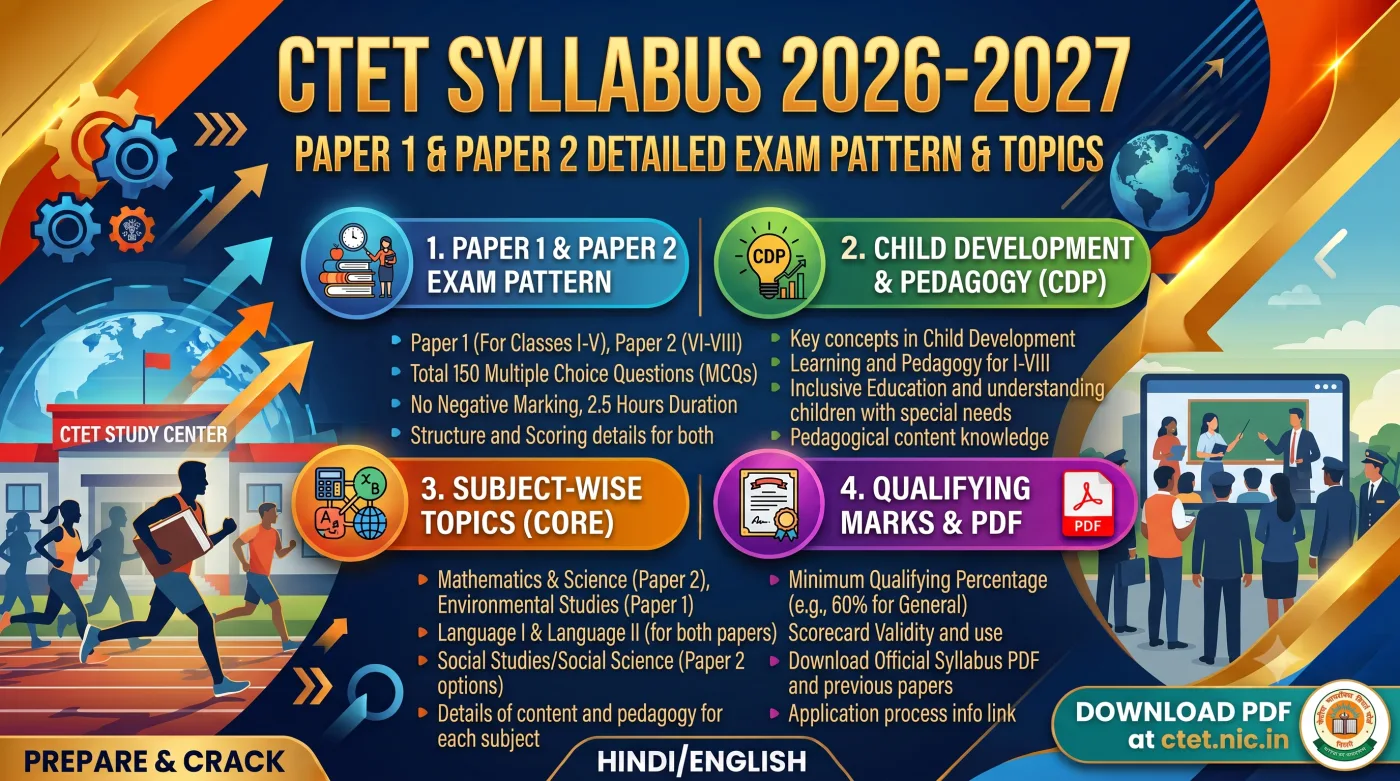
1. Executive Overview: CTET Examination Structure & National Framework
The Central Teacher Eligibility Test (CTET) is conducted biannually by the Central Board of Secondary Education (CBSE / सीबीएसई) pursuant to Section 23(1) of the Right of Children to Free and Compulsory Education (RTE) Act, 2009. The National Council for Teacher Education (NCTE) mandates that passing the Teacher Eligibility Test is an essential minimum condition for any person to be eligible for appointment as a teacher in elementary and secondary schools across India:
- Paper-I (Primary Stage - Classes I to V): For candidates who intend to be teachers for Classes 1 through 5. Comprises 150 objective questions carrying 150 marks across Child Development & Pedagogy, Language I, Language II, Mathematics, and Environmental Studies.
- Paper-II (Elementary Stage - Classes VI to VIII): For candidates who intend to be teachers for Classes 6 through 8. Comprises 150 objective questions carrying 150 marks across Child Development & Pedagogy, Language I, Language II, and specialized subjects (either Mathematics & Science, or Social Studies / Social Science).
- National Applicability: CTET qualification applies to all Central Government schools (Kendriya Vidyalayas / KVS, Jawahar Navodaya Vidyalayas / NVS, Central Tibetan Schools, and schools under the administrative control of UTs like Chandigarh, Dadra & Nagar Haveli, Daman & Diu, Andaman & Nicobar Islands, Lakshadweep, and NCT of Delhi / DSSSB), Army Public Schools, and private unaided schools that mandate CTET.
- Lifetime Certificate Validity: The validity of the CTET qualifying certificate is for LIFETIME (आजीवन वैधता). There is no cap on the number of attempts.
| Recruitment Dimension | Official Specification & Examination Details |
|---|---|
| Exam Conducting Authority | Central Board of Secondary Education (CBSE / सीबीएसई, नई दिल्ली) |
| Statutory Regulatory Body | National Council for Teacher Education (NCTE / राष्ट्रीय अध्यापक शिक्षा परिषद) |
| Frequency of Examination | Conducted Twice a Year (July and December Sessions) |
| Mode of Examination | Offline Pen-Paper OMR Sheet Based (ऑफलाइन ओएमआर आधारित परीक्षा) |
| Total Questions & Marks | 150 Multiple Choice Questions (MCQs) carrying 150 Marks |
| Examination Duration | 150 Minutes (2 Hours 30 Minutes / ढाई घंटे) |
| Negative Marking Penalty | NO Negative Marking (शून्य नकारात्मक अंकन) |
| General / UR Qualifying Benchmark | 60% Marks (90 Marks out of 150) |
| Reserved Category (OBC/SC/ST/PwD) Benchmark | 55% Marks (82 Marks out of 150) |
| Certificate Delivery System | Digital Marksheet & Certificate via DigiLocker with Encrypted QR Code |
| Official Board Portal | ctet.nic.in |
2. Paper-I Blueprint: Primary Stage (Classes I to V - 150 Marks)
Paper-I is designed for prospective Primary Teachers (PRT). It tests foundational pedagogical acumen, language comprehension, basic arithmetic, and environmental observation skills of young children aged 6 to 11 years:
| Subject Domain / Component | Content Breakdown | Total Questions | Maximum Marks | Recommended Time Allocation |
|---|---|---|---|---|
| 1. Child Development and Pedagogy (CDP) | Child Development (15) + Inclusive Education (5) + Learning & Pedagogy (10) | 30 Questions | 30 Marks | 28 - 30 Minutes |
| 2. Language I (Compulsory) | Language Comprehension Prose/Poetry (15) + Pedagogy of Language Development (15) | 30 Questions | 30 Marks | 28 - 30 Minutes |
| 3. Language II (Compulsory) | Two Unseen Prose Passages (15) + Pedagogy of Language Development (15) | 30 Questions | 30 Marks | 28 - 30 Minutes |
| 4. Mathematics (गणित) | Content based on NCERT Classes 1-5 (15) + Pedagogical Issues (15) | 30 Questions | 30 Marks | 30 - 32 Minutes |
| 5. Environmental Studies (EVS / पर्यावरण) | 6 Core NCERT Themes Content (15) + Pedagogical Issues (15) | 30 Questions | 30 Marks | 28 - 30 Minutes |
| Total Paper-I Composite | Full Comprehensive Examination | 150 Questions | 150 Marks | 150 Minutes (2.5 Hours) |
3. Paper-II Blueprint: Elementary Stage (Classes VI to VIII - 150 Marks)
Paper-II is designed for prospective Elementary and Trained Graduate Teachers (TGT) teaching children aged 11 to 14 years. It evaluates advanced conceptual depth and discipline-specific pedagogy:
| Subject Domain / Component | Subject Allocation | Total Questions | Maximum Marks | Recommended Time Budget |
|---|---|---|---|---|
| 1. Child Development & Pedagogy (CDP) | Compulsory for all candidates (Focus on 11-14 age group) | 30 Questions | 30 Marks | 28 - 30 Minutes |
| 2. Language I (Compulsory) | Language Proficiency & Pedagogy | 30 Questions | 30 Marks | 28 - 30 Minutes |
| 3. Language II (Compulsory) | Second Language Comprehension & Pedagogy | 30 Questions | 30 Marks | 28 - 30 Minutes |
| 4. (A) Mathematics & Science (Option A) (For Maths/Science Teachers) |
Mathematics (30 Qs: 20 Content + 10 Pedagogy) Science (30 Qs: 20 Content + 10 Pedagogy) |
60 Questions | 60 Marks | 60 - 64 Minutes |
| 4. (B) Social Studies / Social Science (Option B) (For Social Science Teachers) |
History, Geography, Social & Political Life (40 Content + 20 Pedagogy) | 60 Questions | 60 Marks | 60 - 64 Minutes |
| Total Paper-II Composite | Either Option A OR Option B | 150 Questions | 150 Marks | 150 Minutes (2.5 Hours) |
4. Comprehensive Subject-Wise Syllabus Breakdown (Paper 1 & Paper 2)
Component 1: Child Development and Pedagogy (CDP - 30 Questions, 30 Marks)
CDP is the conceptual cornerstone of CTET, carrying 30 marks in Paper 1 and 30 marks in Paper 2:
Part (A): Child Development (Primary / Elementary Child - 15 Questions):
- Concept of Development: Relationship between development and learning; Growth vs Development; Cephalocaudal and Proximodistal trends of motor development.
- Principles of Child Development: Continuity, Sequentiality, Individual differences, Inter-relation of physical, cognitive, social, and emotional domains.
- Influence of Heredity & Environment: Nature vs Nurture debate; Relative roles of genetic predispositions and environmental stimuli in intellectual development.
- Socialization Processes: Social world and children: Primary agents of socialization (Family, Parents) vs Secondary agents (School, Peers, Media).
- Pivotal Theoretical Constructs:
- Jean Piaget's Cognitive Constructivism: Schemas, Assimilation, Accommodation, Equilibration; Four developmental stages: Sensorimotor (Object permanence), Pre-operational (Egocentrism, Centration, Irreversibility, Animism), Concrete Operational (Conservation, Reversibility, Decentration, Seriation), Formal Operational (Abstract reasoning, Hypothetico-deductive thought).
- Lev Vygotsky's Socio-Cultural Theory: Social interaction as prerequisite for cognition; More Knowledgeable Other (MKO); Zone of Proximal Development (ZPD); Scaffolding (पाड़ / मचान); Private Speech (निज संभाषण) and inner speech.
- Lawrence Kohlberg's Theory of Moral Development: Moral dilemmas (Heinz dilemma); Pre-conventional level (Punishment-Obedience, Instrumental Relativist); Conventional level (Good Boy-Nice Girl orientation, Law & Order); Post-conventional level (Social Contract, Universal Ethical Principles); Carol Gilligan's critique of gender bias.
- Concepts of Child-Centered & Progressive Education: John Dewey's democratic classroom, experiential learning, learning by doing, active inquiry vs passive reception of facts.
- Critical Perspective of Intelligence: Charles Spearman's two-factor theory ($g$-factor, $s$-factor); Howard Gardner's Theory of Multiple Intelligences (Linguistic, Logical-Mathematical, Spatial, Musical, Bodily-Kinesthetic, Interpersonal, Intrapersonal, Naturalistic); Robert Sternberg's Triarchic Theory (Analytical, Creative, Practical).
- Language & Thought: Relationship between linguistic development and cognitive operations (Piaget's view that thought precedes language vs Vygotsky's view that thought and language merge around age 3).
- Gender as a Social Construct: Gender roles, Gender-bias and educational practice, Countering gender stereotypes in classroom discourse and textbook imagery.
- Assessment & Evaluation: Continuous and Comprehensive Evaluation (CCE); Assessment OF Learning (Summative), Assessment FOR Learning (Formative diagnostic feedback), Assessment AS Learning (Self and peer reflection); School-Based Assessment (SBA); Formulating appropriate questions for assessing readiness levels and critical thinking.
Part (B): Concept of Inclusive Education & Understanding Children with Special Needs (5 Questions):
- Addressing learners from diverse backgrounds: Disadvantaged, deprived, linguistic and cultural minority backgrounds.
- Addressing the needs of children with learning difficulties and impairments: Dyslexia (reading), Dyscalculia (mathematics), Dysgraphia (writing), Dyspraxia (motor coordination), ADHD (Attention Deficit Hyperactivity Disorder), and Autism Spectrum Disorder (ASD).
- Addressing talented, creative, and specially-abled learners: Divergent thinking traits, enrichment programs, accelerating curricula.
- RPwD Act, 2016 (Rights of Persons with Disabilities Act): 21 recognized disabilities, barrier-free access, inclusive school policies.
Part (C): Learning and Pedagogy (10 Questions):
- How children think and learn; Why children fail to achieve success in school performance; Constructivist perspective on learning.
- Basic processes of teaching and learning: Children's strategies of learning; Learning as a social activity; Social context of learning.
- Child as a problem solver and 'scientific investigator' (नन्हे वैज्ञानिक).
- Alternative conceptions of learning in children: Understanding children's 'errors' as windows into their thinking processes (भ्रांतियां / पूर्व धारणाएं).
- Cognition and Emotions: Interplay of anxiety, curiosity, self-efficacy, and academic achievement.
- Motivation and Learning: Intrinsic motivation (स्व-प्रेरणा / mastery-oriented) vs Extrinsic motivation (rewards, grades, avoidance of punishment); Attribution theory.
- Factors contributing to learning: Personal (interest, age, health) and Environmental (socio-economic background, teacher-pupil rapport, learning environment).
Component 2: Language I & Language II (60 Questions, 60 Marks)
Part (A): Language I (30 Questions - Focus on Proficiency & Medium of Instruction):
- Language Comprehension (15 Questions): Reading unseen passages: Two passages (one prose/drama and one poem) with questions on comprehension, inference, grammar, and verbal ability. Prose passages may be literary, discursive, scientific, or narrative.
- Pedagogy of Language Development (15 Questions):
- Learning and Acquisition (भाषा अधिगम एवं अर्जन): Noam Chomsky's Language Acquisition Device (LAD) and Universal Grammar; Krashen's Input Hypothesis ($i+1$).
- Principles of Language Teaching (भाषा शिक्षण के सिद्धांत).
- Role of Listening and Speaking: Functions of language and how children use it as a tool.
- Critical perspective on the role of grammar in learning a language for communicating ideas verbally and in written form.
- Challenges of teaching language in a diverse classroom: Language difficulties, errors, and disorders.
- Four Language Skills (LSRW - Listening, Speaking, Reading, Writing / सुनना, बोलना, पढ़ना, लिखना): Sub-skills of reading (Skimming, Scanning, Intensive, Extensive reading).
- Evaluating language comprehension and proficiency: Speaking, listening, reading, and writing assessment tools.
- Teaching-Learning Materials (TLM): Textbook, multi-media materials, multilingual resources of the classroom as a pedagogical asset (बहुभाषिकता एक संसाधन).
- Remedial Teaching (उपचारात्मक शिक्षण): Diagnosing language gaps and conducting corrective interventions.
Part (B): Language II (30 Questions - Focus on Communication & Second Language):
- Comprehension (15 Questions): Two unseen prose passages (discursive or literary or factual) with questions on comprehension, vocabulary, and contextual grammar.
- Pedagogy of Language Development (15 Questions): Second language acquisition theories, Communicative Language Teaching (CLT), bilingual methods, contextual vocabulary instruction, and error analysis.
Component 3: Environmental Studies (EVS - Paper 1 Only - 30 Questions, 30 Marks)
Part (A): Content (15 Questions - NCERT Classes 3 to 5 Themes):
- 1. Family and Friends (परिवार एवं मित्र):
- Relationships: Nuclear vs Joint families, changing family patterns, migration.
- Work and Play: Traditional games, gender roles in sports, child labor issues.
- Animals: Mammals, reptiles, birds (nests of Weaver bird, Tailor bird, Sunbird, Koel), insects (Ants, Honeybees - queen bee, worker bee roles, Elephant herd social structure led by oldest female).
- Plants: Desert Oak (Australia), Pitcher Plant / Nepenthes (insectivorous plant in Meghalaya), Banyan tree aerial roots, seed dispersal mechanisms.
- 2. Food (भोजन): Sources of food, cultural food variations (Ling-hu-fen in Hong Kong, Tapioca/Kappa in Kerala, Mustard fish in Kashmir), Food preservation techniques, Digestion and deficiency diseases (Anemia - lack of iron, sources: Amla, Jaggery, Green leafy vegetables).
- 3. Shelter (आवास): Traditional houses: Bamboo stilt houses in Assam (heavy rain), Mud houses with thorny bushes in Rajasthan, Stone and wood houses with sloping roofs in Manali and Ladakh, Houseboats and Dongas in Srinagar, Igloos of Inuits.
- 4. Water (जल): Water sources, Traditional rainwater harvesting: Bawris (stepwells), Ghadsisar lake (Jaisalmer), Water pollution, Water-borne diseases (Cholera, Typhoid), Mosquito-borne diseases (Malaria discovery by Ronald Ross, Dengue, Chikungunya).
- 5. Travel (यात्रा): Means of transport, Train journeys (Konkan Railway bridges and tunnels, ticket reservation chart reading, timestamps), Mount Everest expedition (Bachendri Pal first Indian woman), Space travel (Sunita Williams, Kalpana Chawla), Map reading (Direction, distance, state boundaries on Indian map).
- 6. Things We Make and Do (हम चीजें कैसे बनाते हैं): Traditional craft forms: Madhubani paintings of Bihar (rice paste and natural dyes), Pochampally and Kalamkari sarees (Andhra Pradesh/Telangana), Pashmina shawls of Ladakh (warmth of 6 sweaters, woven from Changthangi goats), Pottery, Tribal communities (Gonds, Bhils, Santhals, Changpas).
Part (B): Pedagogical Issues in EVS (15 Questions):
- Concept and scope of EVS; Significance of EVS, Integrated EVS (integrating science, social science, and environmental education as per NCF 2005 & NEP 2020).
- Environmental Studies and Environmental Education principles.
- Scope and relation to Science and Social Science; Approaches to presenting concepts.
- Activities, Experiments and Practical work; Field trips and nature walks.
- Discussion and debate in EVS classrooms; Continuous evaluation and assessment techniques.
Component 4: Mathematics (Paper 1 & Paper 2)
(A) Paper-1 Mathematics (30 Questions: 15 Content + 15 Pedagogy):
- Content (15 Questions): Geometry, Shapes and Spatial Understanding, Solids around us, Numbers, Addition and Subtraction, Multiplication, Division, Measurement, Weight, Time, Volume, Data Handling, Patterns, Money.
- Pedagogy (15 Questions): Nature of Mathematics, Place in curriculum, Language of Mathematics, Community Mathematics, Error analysis, Diagnostic & Remedial teaching.
(B) Paper-2 Mathematics (30 Questions: 20 Content + 10 Pedagogy):
- Content (20 Questions):
- Number System: Knowing our numbers, Playing with numbers, Whole numbers, Negative numbers and integers, Fractions, Exponents, Surds.
- Algebra: Introduction to algebra, Algebraic expressions, Linear equations, Ratio and proportion.
- Geometry: Basic geometrical ideas (2D & 3D), Understanding elementary shapes, Triangles, Quadrilaterals, Circles, Symmetry, Constructions.
- Mensuration: Perimeter and area of plane figures, Surface area and volume of Cube, Cuboid, and Cylinder.
- Data Handling: Collection, organization, Mean, Median, Mode, Bar graphs, and Pie charts.
- Pedagogical Issues (10 Questions): Curriculum design, evaluation techniques, remedial instruction.
Component 5: Science (Paper 2 Only - 30 Questions: 20 Content + 10 Pedagogy)
- Content (20 Questions - NCERT Classes 6 to 8):
- Food: Sources of food, Components of food, Cleaning food, Nutrition in plants and animals.
- Materials: Materials of daily use, Acids, bases, and salts, Physical and chemical changes, Metals and non-metals, Synthetic fibres and plastics.
- The World of the Living: Living organisms and their surroundings, Cell structure and functions, Reproduction in animals and plants, Microorganisms: Friend and Foe, Reaching the age of adolescence.
- Moving Things, People and Ideas: Motion and measurement of distances, Speed, Force and pressure, Friction.
- How Things Work: Electric current and simple circuits, Chemical effects of electric current, Magnets and magnetic fields.
- Natural Phenomena: Light (reflection, refraction, lenses, dispersion), Sound (propagation, amplitude, pitch), Some natural phenomena (lightning, earthquakes).
- Natural Resources: Air, Water, Forests, Conservation of plants and animals, Pollution of air and water.
- Pedagogical Issues in Science (10 Questions): Nature and structure of sciences, Natural Science aims and objectives, Understanding and appreciating science, Approaches and integrated perspective, Observation/Experiment/Discovery, Innovations, Text materials/aids, Evaluation, Problems, Remedial teaching.
Component 6: Social Studies / Social Science (Paper 2 Only - 60 Questions: 40 Content + 20 Pedagogy)
- History (NCERT Classes 6-8): When, Where and How; Earliest Societies; The First Farmers and Herders; The First Cities (Harappa); Early States (Janapadas & Mahajanapadas); New Ideas (Buddhism & Jainism); The First Empire (Mauryas); Life in towns and villages; Contacts with Distant lands; Political Developments (Guptas, Harsha); Culture and Science; New Kings and Kingdoms (Cholas); Sultans of Delhi; The Mughal Empire; Creation of an Empire; Architecture; Eighteenth Century Political Formations; Women and Reform; Challenging the Caste System; The Nationalist Movement (Gandhian Era); India After Independence.
- Geography (NCERT Classes 6-8): Geography as a social study and as a science; Planet: Earth in the solar system; Globe; Environment in its totality: natural and human environment; Air (composition, layers); Water (circulation, tides); Human Environment: settlement, transport and communication; Resources: Types-Natural and Human; Agriculture.
- Social and Political Life (Civics - NCERT Classes 6-8): Diversity; Government; Local Government; Making a Living; Democracy; State Government; Understanding Media; Unpacking Gender; The Constitution; Parliamentary Government; The Judiciary; Social Justice and the Marginalized.
- Pedagogical Issues in Social Science (20 Questions): Concept & Nature of Social Science; Class Room Processes, activities and discourse; Developing Critical thinking; Enquiry/Empirical Evidence; Problems of teaching Social Science; Sources - Primary & Secondary; Projects Work; Evaluation.
5. Qualifying Cut-Off Benchmarks & Certificate Issuance Architecture
CTET is purely a qualifying examination. No ranks or comparative merit percentiles are published. The qualifying criteria are governed by NCTE statutory norms:
| Candidate Social Category | Minimum Prescribed Qualifying Percentage | Required Passing Score (Out of 150 Marks) | Official Evaluation Status |
|---|---|---|---|
| General / Unreserved (UR / EWS) | 60% Marks | 90 Marks | Qualified (पात्र / CTET Certificate Awarded) |
| Other Backward Classes (OBC - Non-Creamy) | 55% Marks (5% Concession) | 82 Marks (82.5 rounded down) | Qualified (Valid for central and state quotas) |
| Scheduled Caste (SC) | 55% Marks | 82 Marks | Qualified |
| Scheduled Tribe (ST) | 55% Marks | 82 Marks | Qualified |
| Persons with Benchmark Disabilities (PwD) | 55% Marks | 82 Marks | Qualified |
6. Standard NCERT Textbooks & Study Resources
| Subject Domain | Recommended Study Material | Author / Publisher | Core Preparation Strategy |
|---|---|---|---|
| Child Development & Pedagogy | Child Development and Pedagogy / CDP by Himanshi Singh | Himanshi Singh / Pearson | Thorough conceptual mastery of Piaget, Vygotsky, Kohlberg, inclusive education, and CCE |
| Environmental Studies (EVS) | NCERT Class 3, 4, 5 EVS Textbooks ("Looking Around" / "आस-पास") | NCERT (Official) | Line-by-line reading of all 6 themes; memorizing animal behaviors, birds, houses, and plant facts |
| Paper 2 Science & Math | NCERT Mathematics & Science Textbooks (Classes 6, 7, 8) | NCERT (Official) | Solving all exemplar exercises and conceptual theory points from middle school NCERTs |
| Paper 2 Social Studies | NCERT History ("Our Pasts"), Geography ("Resource and Development"), Civics (Classes 6-8) | NCERT (Official) | Crucial for answering all 40 content questions without relying on superficial guidebooks |
| Previous Years Question Papers | CTET Chapterwise Solved Papers (2011 to 2026) | Kiran / Arihant / Youth Competition Times (YCT) | Solving authentic previous CTET questions to recognize recurring pedagogical traps |
7. 60-Day Strategic Master Study Routine to Score 120+ Marks
- Days 1 to 20 (Foundational Pedagogy & EVS Content):
- Spend 2 hours daily mastering CDP theories: Piaget's cognitive stages, Vygotsky's ZPD and scaffolding, Kohlberg's moral reasoning, and Gardner's multiple intelligences.
- Read one NCERT EVS textbook (Class 3, 4, 5) every 4 days. Make summary flashcards of bird nests, animal sleep cycles, and regional shelters.
- Practice 30 pedagogical questions daily across Hindi and English language development.
- Days 21 to 45 (Discipline Specialization & Sectional Drills):
- For Paper 2 aspirants: Complete Class 6-8 NCERT textbooks in your chosen stream (Science/Math or Social Science). Note down key historical dates, geographic terms, and scientific experiments.
- Practice solving unseen prose and poetry passages under a 12-minute timer to build rapid reading comprehension.
- Practice 25 mathematics arithmetic and geometry problems daily to avoid computational hesitation on exam day.
- Days 46 to 60 (Full-Length OMR Simulation & Error Elimination):
- Attempt one full 150-question mock test every alternate day on printed OMR sheets within the strict 150-minute time window.
- Adopt the "Positive Child-Centered Lens" (बाल-केंद्रित दृष्टिकोण): In pedagogical questions, eliminate options that involve rote memorization (रटना), punishing children, labeling learners, or teacher-dominated lectures. Always select options that foster active inquiry, hands-on experimentation, and democratic peer dialogue.
- Revise all self-prepared summary notes during the final week before the examination.
8. Integration of NEP 2020 & NCF-SE Pedagogical Principles in CTET
Recent CTET question papers systematically reflect the landmark pedagogical paradigms introduced under the National Education Policy (NEP 2020) and the National Curriculum Framework for School Education (NCF-SE):
| NEP 2020 / NCF Core Principle | Pedagogical Meaning & Classroom Application | Relevance in CTET Questions |
|---|---|---|
| 5+3+3+4 Curricular Structure | Foundational Stage (Ages 3-8: Nursery, LKG, UKG + Class 1-2); Preparatory Stage (Ages 8-11: Class 3-5); Middle Stage (Ages 11-14: Class 6-8); Secondary Stage (Ages 14-18: Class 9-12). | Questions assess developmental appropriateness of learning experiences at specific stages. |
| Toy-Based & Play-Way Pedagogy (खिलौना आधारित शिक्षा) | Learning through physical manipulatives, traditional Indian toys, puzzles, puppets, and role play rather than textbook drilling. | Emphasized in Foundational and Preparatory pedagogy questions. |
| Multilingualism as a Classroom Resource (बहुभाषिकता) | Respecting and incorporating the child's home language / mother tongue in classroom discourse without forcing rigid monolingual instruction. | Challenging questions where the teacher uses student linguistic diversity as an asset rather than an obstacle. |
| Holistic Progress Card (HPC / समग्र प्रगति पत्रक) | 360-degree multidimensional assessment evaluating cognitive, socio-emotional, and psychomotor domains including self-assessment and peer-assessment. | Evaluates modern alternatives to traditional marksheet percentages. |
| Experiential Learning (अनुभवात्मक अधिगम) | Hands-on exploration, field trips, scientific experiments, art-integrated and sports-integrated learning. | Correct answers always favor experiential activities over passive listening. |
9. The Golden Pedagogy Tag Words Matrix (सकारात्मक व नकारात्मक टैग वर्ड्स)
One of the most effective techniques used by top-scoring CTET candidates is mastering Positive and Negative Pedagogical Tag Words. Recognizing these keywords allows aspirants to eliminate incorrect multiple-choice options in seconds:
| Negative Tag Words (गलत विकल्प - Avoid These) | Positive Tag Words (सटीक उत्तर - Choose These) | Pedagogical Rationale |
|---|---|---|
| केवल / मात्र / सिर्फ (Only / Solely) | सर्वांगीण विकास (Holistic Development) | Education cannot be restricted to a single rigid method or scholastic goal. |
| रटना / कंठस्थ करना / याद करना (Rote Memorization) | करके सीखना / हस्तपरक अनुभव (Learning by Doing / Hands-on) | Constructivism rejects mechanical rote memorization in favor of active discovery. |
| दंड / सजा देना / भय का वातावरण (Punishment / Fear) | प्रोत्साहित करना / अवसर प्रदान करना (Encouraging / Providing Opportunities) | RTE Act 2009 strictly prohibits corporal punishment or emotional humiliation. |
| पुस्तक-केंद्रित / शिक्षक-केंद्रित (Textbook/Teacher Centered) | बाल-केंद्रित शिक्षा (Child-Centered Education) | The child's needs, interests, and natural developmental pace must drive the classroom. |
| बच्चों को लेबल करना / अलग करना (Labeling / Segregation) | समावेशी शिक्षा / विविध आवश्यकताएं (Inclusive Education / Diverse Needs) | All learners belong in a common classroom regardless of their abilities or backgrounds. |
| त्रुटियों को अनदेखा करना (Ignoring Errors) | त्रुटियां सीखने का हिस्सा हैं (Errors are Windows to Thinking) | Student errors provide vital diagnostic insight into conceptual development. |
| शांत कक्षा / निष्क्रिय छात्र (Silent / Passive Classroom) | जिज्ञासा / सृजनात्मकता / लोकतांत्रिक वातावरण (Curiosity / Creativity / Democratic Classroom) | A lively, interactive, questioning classroom signifies authentic cognitive engagement. |
10. Comparative Analysis: CTET vs State TET Examinations
Aspiring teachers often wonder whether they should appear for CTET, their respective State Teacher Eligibility Test (such as UPTET, Bihar STET, REET, or HTET), or both:
| Feature / Comparison Dimension | Central Teacher Eligibility Test (CTET) | State Teacher Eligibility Tests (State TETs) |
|---|---|---|
| Geographical Validity | Pan-India validity across all Central Government schools, UTs, and states accepting CTET. | Valid predominantly within the specific notifying state jurisdiction. |
| Nature of Questions | Deep conceptual understanding and pedagogical application; minimal factual rote recall. | Heavily fact-oriented, testing direct memorization of dates, definitions, and literary works. |
| Central Recruitment Eligibility | Mandatory for KVS, NVS, Central Tibetan Schools, EMRS, and DSSSB vacancies. | State TETs are generally not accepted for KVS or NVS recruitment. |
| Acceptance in State Recruitments | Directly accepted in states like Bihar (BPSC TRE), Delhi, Haryana, and Jharkhand. | Mandatory in states that require their own state-level TET (e.g., UP Super TET, REET). |
11. DigiLocker Certificate Access & Digital Security Verification
CBSE does not issue hard-copy certificates by postal mail. To secure your authenticated digital documents:
- DigiLocker Account Creation: Download the official DigiLocker application from the Google Play Store / Apple App Store or visit
digilocker.gov.in. Register using your mobile number and 12-digit Aadhaar number. - Locate CBSE Repository: In the search bar, search for "Central Board of Secondary Education" and select either "Teacher Eligibility Test Certificate" or "Teacher Eligibility Test Marksheet".
- Enter Roll Number & Examination Session: Enter your CTET Roll Number and select the appropriate exam session year and month from the dropdown menu.
- Encrypted QR Code Verification: The downloaded PDF contains an encrypted digital signature from CBSE and a verifiable QR code. During school recruitment document verifications, authorities scan this QR code to verify certificate authenticity instantly.
12. Concluding Strategic Advice for Future Teachers
Qualifying the Central Teacher Eligibility Test is not merely an academic milestone; it is your official entry into the noble vocation of shaping the future generation of India. The examination rewards candidates who possess profound empathy for child development, a progressive inclusive mindset, and mastery over NCERT textbooks. Eliminate anxiety, avoid passive rote memorization, embrace the principles of child-centered pedagogy, and step into the examination hall with the poise of an inspiring educator. Best wishes for your grand success! (अध्यापन केवल एक पेशा नहीं, बल्कि राष्ट्र निर्माण की नींव है। बाल-केंद्रित दृष्टिकोण और अटूट लगन के साथ तैयारी करें और अपने शिक्षक बनने के सपने को साकार करें!)
User Discussion & Comments (0)
No comments yet. Be the first to leave a comment below!
Leave a Comment / Ask a Question: