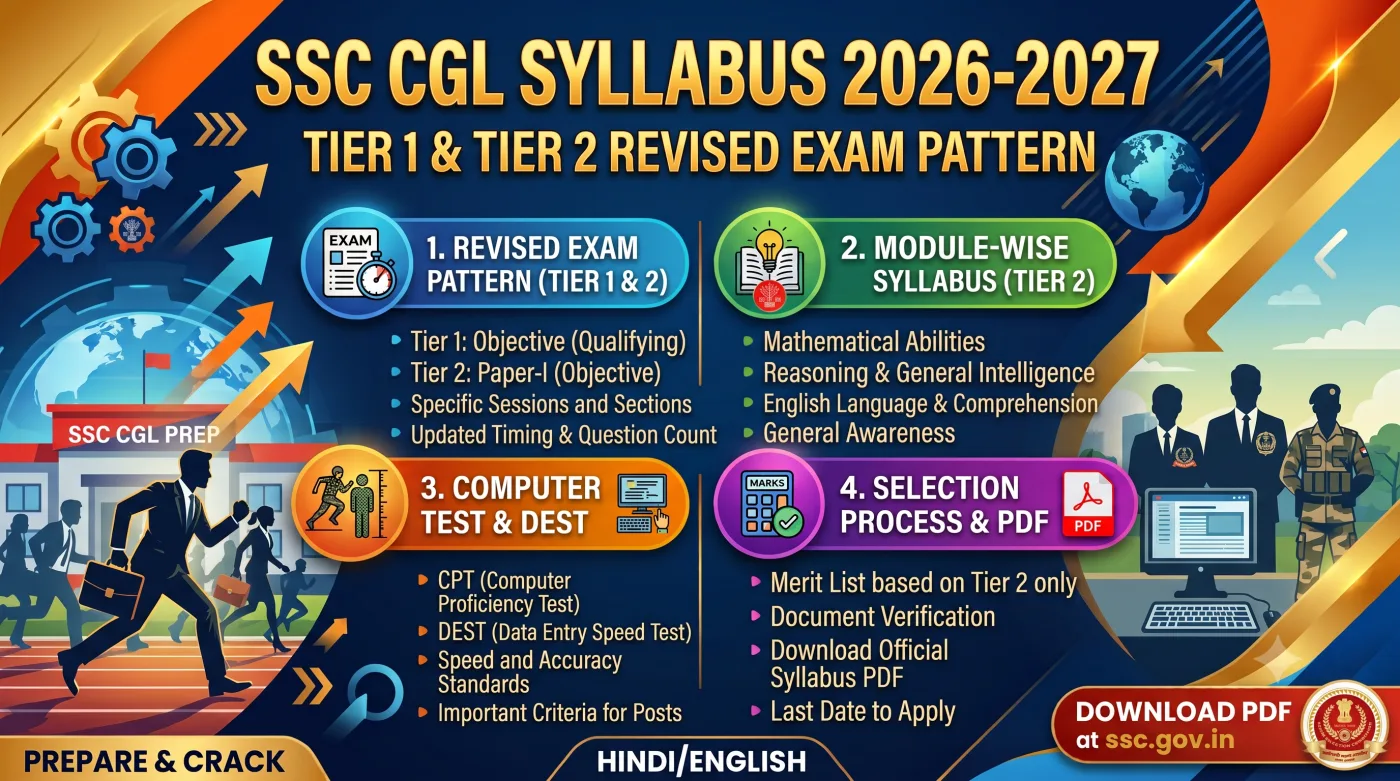
1. Executive Overview: SSC CGL Examination Architecture
The Staff Selection Commission Combined Graduate Level (SSC CGL) examination is the premier all-India competitive gateway for recruitment to Group 'B' Gazetted, Non-Gazetted, and Group 'C' executive, supervisory, and inspection posts across central government ministries, departments, and constitutional bodies. The recruitment process is structured into a streamlined, high-efficiency two-tier system:
- Tier-1 Examination (Computer Based Screening Test - 200 Marks): A 60-minute objective evaluation of Reasoning, General Awareness, Quantitative Aptitude, and English Comprehension. Tier-1 is strictly qualifying in nature.
- Tier-2 Examination (Merit Deciding Examination - 390 Marks + Qualifying Modules):
- Paper-I (Compulsory for All Posts): Split into Session-I (2 hours 15 minutes) and Session-II (15 minutes). Section-I (Maths + Reasoning = 180 Marks) and Section-II (English + General Awareness = 210 Marks) decide 100% of the candidate's final all-India ranking.
- Section-III (Qualifying Modules): Module-I Computer Knowledge Test (60 Marks, 15 minutes) and Module-II Data Entry Speed Test (DEST typing, 2000 key depressions in 15 minutes).
- Paper-II (Specialized Paper for JSO - 200 Marks): Statistics paper for candidates shortlisted for Junior Statistical Officer.
- Document Verification (DV) & Departmental Medical Fitness: Scrutinized directly by user departments upon final allocation by the Commission.
| Recruitment Dimension | Official Specification & Examination Details |
|---|---|
| Exam Conducting Authority | Staff Selection Commission (SSC / कर्मचारी चयन आयोग, नई दिल्ली) |
| Major Posts Offered | ASO (MEA, CSS, IB, Railway), Income Tax Inspector, Central Excise (GST) Inspector, CBI Sub-Inspector, Preventive Officer, Examiner, Auditor, Tax Assistant |
| Educational Qualification | Bachelor's Degree in any discipline from a recognized University |
| Mode of Examination | Computer Based Test (CBT - ऑनलाइन कंप्यूटर आधारित परीक्षा) |
| Tier-1 Nature | Qualifying / Screening Only (200 Marks / 100 Questions / 60 Minutes) |
| Final Merit Score Ceiling | 390 Marks (Normalized Score of Section-I & Section-II of Tier-2 Paper-I) |
| Tier-1 Negative Marking | 0.50 Marks deducted per incorrect response (1/4th penalty) |
| Tier-2 Negative Marking | 1.00 Mark deducted per incorrect response (1/3rd penalty per 3-mark question) |
| Qualifying Modules | Computer Knowledge Test (20 Qs / 60 M) & DEST Typing (2000 key depressions / 15 Mins) |
| Official Commission Portal | ssc.gov.in |
2. Detailed Tier-1 Examination Pattern & Sectional Blueprint
Tier-1 tests foundational aptitude and speed across four equal subjects. Candidates must manage 100 questions in 60 minutes (80 minutes for PwBD scribed candidates). All questions carry equal marks (+2 for correct, -0.50 for incorrect):
| Subject Domain / Section | Number of Questions | Maximum Marks | Negative Marking | Ideal Time Allocation |
|---|---|---|---|---|
| A. General Intelligence and Reasoning | 25 Questions | 50 Marks | -0.50 Marks | 12 - 14 Minutes |
| B. General Awareness (सामान्य जागरूकता) | 25 Questions | 50 Marks | -0.50 Marks | 6 - 8 Minutes |
| C. Quantitative Aptitude (मात्रात्मक योग्यता) | 25 Questions | 50 Marks | -0.50 Marks | 24 - 26 Minutes |
| D. English Comprehension (अंग्रेजी समझ) | 25 Questions | 50 Marks | -0.50 Marks | 10 - 12 Minutes |
| Total Tier-1 Test | 100 Questions | 200 Marks | -0.50 per wrong | 60 Minutes (1 Hour) |
3. Comprehensive Tier-2 Examination Pattern & Scoring Matrix
Tier-2 is the definitive merit-deciding phase of the SSC CGL recruitment. It is structured into objective modular sections designed to evaluate cognitive proficiency, computational speed, and professional administrative competencies:
| Paper / Session | Section & Module | Subject Domains | Total Questions | Marks | Duration |
|---|---|---|---|---|---|
| Paper-I: Session-I (2 Hours 15 Mins) Compulsory for All Posts |
Section-I (Merit Module) |
Module-I: Mathematical Abilities | 30 Questions | 90 Marks | 1 Hour (60 Minutes) |
| Module-II: Reasoning and General Intelligence | 30 Questions | 90 Marks | |||
| Section-II (Merit Module) |
Module-I: English Language and Comprehension | 45 Questions | 135 Marks | 1 Hour (60 Minutes) | |
| Module-II: General Awareness | 25 Questions | 75 Marks | |||
| Section-III (Qualifying) |
Module-I: Computer Knowledge Test | 20 Questions | 60 Marks | 15 Minutes | |
| Paper-I: Session-II (15 Mins) |
Section-III (Qualifying) |
Module-II: Data Entry Speed Test (DEST) | 2,000 Key Depressions | Qualifying | 15 Minutes |
| Paper-II (For JSO Only) |
Specialized Paper | Statistics (सांख्यिकी) | 100 Questions | 200 Marks | 2 Hours (120 Mins) |
Critical Rule Note: Merit marks are evaluated strictly from Section-I (180 Marks) + Section-II (210 Marks) = 390 Marks. Candidates failing to secure the minimum qualifying benchmark in the Computer Module or DEST Module are disqualified outright, irrespective of how high their 390 merit score is!
4. Subject-Wise Detailed Syllabus Breakdown (Tier 1 & Tier 2)
Module 1: Mathematical Abilities & Quantitative Aptitude
This domain is tested across both tiers (Tier-1: 25 Qs; Tier-2: 30 Qs carrying 90 marks). Topics span arithmetic, advanced algebra, geometry, mensuration, trigonometry, and statistical probability:
- Number Systems (संख्या पद्धति): Computation of whole numbers, Decimals, Fractions, Relationships between numbers, Divisibility rules, Unit digit, Remainder theorem, Surds and indices.
- Fundamental Arithmetical Operations:
- Percentages and fractional equivalents (e.g., $1/7 = 14.28\%$, $1/8 = 12.5\%$).
- Ratio and Proportion, Mean proportional, Third and fourth proportional, Invertendo and alternando rules.
- Square roots and cube roots, Averages (weighted average, replacement).
- Interest: Simple Interest and Compound Interest (half-yearly and quarterly compounding, $CI - SI$ difference formulas).
- Profit and Loss, Discount, Successive discounts, False balance calculations.
- Partnership business (capital-time weighted investments), Mixture and Allegation.
- Time and Distance, Relative speed, Train problems, Boats and Streams.
- Time and Work, Men-Women-Days efficiency ($M_1 D_1 H_1 / W_1 = M_2 D_2 H_2 / W_2$), Pipes and Cisterns.
- Algebra (बीजगणित): Basic algebraic identities of School Algebra, Elementary surds, Factorization, Linear equations in one and two variables, Quadratic equations ($ax^2 + bx + c = 0$), Nature of roots.
- Geometry (ज्यामिति):
- Familiarity with elementary geometric figures and facts: Triangle and its various kinds of centres (Incentre, Circumcentre, Orthocentre, Centroid).
- Congruence and similarity of triangles, Apollonius theorem.
- Circle and its chords, Tangents, Angles subtended by chords of a circle, Common tangents to two or more circles.
- Mensuration (क्षेत्रमिति - 2D & 3D): Triangle, Quadrilaterals, Regular Polygons, Circle, Right Prism, Right Circular Cone, Right Circular Cylinder, Sphere, Hemispheres, Rectangular Parallelepiped, Regular Right Pyramid with triangular or square base.
- Trigonometry (त्रिकोणमिति): Trigonometric ratios, Degree and Radian measures, Standard identities ($\sin^2\theta + \cos^2\theta = 1$, $1 + \tan^2\theta = \sec^2\theta$, $1 + \cot^2\theta = \csc^2\theta$), Complementary angles, Heights and Distances (simple problems only).
- Statistics and Probability (सांख्यिकी एवं प्रायिकता - Tier-2 Specific):
- Use of Tables and Graphs: Histogram, Frequency polygon, Bar-diagram, Pie-chart.
- Measures of Central Tendency: Mean, Median, Mode for ungrouped and grouped data.
- Measures of Dispersion: Calculation of Standard Deviation ($s = \sqrt{\frac{\sum(x-\bar{x})^2}{N}}$), Variance, Quartile Deviation.
- Calculation of simple probabilities: Sample space, Mutually exclusive events, Independent events, Dice and Card probability problems.
Module 2: Reasoning and General Intelligence
Evaluating abstract logic, computational spatial orientation, and critical deductive decision-making (Tier-1: 25 Qs; Tier-2: 30 Qs carrying 90 marks):
- Verbal Reasoning:
- Analogies (Semantic, Symbolic, Number, Figural Analogy).
- Similarities and Differences, Odd Man Out / Classification.
- Series Completion: Number series, Alphabetical series, Continuous pattern series.
- Coding and Decoding: Coding by letter shifting, number coding, matrix coding, conditional coding.
- Blood Relations: Coded blood relations ($A + B$ means $A$ is father of $B$), Family tree deduction.
- Direction Sense Test: Cardinal and inter-cardinal headings, Shadow problems, Multi-turn tracking.
- Syllogism: Venn diagram-based deductions, 'Some', 'All', 'No', and 'Possibility' statements.
- Seating Arrangement: Linear single-row/double-row arrangements, Circular inwards/outwards arrangements.
- Critical Reasoning (Tier-2 Advanced): Statement and Assumptions, Statement and Arguments, Statement and Course of Action, Cause and Effect, Drawing Inference.
- Non-Verbal Reasoning: Paper Folding and Paper Cutting, Mirror and Water Images, Embedded Figures, Completion of Incomplete Pattern, Figural Series and Classification, Cube and Dice (opposite face identification).
Module 3: English Language and Comprehension
Carries the single highest weightage in Tier-2 (45 Questions carrying 135 marks) and 25 questions in Tier-1:
- Grammar & Syntax Rules: Spotting the Error, Sentence Improvement, Subject-Verb Agreement, Rules of Nouns, Pronouns, Adjectives, Adverbs, Prepositions, Conjunctions, and Conditionals.
- Active & Passive Voice: Transformation of active sentences into passive voice across present, past, future tenses, and imperative/interrogative sentences.
- Direct & Indirect Speech (Narration): Reporting speech conversion, tense adjustments, pronoun transformations, changing modal auxiliaries (will to would, can to could).
- Vocabulary Mastery: Synonyms, Antonyms, Homonyms, One Word Substitution (e.g., Philanthropist, Somnambulist), Idioms and Phrases (meanings and usage in context), Spelling rules and detecting misspelt words.
- Sentence Rearrangement: Shuffling of sentence parts (PQRS / Para Jumbles), Paragraph completion.
- Comprehension Mastery: Cloze Test (fill in missing blanks in passages assessing contextual grammar), Reading Comprehension passages (evaluating central theme, vocabulary in context, author's tone, and factual inference).
Module 4: General Awareness
Evaluates candidate knowledge of the environment around them and its application to society (Tier-1: 25 Qs; Tier-2: 25 Qs carrying 75 marks):
- History of India: Ancient India (Indus Valley, Vedic, Buddhism/Jainism, Mauryan, Gupta), Medieval India (Delhi Sultanate, Mughal architecture, administrative reforms), Modern India (British expansion, 1857 Revolt, Freedom struggle, Governor Generals, Gandhian Era).
- Indian Polity & Constitution: Historical background, Preamble, Fundamental Rights (Articles 12-35), Directive Principles (Articles 36-51), Fundamental Duties, President, Prime Minister, Parliament, Supreme Court & High Courts, Constitutional & Non-Constitutional bodies, Major Constitutional Amendments.
- Geography: Physical geography, Indian drainage system (Himalayan and Peninsular rivers), Climate and Monsoons, Agriculture, Mineral distribution, National Parks and Biosphere Reserves, World geography essentials.
- Indian Economy: National Income accounting (GDP, GNP, NNP), Inflation types, Monetary Policy (Repo Rate, Reverse Repo, CRR, SLR), Fiscal Policy, Budget, Banking system, NITI Aayog, Foreign trade.
- General Science (Class 9-10 NCERT Standard):
- Physics: Mechanics, Work and Energy, Sound, Optics, Electricity, Units and Dimensions.
- Chemistry: Atomic structure, Periodic table trends, Acids-Bases-Salts, Metals and Non-Metals, Everyday chemistry.
- Biology: Cell biology, Human organ systems (digestive, circulatory, nervous), Genetics, Human diseases and pathogens, Ecology and environmental conservation.
- Current Affairs: National and international events, Government schemes and flagship initiatives, Defense exercises, Science and space missions (ISRO, NASA), Summits (G20, SCO, ASEAN), Books and Authors, Awards and Honors, Sports tournaments.
Module 5: Computer Knowledge Test (Tier-2 Section-III - 20 Qs, 60 Marks)
This module is compulsory and qualifying for all posts, with higher standards enforced for CPST/DEST posts:
- Computer Basics: Organization of a computer system, Central Processing Unit (CPU), Input/Output devices, Computer memory (RAM, ROM, Cache), Memory organization, Back-up devices, Ports, Windows Explorer, Keyboard shortcuts.
- Software Applications: Windows Operating System basics, Microsoft Office Suite: MS Word (document creation, formatting, tables), MS Excel (spreadsheets, basic formulas, cell referencing), MS PowerPoint (slide creation, transitions).
- Working with Internet and E-mails: Web browsing and searching, Downloading and uploading files, Managing an e-mail account, e-Banking services.
- Basics of Networking and Cyber Security: Networking devices (Hub, Switch, Router, Gateway), Network topologies, Protocols (TCP/IP, HTTP, FTP, SMTP), Network and information security threats (Hacking, Virus, Worms, Trojan Horse, Phishing, Malware, Spyware), Antivirus software, Firewalls.
5. Data Entry Speed Test (DEST) Typing Module Standards
Session-II of Tier-2 comprises the mandatory Data Entry Speed Test (DEST). Candidates are presented with a typed English passage of approximately 2,000 characters on screen and must type it within 15 minutes:
| DEST Parameter | Prescribed Official Standard | Operational Remarks |
|---|---|---|
| Total Key Depressions Required | 2,000 Key Depressions (की-स्ट्रोक्स) | Includes spaces and punctuation marks |
| Test Duration | 15 Minutes (15 मिनट) | Electronic timer countdown on computer screen |
| Equivalent Speed in Words Per Minute | Approx. 27 Words Per Minute (WPM) | Calculated assuming 5 depressions per word |
| Permissible Error Percentage (General Posts) | UR: 20% | OBC/EWS: 25% | SC/ST: 30% | Baseline qualifying standard for general cadres |
| Strict Permissible Error (Tax Assistant Posts) | UR: 5% | OBC/EWS: 7% | SC/ST: 10% | Higher qualifying standard mandatory for CBDT/CBIC Tax Assistants |
6. Post-Wise Classification & Grade Pay Matrix under SSC CGL
| Pay Level / Grade Pay | Designation / Post Name | Cadre Ministry / Department | Classification |
|---|---|---|---|
| Level 8 (GP 4800) ₹47,600 - ₹1,51,100 |
Assistant Audit Officer (AAO) / Assistant Accounts Officer | Indian Audit & Accounts Dept under Comptroller & Auditor General (CAG) | Group 'B' Gazetted (Non-Ministerial) |
| Level 7 (GP 4600) ₹44,900 - ₹1,42,400 |
Assistant Section Officer (ASO) | Central Secretariat Service (CSS), Ministry of External Affairs (MEA), Intelligence Bureau (IB), Railways | Group 'B' Non-Gazetted |
| Level 7 (GP 4600) ₹44,900 - ₹1,42,400 |
Inspector of Central Excise / Preventive Officer / Examiner | Central Board of Indirect Taxes and Customs (CBIC) | Group 'B' Non-Gazetted (Executive Khaki / White Uniform) |
| Level 7 (GP 4600) ₹44,900 - ₹1,42,400 |
Inspector of Income Tax (ITI) | Central Board of Direct Taxes (CBDT) | Group 'B' Non-Gazetted |
| Level 7 (GP 4600) ₹44,900 - ₹1,42,400 |
Sub-Inspector (SI) | Central Bureau of Investigation (CBI), National Investigation Agency (NIA) | Group 'B' Non-Gazetted |
| Level 6 (GP 4200) ₹35,400 - ₹1,12,400 |
Junior Statistical Officer (JSO) | Ministry of Statistics and Programme Implementation | Group 'B' Non-Gazetted |
| Level 5 (GP 2800) ₹29,200 - ₹92,300 |
Auditor / Accountant / Junior Accountant | Offices under CAG, CGA, CGDA (Defense Accounts) | Group 'C' |
| Level 4 (GP 2400) ₹25,500 - ₹81,100 |
Tax Assistant (TA) / Upper Division Clerk (UDC) | CBDT, CBIC, Central Bureau of Narcotics, Border Roads Organisation | Group 'C' |
7. Standard Recommended Books & Study Resources
| Subject Domain | Standard Recommended Books | Author / Publication | Utility in CGL Preparation |
|---|---|---|---|
| Quantitative Aptitude | Play with Advanced Maths + Arithmetic | Abhinay Sharma / Rakesh Yadav (7300+) | Concept clarity in geometry, trigonometry, algebra, and rapid arithmetic shortcuts |
| English Comprehension | Plinth to Paramount / Word Power Made Easy | Neetu Singh (KD Campus) / Norman Lewis | Grammar rules mastery, vocabulary root words, active-passive and narration rules |
| Reasoning & Logic | Pinnacle SSC Reasoning Chapterwise Solved | Pinnacle Publications | Extensive practice of latest TCS pattern reasoning and critical inference questions |
| General Awareness | Lucent GK + Pinnacle SSC GS Chapterwise | Lucent / Pinnacle Publications | Static GK consolidation alongside topic-wise PYQ analysis from 2018 onwards |
| Computer Knowledge | Computer Knowledge for SSC Exams | Kiran / Arihant Publications | Hardware, networking, shortcuts, MS Office commands, and cyber security fundamentals |
8. 180-Day Scientific Master Study Routine to Score 340+ in Tier-2
- Phase 1: Comprehensive Concept Building (Months 1 to 3):
- Devote 3 hours daily to Mathematics: Complete arithmetic foundations in Month 1 and advanced mathematics (algebra, geometry, trigonometry) in Months 2 and 3.
- Devote 2 hours daily to English: Study one grammar chapter every two days, read newspaper editorials for 30 minutes, and memorize 30 vocabulary words daily.
- Devote 2 hours daily to General Awareness: Cover NCERT science and Indian Polity thoroughly with self-prepared handwritten notes.
- Devote 1.5 hours daily to Reasoning: Practice 50 mixed-topic questions daily to build recognition speed.
- Phase 2: Tier-1 Speed Drills & Sectional Tests (Months 4 and 5):
- Attempt one full-length Tier-1 Computer Based Test (CBT) mock every alternate day, strictly analyzing speed and unforced negative marking errors.
- Begin daily 20-minute English typing practice using computer typing software to comfortably achieve 35+ WPM with 98% accuracy.
- Dedicate 45 minutes weekly to Computer Knowledge chapters to guarantee clearing Section-III qualifying benchmarks.
- Phase 3: Tier-2 Full-Length Simulation & Rank Boosting (Month 6):
- Attempt 2 full-length Tier-2 Paper-I mocks weekly (Session-I 2 hrs 15 mins + Session-II DEST typing) in realistic exam hall conditions.
- Fine-tune time-management between Maths and Reasoning in Section-I (target 25-28 mins for Reasoning and 32-35 mins for Maths).
- Maintain flawless revision of formula sheets, theorem summaries, and current affairs compilations during the final 15 days.
9. Physical Standards & Physical Tests for Uniform Executive Posts
While ministerial and desk posts (ASO, Auditor, Accountant, Tax Assistant) have no physical standard requirements beyond basic medical fitness, executive uniform posts (Inspector Central Excise / GST, Preventive Officer, Examiner, and Sub-Inspector in CBI / NIA / Narcotics) enforce mandatory Physical Standard Tests (PST) and Physical Tests (PET):
| Cadre Post Name | Gender | Minimum Height | Chest Measurement | Physical Endurance Test (PET) |
|---|---|---|---|---|
| Inspector (Central Excise / Preventive Officer / Examiner) CBIC Dept of Revenue |
Male | 157.5 cms (5 cms relaxation for Gorkhas, Garhwalis, Assamese, ST) |
81 cms unexpanded; Minimum 5 cms expansion (81 - 86 cms) |
Walking: 1,600 Meters in 15 Minutes Cycling: 8 Kilometers in 30 Minutes |
| Female | 152 cms (Height) 48 kg (Min Weight) (2.5 cms & 2 kg relaxation for ST) |
Exempt from chest measurement | Walking: 1.0 Kilometer in 20 Minutes Cycling: 3 Kilometers in 25 Minutes |
|
| Sub-Inspector (CBI / Central Bureau of Investigation) | Male | 165 cms (5 cms relaxation for Hills & ST) |
76 cms with expansion | Eye Vision: Distant vision 6/6 in one and 6/9 in other; Near vision 0.6 in one and 0.8 in other eye |
| Female | 150 cms | Exempt | Same visual acuity standards | |
| Sub-Inspector (National Investigation Agency - NIA) | Male | 170 cms (5 cms relaxation for Hills & ST) |
76 cms with expansion | Vision: 6/6 and 6/9 with or without glasses |
| Female | 150 cms | Exempt | Same visual acuity standards |
10. Specialized Syllabus: Tier-2 Paper-II (Statistics for JSO - 200 Marks)
Candidates who apply for the post of Junior Statistical Officer (JSO) in the Ministry of Statistics & Programme Implementation (MoSPI) must appear in Paper-II (100 Questions, 200 Marks, 2 Hours, negative marking 0.50 marks per wrong answer):
- Collection, Classification and Presentation of Statistical Data: Primary and Secondary data, Methods of data collection; Tabulation of data; Graphs and charts; Frequency distributions; Diagrammatic presentation of frequency distributions.
- Measures of Central Tendency: Common measures of central tendency — mean, median and mode; Partition values — quartiles, deciles, percentiles.
- Measures of Dispersion: Common measures of dispersion — range, quartile deviations, mean deviation and standard deviation; Measures of relative dispersion.
- Moments, Skewness and Kurtosis: Different types of moments and their relationships; Meaning of skewness and kurtosis; Different measures of skewness and kurtosis.
- Correlation and Regression: Scatter diagram; Simple correlation coefficient; Properties of correlation coefficient; Simple regression lines; Spearman's rank correlation; Partial and multiple correlation coefficients (for three variables only).
- Probability Theory: Meaning of probability; Different definitions of probability; Conditional probability; Compound probability; Independent events; Bayes' theorem.
- Random Variables and Probability Distributions: Random variable; Probability functions; Expectation and variance of a random variable; Higher moments of a random variable; Binomial, Poisson, Normal and Exponential distributions.
- Sampling Theory: Concept of population and sample; Parameter and statistic, Sampling and non-sampling errors; Probability and non-probability sampling techniques (Simple random sampling, stratified sampling, multistage sampling, systematic sampling, cluster sampling).
- Statistical Inference: Point estimation and interval estimation; Properties of a good estimator; Methods of estimation (Moments method, Maximum likelihood method, Least squares method); Testing of hypothesis (Null and Alternative hypotheses, Type-I and Type-II errors, Critical region, p-value); Testing based on Z, t, Chi-Square and F statistics.
- Analysis of Variance: Analysis of one-way classified data and two-way classified data.
- Time Series Analysis: Components of time series; Determination of trend component by different methods; Measurement of seasonal variation by different methods.
- Index Numbers: Meaning and uses of index numbers; Problems in the construction of index numbers; Different types of index numbers (Laspeyres, Paasche, Fisher, Marshall-Edgeworth); Tests of an index number (Time reversal test, Factor reversal test).
11. SSC Multi-Shift Normalization Formula Explained
Whenever Tier-1 or Tier-2 is administered across multiple dates and shifts, the Staff Selection Commission applies its standard normalisation formula published in Commission Notice No. 1-1/2018-P&P-I to balance paper variances:
| Formula Variable | Statistical Definition | Practical Consequence |
|---|---|---|
| $M_{ij}$ | Normalized marks of $j^{th}$ candidate in $i^{th}$ shift | The final score displayed on the candidate's scorecard. |
| $\bar{M}_t^g$ | Average marks of the top 0.1% candidates considering all shifts | Establishes the supreme benchmark across the entire examination. |
| $M_q^g$ | Sum of mean and standard deviation marks of candidates across all shifts | Normalizes base variability across all participants nationwide. |
| $\bar{M}_{ti}$ | Average marks of the top 0.1% candidates in the $i^{th}$ shift | Determines shift toughness: lower values indicate a harder shift. |
| $M_{iq}$ | Sum of mean marks and standard deviation of the $i^{th}$ shift | Adjusts scores upwards for candidates who appeared in challenging shifts. |
12. Historical Cut-Off Trends & Tier-2 Safe Score Target Matrix
To secure a high-priority 4600 Grade Pay posting (ASO in MEA/CSS or GST Inspector) in your home zone, candidates must aim for realistic normalized scores based on historic trends:
| Category | Tier-1 Qualifying Cut-Off Range (Out of 200) | Tier-2 Safe Score for 4600 GP Post (Out of 390) | Tier-2 Safe Score for 2400 GP Post (Out of 390) | Computer Module Safe Target (Out of 60) |
|---|---|---|---|---|
| General / Unreserved (UR) | 148 - 155 Marks | 330 - 340 Marks | 305 - 315 Marks | 36+ Marks |
| Other Backward Classes (OBC) | 144 - 152 Marks | 324 - 332 Marks | 298 - 308 Marks | 32+ Marks |
| Economically Weaker Section (EWS) | 140 - 148 Marks | 320 - 328 Marks | 295 - 304 Marks | 32+ Marks |
| Scheduled Caste (SC) | 124 - 132 Marks | 295 - 305 Marks | 270 - 280 Marks | 27+ Marks |
| Scheduled Tribe (ST) | 115 - 124 Marks | 280 - 290 Marks | 255 - 265 Marks | 24+ Marks |
| Ex-Servicemen (ESM) | 95 - 105 Marks | 230 - 245 Marks | 210 - 225 Marks | 24+ Marks |
13. Post-Preference Submission & Departmental Document Verification
Under the revised SSC protocol, the physical Document Verification (DV) is no longer conducted by the Staff Selection Commission. Instead:
- Online Option-cum-Preference Window: After the conduct of Tier-2 and before the declaration of final results, candidates are summoned to fill their post and department preferences online on the official portal (`ssc.gov.in`). Candidates failing to submit their online preferences within the stipulated window are strictly not considered for any post!
- Merit-cum-Preference Post Allocation: The Commission generates the final merit list strictly based on Tier-2 Section-I + Section-II marks (out of 390) mapped against candidate preferences and qualifying status in Computer and DEST modules.
- Direct Departmental DV: Allocated dossiers of selected candidates are forwarded directly to the respective Ministry/Department (e.g., Central Board of Indirect Taxes, Ministry of External Affairs, CAG), which independently verifies original educational degrees, caste validity, biometric data, and conducts medical examinations prior to issuing appointment letters.
14. Mock Test Analytics & Negative Marking Mitigation Strategy
Attempting mock tests without analytical feedback is an ineffective study habit. Top rankers implement the Three-Tier Post-Mock Review Matrix:
- Category A (Unforced Arithmetic & Calculation Slips): Maintain a dedicated "Blunder Notebook" (गलती डायरी) for mathematical slip-ups, sign reversals ($+$ vs $-$), and misreading numbers. Re-solve these questions without a timer before sleeping.
- Category B (Grammar & Vocabulary Blindspots): Note down unknown idioms, phrasal verbs, or new words encountered in the English comprehension and cloze tests. Reviewing 200 such self-identified weak points before the real CBT exam eliminates recurring errors.
- Category C (Temptation Guesses in General Awareness): If you cannot eliminate at least two options conclusively, never take a random gamble. In Tier-2, every wrong guess robs you of 1 negative mark plus the opportunity cost of 3 marks, causing a drop of hundreds of ranks on the all-India merit list.
15. Concluding Strategic Advice for CGL Aspirants
Cracking the SSC Combined Graduate Level examination is the ultimate gateway to administrative authority, prestige, and financial security in the central government. In the revised pattern, success is awarded to candidates who maintain high arithmetic accuracy, robust English grammatical precision, and dependable computer typing fluency. Avoid random guessing in Tier-2 because the 1-mark negative penalty severely punishes carelessness. Treat this syllabus as your daily operational charter. Stay focused, solve previous year questions rigorously, and claim your officer's chair in the Government of India! (एसएससी सीजीएल परीक्षा में सफलता केवल ज्ञान से नहीं, बल्कि गति, सटीकता और निरंतर अभ्यास से मिलती है। अपने लक्ष्य पर अडिग रहें और विजय प्राप्त करें!)
User Discussion & Comments (0)
No comments yet. Be the first to leave a comment below!
Leave a Comment / Ask a Question: