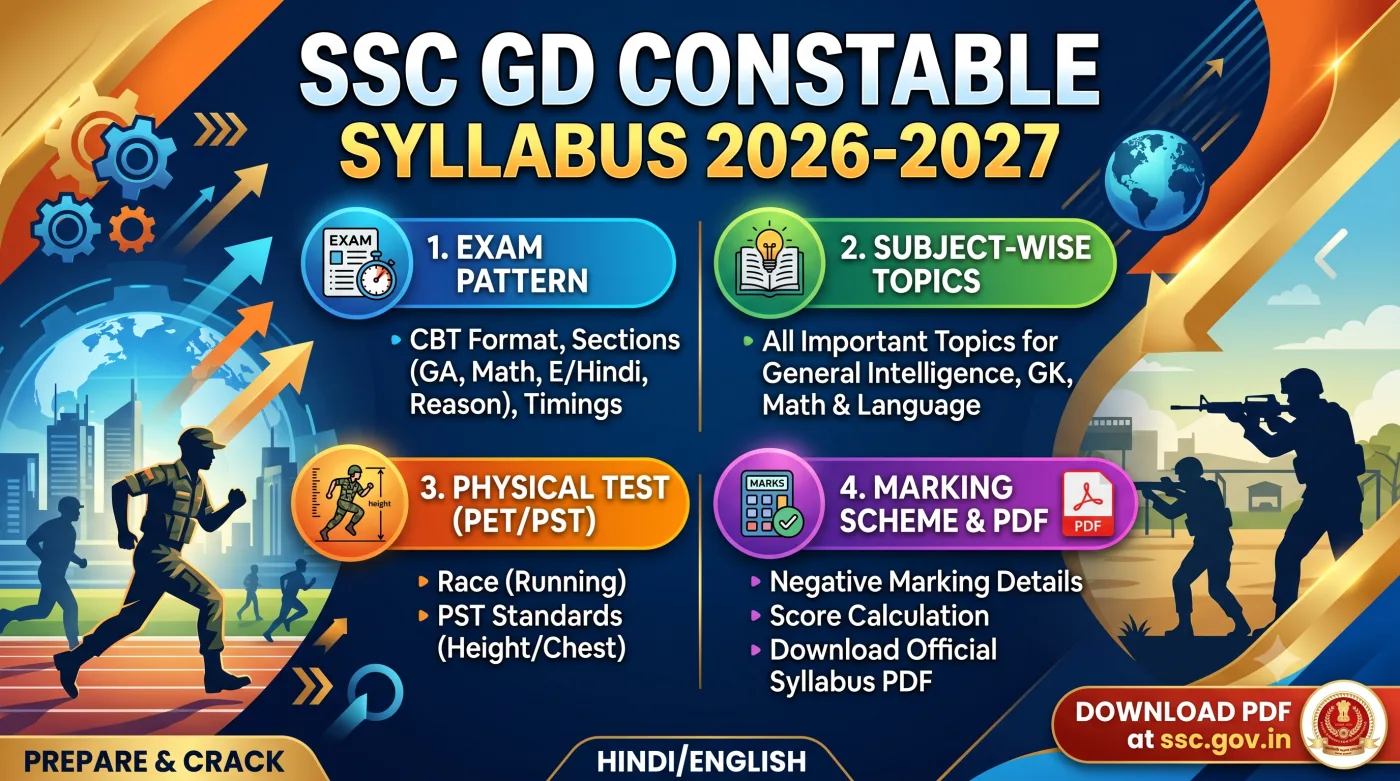
The Staff Selection Commission (SSC) General Duty (GD) Constable Examination is among the most prestigious and fiercely contested competitive recruitment examinations in India. Every year, upwards of 40 to 50 lakh matriculate aspirants nationwide compete for coveted uniform posts across premier Central Armed Police Forces (CAPFs)—including the Border Security Force (BSF), Central Industrial Security Force (CISF), Central Reserve Police Force (CRPF), Indo-Tibetan Border Police (ITBP), Sashastra Seema Bal (SSB), Secretariat Security Force (SSF), and Rifleman (General Duty) in Assam Rifles (AR). To conquer this highly competitive examination and secure your dream uniform, acquiring a surgical, topic-by-topic understanding of the official SSC GD Constable Syllabus 2026-2027 and Computer Based Examination (CBT) pattern is the indispensable first step. (कर्मचारी चयन आयोग (SSC) द्वारा आयोजित GD कांस्टेबल भर्ती परीक्षा में अंतिम चयन प्राप्त करने के लिए नवीनतम पाठ्यक्रम, परीक्षा पैटर्न और शारीरिक दक्षता मानकों की संपूर्ण जानकारी होना अनिवार्य है।)
1. Executive Overview: SSC GD Constable Examination Architecture
The selection architecture for SSC GD Constable comprises four rigorous sequential stages designed to filter out physically robust, mentally agile, and morally disciplined personnel for national border and internal security duties:
- Stage 1: Computer Based Examination (CBT): A centralized objective test administered across thousands of TCS iON examination centers nationwide in 13 regional languages plus English and Hindi.
- Stage 2: Physical Standard Test (PST): Screening of mandatory physical dimensions, including height and chest measurements (chest for males only).
- Stage 3: Physical Efficiency Test (PET): Rigorous endurance running tests (5 km run for males and 1.6 km run for females within strict time ceilings).
- Stage 4: Detailed Medical Examination (DME) & Document Verification (DV): In-depth clinical assessment by CAPF medical boards accompanied by stringent scrutiny of original matriculation certificates, caste reservations, and domicile records.
| Recruitment Parameter | Official Specification & Structural Benchmark |
|---|---|
| Exam Conducting Authority | Staff Selection Commission (SSC / कर्मचारी चयन आयोग) |
| Post Titles | Constable (General Duty) in CAPFs, SSF & Rifleman (GD) in Assam Rifles |
| Participating Forces | BSF, CISF, CRPF, ITBP, SSB, SSF, and Assam Rifles |
| Academic Qualification Level | 10th Standard Matriculation Pass (10वीं कक्षा उत्तीर्ण) |
| Mode of Written Examination | Computer Based Test (CBT - ऑनलाइन कंप्यूटर आधारित परीक्षा) |
| Total Questions in CBT | 80 Multiple Choice Questions (वस्तुनिष्ठ बहुविकल्पीय प्रश्न) |
| Total Marks | 160 Maximum Marks (2 Marks per Question) |
| Total Exam Duration | 60 Minutes (1 Hour / 60 मिनट) |
| Negative Marking Penalty | 0.25 Marks deducted per incorrect answer (1/4th penalty) |
| Medium of Examination | Bilingual (English & Hindi) + 13 Recognized Regional Languages |
| Official Commission Portal | ssc.gov.in |
2. Comprehensive Examination Pattern & Sectional Marking Scheme
The written Computer Based Test consists of four distinct objective sections. Each section carries equal question allocation and scoring weightage. Candidates must cultivate exceptional speed coupled with high accuracy, as solving 80 complex analytical and mathematical problems within 60 minutes affords approximately 45 seconds per question. (लिखित परीक्षा में चार खंड होते हैं, जिसमें प्रत्येक खंड से 20 प्रश्न 40 अंकों के लिए पूछे जाते हैं। परीक्षा की कुल अवधि 60 मिनट निर्धारित है।)
| Section / Test Component | Total Questions | Maximum Marks | Standard Time Allocation | Target Good Attempts |
|---|---|---|---|---|
| Part-A: General Intelligence & Reasoning (तार्किक क्षमता) | 20 Questions | 40 Marks | 18 - 20 Minutes | 17 - 19 Questions |
| Part-B: General Knowledge & General Awareness (सामान्य ज्ञान) | 20 Questions | 40 Marks | 7 - 8 Minutes | 13 - 15 Questions |
| Part-C: Elementary Mathematics (प्रारंभिक गणित) | 20 Questions | 40 Marks | 22 - 25 Minutes | 16 - 18 Questions |
| Part-D: English OR Hindi Grammar (अंग्रेजी अथवा हिंदी व्याकरण) | 20 Questions | 40 Marks | 7 - 8 Minutes | 18 - 20 Questions |
| Grand Cumulative Total | 80 Questions | 160 Marks | 60 Minutes | 65 - 72 Questions |
Salient Structural Rules of the CBT Examination:
- Equal Weightage Per Item: Every correct answer credits +2 marks to the candidate's raw score.
- Negative Marking Precision: For every incorrect response, a penalty deduction of 0.25 marks is levied. Unattempted questions attract zero penalty. (प्रत्येक गलत उत्तर के लिए 0.25 अंक काटे जाएंगे, अतः तुक्का लगाने से बचें।)
- Sectional Switching Liberty: Candidates can freely navigate between different test sections, review flagged questions, and amend choices at any point before the 60-minute automated timer expires.
- Normalization Procedure: Because the examination spans across multiple shifts over 2 to 3 weeks, raw scores are normalized using the standard equipercentile statistical formula published by SSC to neutralize shifts of varying difficulty levels.
3. Exhaustive Subject-Wise Syllabus Breakdown (Matriculation Standard)
The official syllabus formulated by the Staff Selection Commission is strictly pegged at the 10th Standard (Matriculation) level. Below is the granular chapter-by-chapter curriculum across all four examination disciplines:
Part-A: General Intelligence & Reasoning (तर्कशक्ति एवं बौद्धिक क्षमता)
This section evaluates non-verbal thinking, pattern matching, spatial visualization, deductive logic, and arithmetic problem-solving capabilities. Questions test both verbal and non-verbal reasoning formats:
- Analogies (सादृश्यता): Semantic Analogy, Symbolic/Number Analogy, Figural Analogy, Letter-based relationships.
- Similarities and Differences (समानता एवं भिन्नता): Odd one out, classification of word pairs, number groups, and geometrical patterns.
- Spatial Visualization & Orientation (स्थानिक दृश्यीकरण एवं अभिविन्यास): Paper folding, paper cutting, mirror images, water images, and figure completion.
- Discrimination & Observation (विभेदन एवं प्रेक्षण क्षमता): Spotting identical figures, pattern sequence matching, embedded figure identification.
- Relationship Concepts (रक्त संबंध): Coded blood relations, family tree decoding, pointing-based pedigree problems.
- Arithmetical Reasoning and Figural Classification (अंकगणितीय तर्कशक्ति): Word mathematical puzzles, age calculation problems, head-and-feet calculation puzzles.
- Arithmetic Number Series & Alphabet Series (संख्या एवं वर्णमाला श्रृंखला): Missing number series, wrong term detection, double-step series, continuous pattern alphabetic series.
- Coding and Decoding (कोडिंग एवं डिकोडिंग): Letter shifting, reverse alphabetical coding, word substitute coding, matrix coding, numerical substitution.
- Syllogism and Statement Conclusion (न्याय निगमन): Two and three-premise Venn diagram syllogisms, statements and assumptions.
- Direction and Distance Sense (दिशा एवं दूरी परीक्षण): Cardinal points navigation, shadow-based direction problems, Pythagoras theorem displacements.
- Order and Ranking (क्रम व्यवस्था): Linear seating arrangement, circular tables, position interchange in rows.
Part-B: General Knowledge & General Awareness (सामान्य ज्ञान एवं सामान्य अध्ययन)
The General Awareness curriculum assesses a candidate's alertness regarding their surrounding socio-political environment, historical heritage, scientific developments, and everyday observations. Questions do not require specialized postgraduate study but demand deep familiarity with high-frequency facts:
- Indian History (भारतीय इतिहास):
- Ancient India: Indus Valley Civilization (major sites, artifacts), Vedic Culture, Buddhism & Jainism councils, Mauryan Empire (Ashokan Edicts), Gupta Golden Age.
- Medieval India: Delhi Sultanate dynasties (Slave, Khilji, Tughlaq), Mughal Empire (Akbar's administrative revenue reforms, architecture), Maratha Empire under Shivaji.
- Modern India & Freedom Movement: Revolt of 1857, British Governor Generals & Viceroys, Indian National Congress founding, Gandhian movements (Non-Cooperation, Civil Disobedience, Quit India), Revolutionary movements and prominent freedom fighters.
- Indian and World Geography (भूगोल):
- Physical features of India, Himalayan ranges, major river drainage systems (Ganga, Brahmaputra, Indus, Peninsular rivers), dams and multipurpose river valley projects.
- Soil types in India, climate and monsoon cycles, agriculture and major cropping patterns (Kharif, Rabi, Zaid).
- Mineral distribution, National Parks, Wildlife Sanctuaries, Tiger Reserves, Biosphere Reserves, and major international straits and continents.
- Indian Polity & Constitution (भारतीय राजव्यवस्था एवं संविधान):
- Preamble, Fundamental Rights (Articles 12 to 35), Fundamental Duties (Article 51A), Directive Principles of State Policy (DPSP).
- President, Vice President, Prime Minister and Union Council of Ministers, Parliament (Lok Sabha & Rajya Sabha legislative procedures).
- Supreme Court of India, High Courts, Panchayati Raj Institutions (73rd & 74th Constitutional Amendments), Emergency Provisions, and Important Constitutional Amendments.
- Indian Economy (भारतीय अर्थव्यवस्था):
- Key economic terminologies (GDP, GNP, NNP, Inflation, Repo Rate, Reverse Repo Rate, CRR, SLR).
- Five-Year Plans history, NITI Aayog structure, Banking system in India, RBI functions, Budget basics, Goods and Services Tax (GST), and prominent Central Government welfare schemes.
- General Science (सामान्य विज्ञान - 10th NCERT Standard):
- Physics: SI units, Newton's laws of motion, Work, Energy and Power, Gravitation, Light (reflection, refraction, lenses, mirrors), Human eye defects, Electricity basics, Magnetism, Sound waves.
- Chemistry: Periodic table trends, Acids, Bases and Salts, Chemical reactions and equations, Metals and Non-metals, Common chemical compounds and commercial formulas (Baking soda, Bleaching powder, Plaster of Paris).
- Biology: Cell structure and organelles, Human digestive system, Circulatory system (blood groups, heart), Respiratory system, Vitamins and deficiency diseases, Plant morphology, Photosynthesis, Infectious diseases and vaccines.
- Static General Knowledge & Culture (स्थैतिक सामान्य ज्ञान एवं संस्कृति):
- Classical and Folk Dances of Indian States (Bharatanatyam, Kathakali, Bihu, Garba, Ghoomar, Lavani, Chhau).
- Major Indian Festivals, Musical Instruments and celebrated maestros (Sitar, Tabla, Shehnai, Sarod).
- Books and Authors, First in India and World, Major National and International Awards (Bharat Ratna, Padma Awards, Gallantry Awards, Nobel Prize, Oscar Awards), Headquarters of International Organizations (UN, WHO, UNESCO, IMF, World Bank).
- Sports (Olympic Games, Asian Games, Commonwealth Games, ICC Cricket World Cup, FIFA, trophies and terminologies).
- Current Affairs (समसामयिक घटनाएं): National and international events covering the preceding 8 to 12 months, bilateral defense exercises, new appointments, scientific launches (ISRO, DRDO), and state government developmental programs.
Part-C: Elementary Mathematics (प्रारंभिक अंकगणित)
Elementary Mathematics is widely considered the highest-scoring section for candidates who master core arithmetic shortcuts and formula applications. The syllabus emphasizes practical commercial mathematics:
- Number Systems (संख्या पद्धति): Divisibility rules, Prime numbers, Integers, Unit digit calculation, Remainder theorem, Real and rational numbers.
- Computation of Whole Numbers & Decimals (दशमलव एवं भिन्न): BODMAS simplification rules, recurring decimals, fraction comparison, square roots and cube roots.
- LCM and HCF (लघुत्तम समापवर्त्य एवं महत्तम समापवर्तक): Relationship between two numbers and their LCM/HCF, word problems on circular tracks and traffic lights.
- Percentages (प्रतिशत): Fractional equivalents of percentages, successive percentage changes, population growth and depreciation.
- Ratio and Proportion (अनुपात एवं समानुपात): Mean proportional, third and fourth proportional, distribution of money among partners, age problems.
- Averages (औसत): Average speed, average age of family members, cricket batting/bowling averages, weighted average concepts.
- Simple Interest & Compound Interest (साधारण एवं चक्रवृद्धि ब्याज):
- Annual and semi-annual compounding, difference between CI and SI for 2 and 3 years ($D = P(R/100)^2$).
- Installment problems, sum becoming $N$-times in given years.
- Profit, Loss and Discount (लाभ, हानि एवं बट्टा): Cost price, Selling price, Marked price, Successive discounts, Dishonest shopkeeper problems, Faulty weight calculations.
- Time and Work (कार्य एवं समय): Efficiency ratios, Alternate day working, Pipes and Cisterns (filling and emptying taps), Men, Women and Children work equivalence formula ($M_1 D_1 H_1 / W_1 = M_2 D_2 H_2 / W_2$).
- Time, Speed and Distance (समय, चाल एवं दूरी): Unit conversions (km/h to m/s), Relative speed of trains crossing poles, platforms, and moving objects, Boats and Streams (upstream and downstream speeds).
- Mensuration 2D & 3D (क्षेत्रमिति):
- 2D Plane Figures: Perimeter and area of Triangles (Equilateral, Right-angled), Quadrilaterals (Rectangle, Square, Rhombus, Parallelogram, Trapezium), Circles, Sectors.
- 3D Solid Figures: Surface area and volume of Cube, Cuboid, Cylinder, Cone, Sphere, and Hemisphere.
Part-D: Language Section (Option to Choose Either Hindi OR English)
Candidates must select either English or Hindi during the examination to assess their fundamental grammatical command, syntax accuracy, and comprehension skills:
Option 1: General Hindi (सामान्य हिंदी व्याकरण)
The vast majority of candidates from the Northern, Central, and Eastern belts opt for General Hindi due to its intuitive grammar structure:
- वर्तनी की सामान्य अशुद्धियाँ (Spelling Errors): शब्दों के शुद्ध रूप और वाक्य में गलत वर्तनी की पहचान।
- पर्यायवाची एवं समानार्थी शब्द (Synonyms): जल, अग्नि, पृथ्वी, आकाश, सूर्य, चंद्रमा, कमल, वायु आदि के प्रमुख पर्यायवाची।
- विलोमार्थी शब्द (Antonyms): विपरीतार्थक शब्द और उनके सटीक वाक्य प्रयोग।
- मुहावरे और लोकोक्तियां (Idioms & Proverbs): लोक-प्रचलित कहावतें, उनके अर्थ तथा व्यावहारिक वाक्यों में प्रयोग।
- अनेक शब्दों के लिए एक शब्द (One Word Substitutions): वाक्यांश के स्थान पर प्रयुक्त होने वाले एकल सार्थक शब्द।
- वाक्य शुद्धि (Sentence Correction): लिंग, वचन, कारक, काल और वर्तनी संबंधी त्रुटियों से युक्त अशुद्ध वाक्यों का संशोधन।
- संधि एवं संधि विच्छेद (Sandhi): स्वर संधि, व्यंजन संधि और विसर्ग संधि के मूलभूत नियम।
- उपसर्ग एवं प्रत्यय (Prefix & Suffix): मूल शब्दों से नए शब्दों की रचना और अर्थ परिवर्तन।
- समास (Compound Words): अव्ययीभाव, तत्पुरुष, कर्मधारय, द्विगु, द्वंद्व और बहुव्रीहि समास के भेद।
- अपठित गद्यांश / रिक्त स्थान पूर्ति (Cloze Test Comprehension): दिए गए अनुच्छेद में उचित शब्दों का चयन कर रिक्त स्थानों की पूर्ति करना और अनुच्छेद आधारित प्रश्नों के उत्तर।
Option 2: English Language (अंग्रेजी भाषा)
- Spotting Errors: Identifying subject-verb disagreement, incorrect preposition usage, tense inconsistencies, and modifier errors.
- Fill in the Blanks: Appropriate choice of articles, conjunctions, phrasal verbs, and vocabulary words.
- Vocabulary Building: Synonyms, Antonyms, Homonyms, and Spelling error detection.
- Idiomatic Expressions: Widely tested English idioms, phrasal expressions, and proverbial meanings.
- One Word Substitution: Academic, occupational, and psychological terms in one word.
- Sentence Improvement: Replacing underlined clauses with grammatically superior phrases.
- Voice and Narration Basics: Active vs Passive transformation, Direct vs Indirect reported speech fundamentals.
- Reading Comprehension & Cloze Test: Evaluating contextual flow, tone comprehension, and vocabulary substitution within a paragraph.
4. Chapter-Wise Weightage & Question Distribution Analysis
Based on the meticulous statistical analysis of over 150+ official TCS question papers administered across recent SSC GD cycles, here is the empirical chapter-by-chapter question weightage breakdown:
| Subject Domain | Core Chapter / Topic | Expected Questions Range | Difficulty Benchmark |
|---|---|---|---|
| Mathematics (20 Questions) | Profit, Loss, Discount & MP | 3 - 4 Questions | Moderate |
| Simple & Compound Interest (CI/SI) | 2 - 3 Questions | Moderate to Calculative | |
| Time, Speed, Distance & Trains | 2 - 3 Questions | Moderate | |
| Time & Work, Pipes and Cisterns | 2 Questions | Easy to Moderate | |
| Ratio, Proportion & Percentages | 3 - 4 Questions | Easy to Moderate | |
| 2D/3D Mensuration & Number System | 4 - 5 Questions | Formula-Based / Direct | |
| Reasoning (20 Questions) | Coding-Decoding & Analogy | 4 - 5 Questions | Easy |
| Number & Alphabet Series | 3 - 4 Questions | Moderate | |
| Non-Verbal Figures (Mirror, Paper, Embedded) | 3 - 4 Questions | Easy | |
| Blood Relations & Direction Sense | 2 - 3 Questions | Easy to Moderate | |
| Syllogisms & Seating Arrangement | 3 - 4 Questions | Moderate | |
| General Awareness (20 Questions) | Static GK (Dances, Festivals, Awards, Sports) | 5 - 6 Questions | Direct Fact-Based |
| General Science (Physics, Chem, Biology) | 4 - 5 Questions | 10th NCERT Concepts | |
| Indian Polity & Constitution | 3 - 4 Questions | Articles & Amendments | |
| History & Freedom Struggle | 2 - 3 Questions | Chronology & Personalities | |
| Geography & Current Affairs | 3 - 4 Questions | Rivers, Summits, Schemes | |
| Hindi / English (20 Questions) | Synonyms, Antonyms & One Word | 6 - 7 Questions | Vocabulary Command |
| Spelling & Sentence Error Correction | 4 - 5 Questions | Grammar Rules | |
| Idioms & Phrases (मुहावरे व लोकोक्तियां) | 3 - 4 Questions | Direct Meanings | |
| Cloze Test Passage (अपठित गद्यांश रिक्त स्थान) | 5 Questions | Contextual Flow |
5. Physical Standard Test (PST) & Physical Efficiency Test (PET) Benchmarks
Clearing the written Computer Based Test qualifies candidates for the physical rounds. It is vital to note that failure to meet physical measurement parameters or failure to complete the endurance run leads to instant elimination on the spot. No appeals are permitted for running disqualification. (लिखित परीक्षा पास करने के बाद शारीरिक मानक परीक्षण (PST) और शारीरिक दक्षता परीक्षा (PET) में शामिल होना होता है। इसमें कोई अंक नहीं मिलते, यह केवल क्वालिफाइंग प्रकृति का होता है।)
A. Physical Standard Test (PST - शारीरिक मानक परीक्षण):
| Candidate Category | Male Height (पुरुष ऊंचाई) | Female Height (महिला ऊंचाई) | Male Chest (पुरुष सीना) |
|---|---|---|---|
| General / OBC / SC / EWS Candidates | 170 cms | 157 cms | 80 cms (Min 5 cms expansion: 80 - 85 cms) |
| All Scheduled Tribe (ST) Candidates | 162.5 cms | 150 cms | 76 cms (Min 5 cms expansion: 76 - 81 cms) |
| ST Candidates of North-Eastern States | 157 cms | 147.5 cms | 76 cms (Min 5 cms expansion) |
| Garhwalis, Kumaonis, Dogras, Marathas, Assam, HP, J&K, Ladakh | 165 cms | 155 cms | 78 cms (Min 5 cms expansion: 78 - 83 cms) |
| North-Eastern States (Arunachal, Manipur, Meghalaya, Mizoram, Nagaland, Sikkim, Tripura) | 162.5 cms | 152.5 cms | 77 cms (Min 5 cms expansion: 77 - 82 cms) |
B. Physical Efficiency Test (PET - शारीरिक दक्षता दौड़):
| Gender / Regional Category | Race Distance (दौड़ की दूरी) | Time Ceiling (अधिकतम समय सीमा) | Mandatory Requirement |
|---|---|---|---|
| Male Candidates (All India except Ladakh) | 5.0 Kilometers (5,000 Meters) | 24 Minutes | Single attempt, RFID chip tracked |
| Female Candidates (All India except Ladakh) | 1.6 Kilometers (1,600 Meters) | 8 Minutes 30 Seconds | Single attempt on track or road circuit |
| Male Candidates (Ladakh Region Only) | 1.6 Kilometers (1,600 Meters) | 7 Minutes | Altitude-adjusted benchmark |
| Female Candidates (Ladakh Region Only) | 800 Meters | 5 Minutes | Altitude-adjusted benchmark |
6. Recommended Booklist & Authentic Study Resources
To score 140+ marks out of 160 and secure prime force preferences such as the Secretariat Security Force (SSF) or Central Industrial Security Force (CISF), relying on concise, authoritative literature is paramount:
| Subject | Standard Recommended Books | Author / Publication | Key Strategic Benefit |
|---|---|---|---|
| Mathematics | Fast Track Objective Arithmetic / SSC GD Solved Papers | Rajesh Verma (Arihant) / Kiran Publication | Concise concept clarity with chapter-wise TCS previous years questions |
| Reasoning | A Modern Approach to Verbal & Non-Verbal Reasoning | Dr. R.S. Aggarwal (S. Chand) | Exhaustive variety of series, analogy, and non-verbal diagram drills |
| General Knowledge | General Knowledge (Yellow Book) + NCERT Class 9-10 Science | Lucent Publication / NCERT | Complete coverage of static GK, Indian Polity, History, and Science fundamentals |
| General Hindi | Samanya Hindi (सामान्य हिंदी) | Lucent Publication / Vasudeo Nandan Shukla | Mastery over idioms, synonyms, antonyms, sentence correction, and vocabulary |
| General English | Objective General English | S.P. Bakshi (Arihant) / Neetu Singh (KD Campus) | Crystal-clear grammar rules with targeted spotting error exercises |
7. 120-Day Scientific Preparation Roadmap to Score 140+ Marks
A systematic 4-month preparation timetable enables aspirants from humble rural and semi-urban backgrounds to outcompete lakhs of applicants through phased conceptual mastery:
- Phase 1: Foundation Building (Days 1 to 45):
- Complete foundational chapters in Mathematics (Percentages, Ratios, Profit & Loss, Work, and Time-Distance).
- Build a personalized notebook of mathematical shortcuts, square roots up to 50, cube roots up to 30, and fractional tables ($1/2$ to $1/20$).
- Read 5 pages of Lucent Static GK daily, focusing on Indian History and Constitutional Articles.
- Begin morning physical running (3 to 4 km daily) to develop endurance for the 5 km PET run.
- Phase 2: Chapter-Wise Previous Year Questions Drill (Days 46 to 85):
- Solve at least 50 to 60 chapter-wise previous year questions (PYQs) daily for Mathematics and Reasoning.
- Memorize 20 idioms, 20 synonyms, and 20 one-word substitutions daily from the Hindi/English grammar guide.
- Revise monthly current affairs digests covering the preceding 8 months.
- Timed running: Measure 5 km runs once a week using GPS/stopwatch to benchmark endurance under 24 minutes.
- Phase 3: Full-Length Mock Tests & Error Journaling (Days 86 to 110):
- Attempt one full-length 60-minute Computer Based Test (CBT) mock exam every alternate day under strict examination hall conditions.
- Maintain an "Error Notebook" (गलती सुधार डायरी) to record silly miscalculations, forgotten GK facts, and incorrect grammar questions. Review this notebook every morning.
- Optimize sectional order: Attempt Hindi/English first (8 mins), General Knowledge second (8 mins), Reasoning third (19 mins), and Mathematics last (25 mins).
- Phase 4: Intensive Revision & Speed Tuning (Days 111 to 120):
- Stop learning entirely new topics. Dedicate 100% of study hours to revising formula cheat sheets, constitutional amendments, and error notebooks.
- Taper down physical training intensity 5 days before the CBT examination to prevent muscular fatigue or accidental sprains.
8. Detailed Medical Examination (DME) & Review Medical (RME) Protocols
After clearing both the Computer Based Examination (CBT) and the Physical Efficiency & Standard Tests (PET/PST), candidates are summoned for the Detailed Medical Examination (DME) administered by central medical boards composed of senior CAPF medical officers. The physical fitness standards for armed constabulary forces are unyielding. Understanding these parameters well in advance prevents candidates from wasting months of intense academic preparation only to face unexpected disqualification at the final medical stage:
| Medical Fitness Parameter | Prescribed Standards for Male & Female Candidates | Disqualification Threshold |
|---|---|---|
| Visual Acuity (Distant Vision) | Better Eye (Right eye for right-handed): 6/6; Worse Eye: 6/9 without visual aids | Wearing spectacles, contact lenses, or visual aids is strictly impermissible |
| Near Vision | Better Eye: N6; Worse Eye: N9 | Inability to read standard Snellen near vision charts without glasses |
| Refractive Surgical Procedures (LASIK / PRK / ICL) | Candidates who have undergone LASIK surgery or any corneal refractive corrective surgery are strictly disqualified | Permanent rejection during slit-lamp biomicroscopy examination |
| Color Vision Test | Must successfully read all plates of the standard Ishihara 38-Plate Color Book under daylight conditions (CP-III standard) | Red-Green color blindness or partial color deficiency leads to immediate rejection |
| Knock Knees (नॉक नी) | A clear inter-malleolar space of at least 5 cms must exist between inner ankle bones when knees touch | Touching of knees while standing erect with feet together |
| Flat Foot (समतल पैर) | Presence of a distinct natural longitudinal plantar medial arch along the sole | Complete contact of the sole arch with the ground surface (flat footprint test) |
| Varicose Veins (वैरिकोज वेन्स) | Leg veins must be healthy, non-dilated, non-tortuous, and free of visible venous engorgement | Dilated, twisted, palpable superficial veins on the calves or thighs |
| Hearing & ENT Standards | Able to hear a forced whisper at a distance of 6 meters (20 feet) in each ear separately | Perforated eardrums, chronic suppurative otitis media (CSOM), deviated nasal septum (DNS) with obstruction |
| Dental Condition | Must possess a minimum of 14 Dental Points out of a maximum 22 points, with healthy gums | Severe pyorrhea, missing essential molars, severe malocclusion or cleft palate |
| Tattoo Policy (टैटू नियम) | Religious symbols or figures permitted on inner aspect of forearm (saluting arm excluded) or dorsum of hands only. Size must not exceed 1/4th of the limb area | Tattoos on saluting arm, neck, face, obscene text, or gang symbols |
Review Medical Examination (RME) Safeguards:
Under the revised Ministry of Home Affairs (MHA) operational guidelines, if a candidate is declared "Unfit" during the Detailed Medical Examination (DME), they are informed on the same day in writing with explicit medical reasons. Candidates are afforded the opportunity to submit a formal application for a Review Medical Examination (RME). The RME is typically conducted within 24 to 72 hours of the original rejection by a newly constituted Appellate Medical Board featuring specialized medical consultants (such as Ophthalmologists, Orthopedic Surgeons, or Radiologists). The verdict delivered by the RME Appellate Board is conclusive and final.
9. CAPFs Force Preference & Operational Deployment Matrix
When submitting the online application on ssc.gov.in, candidates must declare their priority order of paramilitary forces. Cadre allocation is determined strictly on the basis of final normalized CBT merit score, category quota, domicile state, and the candidate's chosen preference order. Aspirants must make informed choices matching their personal temperament:
| Paramilitary Force | Preference Code | Primary Operational Mandate | Working Environment & Deployment Profile |
|---|---|---|---|
| Secretariat Security Force (SSF) | H | In-house security of central government secretariats and high-security ministries | Stationed 100% in New Delhi. Regular fixed hours, metro city amenities, highest competitive cutoff across India. |
| Central Industrial Security Force (CISF) | B | Protection of vital national economic infrastructure, international airports, Delhi Metro, space installations, and nuclear plants | Predominantly urban and industrial postings. Excellent family quarters, organized shifts, second highest choice among male and female aspirants. |
| Sashastra Seema Bal (SSB) | D | Guarding peaceful, open, and friendly international borders of India-Nepal and India-Bhutan | Sub-Himalayan plains and foothills (Bihar, UP, Uttarakhand, West Bengal, Assam). Friendly border management, community policing programs. |
| Indo-Tibetan Border Police (ITBP) | E | High-altitude defense along the India-China LAC extending from Ladakh to Arunachal Pradesh | Rugged mountainous terrain, freezing temperatures, specialized mountaineering, skiing, and high-altitude warfare duties. |
| Assam Rifles (AR) | F | Border security along the India-Myanmar boundary and counter-insurgency operations across North-Eastern states | Operates under military operational control of the Indian Army. Semi-military lifestyle, jungle warfare operations, distinct martial traditions. |
| Border Security Force (BSF) | A | First line of defense guarding volatile international borders with Pakistan and Bangladesh | Demanding border duties across Thar Desert of Rajasthan, Rann of Kutch, Punjab plains, Jammu border, and riverine terrain of Bengal. |
| Central Reserve Police Force (CRPF) | C | Premier strike force for internal security, counter-terrorism in Jammu & Kashmir, anti-Naxalite operations in Bastar, and election security | Most mobile force in India. Frequent tactical deployments in high-intensity operational theaters; requires supreme mental and physical grit. |
10. Normalization Statistical Model & Tie-Breaking Principles
Because the SSC GD examination is administered across multiple shifts spanning weeks, the Staff Selection Commission applies an internationally recognized, peer-reviewed mathematical normalization algorithm. This formula accounts for minute variations in the difficulty levels of questions across different test shifts:
The Official Equipercentile Normalization Formula:
\hat{M}_{ij} = \frac{\bar{M}_t^g - M_q^g}{\bar{M}_{ti} - M_{iq}} (M_{ij} - M_{iq}) + M_q^{gm}
Where:
- $\hat{M}_{ij}$ represents the final normalized marks of the $j$-th candidate in the $i$-th shift.
- $\bar{M}_t^g$ represents the average marks of the top 0.1% candidates considering all shifts combined.
- $M_q^g$ represents the sum of mean and standard deviation of the marks of all candidates across all shifts.
- $\bar{M}_{ti}$ represents the average marks of the top 0.1% candidates in the $i$-th shift.
- $M_{iq}$ represents the sum of mean and standard deviation for the $i$-th shift.
- $M_{ij}$ is the raw score actually earned by the candidate in the $i$-th shift.
- $M_q^{gm}$ is the sum of mean marks of candidates in the shift having maximum average.
Official Tie-Breaking Resolution Criteria:
In instances where two or more candidates secure identical normalized aggregate scores in the Computer Based Examination (CBT), their merit position is decided sequentially using the following statutory tie-breaker criteria:
- Marks in Part-A: Higher marks scored in General Intelligence & Reasoning.
- Marks in Part-B: Higher marks scored in General Knowledge & General Awareness.
- Date of Birth: Older candidate in age is assigned higher rank in the merit order.
- Alphabetical Order of Names: Candidate whose legal name appears first in alphabetical order (A to Z) is placed higher.
11. State-Wise Domicile & District Category Dynamics (General, Border & Naxal)
A unique and vital structural aspect of the SSC GD recruitment architecture is its State-Wise Quota System. Unlike central examinations like SSC CGL or CHSL where cutoffs are uniform across the entire Indian territory, SSC GD vacancies are statutory allocations demarcated state-by-state, and further segregated into three distinct territorial categories:
- General Districts (सामान्य क्षेत्र): Standard revenue districts not abutting hostile foreign international borders and unaffected by Left Wing Extremism (LWE). The cutoffs in these areas represent standard state merit benchmarks.
- Border Districts (सीमावर्ती जिले): Designated districts immediately adjoining the international borders of Pakistan, Bangladesh, Myanmar, China, Nepal, or Bhutan. Special reserved vacancies exist exclusively for residents of these border areas, historically resulting in cutoffs that are 8 to 15 marks lower than general district quotas.
- Naxal / Left-Wing Extremism (LWE) Affected Districts (नक्सल प्रभावित क्षेत्र): Districts officially notified by the Ministry of Home Affairs as affected by red corridor insurgency (such as Bastar, Sukma, Dantewada, Gaya, Aurangabad, Malkangiri). Candidates possessing valid permanent residential certificates from these districts enjoy lower cutoffs designed to integrate tribal and rural youth into national armed services.
12. Concluding Strategic Blueprint for Aspiring Constables
The SSC GD Constable examination does not require extraordinary academic pedigree; it is a battle of tenacity, unbending daily discipline, and emotional stamina. Every single step—from memorizing 10th-grade arithmetic shortcuts to running 5 kilometers on dusty village tracks at sunrise—is forging the character of an armed defender of the Republic. Treat this syllabus as your operational deployment order. Master your weaknesses, protect your health, drill 100+ CBT practice sets, and walk into the examination center with the unshakeable confidence of a future soldier. We stand with you on this noble journey to uniform glory. (अपनी मेहनत पर भरोसा रखें, नियम और समय का पालन करें, और अपने माता-पिता और देश का नाम रोशन करें। जय हिंद!)
User Discussion & Comments (0)
No comments yet. Be the first to leave a comment below!
Leave a Comment / Ask a Question: