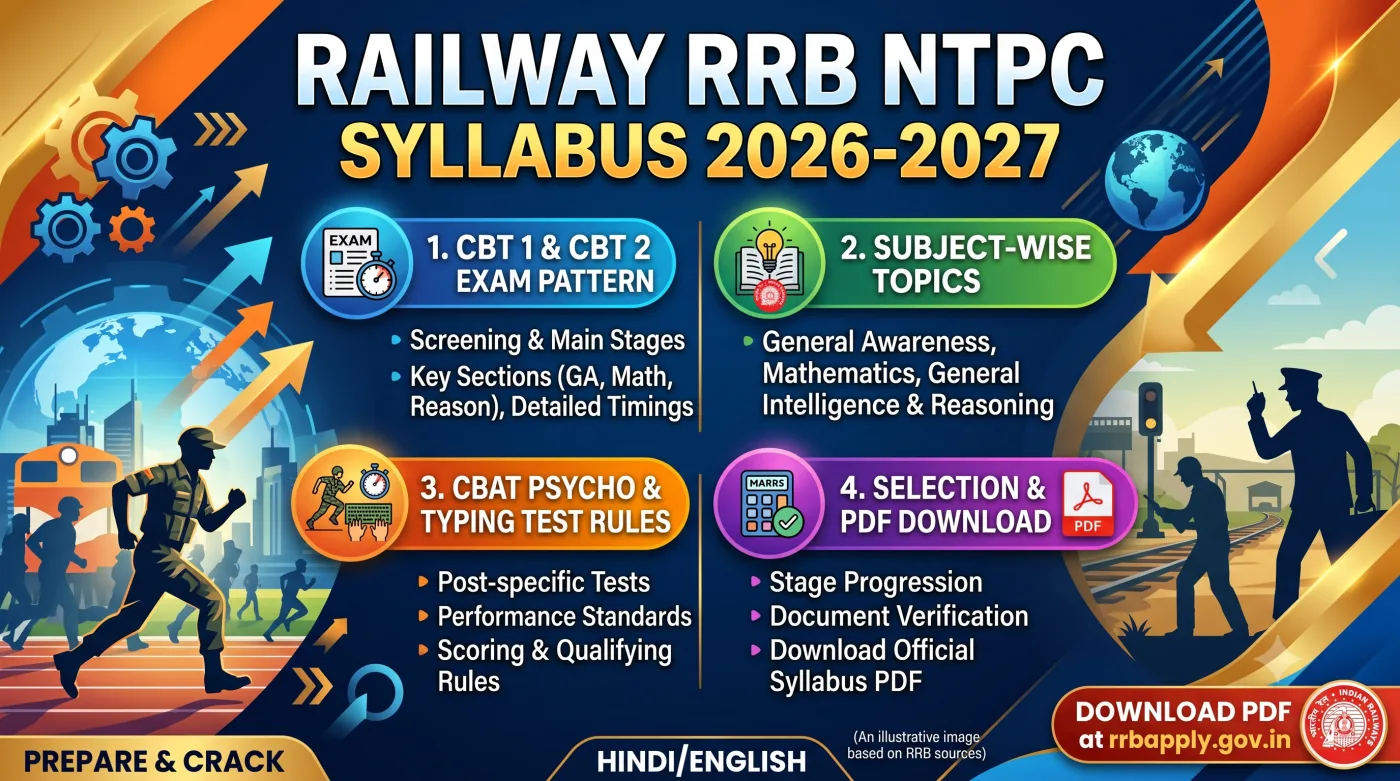
The Railway Recruitment Board Non-Technical Popular Categories (RRB NTPC) examination stands as one of the largest competitive public employment recruitment drives on earth. Notified by the Ministry of Railways, Government of India, RRB NTPC attracts upwards of 1.25 Crore (12.5 Million) graduate and 12th-pass aspirants across India. Successful candidates are inducted into pivotal administrative, commercial, ticketing, operational, and traffic supervisory roles within Indian Railways—including Station Master (SM), Goods Train Manager (formerly Goods Guard), Commercial Apprentice (CA), Senior Commercial cum Ticket Clerk (Sr. CC/TC), Junior Accounts Assistant cum Typist (JAA), and Trains Clerk. To secure a permanent appointment in Indian Railways, gaining mastery over the dual-stage RRB NTPC CBT 1 & CBT 2 Syllabus 2026-2027, the RDSO Computer Based Aptitude Test (CBAT), and Typing Skill Test protocols is essential. (रेलवे भर्ती बोर्ड (RRB) गैर-तकनीकी लोकप्रिय श्रेणियां (NTPC) परीक्षा में सफलता प्राप्त करने के लिए CBT 1, CBT 2, साइको टेस्ट और टाइपिंग टेस्ट के विस्तृत पाठ्यक्रम और परीक्षा पैटर्न की संपूर्ण समझ होना अत्यंत आवश्यक है।)
1. Executive Overview: RRB NTPC Recruitment Stages Architecture
The selection architecture for RRB NTPC is comprehensive, rigorous, and completely merit-based. Across all 21 regional Railway Recruitment Boards (RRBs), the examination follows a multi-tier structure tailored to the functional nature of each 7th CPC Pay Level:
- First Stage Computer Based Test (CBT-1): A centralized screening test common to all notified Graduate and Undergraduate posts (100 Questions, 100 Marks, 90 Minutes).
- Second Stage Computer Based Test (CBT-2): Post-level specific examination (separate papers for Level 2, Level 3, Level 5, and Level 6) evaluating advanced proficiency (120 Questions, 120 Marks, 90 Minutes).
- Skill Tests (CBAT / TST):
- Computer Based Aptitude Test (CBAT / Psycho): Required exclusively for Station Master (Pay Level 6) and Traffic Assistant.
- Typing Skill Test (TST): Required for clerical and accounting cadres (Senior Clerk, Junior Accounts Assistant, Junior Clerk, Accounts Clerk).
- Document Verification (DV) & Comprehensive Medical Examination: Rigid verification of original academic, community, and identity credentials, followed by strict medical classification testing (A-2, A-3, B-2, and C-2 standards).
| Recruitment Attribute | Official Specification & Examination Details |
|---|---|
| Exam Conducting Authority | Railway Recruitment Boards (RRBs / रेलवे भर्ती बोर्ड), Ministry of Railways |
| Recruitment Cadres | Non-Technical Popular Categories (Graduate & Undergraduate Posts) |
| 7th CPC Pay Levels Covered | Level 2, Level 3, Level 5, and Level 6 (Basic Pay ₹19,900 to ₹1,12,400) |
| Mode of Examination | Computer Based Test (CBT - ऑनलाइन कंप्यूटर आधारित परीक्षा) |
| CBT-1 Structure | 100 MCQs | 100 Marks | 90 Minutes Duration |
| CBT-2 Structure | 120 MCQs | 120 Marks | 90 Minutes Duration |
| Negative Marking Rule | 1/3rd Mark Deduction for each incorrect response in CBT-1 & CBT-2 |
| Test Medium Languages | 15 Recognized Indian Languages (English, Hindi, Bengali, Gujarati, Kannada, etc.) |
| Centralized Application Portal | rrbapply.gov.in |
| Apex Ministry Website | indianrailways.gov.in |
2. Post-Wise Pay Level, Eligibility & Selection Stages Matrix
RRB NTPC encompasses two broad entry cadres: Undergraduate posts requiring 12th standard education, and Graduate posts requiring a recognized University degree. The required subsequent testing stages vary based on job operational responsibilities:
| Post Title & Cadre | 7th CPC Pay Level | Minimum Education | Mandatory Medical Standard | Subsequent Selection Stages After CBT-2 |
|---|---|---|---|---|
| Station Master (SM) | Pay Level 6 (₹35,400) | Bachelor's Degree | A-2 (6/9 without glasses, no LASIK) | Computer Based Aptitude Test (CBAT) + DV/Medical |
| Commercial Apprentice (CA) | Pay Level 6 (₹35,400) | Bachelor's Degree | B-2 (Spectacles up to 4D permitted) | Direct Selection on CBT-2 Merit + DV/Medical |
| Goods Train Manager (Guard) | Pay Level 5 (₹29,200) | Bachelor's Degree | A-2 (6/9 without glasses, no LASIK) | Direct Selection on CBT-2 Merit + DV/Medical |
| Junior Accounts Assistant cum Typist (JAA) | Pay Level 5 (₹29,200) | Bachelor's Degree | C-2 (Normal clerical medical) | Typing Skill Test (30 WPM Eng / 25 WPM Hindi) + DV |
| Senior Clerk cum Typist | Pay Level 5 (₹29,200) | Bachelor's Degree | C-2 (Spectacles allowed) | Typing Skill Test (30 WPM Eng / 25 WPM Hindi) + DV |
| Senior Commercial cum Ticket Clerk | Pay Level 5 (₹29,200) | Bachelor's Degree | B-2 (Commercial passenger cadre) | Direct Selection on CBT-2 Merit + DV/Medical |
| Commercial cum Ticket Clerk (CC/TC) | Pay Level 3 (₹21,700) | 12th Pass (Min 50% Marks) | B-2 (Field ticketing standard) | Direct Selection on CBT-2 Merit + DV/Medical |
| Accounts Clerk cum Typist | Pay Level 2 (₹19,900) | 12th Pass (Min 50% Marks) | C-2 (Office accounting cadre) | Typing Skill Test (30 WPM Eng / 25 WPM Hindi) + DV |
| Junior Clerk cum Typist | Pay Level 2 (₹19,900) | 12th Pass (Min 50% Marks) | C-2 (General administrative office) | Typing Skill Test (30 WPM Eng / 25 WPM Hindi) + DV |
| Trains Clerk (TC) | Pay Level 2 (₹19,900) | 12th Pass (Min 50% Marks) | A-3 (6/9 with/without glasses) | Direct Selection on CBT-2 Merit + DV/Medical |
3. CBT-1 Exam Pattern & Sectional Weightage Breakdown
The First Stage CBT is common across all posts. Its primary statutory objective is to screen candidates and reduce the massive applicant volume to 15 times the notified vacancies for each category and pay level:
| Test Domain / Subject Section | Total Questions | Maximum Marks | Recommended Time Budget | Target Competitive Score |
|---|---|---|---|---|
| General Awareness (सामान्य जागरूकता) | 40 Questions | 40 Marks | 18 - 20 Minutes | 32 - 35 Marks |
| Mathematics (गणित) | 30 Questions | 30 Marks | 35 - 38 Minutes | 25 - 28 Marks |
| General Intelligence & Reasoning (तार्किक क्षमता) | 30 Questions | 30 Marks | 32 - 35 Minutes | 26 - 28 Marks |
| Cumulative Total (CBT-1) | 100 Questions | 100 Marks | 90 Minutes | 82 - 88 Marks |
Key Ground Rules of CBT-1:
- Screening Nature: Marks scored in CBT-1 do not carry forward into the final recruitment appointment merit list. However, scoring above the cutoffs is mandatory to qualify for CBT-2.
- Negative Marking: Each incorrect answer attracts a penalty deduction of 1/3rd (0.333) marks. If three questions are answered incorrectly, one full earned mark is cancelled. (प्रत्येक गलत उत्तर के लिए 1/3 अंक की नेगेटिव मार्किंग की जाएगी।)
- Compensatory Time: Eligible PwBD candidates utilizing scribe facilities are provided 120 minutes total duration.
4. CBT-2 Exam Pattern & Sectional Weightage Breakdown
The Second Stage CBT-2 is the definitive academic arena where final selection scores are established. The total number of questions expands from 100 to 120 while maintaining the same 90-minute time constraint, creating exceptional cognitive pressure:
| Test Domain / Subject Section | Total Questions | Maximum Marks | Recommended Time Budget | Target Competitive Score |
|---|---|---|---|---|
| General Awareness (सामान्य जागरूकता) | 50 Questions | 50 Marks | 20 - 22 Minutes | 40 - 44 Marks |
| Mathematics (गणित) | 35 Questions | 35 Marks | 34 - 36 Minutes | 30 - 33 Marks |
| General Intelligence & Reasoning (तार्किक क्षमता) | 35 Questions | 35 Marks | 32 - 34 Minutes | 30 - 33 Marks |
| Cumulative Total (CBT-2) | 120 Questions | 120 Marks | 90 Minutes | 100 - 108 Marks |
5. Exhaustive Subject-Wise Syllabus for CBT 1 & CBT 2
The official syllabus prescribed by the Railway Recruitment Boards covers broad scientific, mathematical, and logical disciplines. Below is the granular chapter-by-chapter curriculum:
A. Mathematics (गणित पाठ्यक्रम):
The mathematics curriculum evaluates numerical fluency, arithmetic calculations, and foundational secondary algebra, geometry, and statistics:
- Number System (संख्या पद्धति): Classification of numbers (natural, whole, prime, composite), unit digit calculations, divisibility tests (for 7, 11, 13, 17, 19, 72, 88), remainder theorem, Euler's totient, and recurring decimals.
- BODMAS & Simplification (सरलीकरण): Order of algebraic operations, nested brackets, continued fractions, surds and indices ($a^m \times a^n$, rationalizing denominators).
- LCM & HCF (ल.स.प. एवं म.स.प.): Fundamental theorem of arithmetic, highest common factors of large polynomials, word problems on bells tolling, traffic lights, and circular tracks.
- Fractions & Decimals (दशमलव एवं भिन्न): Comparing fractions, recurring decimals to vulgar fractions conversion, terminating and non-terminating decimals.
- Ratio and Proportion (अनुपात एवं समानुपात): Mean proportional, third and fourth proportional, compounding of ratios, coin ratio problems, partnership investments and profit sharing.
- Percentages (प्रतिशत): Fractional equivalents, consecutive percentage changes, population variation, election problems with valid/invalid votes.
- Mensuration (क्षेत्रमिति 2D & 3D):
- 2D Plane Figures: Area, perimeter, and in-radius/circum-radius of Scalene, Isosceles, Equilateral, and Right-angled triangles; Rectangle, Square, Rhombus, Parallelogram, Trapezium; Circle, Semi-circle, and circular tracks.
- 3D Solid Figures: Volume, Curved Surface Area (CSA), and Total Surface Area (TSA) of Cube, Cuboid, Right Circular Cylinder, Hollow Cylinder, Right Circular Cone, Frustum of Cone, Sphere, and Hemisphere.
- Time and Work & Pipes and Cisterns (कार्य एवं समय): Individual and group efficiencies, alternate day work, wage distribution based on work units, inlet and outlet pipes, leak problems.
- Time, Speed and Distance (समय, चाल एवं दूरी): Unit conversions, average speed, problems on trains (crossing poles, stationary platforms, and moving trains), Boats and Streams (upstream/downstream speeds, river flow velocity).
- Simple and Compound Interest (साधारण एवं चक्रवृद्धि ब्याज): Formulas for annual, half-yearly, and quarterly compounding; Difference between CI and SI for 2 years ($D = P(R/100)^2$) and 3 years; Installment repayment schemes.
- Profit, Loss and Discount (लाभ, हानि एवं बट्टा): Cost Price, Selling Price, Marked Price; Successive discounts; Dishonest dealer concepts using faulty weights or adulteration.
- Elementary Algebra (प्रारंभिक बीजगणित): Algebraic identities ($a^3+b^3+c^3-3abc$), linear equations in one and two variables, quadratic equations (roots, discriminant $\Delta = b^2 - 4ac$, sum and product of roots).
- Geometry (ज्यामिति): Lines and angles, properties of triangles (congruence, similarity, centroid, orthocenter, circumcenter, incenter), circles (chords, tangents, secants, alternate segment theorem), cyclic quadrilaterals.
- Trigonometry (त्रिकोणमिति): Trigonometric ratios ($\sin, \cos, \tan, \cot, \sec, \text{cosec}$), standard angle values ($0^\circ, 30^\circ, 45^\circ, 60^\circ, 90^\circ$), trigonometric identities ($\sin^2 \theta + \cos^2 \theta = 1$), Heights and Distances (angles of elevation and depression).
- Elementary Statistics (प्रारंभिक सांख्यिकी): Calculation of Mean, Median, Mode; Empirical relationship ($\text{Mode} = 3\text{Median} - 2\text{Mean}$); Variance, Standard Deviation ($\sigma$), and Coefficient of Variation.
B. General Intelligence & Reasoning (तार्किक एवं मानसिक क्षमता):
The reasoning syllabus tests logical deduction, spatial patterns, data relationships, and analytical decision making:
- Analogies (सादृश्यता): Semantic, numerical, symbolic, and figural analogies based on geography, science, tools, and vocabulary.
- Completion of Number and Alphabetical Series (श्रृंखला): Prime number series, Fibonacci series, alternate difference series, continuous pattern alphabet clusters.
- Coding and Decoding (कोडिंग एवं डिकोडिंग): Letter-to-letter coding, letter-to-number coding, symbol substitution, matrix coding, conditional coding.
- Mathematical Operations (गणितीय संक्रियाएं): Interchanging operational signs and numbers, balancing mathematical equations, operator replacement puzzles.
- Similarities and Differences (समानता एवं असमानता): Odd-one-out classification of word pairs, numbers, and figures.
- Relationships (रक्त संबंध): Coded family trees, generation gap trees, portrait pointing problems.
- Analytical Reasoning & Puzzles (विश्लेषणात्मक तर्कशक्ति एवं पहेलियां): Floor puzzles, box puzzles, day/month scheduling puzzles, linear and circular seating arrangements (facing inside/outside).
- Syllogism (न्याय निगमन): Deductive two and three-statement syllogisms, standard categorical propositions (All, Some, No, Some Not), "Possibility" conclusions, Either-Or conditions.
- Jumbling (क्रम व्यवस्था): Para jumbles, word re-arrangement, logical sentence sequences.
- Venn Diagrams (वेन आरेख): Two and three-circle logical Venn diagram interpretations, quantitative Venn diagrams.
- Data Sufficiency (आंकड़ा पर्याप्तता): Determining whether given mathematical or logical statements are sufficient to answer the prompt.
- Statement & Conclusions, Courses of Action (कथन एवं निष्कर्ष / कार्यवाही): Critical reasoning evaluating whether given conclusions logically follow; recommending practical, non-extreme administrative courses of action.
- Decision Making (निर्णय लेने की क्षमता): Evaluating employment/admission criteria based on age, qualification, and score conditions.
- Maps & Interpretation of Graphs (मानचित्र एवं ग्राफ व्याख्या): Route finding, interpretation of Bar Charts, Pie Charts, Line Graphs, and Tabular data.
C. General Awareness (सामान्य जागरूकता - 40 Marks in CBT-1 / 50 Marks in CBT-2):
General Awareness is the decisive differentiator in RRB NTPC. Below is the detailed thematic syllabus:
- Current Events of National and International Importance: National summits, international treaties, defense procurements, sports tournaments (Olympic Games, Asian Games, World Cups), and awards (Padma, Bharat Ratna, Nobel).
- Games and Sports (खेलकूद): Rules, dimensions of courts/fields, trophies, terminologies, medals tally, and prominent Indian sportspersons.
- Art and Culture of India (भारतीय कला एवं संस्कृति): Classical dances (8 Sangeet Natak Akademi traditions), regional folk dances, music gharanas, architectural monuments (Mughal, Dravidian, Nagara, Rock-cut temples).
- Indian Literature (भारतीय साहित्य): Classical Sanskrit texts (Kalidasa, Harsha, Banabhatta), ancient epics, modern Sahitya Akademi & Jnanpith awardees.
- Monuments and Places of India: UNESCO World Heritage Sites in India, historical forts, caves (Ajanta, Ellora, Elephanta), stupas, and heritage railway stations.
- General Science and Life Science (up to 10th CBSE/NCERT):
- Physics: Mechanics, Units, Work-Power-Energy, Gravitation, Heat and Thermodynamics, Sound, Light and Optics, Electricity and Magnetism, Nuclear Physics basics.
- Chemistry: Structure of Atom, Periodic Table, Metals and Non-Metals, Carbon and its Compounds, Chemical Reactions, Everyday Chemistry (Soaps, Polymers, Fertilizers).
- Biology (Life Science): Human Physiology (Nervous, Circulatory, Endocrine, Digestive, Excretory systems), Genetics and Evolution, Cell Biology, Plant Anatomy, Nutrition and Vitamins, Human Diseases (Bacterial, Viral, Fungal, Protozoan).
- History of India and Freedom Struggle (इतिहास एवं स्वतंत्रता संग्राम): Ancient civilizations, Mahajanapadas, Mauryan & Gupta dynasties, Medieval Delhi Sultanate & Mughals, British Colonial Expansion, Revolt of 1857, Indian National Movement (1885-1947), Partition, and post-independence integration.
- Physical, Social and Economic Geography of India and World: Mountain ranges, passes, rivers and tributaries, climate zones, soils, natural vegetation, mineral resources, major ports, airports, and demographic census data.
- Indian Polity and Governance - Constitution and Political System: Framing of Constitution, Preamble, Fundamental Rights & Duties, DPSP, Union Executive (President, PM), Parliament, Judiciary, Constitutional Bodies (ECI, UPSC, CAG, Finance Commission).
- General Scientific and Technological Developments: Indian Space Program (ISRO launch vehicles PSLV, GSLV, LVM3, Chandrayaan, Gaganyaan, Aditya-L1 missions), Nuclear energy installations (BARC, NPCIL, reactors), Defense Research (DRDO missile systems: Agni, Prithvi, BrahMos, Akash).
- Environmental Issues Concerning India and World at Large: Climate Change agreements (Paris Accord, COP summits), biodiversity hotspots, global warming, pollution indices, Project Tiger, Project Elephant, Ramsar Wetland sites in India.
- Basics of Computers and Computer Applications: Computer architecture (CPU, RAM, ROM, Cache), Input/Output devices, Operating Systems, Networking (LAN, WAN, IP addresses, OSI layers), Internet & Cyber Security (viruses, malware, firewalls), Common extensions, Short keys in MS Office (Word, Excel, PowerPoint).
- Common Abbreviations (संक्षिप्त रूप): Prominent national and international acronyms (ISRO, DRDO, UNESCO, INTERPOL, NITI, TRAI, SEBI).
- Transport Systems in India (विशेष: भारतीय रेलवे): National Highway networks (Golden Quadrilateral), Inland waterways, and specialized facts on Indian Railways (Zones, Production Units, Dedicated Freight Corridors, Metro Rail systems).
6. RDSO Computer Based Aptitude Test (CBAT / Psycho) Complete Guide
Candidates who qualify CBT-2 for the post of Station Master (Pay Level 6) are called for the mandatory Computer Based Aptitude Test (CBAT) conducted by the Research Designs and Standards Organisation (RDSO, Lucknow). The test comprises five distinct test batteries designed to test personality, alertness, and perceptual speed:
| Test Battery Name | Cognitive Skill Evaluated | Total Items / Time Frame | Mandatory Passing Benchmark |
|---|---|---|---|
| Battery 1: Intelligence Test | Abstract reasoning & non-verbal shape classification | 35 Figures / 10 Minutes | Minimum T-Score of 42 marks |
| Battery 2: Selective Attention Test | Odd-Even number summation under high speed | 30 Problems / 8 Minutes | Minimum T-Score of 42 marks |
| Battery 3: Spatial Scanning Test | Shortest path / route finding between points | 40 Grids / 8 Minutes | Minimum T-Score of 42 marks |
| Battery 4: Information Ordering Test | Clock-based sequencing and process tracking | 25 Tasks / 10 Minutes | Minimum T-Score of 42 marks |
| Battery 5: Personality Test | Attitude assessment, safety mindset & decision stability | 35 Questions / 12 Minutes | Minimum T-Score of 42 marks |
Crucial Statutory CBAT Guidelines:
- The 42 T-Score Mandate: A candidate must score a minimum T-Score of 42 marks in each of the 5 test batteries independently. There is zero reservation relaxation in T-Score cutoffs; scoring 41.9 in even one battery results in instant elimination.
- Zero Negative Marking: There is no negative marking in CBAT, but speed and accuracy are evaluated concurrently.
- 70:30 Merit Ratio: For Station Master final merit, 70% weightage is derived from CBT-2 marks and 30% weightage from CBAT marks.
7. Typing Skill Test (TST) Guidelines & Speed Benchmarks
For clerical and accounting posts (Senior Clerk cum Typist, Junior Accounts Assistant, Junior Clerk, Accounts Clerk), qualifying the Typing Skill Test is a mandatory statutory prerequisite:
- Speed Requirements:
- English Medium: Minimum 30 Words Per Minute (WPM) on computer.
- Hindi Medium: Minimum 25 Words Per Minute (WPM) on computer (using KrutiDev or Mangal font).
- Duration: 10 minutes continuous typing of an unedited printed passage of approximately 300 words in English or 250 words in Hindi.
- Error Allowance: Mistakes up to 5% of total words typed are ignored. Mistakes exceeding 5% are penalized heavily by deducting 10 words for every single error from the gross typed words.
- Qualifying Nature: TST marks are not added to the final selection merit list; candidates simply need a "Qualified" status.
8. Recommended Authoritative Study Material & Preparation Strategy
To achieve a top percentile ranking among 1+ Crore candidates, strategic resource curation is essential:
| Subject | Standard Recommended Books | Author / Publication | Strategic Core Focus |
|---|---|---|---|
| Mathematics | Quantitative Aptitude / Advance Maths | Dr. R.S. Aggarwal / Rakesh Yadav | Arithmetic formulas, mensuration shortcuts, and algebra identities |
| Reasoning | A Modern Approach to Verbal & Non-Verbal Reasoning | Dr. R.S. Aggarwal (S. Chand) | Puzzles, seating arrangements, statement-conclusions, and syllogisms |
| General Science | NCERT Class 9th & 10th Science + Lucent General Science | NCERT / Lucent Publication | Conceptual Physics, Human Physiology, and Periodic Table trends |
| Static GK & History | General Knowledge (Yellow Book) + Indian Railways Factbook | Lucent / Arihant Publication | Monuments, National Parks, Constitution articles, and Railway zones |
| PYQ Practice | RRB NTPC Chapter-Wise Solved Papers (CBT-1 & CBT-2) | Youth Competition Times (YCT) / Kiran | Solving 8,000+ actual TCS online examination questions |
9. Comprehensive Railway Medical Standards (IRMM) Diagnostic Matrix
A distinctive operational requirement of Indian Railways is that final appointment is 100% contingent upon qualifying the strict medical category prescribed for that specific cadre under the Indian Railway Medical Manual (IRMM). Many brilliant candidates score 90+ marks in CBT-2 but face heartbreak during the clinical medical examination due to unrecognized visual deficiencies. Aspirants must carefully cross-check their medical profile against the official standards before locking in their post preferences:
| Medical Category | Prescribed Visual Acuity (Distant & Near) | Special Clinical Tests | Applicable NTPC Posts |
|---|---|---|---|
| A-2 (Strict Running Standard) | Distant Vision: 6/9, 6/9 without glasses (No spectacles permitted). Near Vision: Sn. 0.6, 0.6 without glasses. | Mandatory passing of Color Vision, Binocular Vision, Field of Vision, and Night Vision tests. LASIK surgery strictly prohibited. | Station Master (Pay Level 6), Goods Train Manager / Guard (Pay Level 5) |
| A-3 (Operational Traffic Standard) | Distant Vision: 6/9, 6/9 with or without glasses (Power of lenses must not exceed 2D). Near Vision: Sn. 0.6, 0.6 with/without glasses. | Mandatory passing of Color Vision, Binocular Vision, Field of Vision, and Night Vision tests. LASIK prohibited. | Trains Clerk (Pay Level 2) |
| B-2 (Commercial Station Standard) | Distant Vision: 6/9, 6/12 with or without glasses (Power of lenses must not exceed 4D). Near Vision: Sn. 0.6, 0.6 with/without glasses. | Must pass Binocular Vision test. Color Vision test not strictly disqualifying for select commercial duties. | Commercial Apprentice (Level 6), Senior Commercial cum Ticket Clerk (Level 5), Commercial cum Ticket Clerk (Level 3) |
| C-2 (Clerical / Office Standard) | Distant Vision: 6/12, nil with or without glasses. Near Vision: Sn. 0.6 combined with or without glasses for reading/close work. | Standard physical fitness without mandatory color vision constraints. Spectacles fully permitted. | Senior Clerk cum Typist (Level 5), Junior Accounts Assistant (Level 5), Senior Time Keeper, Junior Clerk cum Typist (Level 2), Accounts Clerk (Level 2) |
The Absolute Prohibition of LASIK / Refractive Corneal Surgery:
Under Para 512 of the Indian Railway Medical Manual (IRMM), candidates who have undergone LASIK, PRK, Epi-LASIK, or any refractive laser surgery are permanently declared UNFIT for A-2 and A-3 medical categories. Railway medical boards employ sophisticated dilated slit-lamp biomicroscopy, corneal topography, and Pentacam scanning. Attempting to conceal refractive surgery will lead to immediate cancellation of candidature and debarment.
10. All 21 Regional Railway Recruitment Boards (RRBs) Cadre & Cutoff Dynamics
Candidates must apply to exactly ONE regional Railway Recruitment Board (RRB) during the centralized online application window. Once selected, the chosen examining RRB cannot be modified under any circumstances. Historical data reveals substantial score variance across different Railway Zones due to regional applicant density:
| Railway Recruitment Board (RRB Zone) | Zonal Railway Headquarters Affiliated | Historical Competition Intensity | Strategic Cadre Insights |
|---|---|---|---|
| RRB Prayagraj (formerly Allahabad) | North Central Railway (NCR) & Northern Railway (NR) | Extreme High (Highest in India) | Massive applicant volume from UP, Bihar, and MP. Historically records CBT-1 cutoffs between 78 - 84 marks for UR. |
| RRB Patna & Muzaffarpur | East Central Railway (ECR) | Extreme High | Fierce academic competition; exceptionally high cutoffs in Mathematics and Reasoning sections. |
| RRB Chandigarh | Northern Railway (NR) | Very High | Encompasses Punjab, Haryana, Delhi, Himachal, and J&K. High average scores in General Awareness. |
| RRB Kolkata & Malda | Eastern Railway (ER), South Eastern Railway (SER) & Metro | High to Very High | Extensive vacancies across Howrah, Sealdah, and Asansol divisions; competitive cutoffs. |
| RRB Mumbai & Ahmedabad | Central Railway (CR) & Western Railway (WR) | Moderate to High | Huge vacancy allocations across Mumbai, Pune, Nagpur, Bhusawal, and Vadodara divisions. |
| RRB Secunderabad & Bangalore | South Central Railway (SCR) & South Western Railway (SWR) | Moderate | Favorable vacancy-to-applicant ratios; preferred destination for multi-lingual and non-local aspirants. |
| RRB Chennai & Thiruvananthapuram | Southern Railway (SR) | Moderate | Balanced competition; requires adaptability to southern zone work environments. |
| RRB Guwahati & Siliguri | Northeast Frontier Railway (NFR) | Moderate to Low | Historically records lower cutoffs compared to northern zones; extensive geographical terrain. |
| RRB Bilaspur, Bhopal, Bhubaneswar & Ranchi | SECR, WCR, ECoR, and SER | Moderate to High | Centrally located industrial and mineral transit railway divisions; balanced merit lists. |
11. 150-Day Scientific Master Plan to Crack RRB NTPC CBT-1 & CBT-2
Cracking an examination contested by over one crore aspirants requires an uncompromising, phase-wise daily study strategy that balances speed, concept mastery, and error mitigation:
- Month 1: Arithmetic & Foundational Science Immersion (Days 1 to 30):
- Master core arithmetic: Percentages, Profit-Loss, Ratio-Proportion, Time-Work, and Time-Distance. Memorize fraction-to-percentage conversion tables ($1/2$ to $1/25$).
- Study Class 9th and 10th NCERT Science textbooks thoroughly, highlighting biology systems (digestive, circulatory, vitamins) and physics formulas (optics, electricity, motion).
- Solve 30 questions daily on coding-decoding, number series, and analogies.
- Month 2: Advanced Mathematics & Reasoning Deep-Dive (Days 31 to 60):
- Complete Advanced Mathematics topics: Trigonometry identities, Mensuration 2D/3D formulas, Geometry theorems (chords, tangents, similarity), and Statistics (mean, median, mode, standard deviation).
- Tackle complex reasoning puzzles: 8-person circular seating arrangement (inside/outside facing), floor puzzles, and syllogisms with "Possibility" conclusions.
- Begin reading Indian Railways specialized history, zones, production units, and prestigious train networks.
- Month 3: Previous Year Question Banks & Static GK Mastery (Days 61 to 90):
- Solve the complete archive of RRB NTPC previous year shift papers (Youth Competition Times YCT or Kiran Publication). Complete at least 4,000 previous questions.
- Cover Lucent Static GK: Folk Dances, Classical Music, UNESCO Heritage Sites, Constitutional Articles (Fundamental Rights, DPSP, Emergency), and Modern Indian Freedom Struggle.
- Consolidate monthly current affairs magazines covering the preceding 12 months.
- Month 4: Full-Length Timed Mocks & Error Journaling (Days 91 to 125):
- Attempt one full-length 100-question CBT-1 mock test every alternate day strictly within 90 minutes.
- Dedicate a minimum of 2 hours post-test to Error Analysis: Identify whether errors stemmed from conceptual gaps, calculation slips, or rushed misreading. Maintain an Error Notebook.
- Enforce strict sectional time discipline: General Awareness (18 mins), Reasoning (34 mins), and Mathematics (38 mins).
- Month 5: Final Simulation & Speed Tuning (Days 126 to 150):
- Attempt daily full-length mock tests mimicking actual examination shift timings (9:00 AM, 12:30 PM, or 4:00 PM) to align your circadian rhythm with maximum cognitive alertness.
- Cease touching new textbooks; revise formula sheets, tables, error notebooks, and constitutional amendments relentlessly.
12. Concluding Strategic Blueprint for Railway Aspirants
Securing an administrative appointment in Indian Railways through RRB NTPC transforms not only the aspirant's career but the socio-economic standing of their entire family for generations. The staggering magnitude of national competition demands an extraordinary standard of preparation: solving 100+ CBT mock tests, mastering complex analytical puzzles, building lightning calculation speed, and maintaining immaculate medical health. Treat this official syllabus document as your operational blueprint for the Indian Railway Officers and Staff Cadres. Study with relentless consistency, monitor your sectional speed, maintain high accuracy, and claim your place in the lifeblood network of our nation. Best wishes on your journey to becoming an Indian Railways professional! (भारतीय रेल में सेवा का अवसर पाना एक महान गौरव है। अपनी तैयारी को सटीक और अनुशासित बनाएं और अपने लक्ष्य को प्राप्त करें!)
User Discussion & Comments (0)
No comments yet. Be the first to leave a comment below!
Leave a Comment / Ask a Question: