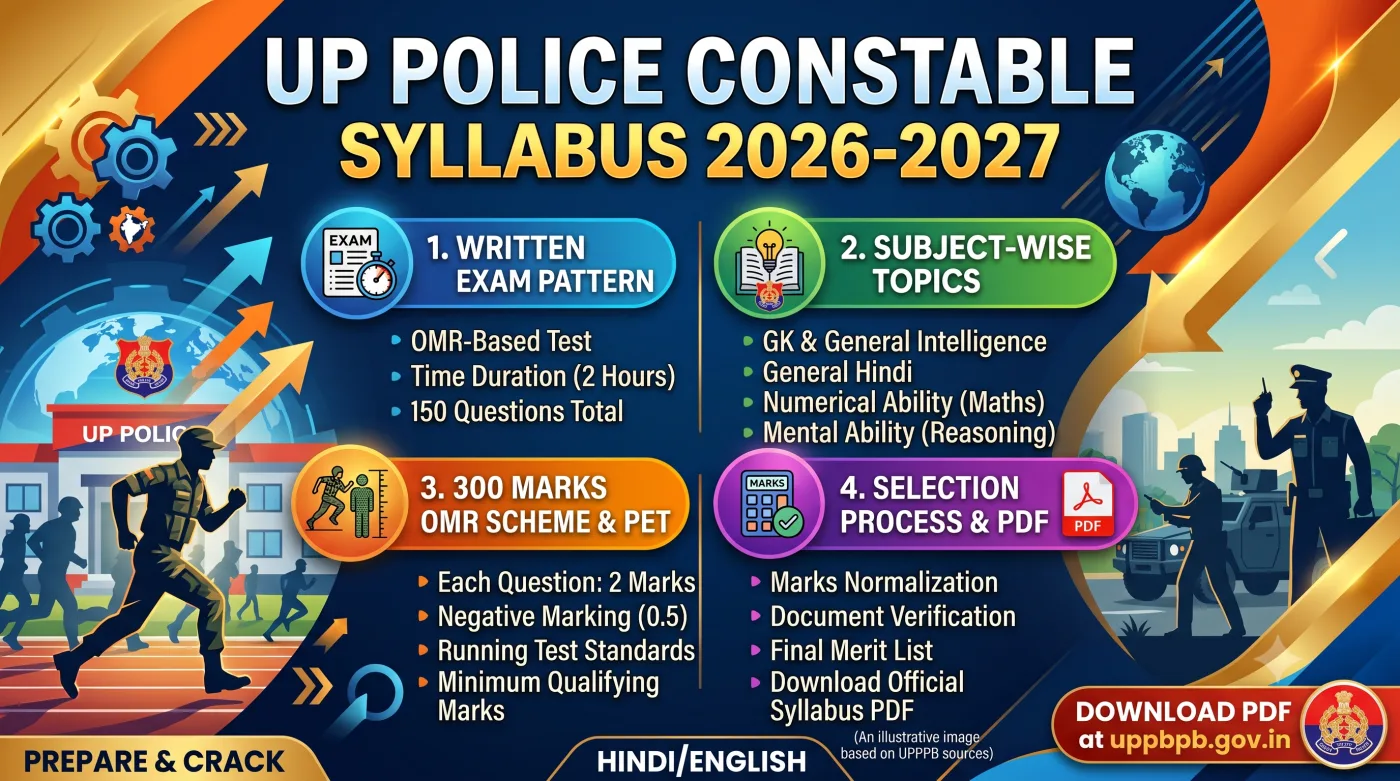
The Uttar Pradesh Police Constable Recruitment Examination, conducted by the Uttar Pradesh Police Recruitment and Promotion Board (UPPRPB / उ.प्र. पुलिस भर्ती एवं प्रोन्नति बोर्ड), represents the largest single state police recruitment drive in the Republic of India. In recent cycles, over 50 Lakh male and female aspirants have applied to don the prestigious khaki uniform of the UP Police (Civil Police & Provincial Armed Constabulary - PAC). Competing successfully among millions of dedicated aspirants requires a meticulous, topic-by-topic comprehension of the official UP Police Constable Syllabus 2026-2027, the 300-mark offline OMR examination pattern, negative marking rules, and the rigorous Physical Standard (PST) & Physical Efficiency (PET) benchmarks. (उत्तर प्रदेश पुलिस आरक्षी (नागरिक पुलिस एवं पीएसी) भर्ती परीक्षा में सफलता प्राप्त करने के लिए 300 अंकों की लिखित परीक्षा, 0.50 की नेगेटिव मार्किंग और 4.8 किमी की शारीरिक दक्षता परीक्षा के संपूर्ण पाठ्यक्रम की विस्तृत जानकारी होना अनिवार्य है।)
1. Executive Overview: UP Police Constable Selection Architecture
The Uttar Pradesh Police selection process is divided into three consecutive, highly structured stages designed to evaluate academic proficiency, mental fortitude, and physical endurance:
- Stage 1: Offline Written Examination (OMR Based): A single pen-and-paper examination comprising 150 objective multiple-choice questions carrying 300 marks to be completed in 120 minutes.
- Stage 2: Document Verification (DV) & Physical Standard Test (PST): Scrutiny of original educational and state domicile certificates along with height and chest measurements (weight measurement for female candidates).
- Stage 3: Physical Efficiency Test (PET - Running): An endurance running test on ground circuits (4.8 km for males in 25 minutes; 2.4 km for females in 14 minutes) utilizing electronic RFID timing chips.
- Stage 4: Detailed Medical Examination (DME) & Character Verification: Clinical fitness checkup administered by Chief Medical Officer (CMO) district boards accompanied by local police station background verification.
| Recruitment Dimension | Official Specification & Examination Details |
|---|---|
| Exam Conducting Authority | Uttar Pradesh Police Recruitment and Promotion Board (UPPRPB / लखनऊ) |
| Notified Cadres | Constable Civil Police (नागरिक पुलिस) & Constable PAC (प्रादेशिक आर्म्ड कांस्टेबुलरी) |
| Educational Eligibility | 10+2 Intermediate (Class 12th Pass) from a Recognized Board |
| Mode of Written Examination | Offline Pen-Paper OMR Sheet Based (ऑफलाइन ओएमआर आधारित परीक्षा) |
| Total Questions | 150 Objective Multiple Choice Questions (MCQs) |
| Maximum Marks | 300 Marks (2 Marks credited per correct response) |
| Exam Duration | 120 Minutes (2 Hours / 120 मिनट) |
| Negative Marking Penalty | 0.50 Marks Deducted per incorrect response (1/4th penalty rule) |
| Question Paper Medium | Bilingual (Hindi & English), except the General Hindi section |
| Official Board Website | uppbpb.gov.in |
2. Comprehensive Written Examination Pattern & Sectional Blueprint
The written test consists of four distinct subject domains designed to evaluate linguistic command, general awareness, arithmetic calculation, and logical reasoning. Every question carries equal weightage (+2 marks):
| Subject Domain / Section | Total Questions | Maximum Marks | Ideal Time Allocation | Target Competitive Score |
|---|---|---|---|---|
| 1. General Knowledge (सामान्य ज्ञान) | 38 Questions | 76 Marks | 18 - 20 Minutes | 28 - 32 Questions (56 - 64 Marks) |
| 2. General Hindi (सामान्य हिन्दी) | 37 Questions | 74 Marks | 18 - 20 Minutes | 32 - 35 Questions (64 - 70 Marks) |
| 3. Numerical & Mental Ability (संख्यात्मक एवं मानसिक योग्यता) | 38 Questions | 76 Marks | 35 - 38 Minutes | 28 - 32 Questions (56 - 64 Marks) |
| 4. Mental Aptitude, IQ & Reasoning (मानसिक अभिरुचि, बुद्धिलब्धि एवं तार्किक क्षमता) | 37 Questions | 74 Marks | 35 - 38 Minutes | 30 - 34 Questions (60 - 68 Marks) |
| Grand Cumulative Total | 150 Questions | 300 Marks | 120 Minutes | 118 - 130 Questions (236 - 260 Marks) |
Crucial OMR Examination Rules:
- Ballpoint Pen Only: Candidates must strictly darken OMR circles using black or blue ballpoint pens. Pencils, gel pens, or fountain pens are prohibited and cause scanner rejection.
- Double Bubbling Penalty: Marking more than one circle for a single question is automatically treated as an incorrect response, resulting in a 0.50 mark deduction.
- Normalization Across Multi-Shift Papers: Because millions of candidates appear across 4 to 6 separate shifts over two days, UPPRPB implements judicial-approved normalization to equalize shift variances.
3. Exhaustive Subject-Wise Syllabus Breakdown (10+2 Intermediate Standard)
The official curriculum prescribed by the Uttar Pradesh Police Recruitment and Promotion Board covers four broad disciplines. Below is the detailed chapter-by-chapter curriculum:
Section 1: General Knowledge (सामान्य ज्ञान - 38 Questions, 76 Marks)
The General Knowledge syllabus evaluates awareness of surrounding society, scientific phenomena, Indian governance, national heritage, and vital state-specific information regarding Uttar Pradesh:
- General Science (सामान्य विज्ञान): Fundamentals of 10th standard Physics, Chemistry, and Biology (laws of motion, gravitation, optics, periodic table, acids and bases, human digestive/circulatory systems, vitamins and diseases).
- History of India (भारत का इतिहास):
- Ancient India: Indus Valley civilization, Vedic period, Jainism and Buddhism, Mauryan Empire, Gupta period.
- Medieval India: Delhi Sultanate, Mughal architecture, administrative revenue systems under Todar Mal.
- Modern India & Freedom Struggle: Revolt of 1857 (special reference to Meerut, Lucknow, Jhansi, Kanpur, Faizabad leaders), Indian National Congress, Non-Cooperation Movement, Civil Disobedience, Quit India, revolutionary heroes (Bhagat Singh, Chandrashekhar Azad).
- Indian Constitution & Polity (भारतीय संविधान एवं राजव्यवस्था): Preamble, Fundamental Rights, Fundamental Duties, Directive Principles (DPSP), President, Governor, Parliament, State Legislative Assemblies, Supreme Court, High Courts, Panchayati Raj, and Landmark Constitutional Amendments.
- Indian Economy and Culture (भारतीय अर्थव्यवस्था एवं संस्कृति): Indian agriculture, planning commission to NITI Aayog, GST (वस्तु एवं सेवा कर), demonetization and economic impacts, banking fundamentals (RBI, inflation, repo rates), Indian fairs, festivals, and cultural heritage.
- Commerce and Trade & Population (वाणिज्य, व्यापार एवं जनसंख्या): Indian import-exports, Census of India (demographic indicators, literacy rates, sex ratio of India and UP).
- Environment, Urbanization & Geography (पर्यावरण, नगरीकरण एवं भूगोल): Rivers of India and UP (Ganga, Yamuna, Gomti, Ghaghara, Betwa, Ken), dams, irrigation canals, soil types, natural vegetation, minerals, world geography basics (continents, oceans, straits).
- Uttar Pradesh Special General Knowledge (उत्तर प्रदेश विशेष - 8 to 12 Questions):
- Education, culture, social practices, and folk arts of UP (Kathak dance, Birha, Kajari, Chaiti, Rasia).
- Revenue and police administrative hierarchy in UP (DGP, ADG, IG, DIG, SSP, SP, ASP, DSP/CO, Inspector, Sub-Inspector, Head Constable, Constable).
- One District One Product (ODOP - एक जिला एक उत्पाद योजना) items across all 75 districts.
- Major industrial centers: Kanpur (Leather/Textile), Varanasi (Silk/Handloom), Moradabad (Brassware), Firozabad (Glassware), Aligarh (Locks), Bhadohi (Carpets), Agra (Footwear/Petha).
- Internal Security and Cyber Crime (आंतरिक सुरक्षा एवं साइबर अपराध): Police organizations, internal security challenges, terrorism, social media communication ethics, cyber fraud mechanisms, IT Act provisions.
- Human Rights (मानवाधिकार): Universal Declaration of Human Rights, National Human Rights Commission (NHRC), State Human Rights Commission (SHRC).
- Current Affairs & Miscellaneous: National & international current events over the preceding 10 months, awards and honors (Bharat Ratna, Gallantry Awards, Khel Ratna), national and international days, countries, capitals, and currencies, books and authors.
Section 2: General Hindi (सामान्य हिन्दी - 37 Questions, 74 Marks)
General Hindi is the primary scoring backbone in UP Police Constable. Scoring 34+ questions out of 37 is realistic for well-prepared aspirants:
- हिन्दी और अन्य भारतीय भाषाएं (Hindi and Other Indian Languages): भारतीय संविधान की आठवीं अनुसूची में शामिल 22 भाषाएं, हिन्दी की प्रमुख बोलियां (ब्रजभाषा, अवधी, खड़ी बोली, भोजपुरी, बुंदेली) एवं उनका उद्भव।
- हिन्दी व्याकरण का मौलिक ज्ञान (Hindi Grammar Fundamentals):
- हिन्दी वर्णमाला (Hindi Alphabet): स्वर (ह्रस्व, दीर्घ, प्लुत), व्यंजन (स्पर्श, अंतःस्थ, ऊष्म), अल्पप्राण, महाप्राण, अघोष एवं सघोष ध्वनियां, उच्चारण स्थान (कंठ्य, तालव्य, मूर्धन्य, दंत्य, ओष्ठ्य)।
- तद्भव एवं तत्सम शब्द (Tadbhav & Tatsam): संस्कृत के मूल शब्द एवं उनसे विकसित आधुनिक हिन्दी शब्द।
- पर्यायवाची एवं समानार्थी शब्द (Synonyms): महत्वपूर्ण प्राकृतिक, धार्मिक एवं व्यावहारिक पर्यायवाची शब्द।
- विलोम शब्द (Antonyms): प्रमुख विलोमार्थी शब्द एवं उनके सटीक वाक्य प्रयोग।
- अनेकार्थक शब्द (Words with Multiple Meanings): एक शब्द के विभिन्न संदर्भों में भिन्न अर्थ (जैसे: कनक, अंबर, सारंग, हरि)।
- वाक्यांशों के स्थान पर एक शब्द (One Word Substitutions): अनेक शब्दों के स्थान पर उपयुक्त संक्षिप्त शब्द।
- समरूपी भिन्नार्थक शब्द (Homonyms): उच्चारण में समान किंतु अर्थ में भिन्न शब्द (जैसे: अंश-अंस, कुल-कूल, अली-आली)।
- अशुद्ध वाक्यों को शुद्ध करना (Sentence Correction): लिंग, वचन, कारक, काल, वर्तनी एवं पदक्रम संबंधी अशुद्धियों का निवारण।
- लिंग, वचन, कारक एवं सर्वनाम (Noun, Gender, Number, Cases & Pronouns): संज्ञा के भेद, लिंग परिवर्तन, वचन के नियम, कारक की आठ विभक्तियां (कर्ता से संबोधन तक)।
- विशेषण, क्रिया एवं काल (Adjectives, Verbs & Tenses): गुणवाचक/संख्यावाचक विशेषण, अकर्मक-सकर्मक क्रिया, भूत, वर्तमान एवं भविष्य काल के भेद।
- वाच्य, अव्यय, उपसर्ग एवं प्रत्यय (Voice, Indecinables, Prefix & Suffix): कर्तृवाच्य, कर्मवाच्य, भाववाच्य; अविकारी शब्द; मूल शब्दों में उपसर्ग एवं प्रत्यय का प्रयोग।
- संधि एवं समास (Sandhi & Samas): स्वर, व्यंजन एवं विसर्ग संधि; अव्ययीभाव, तत्पुरुष, कर्मधारय, द्विगु, द्वंद्व एवं बहुव्रीहि समास।
- विराम चिन्ह (Punctuation Marks): पूर्णविराम, अल्पविराम, अर्धविराम, प्रश्नवाचक, योजक, उद्धरण चिन्हों का शुद्ध प्रयोग।
- मुहावरे एवं लोकोक्तियां (Idioms & Proverbs): लोक-प्रचलित कहावतों के अर्थ एवं व्यावहारिक वाक्यों में सटीक प्रयोग।
- रस, छंद एवं अलंकार (Poetic Devices):
- रस: श्रृंगार, करुण, वीर, हास्य, रौद्र, शांत आदि के स्थायी भाव।
- छंद: दोहा, सोरठा, चौपाई, रोला की मात्रा गणना।
- अलंकार: शब्दालंकार (अनुप्रास, यमक, श्लेष) एवं अर्थालंकार (उपमा, रूपक, उत्प्रेक्षा, अतिशयोक्ति)।
- अपठित बोध (Reading Comprehension Passage): दिए गए गद्यांश को पढ़कर उस पर आधारित 5 प्रश्नों के सटीक उत्तर देना।
- प्रसिद्ध कवि, लेखक एवं उनकी रचनाएं (Famous Hindi Literature & Authors): कबीरदास, सूरदास, तुलसीदास, भारतेन्दु हरिश्चंद्र, जयशंकर प्रसाद, मुंशी प्रेमचंद (गोदान, गबन, कफन), महादेवी वर्मा (यामा), सूर्यकांत त्रिपाठी 'निराला', रामधारी सिंह 'दिनकर' (उर्वशी, रश्मिरथी), मैथिलीशरण गुप्त।
- हिन्दी भाषा में प्रमुख पुरस्कार (Hindi Literary Awards): ज्ञानपीठ पुरस्कार, साहित्य अकादमी पुरस्कार, व्यास सम्मान, सरस्वती सम्मान के प्राप्तकर्ता एवं वर्ष।
Section 3: Numerical & Mental Ability (संख्यात्मक एवं मानसिक योग्यता - 38 Questions, 76 Marks)
This section is split into two components: Part (A) Pure Numerical Arithmetic (approx 20-22 Qs) and Part (B) Mental Ability & Logic (approx 16-18 Qs):
Part (A): Numerical Ability (संख्यात्मक योग्यता):
- Number System (संख्या पद्धति): Divisibility rules, Unit digit calculation, Prime numbers, Integers, Real numbers.
- Simplification & Decimals (सरलीकरण, दशमलव एवं भिन्न): BODMAS rules, nested brackets, surds and indices, continued fractions.
- HCF and LCM (महत्तम समापवर्तक एवं लघुत्तम समापवर्त्य): Highest common factor, least common multiple, word problems on circular tracks and bells.
- Ratio and Proportion (अनुपात एवं समानुपात): Mean proportional, third/fourth proportional, coin problems, partnership ratios.
- Percentage (प्रतिशत): Fractional percentages, successive increases/decreases, voting and election problems.
- Profit and Loss & Discount (लाभ, हानि एवं बट्टा): Cost price, selling price, marked price, successive discounts, dishonest shopkeeper tricks.
- Simple and Compound Interest (साधारण एवं चक्रवृद्धि ब्याज): Formulas for SI and CI, 2-year and 3-year CI-SI difference formulas ($D = P(R/100)^2$).
- Partnership & Average (साझेदारी एवं औसत): Capital-time investments, weighted averages, replacement of members in a group.
- Time and Work & Pipes and Cisterns (कार्य एवं समय): Man-day efficiency formulas, alternate day working, leaking cistern problems.
- Time, Speed and Distance (समय, चाल एवं दूरी): Speed conversion (km/h to m/s), Relative speed of moving trains, Boats and streams.
- Mensuration 2D/3D (क्षेत्रमिति): Perimeter and area of Triangles, Rectangles, Squares, Rhombuses, Circles; Surface area and volume of Cylinder, Cone, Sphere, Cube, and Cuboid.
- Tables and Graphs (सारणी और ग्राफ का प्रयोग): Interpretation of Bar Charts, Pie Charts, Line Graphs, and Tabulations.
Part (B): Mental Ability (मानसिक योग्यता):
- Logical Diagrams & Symbol-Relationship Interpretation.
- Codification & Perception Tests.
- Word Formation Test & Letter and Number Series.
- Word and Alphabet Analogy & Common Sense Test.
- Direction Sense Test & Logical Interpretation of Data.
- Forcefulness of Arguments & Determining Implied Meanings.
Section 4: Mental Aptitude, IQ & Reasoning Ability (मानसिक अभिरुचि, बुद्धिलब्धि एवं तार्किक क्षमता - 37 Questions, 74 Marks)
This section evaluates the applicant's ethical mindset, emotional maturity, professional attitude towards law enforcement, and abstract logical capabilities:
Part (A): Mental Aptitude (मानसिक अभिरुचि - Police Professionalism):
- Public Interest & Rule of Law (जनहित एवं विधि का शासन): Protecting public welfare, adhering to constitutional rule of law without prejudice.
- Communal Harmony & Crime Control (सांप्रदायिक सद्भाव एवं अपराध नियंत्रण): Preventing communal flare-ups, neutralizing mob violence, community policing.
- Contemporary Police Issues & Law and Order (समकालीन पुलिस मुद्दे एवं कानून व्यवस्था): Modern challenges in traffic management, crowd control during festivals, maintaining peace.
- Basic Law (विधि का शासन एवं मूल विधि की समझ): Fundamental penal concepts, arrest protocols, protection of women, children, and senior citizens.
- Sensitivity towards Minorities and Underprivileged (अल्पसंख्यकों एवं वंचितों के प्रति संवेदनशीलता): Constitutional safeguards for SC, ST, OBC, and weaker sections.
- Gender Sensitivity (लैंगिक संवेदनशीलता): Handling crimes against women, domestic violence, POCSO provisions, women helplines (1090).
- Mental Toughness (मानसिक दृढ़ता): Staying composed during riots, disasters, and extreme physical exhaustion.
Part (B): IQ Test (बुद्धिलब्धि परीक्षा):
- Relationship and Analogy Test & Spotting the Dissimilar.
- Series Completion Test & Coding-Decoding.
- Direction Sense Test & Blood Relations.
- Problems based on Alphabet & Time Sequence Test.
- Venn Diagram and Chart type tests & Mathematical Ability Test.
- Arranging in Order (Ascending/Descending sequencing).
Part (C): Reasoning Ability (तार्किक क्षमता):
- Analogies, Similarities, and Differences.
- Space Visualization, Problem Solving, and Analysis.
- Judgment and Decision Making & Visual Memory.
- Discriminating Observation & Relationship Concepts.
- Arithmetical Reasoning and Figural Classification.
- Arithmetic Number Series, Non-Verbal Series, and Coding-Decoding.
4. Physical Standard Test (PST) & Physical Efficiency Test (PET) Benchmarks
After clearing the written examination, candidates equal to approximately 2.5 times the category-wise vacancies are summoned for Document Verification and Physical Standard Testing (DV/PST):
| Physical Standard Parameter | General / OBC / SC Candidates | Scheduled Tribe (ST) Candidates |
|---|---|---|
| Male Height (पुरुष ऊंचाई) | Minimum 168 cms | Minimum 160 cms (8 cms relaxation) |
| Male Chest (पुरुष सीना) | 79 cms unexpanded; Minimum 5 cms expansion (79 - 84 cms) | 77 cms unexpanded; Minimum 5 cms expansion (77 - 82 cms) |
| Female Height (महिला ऊंचाई) | Minimum 152 cms | Minimum 147 cms (5 cms relaxation) |
| Female Minimum Weight | Minimum 40 Kilograms (40 किग्रा) | Minimum 40 Kilograms (40 किग्रा) |
Physical Efficiency Test (PET - शारीरिक दक्षता दौड़):
| Gender Category | Running Distance (दौड़ की दूरी) | Maximum Prescribed Time Ceiling | Evaluation Status |
|---|---|---|---|
| Male Candidates (All Categories) | 4.8 Kilometers (4,800 Meters) | 25 Minutes (25 मिनट) | Qualifying in nature (RFID Chip Tracked) |
| Female Candidates (All Categories) | 2.4 Kilometers (2,400 Meters) | 14 Minutes (14 मिनट) | Qualifying in nature (RFID Chip Tracked) |
5. Detailed Medical Examination (DME) Diagnostic Protocol
Qualified candidates who successfully complete the PET run undergo detailed clinical assessment before a District Medical Board convened under the presidency of the Chief Medical Officer (CMO):
- Eye Vision Standard: Distant vision must be 6/6 in one eye and not less than 6/9 in the other eye without wearing glasses. Spectacles or contact lenses are strictly not permitted.
- Color Blindness (वर्णांधता): Candidates must read all color plates of the Ishihara book. Candidates with color vision deficiency are permanently rejected.
- Physical Orthopedic Deformities: Severe knock-knees, flat foot, bow legs, hammer toes, or limited joint movements result in immediate medical disqualification.
- Hearing / Speech: Normal auditory acuity (whisper test at 6 meters) and absence of severe stuttering or stammering.
6. Recommended Books & Authentic Study Material
| Subject Domain | Standard Recommended Books | Author / Publication | Core Utility |
|---|---|---|---|
| General Hindi | Samanya Hindi (सामान्य हिन्दी) | Lucent / Dr. Vasudeo Nandan Shukla | Mastery over grammar rules, vocabulary, sandhi, samas, and poetic devices |
| General Knowledge | GK Yellow Book + UP Tathya Saar | Lucent / Ghatna Chakra (घटना चक्र) | Comprehensive static GK, Indian Polity, and complete UP Special GK |
| Numerical Ability | Quantitative Aptitude / Fast Track Arithmetic | Dr. R.S. Aggarwal / Rajesh Verma | Arithmetic calculations, percentages, profit-loss, and mensuration shortcuts |
| Reasoning & Mental Aptitude | Verbal and Non-Verbal Reasoning | Dr. R.S. Aggarwal / Lucent | Extensive practice sets on analogies, series, blood relations, and police attitude |
| Previous Year Papers | UP Police Constable Chapter-Wise Solved Papers | Youth Competition Times (YCT) | Practicing previous shift question papers with detailed authentic solutions |
7. 120-Day Scientific Study Schedule to Score 230+ Marks
- Days 1 to 40 (Conceptual Foundation):
- Devote 2 hours daily to General Hindi. Master basic grammar rules, gender, number, case, sandhi, and samas.
- Devote 2 hours daily to Numerical Ability. Learn arithmetic shortcuts, square roots, cubes, and fraction tables.
- Study UP Special GK (history, geography, districts, ODOP) from Ghatna Chakra for 1.5 hours daily.
- Begin light evening running (3 to 4 km) to build stamina for the 4.8 km PET run.
- Days 41 to 80 (Sectional Drills & Vocabulary Expansion):
- Memorize 25 synonyms, 25 antonyms, and 25 one-word substitutions daily from the Hindi book.
- Practice 40 reasoning and mental aptitude questions daily, focusing on seating arrangements and police ethics.
- Review NCERT Class 9-10 science concepts (physics units, chemistry formulas, human body systems).
- Timed running: Complete 4.8 km running on track once a week, benchmarking against the 25-minute ceiling.
- Days 81 to 110 (Full OMR Mock Tests & Time Management):
- Attempt one full-length 150-question OMR mock test every alternate day using printed OMR sheets and ballpoint pens within 120 minutes.
- Perform strict error analysis: Identify miscalculated math questions or rushed GK guesses that triggered the 0.50 negative marking penalty.
- Days 111 to 120 (Final Consolidation & Revision):
- Stop reading new topics. Revise Hindi grammar rules, poet names, constitutional articles, and formula sheets exclusively.
- Rest physically for 3-4 days before the written exam to ensure peak mental sharpness on examination day.
8. UP Police Multi-Shift Normalization Formula & Equipercentile Scoring Explained
Because the UP Police Constable recruitment involves 40 to 50 lakh applicants, the examination is conducted across multiple consecutive days in morning and afternoon shifts. Because question papers vary in difficulty levels despite stringent board moderation, UPPRPB applies the Mean-Standard Deviation Normalization Method (or Equipercentile Equating Method) pursuant to the Hon'ble Supreme Court directives in police recruitments:
| Normalization Parameter | Mathematical Representation | Practical Operational Impact on Candidate Score |
|---|---|---|
| Raw Score ($X_{ij}$) | $X_{ij} = (Correct \times 2) - (Wrong \times 0.50)$ | Actual marks calculated from the candidate's physical OMR evaluation sheet prior to normalization. |
| Shift Mean ($\mu_i$) | Average score of all candidates in Shift $i$ | Measures relative difficulty. If a shift has a lower mean, the paper is classified as tougher, resulting in an upward mark adjustment. |
| Shift Standard Deviation ($\sigma_i$) | Dispersion of marks across Shift $i$ | Measures the spread of candidate performance and prevents abnormal scaling spikes. |
| Base Benchmark Group ($\mu_{g}, \sigma_{g}$) | Top 0.1% or combined multi-shift pool parameters | Ensures that applicants in easier shifts do not gain an unfair advantage over candidates who faced rigorous shifts. |
रणनीतिक सलाह (Strategic Takeaway): Never get demoralized if your shift's question paper features exceptionally difficult General Science or tricky Reasoning puzzles. Under the normalization formula, hard shifts receive upward scaling of 10 to 18 marks, whereas simple shifts may see minimal increment or slight downward adjustment. Maintain high accuracy (90%+ accuracy) because candidates with fewer negative penalties benefit significantly more during statistical normalization.
9. Category-Wise Expected Safe Scores & Historic Cut-Off Benchmark Analysis
To secure a guaranteed recommendation in the final selection merit list for Civil Police or PAC, candidates must aim well above the baseline qualifying mark. Here is an authoritative analysis of historic cut-offs and projected target scores for the 300-mark examination:
| Reservation Category | Male Candidate Safe Target | Female Candidate Safe Target | Historic Cut-Off Range (Out of 300) | Recommended Net Question Target (out of 150) |
|---|---|---|---|---|
| General / Unreserved (UR) | 215 - 225 Marks | 195 - 205 Marks | 187.5 - 214.0 Marks | 110 - 115 Net Correct Questions |
| Economically Weaker Section (EWS) | 205 - 215 Marks | 185 - 195 Marks | 180.0 - 200.5 Marks | 105 - 110 Net Correct Questions |
| Other Backward Classes (OBC - Non-Creamy Layer) | 208 - 218 Marks | 190 - 200 Marks | 182.0 - 208.5 Marks | 106 - 112 Net Correct Questions |
| Scheduled Caste (SC) | 180 - 190 Marks | 160 - 170 Marks | 150.0 - 175.0 Marks | 92 - 98 Net Correct Questions |
| Scheduled Tribe (ST) | 155 - 165 Marks | 135 - 145 Marks | 115.0 - 142.5 Marks | 80 - 85 Net Correct Questions |
| Ex-Servicemen (भूतपूर्व सैनिक - ESM) | 110 - 120 Marks | N/A | 65.0 - 102.0 Marks | 58 - 62 Net Correct Questions |
| Freedom Fighter Dependents (FFD) | 115 - 125 Marks | 105 - 115 Marks | 75.0 - 105.0 Marks | 60 - 65 Net Correct Questions |
| Home Guards (होमगार्ड्स कोटा) | 110 - 120 Marks | N/A | 60.0 - 95.0 Marks | 56 - 62 Net Correct Questions |
10. UP Police Rank Hierarchy & Career Progression Roadmap
Joining the Uttar Pradesh Police as a Constable opens doors to steady promotional ladders, administrative authority, and specialized cadre postings in anti-terror squads, cyber crime cells, and intelligence wings. Below is the promotional hierarchy for candidates entering through this recruitment drive:
| Hierarchy Level | Designation & Insignia | Standard Promotion Timeline | Primary Responsibilities & Key Postings |
|---|---|---|---|
| Level 1 (Entry) | Police Constable (कांस्टेबल) No Star, Plain Khaki Epaulette |
Direct Recruitment via UPPRPB | Beat policing, patrolling, criminal escort, checkpost duty, crowd management, VIP security. |
| Level 2 | Head Constable (मुख्य आरक्षी) Three Pointed Red/Blue Chevrons |
8 to 12 Years of Service (or Limited Departmental Exam) | Station Diary Incharge, Police Post (Chowki) supervision, Malkhana incharge, investigation assistance. |
| Level 3 | Assistant Sub-Inspector (ASI - उप-निरीक्षक सहायक) One Star with Red-Blue Ribbon |
5 to 7 Years as Head Constable | Clerical administration, confidential record maintenance, minor criminal case inquiry officer. |
| Level 4 | Sub-Inspector (SI / Daroga - उप-निरीक्षक) Two Stars with Red-Blue Ribbon |
Departmental Promotion / Fast-track Examination | Station Officer (SO) at rural Thana, Investigating Officer (IO) under CrPC/BNSS, filing chargesheets. |
| Level 5 | Inspector of Police (निरीक्षक) Three Stars with Red-Blue Ribbon |
Seniority & Outstanding Service Record | Station House Officer (SHO) of major urban police stations, Circle Inspector, specialized cell incharge. |
| Level 6 | Deputy Superintendent of Police (DSP / CO) Three Stars (State Police Service Cadre) |
Induction into Provincial Police Service (PPS) | Supervisory command over entire police circles comprising 3 to 5 police stations. |
11. Document Verification (DV) Checklist & Common Disqualification Traps
Every year, thousands of candidates pass the written exam but face outright rejection during Stage 2 Document Verification due to invalid certificates or mismatched bio-data. Ensure your paperwork adheres strictly to UPPRPB guidelines:
- 10th (High School) Certificate & Marksheet: Required as conclusive legal proof for candidate's Date of Birth (DOB) and exact spelling of candidate's, father's, and mother's names.
- 12th (Intermediate / 10+2) Marksheet & Certificate: Must be issued by a recognized state or central board on or before the closing date of application submission. Appearing candidates are strictly ineligible.
- Uttar Pradesh State Domicile Certificate (निवास प्रमाण पत्र): Mandatory for candidates claiming age relaxation or category quota (OBC, SC, ST, EWS, Female). Candidates without a valid UP domicile are treated as General/Unreserved irrespective of their social category.
- OBC (Non-Creamy Layer) Caste Certificate: Must be issued strictly within the official notification's designated cutoff window (usually issued on or after April 1 of the recruitment financial year and on or before the application last date) in the prescribed Uttar Pradesh state government format. Central government OBC formats are not accepted.
- EWS Certificate: Must be valid for the financial year of recruitment, certifying annual family income below Rs 8.00 Lakh from all sources.
- Name Mismatch Affidavit: If there is a slight spelling variation in your Aadhaar card or intermediate marksheet, obtain an Executive Magistrate notary affidavit beforehand explaining the clerical error.
- Aadhaar Card & Photo Identity: Original biometric Aadhaar card along with 6 recent passport-size color photographs identical to the one uploaded during online registration.
12. Concluding Strategic Guidance for Khaki Aspirants
Wearing the khaki uniform of the Uttar Pradesh Police is a matter of immense pride and societal respect across North India. This selection is not determined by luck; it is achieved through meticulous planning, relentless daily practice of Hindi and Mathematics, and physical endurance. Treat this syllabus as your daily roadmap. Maintain strict self-discipline, protect your health, avoid negative marking through calculated decision making, and step into the examination hall with the conviction of a future law enforcement officer. Best wishes for your grand success! (उत्तर प्रदेश पुलिस में शामिल होने का आपका सपना आपकी कड़ी मेहनत और अनुशासन से ही साकार होगा। निरंतर प्रयास करें और सफलता प्राप्त करें!)
User Discussion & Comments (0)
No comments yet. Be the first to leave a comment below!
Leave a Comment / Ask a Question: