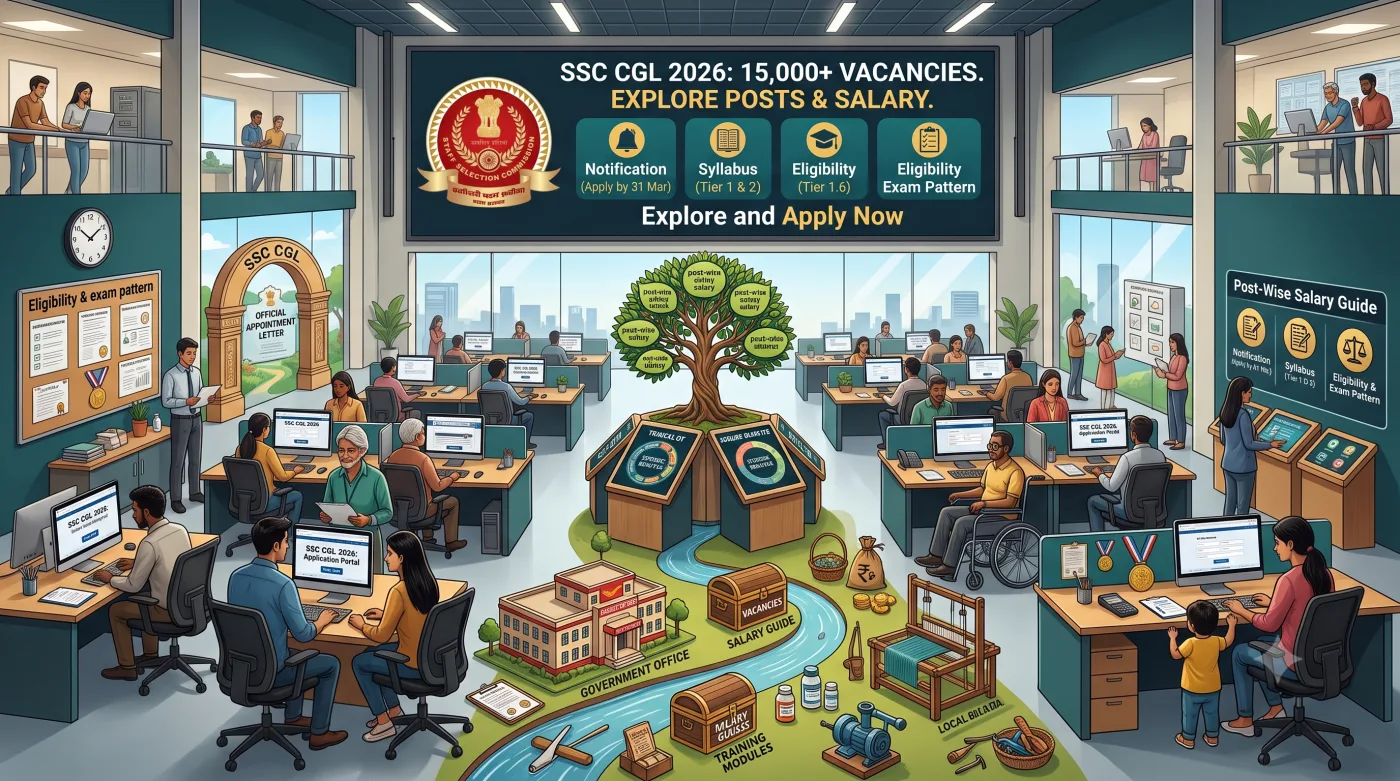
1. Comprehensive Examination Overview & Inception of SSC CGL 2026
The Staff Selection Commission Combined Graduate Level Examination (SSC CGL 2026) represents the most prestigious and competitive non-UPSC recruitment examination in the Republic of India. Administered by the Staff Selection Commission (an attached office of the Department of Personnel and Training - DoPT, Ministry of Personnel, Public Grievances and Pensions, Government of India), SSC CGL serves as the single centralized gateway for enrolling qualified graduate talent into premier Group 'B' (Gazetted and Non-Gazetted) and Group 'C' ministerial, executive, investigative, and financial positions across all Central Government Ministries, Attached and Subordinate Departments, Constitutional Bodies, and Apex Tribunals.
Every year, over 25 to 30 lakh candidates from across all 28 States and 8 Union Territories submit applications for the coveted CGL examination. Successful candidates are appointed to frontline national security, tax enforcement, diplomatic administration, and fiscal audit roles such as Assistant Section Officer (ASO) in the Central Secretariat Service (CSS), Ministry of External Affairs (MEA), Intelligence Bureau (IB), and Ministry of Railways; Inspector of Income Tax under the Central Board of Direct Taxes (CBDT); Inspector of Central Excise, Preventive Officer, and Examiner under the Central Board of Indirect Taxes and Customs (CBIC); Assistant Enforcement Officer (AEO) in the Directorate of Enforcement (ED); Sub-Inspector (SI) in the Central Bureau of Investigation (CBI) and National Investigation Agency (NIA); as well as Assistant Audit Officer (AAO) in the Indian Audit and Accounts Department under the Comptroller and Auditor General of India (CAG).
The 2026 edition of the recruitment drive features an estimated 15,000+ vacancies across 34 distinct cadres, offering competitive career growth, unmatched societal prestige, 7th Central Pay Commission salaries ranging from Level 4 (₹25,500 basic) up to Level 8 (₹47,600 basic), along with full Central Government benefits, pension coverage under the National Pension System (NPS), Central Government Health Scheme (CGHS) medical coverage, and government residential accommodation in prime metropolitan postings.
📢 कर्मचारी चयन आयोग संयुक्त स्नातक स्तरीय परीक्षा 2026 (SSC CGL 2026): आधिकारिक सारांश
कर्मचारी चयन आयोग (SSC) द्वारा आयोजित संयुक्त स्नातक स्तरीय परीक्षा (CGL 2026) भारत की सबसे प्रतिष्ठित स्नातक स्तरीय भर्ती परीक्षा है। इसके माध्यम से केंद्र सरकार के विभिन्न मंत्रालयों, जैसे- विदेश मंत्रालय (MEA), केंद्रीय सचिवालय (CSS), इंटेलिजेंस ब्यूरो (IB), आयकर विभाग (Income Tax), केंद्रीय उत्पाद शुल्क (Central Excise), सीबीआई (CBI), तथा प्रवर्तन निदेशालय (ED) में 15,000 से अधिक ग्रुप 'बी' और 'सी' पदों पर चयन किया जाता है। परीक्षा का आयोजन आयोग के नए डिजिटल पोर्टल ssc.gov.in के माध्यम से किया जा रहा है, जिसमें वन-टाइम रजिस्ट्रेशन (OTR) और लाइव वेबकैम फोटो सत्यापन पूरी तरह अनिवार्य है।
2. Complete Post-Wise Classification, Cadre Departments & 7th CPC Pay Scale Matrix
Central Government cadres recruited through SSC CGL 2026 are organized hierarchically across five distinct pay levels under the 7th Central Pay Commission matrix. Below is the comprehensive classification specifying the official nomenclature, ministry/department allocation, group status, and post-specific age ceilings:
| Pay Level & Basic Scale | Designated Post Nomenclature | Cadre Ministry / Department | Classification | Age Ceiling |
|---|---|---|---|---|
| Pay Level 8 (₹47,600 - ₹1,51,100) Gross: ~₹85,000 - ₹95,000 |
Assistant Audit Officer (AAO) Assistant Accounts Officer (AAO) |
Indian Audit & Accounts Department under the Comptroller and Auditor General (CAG) | Group 'B' Gazetted (Non-Ministerial) | 18 to 30 Years |
| Pay Level 7 (₹44,900 - ₹1,42,400) Gross: ~₹78,000 - ₹88,000 |
Assistant Section Officer (ASO) | Central Secretariat Service (DoPT - CSS) | Group 'B' Non-Gazetted | 20 to 30 Years |
| Assistant Section Officer (ASO) | Intelligence Bureau (Ministry of Home Affairs - IB) | Group 'B' Non-Gazetted | 18 to 30 Years | |
| Assistant Section Officer (ASO) | Ministry of External Affairs (MEA - Foreign Postings) | Group 'B' Non-Gazetted | 20 to 30 Years | |
| Assistant Section Officer (ASO) | Ministry of Railways (Railway Board Secretariat) | Group 'B' Non-Gazetted | 20 to 30 Years | |
| Inspector of Income Tax | Central Board of Direct Taxes (Department of Revenue - CBDT) | Group 'C' / Group 'B' | 18 to 30 Years | |
| Inspector (Central Excise / CGST) Inspector (Preventive Officer) Inspector (Examiner - Custom Ports) |
Central Board of Indirect Taxes and Customs (Department of Revenue - CBIC) | Group 'B' Non-Gazetted | 18 to 30 Years | |
| Assistant Enforcement Officer (AEO) Sub-Inspector (CBI) |
Directorate of Enforcement (ED) / Central Bureau of Investigation (DoPT - CBI) |
Group 'B' Non-Gazetted | 20 to 30 Years | |
| Pay Level 6 (₹35,400 - ₹1,12,400) Gross: ~₹62,000 - ₹70,000 |
Assistant / Section Officer | Other Central Ministries / Attached Departments / Tribunals | Group 'B' Non-Gazetted | 18 to 30 Years |
| Inspector | Central Bureau of Narcotics (Ministry of Finance - CBN) | Group 'B' Non-Gazetted | 18 to 30 Years | |
| Sub-Inspector (SI) | National Investigation Agency (Ministry of Home Affairs - NIA) | Group 'B' Non-Gazetted | 18 to 30 Years | |
| Junior Statistical Officer (JSO) | Ministry of Statistics & Programme Implementation (MoSPI) | Group 'B' Non-Gazetted | 18 to 32 Years | |
| Pay Level 5 (₹29,200 - ₹92,300) Gross: ~₹52,000 - ₹58,000 |
Auditor | Offices under CAG, CGDA (Defense Accounts), and CGA | Group 'C' Non-Gazetted | 18 to 27 Years |
| Accountant / Junior Accountant | Offices under CAG, CGA (Civil Accounts), and Department of Posts | Group 'C' Non-Gazetted | 18 to 27 Years | |
| Pay Level 4 (₹25,500 - ₹81,100) Gross: ~₹45,000 - ₹50,000 |
Postal Assistant (PA) / Sorting Assistant (SA) | Department of Posts (Ministry of Communications - India Post) | Group 'C' Non-Gazetted | 18 to 27 Years |
| Tax Assistant (TA) | Central Board of Direct Taxes (CBDT) & CBIC | Group 'C' Non-Gazetted | 18 to 27 Years | |
| Upper Division Clerk (UDC) / Senior Admin Assistant | Central Government Offices, Border Roads Organisation (BRO), Directorate General of Aeronautical Quality Assurance | Group 'C' Non-Gazetted | 18 to 27 Years |
*Note: Gross salary estimates are calculated for 'X' Category Metropolitan Cities (such as New Delhi, Mumbai, Kolkata, Chennai, Bengaluru, and Hyderabad) incorporating 50% Dearness Allowance (DA), 30% House Rent Allowance (HRA), Transport Allowance (TA), and DA on TA. For 'Y' and 'Z' Class cities, gross pay varies moderately according to lower HRA slabs (20% and 10% respectively).
3. Statutory Eligibility Criteria: Nationality, Education & Crucial Cut-off Dates
To participate in SSC CGL 2026, candidates must fulfill three fundamental eligibility conditions as laid down in the official notification issued by the Commission:
A. Citizenship & Nationality
A candidate must be either: (a) a citizen of India, or (b) a subject of Nepal, or (c) a subject of Bhutan, or (d) a Tibetan refugee who entered India prior to January 1, 1962, with the permanent intention of settling in India, or (e) a person of Indian origin who has migrated from Pakistan, Burma, Sri Lanka, East African countries of Kenya, Uganda, the United Republic of Tanzania, Zambia, Malawi, Zaire, Ethiopia, or Vietnam with the intention of permanently settling in India. Candidates falling under categories (b), (c), (d), and (e) must possess a valid certificate of eligibility issued by the Government of India.
B. Crucial Age Limits & Relaxation Table
The crucial date for age calculation is officially fixed as 1st August 2026. Candidates must check the specific age range for their desired post:
| Reserved Category Code | Permissible Upper Age Relaxation Beyond Prescribed Ceiling |
|---|---|
| Scheduled Caste (SC) / Scheduled Tribe (ST) | 5 Years (Can apply up to 32, 35, or 37 years depending on post) |
| Other Backward Classes (OBC - Non Creamy Layer) | 3 Years (Can apply up to 30, 33, or 35 years depending on post) |
| Persons with Benchmark Disabilities (PwBD - Unreserved) | 10 Years |
| PwBD (OBC - Non-Creamy Layer) | 13 Years |
| PwBD (SC / ST) | 15 Years |
| Ex-Servicemen (ESM) | 3 Years after deduction of military service rendered from actual age |
| Defense Personnel Disabled in Operations | 3 Years (8 Years for SC/ST Defense Personnel) |
| Central Govt Civilian Employees (Group 'C' Posts - 3 Yrs Service) | Up to 40 Years of Age (45 Years for SC/ST) |
| Widows / Divorced Women / Legally Separated Women | Up to 35 Years of Age (40 Years for SC/ST) for Group 'C' posts |
⚠️ महत्वपूर्ण विधिक सूचना: ओबीसी (OBC) नॉन-क्रीमी लेयर एवं ईडब्ल्यूएस (EWS) प्रमाण पत्र की क्रूशियल डेट (Crucial Date Rule)
कर्मचारी चयन आयोग के नए विधिक नियमों के अनुसार, आरक्षित वर्ग के सभी प्रमाण पत्र (OBC-NCL, EWS, SC, ST) ऑनलाइन आवेदन करने की अंतिम तिथि (Crucial Date) तक या उससे पूर्व जारी होने चाहिए:
- OBC नॉन-क्रीमी लेयर प्रमाण पत्र: यह प्रमाण पत्र केंद्र सरकार के प्रारूप (Central Government Format) में होना चाहिए तथा आवेदन के वित्तीय वर्ष के अनुसार जारी होना चाहिए। राज्य स्तरीय पिछड़ा वर्ग प्रमाण पत्र केंद्र सरकार की नौकरियों में स्वीकार्य नहीं होता।
- EWS प्रमाण पत्र: संबंधित वित्तीय वर्ष (Financial Year 2025-2026) की आय पर आधारित होना चाहिए और प्रमाण पत्र की वैधता (Valid for the Year 2026-2027) स्पष्ट रूप से अंकित होनी चाहिए।
- दस्तावेज सत्यापन (DV) में अस्वीकृति: यदि किसी अभ्यर्थी के पास क्रूशियल डेट का वैध प्रमाण पत्र नहीं होता है, तो उसे सीधे अनारक्षित (General/UR) श्रेणी में डाल दिया जाता है, बशर्ते वह सामान्य श्रेणी की आयु और कटऑफ को पूरा करता हो।
C. Essential Educational Qualifications (Reckoned as on 1st August 2026)
- For All General Group 'B' & 'C' Posts (ASO, Inspector, Auditor, Tax Assistant, etc.): A Bachelor's Degree in any discipline from a recognized University or Institute established by an Act of Central/State Legislature, or an equivalent qualification recognized by the Central Government. Candidates in the final semester/year of their graduation are eligible to apply provided their result is declared on or before the crucial cut-off date (01-08-2026).
- For Junior Statistical Officer (JSO - MoSPI): Bachelor's Degree in any subject from a recognized University with at least 60% marks in Mathematics at 10+2 standard, OR Bachelor's Degree in any discipline with Statistics as one of the subjects in all three years of degree course.
- For Statistical Investigator Grade-II (Registrar General of India): Bachelor's Degree in any subject with Statistics as one of the subjects from a recognized University. The candidate must have studied Statistics in all three years of the degree curriculum.
- For Assistant Audit Officer / Assistant Accounts Officer (AAO): Essential: Bachelor's Degree from a recognized University. Desirable: Chartered Accountant (CA), Cost & Management Accountant (CMA), Company Secretary (CS), Master in Commerce (M.Com), or Master in Business Administration (Finance). During the statutory two-year probation period, direct recruits must pass the Subordinate Audit/Accounts Service (SAS) examination.
4. Two-Tier Examination Architecture & Revised Examination Pattern
The Staff Selection Commission implements a streamlined Two-Tier Computer Based Examination (CBE) pattern. The erstwhile descriptive Paper-III and offline Document Verification (DV) stages have been completely abolished to accelerate recruitment timelines:
| Examination Tier | Testing Mode | Statutory Role in Final Merit List | Key Testing Focus |
|---|---|---|---|
| Tier-1 (Preliminary) | Computer Based Objective Test (CBE) | Qualifying in Nature Only (Marks not counted for final rank) |
Screening filter across 4 core aptitude domains (100 Qs / 200 Marks) |
| Tier-2 (Mains) | Computer Based Objective + Skill Test (CBE) | 100% Final Merit Deciding (Rank, Ministry & Post allocation) |
Multi-section mastery: Quant, Reasoning, English, GA, Computer, & DEST Typing |
Tier-1 Examination Pattern (Screening Test)
Tier-1 is conducted across multiple computer test centers across India in shifts. It consists of 100 objective multiple-choice questions carrying 200 total marks. The duration is exactly 60 minutes (1 hour) (80 minutes for compensatory scribe eligible candidates):
| Subject / Test Component | Total Questions | Maximum Marks | Negative Marking Penalty |
|---|---|---|---|
| General Intelligence & Reasoning | 25 Questions | 50 Marks | -0.50 Marks per wrong answer |
| General Awareness (Current Affairs & Static GK) | 25 Questions | 50 Marks | -0.50 Marks per wrong answer |
| Quantitative Aptitude (Mathematics) | 25 Questions | 50 Marks | -0.50 Marks per wrong answer |
| English Comprehension | 25 Questions | 50 Marks | -0.50 Marks per wrong answer |
| Tier-1 Grand Total | 100 Questions | 200 Marks | Composite Time: 60 Minutes |
⚖️ टियर-1 नॉर्मलाइजेशन एवं न्यूनतम अर्हक अंक (Normalization & Qualifying Criteria)
चूंकि टियर-1 परीक्षा देश भर में कई दिनों तक विभिन्न पालियों (Multiple Shifts) में आयोजित होती है, इसलिए प्रश्न पत्रों के कठिनाई स्तर में भिन्नता को संतुलित करने के लिए आयोग द्वारा एक मानक गणितीय नॉर्मलाइजेशन फॉर्मूला (Standard Normalization Equation) लागू किया जाता है। टियर-1 में प्राप्त नॉर्मलाइज्ड स्कोर के आधार पर ही श्रेणी-वार कटऑफ निर्धारित होती है। टियर-1 केवल अर्हक (Qualifying) है—अर्थात मुख्य परीक्षा (Tier-2) में बैठने के लिए इसे पास करना अनिवार्य है, परंतु इसके अंक अंतिम मेरिट सूची में नहीं जोड़े जाते हैं।
Tier-2 Examination Pattern (Final Merit decider)
Tier-2 is the decisive examination. For all common Group 'B' and 'C' positions, Paper-I is compulsory for all candidates. It is conducted in two separate sessions on the same single day:
| Paper & Session | Section & Module | Subject Area | No. of Qs | Marks | Allotted Time | Evaluation Weightage |
|---|---|---|---|---|---|---|
| Paper-I (Session-I) Total Time: 2 Hours 15 Minutes |
Section-I | Module-I: Mathematical Abilities | 30 Qs | 90 Marks (3 marks/Q) | 1 Hour (60 Minutes for Section-I) | Merit Score (Total: 390 Marks) Determines Candidate's Final All-India Rank, Service & Post Allocation. |
| Module-II: Reasoning and General Intelligence | 30 Qs | 90 Marks (3 marks/Q) | ||||
| Section-II | Module-I: English Language and Comprehension | 45 Qs | 135 Marks (3 marks/Q) | 1 Hour (60 Minutes for Section-II) | ||
| Module-II: General Awareness | 25 Qs | 75 Marks (3 marks/Q) | ||||
| Section-III | Module-I: Computer Knowledge Test (CKT) | 20 Qs | 60 Marks (3 marks/Q) | 15 Minutes | Qualifying in Nature (Higher standard cutoff for ASO CSS/MEA, Inspector, TA). | |
| Paper-I (Session-II) |
Section-III | Module-II: Data Entry Speed Test (DEST) | 2,000 Key Depressions | Qualifying | 15 Minutes | Qualifying in Nature (Mandatory for ALL posts. Permissible error: UR 20%, OBC/EWS 25%, SC/ST 30%). |
| Paper-II (Only for JSO Candidates) |
Statistics | Paper-II: Statistics (Comprehensive Graduate Level) | 100 Qs | 200 Marks (2 marks/Q) | 2 Hours (120 Minutes) | Added to 390 marks (Total 590 Marks) for JSO merit list only. |
🔴 टियर-2 में नेगेटिव मार्किंग एवं सेक्शनल कटऑफ का कठोर नियम (Strict Negative Marking Norms)
टियर-2 के पेपर-1 में प्रत्येक गलत उत्तर के लिए 1 अंक की नकारात्मक कटौती (-1 Mark Negative Marking) की जाती है (क्योंकि प्रत्येक सही प्रश्न 3 अंक का होता है, अर्थात 33.33% नेगेटिव मार्किंग)। इसके अतिरिक्त निम्न दो नियमों को ध्यान से समझें:
- सेक्शनल टाइमिंग एवं लॉक सिस्टम: सेशन-1 में जैसे ही पहले 60 मिनट पूरे होंगे, सेक्शन-I (Math & Reasoning) स्वतः लॉक हो जाएगा और सेक्शन-II (English & GA) खुल जाएगा। आप वापस पिछले सेक्शन में नहीं लौट सकते।
- प्रत्येक सेक्शन को अलग-अलग पास करना अनिवार्य: यदि किसी अभ्यर्थी का कुल स्कोर 390 में से 350 भी आ जाए, परंतु वह सेक्शन-III के कंप्यूटर टेस्ट (CKT) अथवा टाइपिंग टेस्ट (DEST) में फेल हो जाता है, तो उसे किसी भी पद के लिए अयोग्य (Disqualified) घोषित कर दिया जाएगा।
5. Exhaustive Subject-Wise Syllabus Breakdown (Tier 1 & Tier 2)
Mastering SSC CGL demands targeted preparation aligned strictly with the official curriculum notified by the Commission:
A. Mathematical Abilities / Quantitative Aptitude
- Number Systems: Computation of whole numbers, decimals, fractions, relationships between numbers, divisibility tests, remainders, LCM & HCF, surds & indices, simplification.
- Fundamental Arithmetical Operations: Percentages, Ratio and Proportion, Square roots, Averages, Simple and Compound Interest (Annual & Half-Yearly), Profit and Loss, Discount, Partnership Business, Mixture and Alligation, Time and Distance, Problems on Trains, Boats & Streams, Time and Work, Pipes & Cisterns.
- Algebra: Basic algebraic identities of School Algebra & Elementary surds, graphs of linear equations, quadratic equations, factorization.
- Geometry: Familiarity with elementary geometric figures and facts: Triangle and its various kinds of centers (Incentre, Circumcentre, Orthocentre, Centroid), Congruence and similarity of triangles, Circle and its chords, tangents, angles subtended by chords of a circle, common tangents to two or more circles.
- Mensuration (2D & 3D): Triangle, Quadrilaterals, Regular Polygons, Circle, Right Prism, Right Circular Cone, Right Circular Cylinder, Sphere, Hemispheres, Rectangular Parallelepiped, Regular Right Pyramid with triangular or square base.
- Trigonometry: Trigonometric ratios, degree and radian measures, standard identities (sin²θ + cos²θ = 1), complementary angles, Heights and Distances (simple problems only).
- Statistics & Probability: Use of tables and graphs (Histogram, Frequency polygon, Bar-diagram, Pie-chart), Measures of Central Tendency (Mean, median, mode), calculation of simple probabilities.
B. General Intelligence & Reasoning
- Analogy: Semantic, Symbolic/Number, Figural Analogy.
- Classification & Series: Semantic classification, Symbolic/Number classification, Number Series, Figural Series, Semantic Series.
- Spatial & Logical Reasoning: Space orientation, Venn Diagrams, Drawing inferences, Punched hole/pattern folding & unfolding, Figural pattern completion, Embedded figures, Critical thinking, Emotional Intelligence, Social Intelligence.
- Coding-Decoding: Matrix coding, substitution coding, numerical decoding, Blood Relations, Direction Sense Test, Syllogisms, Statement and Assumptions, Statement and Conclusions, Course of Action.
C. English Language & Comprehension
- Vocabulary: Synonyms, Antonyms, Homonyms, Spelling check/detecting mis-spelt words, Idioms and Phrases, One-word substitution.
- Grammar & Syntax: Parts of Speech, Sentence structure, Subject-Verb Agreement, Tenses, Prepositions, Conjunctions, Spotting the Error, Fill in the Blanks, Sentence Improvement.
- Active/Passive Voice & Direct/Indirect Speech: Conversion of sentences from Active into Passive Voice, Conversion into Direct/Indirect narration.
- Comprehension Passages: Shuffling of sentence parts in a passage (Para Jumbles / PQRS), Cloze Passage, Reading Comprehension passages (evaluating thematic understanding, tone of author, factual inferences).
D. General Awareness
- Current Affairs: National and International events of the past 12 months, Union Budget and Economic Survey highlights, Government welfare schemes, Science and Technology breakthroughs, Defense exercises, Sports championships and medals, Awards and Honors, Books and Authors, Summits and Bilateral treaties.
- Static General Knowledge: Indian History (Ancient, Medieval, Modern Freedom Movement), Indian Geography (Physical, Rivers, Mountains, Climate, Soils, Agriculture, Mineral distribution), Indian Polity and Constitution (Fundamental Rights, DPSP, Preamble, Constitutional Amendments, Judiciary, Parliament, Panchayati Raj), Indian Economy (Macroeconomics, Five Year Plans, Inflation, Monetary Policy, Banking structure), General Science (Physics, Chemistry, Biology up to 10th standard CBSE level), Environment and Ecology (National Parks, Biosphere Reserves, Ramsar Wetlands, Wildlife Sanctuaries, Biodiversity hotspots).
E. Computer Knowledge Module (Section-III)
- Computer Basics: Organization of a computer system, Central Processing Unit (CPU), Input/Output devices, Computer memory (RAM, ROM, Cache, Secondary storage), Memory organization, Back-up devices, Windows Operating System basics.
- Software Applications: Microsoft Office Suite: MS Word, MS Excel (Formulas, Pivot tables, Worksheets), MS PowerPoint (Slide animations, Master slides).
- Internet & Communication: Web browsing, search engines, Email communication, downloading and uploading files, Social networking protocols.
- Cyber Security & Networking Basics: Networking devices (Modem, Router, Switch, Gateway), Network topologies, Network protocols (TCP/IP, HTTP, FTP), Cyber threats (Viruses, Worms, Trojan Horses, Ransomware, Phishing, Spyware), Firewalls, Antivirus tools.
6. Mandatory Physical Endurance Test (PET) & Physical Standards (PST)
While standard desk positions (like ASO in CSS, Auditor, or Tax Assistant) require no physical measurement, specific uniformed and investigative posts mandate compliance with strict Physical Standards and Physical Tests conducted after Tier-2:
| Designated Post | Gender Category | Mandatory Physical Standards (PST) | Physical Endurance Test (PET) Norms |
|---|---|---|---|
| Inspector (Central Excise / CGST) Preventive Officer Examiner (CBIC) |
Male Candidates | Height: 157.5 cms (5 cms relaxable for Gorkhas, Assamese, ST) Chest: 81 cms (Fully expanded with 5 cms minimum expansion) |
Walking: 1,600 meters in 15 Minutes Cycling: 8 Kilometers in 30 Minutes |
| Female Candidates | Height: 152 cms (2.5 cms relaxable for ST/Gorkhas) Weight: 48 Kgs (2 Kgs relaxable for ST) |
Walking: 1 Kilometer in 20 Minutes Cycling: 3 Kilometers in 25 Minutes |
|
| Sub-Inspector (Central Bureau of Investigation - CBI) | Male Candidates | Height: 165 cms (Relaxable for Hills/Tribals by 5 cms) Chest: 76 cms with expansion |
Vision: Distant Vision: 6/6 in one eye and 6/9 in another. Near Vision: 0.6 in one eye and 0.8 in another. |
| Female Candidates | Height: 150 cms Chest: Not Applicable |
Vision standards identical to male candidates. Glasses permitted. | |
| Sub-Inspector (National Investigation Agency - NIA) | Male / Female | Male Height: 165 cms | Female Height: 150 cms Chest: 76 cms with expansion (Male). |
Distant Vision: 6/6 in one eye and 6/9 in another. Near vision: 0.6 in one eye and 0.8 in another. |
| Inspector / Sub-Inspector (Central Bureau of Narcotics - CBN) | Male / Female | Male Height: 165 cms, Chest: 76-81 cms. Female Height: 152 cms, Weight: 48 kgs. |
Walking and cycling tests identical to CBIC norms. |
🩺 कलर ब्लाइंडनेस (Color Blindness) एवं मेडिकल अनफिटनेस चेतावनी
अभ्यर्थियों को पद प्राथमिकता (Post Preference) भरते समय अत्यंत सतर्क रहना चाहिए। सेंट्रल एक्साइज इंस्पेक्टर, प्रिवेंटिव ऑफिसर, एग्जामिनर तथा सब-इंस्पेक्टर (CBI/NIA) जैसे वर्दीधारी पदों के लिए कलर ब्लाइंड (Color Blind) अभ्यर्थी पूरी तरह अनफिट होते हैं। यदि कोई कलर ब्लाइंड उम्मीदवार इन पदों को शीर्ष प्राथमिकता देता है, तो मेडिकल टेस्ट में फेल होने पर उसे किसी अन्य पद पर स्थानांतरित नहीं किया जाएगा और उसकी उम्मीदवारी निरस्त हो जाएगी। ऐसे अभ्यर्थी केवल एएसओ (CSS/MEA), आयकर निरीक्षक (Income Tax Inspector), ऑडिटर तथा टैक्स असिस्टेंट (CBDT) जैसे पदों को ही प्राथमिकता दें।
7. Step-by-Step Online Application Procedure via New SSC Portal (ssc.gov.in)
The Staff Selection Commission discontinued the legacy portal (ssc.nic.in) and migrated all operations to the high-tech cloud architecture at https://ssc.gov.in/. Completing the application involves two sequential phases:
Phase 1: One-Time Registration (OTR) Generation
- Visit the new official portal:
https://ssc.gov.in/and click on "Login or Register" > "Register Now". - Personal Details: Enter your 12-digit Aadhaar Number (or voter card, PAN, driving license, passport if Aadhaar not available), Full Legal Name matching 10th certificate, Father's Name, Mother's Name, and Date of Birth (DD/MM/YYYY).
- Contact Particulars: Provide your active personal Mobile Number and Email Address. Authenticate both through instant separate One-Time Passwords (OTPs).
- Set Password: Create a strong alphanumeric master password (minimum 8 characters with upper, lower, numeric, and special characters). Upon successful generation, the system assigns a permanent 11-digit OTR Registration Number.
- Additional Details: Log back in, specify Nationality, Visible Identification Marks (e.g., mole on right cheek), Category (UR/OBC/SC/ST/EWS), and permanent communication address.
Phase 2: Filling the SSC CGL 2026 Examination Form
- Log into your candidate dashboard using your Registration Number and Password.
- Under "Live Examinations", locate Combined Graduate Level Examination, 2026 and click on "Apply".
- Verify pre-populated OTR data (Name, Father's name, Category, DOB).
- Select three preferred Examination Centers in order of priority within the same Examination Region (e.g., Central Region: Patna, Muzaffarpur, Prayagraj).
- Indicate whether applying for the post of Junior Statistical Officer (JSO) and confirm possessing the required mathematical/statistical educational qualifications.
- Provide details of highest educational qualification, qualifying degree name, university board, roll number, year of passing, and aggregate percentage/CGPA.
- Live Photo Capture (Mandatory): Unlike earlier years where scanned passport photos were uploaded, candidates must capture a Live Photo using either a high-resolution desktop webcam or the official "MySSC" mobile application downloaded from Google Play Store. Ensure proper plain white background, sharp frontal facial lighting, no caps, no spectacles, and direct eye contact with the camera lens.
- Scanned Signature Upload: Upload a sharp scanned copy of your signature in JPEG/JPG format (File size between 10 KB to 20 KB; dimensions roughly 4.0 cm width x 2.0 cm height) on white paper with black/blue ink.
- Preview the complete application form, accept the legal declaration, and click on Submit.
- Pay the ₹100 application fee via UPI, debit card, or net banking (exempted categories bypass payment automatically).
- Download and securely print two copies of the finalized application form carrying the official system timestamp and watermark.
8. Cutoff Trends, Safe Scores & Strategic Preparation Methodology
Analyzing historical qualifying benchmarks from past CGL cycles provides valuable perspective for structuring daily study targets:
| Category | Tier-1 Normalized Cutoff (Raw / 200) | Tier-2 Safe Merit Target (Raw / 390) | Targeted Safe Percentile |
|---|---|---|---|
| Unreserved (UR / General) | 145 - 152 Marks | 325 - 335+ Marks | 98.5+ Percentile |
| Other Backward Classes (OBC - NCL) | 142 - 148 Marks | 318 - 328+ Marks | 97.8+ Percentile |
| Economically Weaker Sections (EWS) | 140 - 146 Marks | 315 - 325+ Marks | 97.2+ Percentile |
| Scheduled Castes (SC) | 124 - 132 Marks | 285 - 295+ Marks | 92.0+ Percentile |
| Scheduled Tribes (ST) | 115 - 124 Marks | 265 - 275+ Marks | 88.5+ Percentile |
Four-Pillar Daily Preparation Strategy for Aspirants
- Mathematical Mastery (Quant): Transition from conventional formulaic calculation to intuitive speed math (learning tables up to 30, squares up to 50, cubes up to 30, and fraction-to-percentage conversions). Practice 100 mixed arithmetic and advanced math questions daily with strict 45-second timer constraints.
- High-Frequency English Reading: Dedicate 60 minutes every morning to editorial analysis from national dailies (The Hindu or Indian Express) to build reading comprehension agility for Tier-2 passages. Review Neetu Singh's Volume 1 and SP Bakshi for syntactic error spotting rules.
- General Awareness Current & Static Synthesis: Compile monthly topical notes covering appointments, sports, awards, government welfare missions, and military drills. For static GK, revise NCERT summaries in Indian Polity (Articles 1 to 51A, Parliament, Amendments), Modern History (1857 to 1947), and Geography maps.
- Mock Test Simulation & In-Depth Error Analysis: Attempt at least 2 full-length Computer Based Mock Tests every week for Tier-1, escalating to 1 daily mock in the final 45 days. Never skip post-mock diagnostics: categorize errors into 'Conceptual Deficit', 'Calculation Slip', and 'Time Management Lapse' to systematically plug score leakages.
9. Official Commission Regional Directory & Candidate Helplines
In case of technical issues during One-Time Registration, fee payment deductions without receipt generation, or admit card discrepancies, candidates must contact their respective jurisdictional SSC Regional Offices:
| SSC Regional Directorate | Jurisdiction States & Union Territories | Official Regional Portal & Helpline |
|---|---|---|
| SSC Central Region (CR) | Uttar Pradesh (UP) & Bihar | www.ssc-cr.org | Tel: 0532-2250372, 0532-2460511 |
| SSC Northern Region (NR) | Delhi, Rajasthan, Uttarakhand | www.sscnr.nic.in | Tel: 011-24363343, 011-24360840 |
| SSC Eastern Region (ER) | West Bengal, Odisha, Jharkhand, A&N Islands, Sikkim | www.sscer.org | Tel: 033-22902230, 033-22904422 |
| SSC Western Region (WR) | Maharashtra, Gujarat, Goa, Daman & Diu, Dadra & Nagar Haveli | www.sscwr.net | Tel: 022-22019165, 022-22018527 |
| SSC Southern Region (SR) | Andhra Pradesh, Telangana, Tamil Nadu, Puducherry | www.sscsr.gov.in | Tel: 044-28251009, 044-28220070 |
| SSC North Western Region (NWR) | Punjab, Haryana, Himachal Pradesh, J&K, Ladakh, Chandigarh | www.sscnwr.org | Tel: 0172-2744366, 0172-2749378 |
| SSC North Eastern Region (NER) | Assam, Arunachal Pradesh, Manipur, Meghalaya, Mizoram, Nagaland, Tripura | www.sscner.org.in | Tel: 0361-2229212, 0361-2229211 |
| SSC Karnataka Kerala Region (KKR) | Karnataka, Kerala, Lakshadweep | www.ssckkr.kar.nic.in | Tel: 080-25502520, 080-25527342 |
| SSC Madhya Pradesh Region (MPR) | Madhya Pradesh, Chhattisgarh | www.sscmpr.org | Tel: 0771-2424040, 0771-2423610 |
🏆 निर्णायक सफलता संदेश: एसएससी सीजीएल 2026 में अंतिम चयन कैसे सुनिश्चित करें?
एसएससी सीजीएल में सफलता का मूल मंत्र है—नियमित अभ्यास (Daily Consistency), गति के साथ शुद्धता (Accuracy with Speed), और टियर-2 के सभी मॉड्यूल्स पर समान पकड़। याद रखें कि केवल गणित और अंग्रेजी में 100% अंक लाने से चयन नहीं होगा यदि आप कंप्यूटर नॉलेज टेस्ट या 15 मिनट के टाइपिंग टेस्ट (DEST) में चूक जाते हैं। आज ही से अपनी तैयारी को टियर-1 और टियर-2 के संयुक्त दृष्टिकोण के साथ शुरू करें, मॉक टेस्ट में गलतियों का विश्लेषण करें और केंद्र सरकार के सर्वोच्च मंत्रालयों में प्रतिष्ठित अधिकारी बनने के अपने सपने को साकार करें।
User Discussion & Comments (0)
No comments yet. Be the first to leave a comment below!
Leave a Comment / Ask a Question: