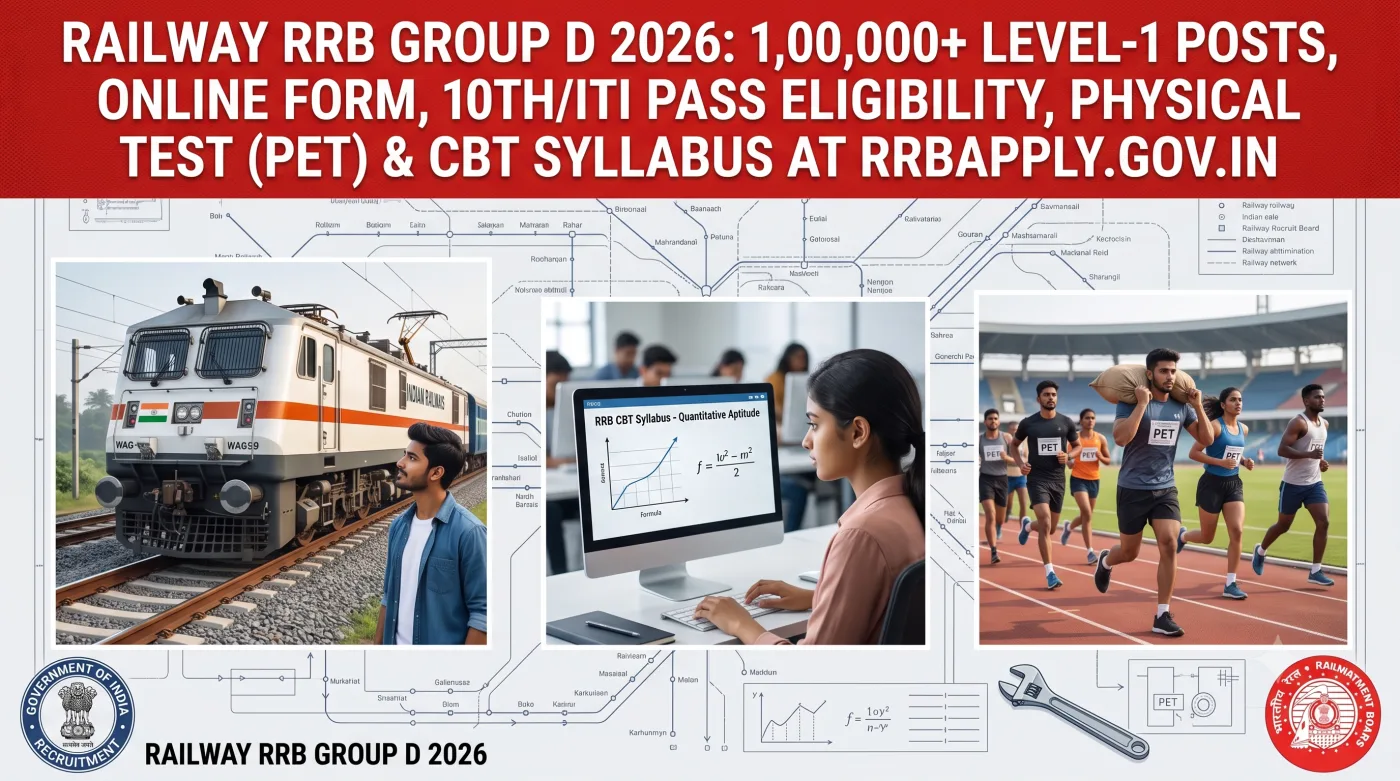
1. Legislative Mandate & Operational Significance of Railway Group D (Level-1)
The Railway Recruitment Board Level-1 Examination (popularly recognized nationwide as RRB Group D 2026) represents the world’s largest mass workforce mobilization exercise conducted by any government infrastructure agency. Overseen by the Railway Recruitment Control Board (RRCB) under the Ministry of Railways, Government of India, and executed in coordination with 16 Zonal Railway Recruitment Cells (RRCs), this mega recruitment drive supplies the frontline operational backbone that sustains the safe, reliable, and continuous movement of over 13,000 passenger trains and 9,000 freight trains daily across India's 68,000-route-kilometer rail network.
Every single train moving across the Indian subcontinent—from the high-speed semi-high-speed Vande Bharat Express to heavy freight container rakes carrying coal, petroleum, and food grains—relies critically upon the vigilant round-the-clock stewardship of Level-1 personnel. Appointees serve as Track Maintainers Grade-IV (patrolling tracks in extreme summer heat, winter cold, and monsoon deluges to detect rail fractures and fishplate defects), Assistant Pointsmen (executing train shunting operations, manual point lever alignments, and displaying green/red flag signals during train run-throughs), Assistant Carriage & Wagon (C&W) technicians (conducting under-gear rolling stock examinations in railway yards), and Signal & Telecommunication (S&T) technicians (maintaining electronic track circuits, axle counters, and signaling relays).
With an anticipated notification exceeding 1,00,000+ vacancies across 16 Railway Zones (Northern Railway, East Central Railway, Eastern Railway, Western Railway, South Central Railway, etc.), RRB Group D offers permanent Central Government service with 7th Central Pay Commission Level-1 salaries (basic pay ₹18,000/-), comprehensive medical benefits for the entire family in Railway Hospitals, government residential quarters, free railway passes, and rapid career promotions to Level-2 (Assistant Loco Pilot, Junior Clerk, Technician) through departmental General Departmental Competitive Examinations (GDCE) and Limited Departmental Competitive Examinations (LDCE).
📢 भारतीय रेलवे ग्रुप 'डी' (लेवल-1 भर्ती 2026): आधिकारिक सारांश
रेलवे भर्ती बोर्ड (RRB) एवं 16 जोनल रेलवे भर्ती प्रकोष्ठों (RRC) द्वारा 1,00,000 से अधिक लेवल-1 पदों पर ऐतिहासिक भर्ती निकाली जा रही है। 10वीं पास तथा आईटीआई (ITI) उत्तीर्ण अभ्यर्थियों के लिए यह केंद्र सरकार में स्थायी सरकारी नौकरी पाने का सबसे बड़ा अवसर है। भर्ती प्रक्रिया में कंप्यूटर आधारित परीक्षा (CBT), शारीरिक दक्षता परीक्षण (PET), दस्तावेज सत्यापन एवं मेडिकल परीक्षण शामिल हैं। आवेदन की समस्त प्रक्रिया रेलवे के आधिकारिक राष्ट्रीय पोर्टल rrbapply.gov.in के जरिए संपन्न होगी।
2. Post-Wise Classification, 7th CPC Salary Structure & Allowances
All positions recruited under RRB Group D belong to Pay Level 1 of the 7th Central Pay Commission Pay Matrix. Below is an exhaustive structural breakdown specifying cadre nomenclatures, allocating technical departments, assigned basic scales, special monthly hardship allowances, and estimated in-hand earnings:
| Post Designation | Railway Department | Medical Standard | Starting Basic Pay | Special Duty Allowances | Estimated In-Hand Salary (X/Y Cities) |
|---|---|---|---|---|---|
| Track Maintainer Grade-IV | Civil Engineering | B-1 | ₹18,000/- | ₹2,700/- Risk & Hardship Allowance + Night Patrolling Allowance | ₹28,000 - ₹34,000/- (Highest gross in Group D due to risk allowance) |
| Assistant Pointsman | Traffic (Operating) | A-2 (Strict 6/9 eye vision without glasses) | ₹18,000/- | Night Duty Allowance (NDA) + Overtime Allowance (OTA) + National Holiday Allowance | ₹26,000 - ₹31,000/- (Fast promotion track to Goods Guard) |
| Assistant Workshop | Mechanical | C-1 | ₹18,000/- | Workshop Incentive Bonus (PCO Allowance up to ₹3,000 - ₹5,000/month) | ₹27,000 - ₹32,000/- (Fixed 8-hour shift, Sunday closed) |
| Assistant Carriage & Wagon (C&W) | Mechanical | B-1 | ₹18,000/- | Yard Shift Allowance + Night Duty Allowance + Washing Allowance | ₹25,500 - ₹30,000/- |
| Assistant Signal & Telecommunication (S&T) | S&T | B-1 | ₹18,000/- | Call-Out Allowance during signal failures + Traveling Allowance (TA) | ₹25,500 - ₹30,000/- |
| Assistant Loco Shed (Diesel / Electrical) | Mechanical / Electrical | B-1 | ₹18,000/- | Overhauling Incentive + Shift Duty Allowance | ₹25,000 - ₹29,500/- |
| Assistant Bridge & Track Machine | Civil Engineering | B-1 | ₹18,000/- | Daily Travel Allowance (₹500/day during track tamping deployments) | ₹27,000 - ₹33,000/- |
| Hospital Assistant | Medical | C-1 | ₹18,000/- | Hospital Patient Care Allowance (HPCA) of ₹4,100/month | ₹27,500 - ₹32,000/- (Clean hospital environment, zero field risk) |
*Salary Breakdown: Basic Pay: ₹18,000 + Dearness Allowance (DA @ 50%): ₹9,000 + House Rent Allowance (HRA @ 30% in X cities): ₹5,400 + Transport Allowance (TA): ₹1,350 + DA on TA: ₹675 = Minimum Gross Salary ₹34,425/- before allowances. Deductions include NPS contribution (10% of Basic + DA = ₹2,700) and Railway Employees Insurance Scheme (REIS = ₹30).
3. Eligibility Criteria: 10th Pass vs ITI Qualification Debate & Cut-off Dates
One of the most intensely monitored aspects of Railway Group D recruitment is the educational qualification threshold:
A. Statutory Educational Qualification Rule
According to the Railway Board's official policy circular (RBE No. 148/2019 and subsequent official amendments), the baseline educational benchmark for Level-1 posts is:
- 10th Standard Pass (Matriculation) from a recognized Board/Institution established by Central/State Government, OR
- National Apprenticeship Certificate (NAC) granted by the National Council for Vocational Training (NCVT), OR
- Industrial Training Institute (ITI) Pass in designated engineering and mechanical trades recognized by NCVT or SCVT.
⚠️ महत्वपूर्ण विधिक स्पष्टीकरण: 10वीं पास बनाम आईटीआई (10th Pass vs ITI Eligibility Norm)
रेलवे भर्ती बोर्ड द्वारा समय-समय पर तकनीकी पदों (जैसे- ट्रैक मेंटेनर, वर्कशॉप, S&T) के लिए केवल ITI को अनिवार्य करने का प्रयास किया गया था। परंतु छात्रों की राष्ट्रव्यापी मांग और संसद में सरकार के आधिकारिक वक्तव्यों के अनुसार, सामान्य 10वीं (हाईस्कूल) पास अभ्यर्थी भी लेवल-1 के अधिकांश पदों के लिए पूरी तरह पात्र (Eligible) हैं:
- सामान्य 10वीं पास अभ्यर्थी: असिस्टेंट पॉइंट्समैन (Pointsman), हॉस्पिटल असिस्टेंट, कमर्शियल पोर्टर तथा अधिकांश ट्रैक मेंटेनर पदों के लिए बिना किसी ITI सर्टिफिकेट के आवेदन कर सकते हैं।
- ITI और अप्रेंटिस (CCAA) धारकों को लाभ: जिन अभ्यर्थियों के पास रेलवे से अप्रेंटिस (Course Completed Act Apprentices - CCAA) है, उनके लिए 20% सीटें आरक्षित रहती हैं तथा उन्हें शारीरिक दक्षता परीक्षा (PET) से 100% छूट मिलती है!
B. Crucial Age Limits & Comprehensive Reservation Concessions
The age calculation date is formally reckoned as 1st July 2026. Candidates must fall within the prescribed age bracket:
| Category / Community | Standard Entry Age | Upper Age Ceiling (With 3-Year Railway Board Concession) |
|---|---|---|
| Unreserved (General / UR) & EWS | 18 to 33 Years | 18 to 36 Years |
| Other Backward Classes (OBC - Non-Creamy Layer) | +3 Years Relaxation | 18 to 39 Years |
| Scheduled Castes (SC) & Scheduled Tribes (ST) | +5 Years Relaxation | 18 to 41 Years |
| Persons with Benchmark Disabilities (PwBD - UR) | +10 Years Relaxation | 18 to 46 Years (OBC PwBD: 49 Years | SC/ST PwBD: 51 Years) |
| Ex-Servicemen (ESM) | Service + 3 Years | Deducting actual military service duration from age |
4. Multi-Stage Selection Framework: From CBT to Appointment
The selection process for Railway Group D is rigorously merit-based and standardized across four consecutive stages:
- Stage 1: Computer Based Test (CBT): Single-tier national examination evaluating objective aptitude across 4 disciplines.
- Stage 2: Physical Efficiency Test (PET): Mandatory field fitness test conducted on railway grounds. Qualifying in nature.
- Stage 3: Document Verification (DV): In 1:1 ratio based on CBT normalized marks (for candidates passing PET).
- Stage 4: Comprehensive Railway Medical Examination: Conducted in Railway Divisional Hospitals under designated medical standards (A-2, B-1, C-1).
5. Detailed CBT Examination Pattern & Marking Scheme
The Computer Based Test is administered across dozens of shifts using computerized test software. It carries 100 multiple-choice questions for 100 marks with a total duration of 90 minutes (120 minutes for eligible PwBD candidates with scribes):
| Examination Subject Area | Number of Questions | Total Marks | Composite Test Duration | Negative Marking Penalty |
|---|---|---|---|---|
| General Science (Physics, Chemistry, Life Sciences) | 25 Questions | 25 Marks | 90 Minutes (1 Hour 30 Minutes) |
1/3rd (-0.33 Marks) deducted for each incorrect answer |
| Mathematics (Arithmetic & Elementary Algebra/Geometry) | 25 Questions | 25 Marks | ||
| General Intelligence and Reasoning | 30 Questions | 30 Marks | ||
| General Awareness and Current Affairs | 20 Questions | 20 Marks | ||
| CBT Grand Total | 100 Questions | 100 Marks | 90 Minutes | Percentile Normalization Applied |
🧮 नॉर्मलाइज्ड परसेंटाइल स्कोरिंग सिस्टम (Percentile Score Calculation Method)
रेलवे भर्ती बोर्ड द्वारा ग्रुप डी की परीक्षा में परसेंटाइल आधारित नॉर्मलाइजेशन (Percentile-Based Normalization) लागू किया जाता है। किसी अभ्यर्थी का परसेंटाइल स्कोर यह दर्शाता है कि उसकी विशिष्ट शिफ्ट में कितने प्रतिशत अभ्यर्थियों ने उससे कम या उसके बराबर अंक प्राप्त किए हैं। सूत्र निम्नवत है:
परसेंटाइल स्कोर = (अभ्यर्थी के बराबर या कम अंक पाने वाले उम्मीदवारों की संख्या / शिफ्ट में उपस्थित कुल उम्मीदवारों की संख्या) × 100
इस प्रणाली से किसी भी शिफ्ट के सरल या कठिन होने का प्रभाव पूरी तरह निष्प्रभावी हो जाता है और निष्पक्ष मेरिट तैयार होती है।
6. Mandatory Physical Efficiency Test (PET): 100% Comprehensive Breakdown
Candidates qualifying the CBT at a ratio of 1:3 (3 times the notified vacancies) are called to participate in the Physical Efficiency Test (PET). Passing PET is 100% MANDATORY; failing in either test results in instantaneous elimination from the selection process!
| Gender Category | Test 1: Weight Carrying Test (बोरी उठाने का परीक्षण) | Test 2: Endurance Running Test (दौड़ परीक्षण) |
|---|---|---|
| Male Candidates (पुरुष अभ्यर्थी) | Lift and carry 35 Kg of sand/weight for a distance of 100 Meters in 2 Minutes in one single chance without putting the weight down on the ground! | Run for a distance of 1,000 Meters (1 Kilometer) in 4 Minutes and 15 Seconds (4 min 15 sec) in one single chance on a standard athletic track. |
| Female Candidates (महिला अभ्यर्थी) | Lift and carry 20 Kg of sand/weight for a distance of 100 Meters in 2 Minutes in one single chance without putting the weight down on the ground! | Run for a distance of 1,000 Meters (1 Kilometer) in 5 Minutes and 40 Seconds (5 min 40 sec) in one single chance on a standard athletic track. |
| PwBD & CCAA Apprentices | 100% EXEMPTED (शारीरिक दक्षता परीक्षण से पूर्ण छूट) | 100% EXEMPTED (शारीरिक दक्षता परीक्षण से पूर्ण छूट) |
🔴 पीईटी (PET) वजन उठाने के परीक्षण में ध्यान रखने योग्य अति-महत्वपूर्ण नियम
शारीरिक दक्षता परीक्षण में सबसे अधिक अभ्यर्थी 35 किलो वजन उठाने वाले टेस्ट में बाहर होते हैं। इसके विधिक नियमों को अच्छी तरह समझ लें:
- सिंगल चांस नियम (Only One Chance): वजन उठाने और दौड़ने दोनों परीक्षणों के लिए केवल एक अवसर (Single Attempt) दिया जाता है। दूसरा मौका कभी नहीं मिलता।
- जमीन पर वजन छूना प्रतिबंधित: 35 किलो की बालू की बोरी को टेबल से उठाकर अपने कंधे, सिर अथवा दोनों हाथों में सीने से चिपकाकर ले जा सकते हैं। परंतु 100 मीटर की दूरी तय करने से पहले यदि बोरी शरीर से फिसलकर जमीन पर गिर गई या आपने उसे जमीन पर रख दिया, तो आपको तुरंत अयोग्य (Disqualified) घोषित कर दिया जाएगा!
- आरएफआईडी चिप ट्रैकिंग: दौड़ के समय अभ्यर्थी के पैर में आरएफआईडी (RFID) इलेक्ट्रॉनिक चिप बांधी जाती है। ट्रैक के स्टार्टिंग और फिनिशिंग मैट पर पैर पड़ते ही कंप्यूटर द्वारा माइक्रोसेकंड में समय रिकॉर्ड होता है।
7. Exhaustive Subject-Wise Syllabus Breakdown (10th Standard Level)
The syllabus for RRB Group D is tailored around 10th Standard CBSE/NCERT curriculum benchmarks:
A. General Science (25 Questions - High Weightage)
- Physics: Units and Measurements, Motion, Newton's Laws of Motion, Work, Energy and Power, Gravitation, Thrust and Pressure, Archimedes' Principle, Sound (Echo, Sonar, Audible frequency), Light (Reflection, Refraction, Spherical Mirrors, Lenses, Lens Formula, Human Eye, Defects of Vision), Electricity (Ohm's Law, Resistance in Series and Parallel, Heating effect of electric current, Electric Power), Magnetic Effects of Electric Current (Electromagnetic induction, Electric Motor, Generator).
- Chemistry: Chemical Reactions and Equations (Types of chemical reactions, Oxidation and Reduction, Corrosion, Rancidity), Acids, Bases and Salts (pH scale, Bleaching powder, Baking soda, Washing soda, Plaster of Paris), Metals and Non-Metals (Reactivity series, Ionic compounds, Metallurgy), Carbon and its Compounds (Covalent bonding, Versatile nature of carbon, Homologous series, IUPAC nomenclature, Ethanol and Ethanoic acid), Periodic Classification of Elements (Mendeleev's Periodic Table, Modern Periodic Law, Groups and Periods, Valency, Atomic size trends).
- Life Sciences (Biology): Life Processes (Nutrition in plants and animals, Respiration, Transportation in humans and plants, Excretion), Control and Coordination (Nervous system, Reflex action, Human Brain, Plant hormones, Endocrine glands), How do Organisms Reproduce (Asexual reproduction, Sexual reproduction in flowering plants, Human reproductive system), Heredity and Evolution (Mendel's experiments, Sex determination), Our Environment (Ecosystem, Food chain, Ozone depletion, Waste management).
B. Mathematics (25 Questions)
- Core Arithmetic: Number System, BODMAS Rule, Decimals and Fractions, LCM and HCF, Ratio and Proportion, Percentages, Mensuration (Area and Perimeter of 2D shapes, Volume of 3D solids), Time and Work, Pipes and Cisterns, Time and Distance, Problems on Trains, Boats and Streams, Simple Interest, Compound Interest, Profit and Loss, Discount, Partnership.
- Algebra & Geometry: Basic Algebraic Identities, Linear Equations in one and two variables, Quadratic Equations, Elementary Geometry (Lines, Angles, Triangles, Quadrilaterals, Circles, Chords), Trigonometry (Trigonometric ratios, Standard angles 0° to 90°, Heights and Distances), Elementary Statistics (Mean, Median, Mode, Frequency distribution, Pie charts).
C. General Intelligence and Reasoning (30 Questions - Scoring Section)
- Analogies, Alphabetical and Number Series, Coding and Decoding, Mathematical Operations, Direction and Distance, Blood Relations, Syllogisms, Jumbling, Venn Diagrams, Data Interpretation and Sufficiency, Conclusions and Decision Making, Similarities and Differences, Analytical Reasoning, Classification, Statement and Arguments, Statement and Assumptions.
D. General Awareness on Current Affairs (20 Questions)
- Recent national events, Union Budget highlights, Sports champions and tournaments, Famous personalities, Books and Authors, Science and Technology missions (ISRO Chandrayaan, Gaganyaan, Aditya-L1), Awards and Honors, Geography (Rivers, Dams, National Parks), History of Freedom Struggle, Indian Constitution (Fundamental Rights, Preamble, President, Parliament), Culture and Heritage.
8. Medical Standards in Railway Hospitals: A-2, B-1, C-1 Breakdown
Every candidate qualifying Document Verification undergoes thorough medical tests conducted by Indian Railway Medical Service (IRMS) doctors:
| Medical Category | Prescribed Visual Acuity Standards | Eligible Group D Posts |
|---|---|---|
| A-2 |
Distant Vision: 6/9, 6/9 without glasses (No fogging test). Near Vision: Sn. 0.6, 0.6 without glasses. Must pass tests for Color Vision, Binocular Vision, Field of Vision, and Night Vision. |
Assistant Pointsman |
| B-1 |
Distant Vision: 6/9, 6/12 with or without glasses (Power of lenses not to exceed 4D). Near Vision: Sn. 0.6, 0.6 with or without glasses. Must pass tests for Color Vision, Binocular Vision, Field of Vision, and Night Vision. |
Track Maintainer Grade-IV, Assistant C&W, Assistant S&T, Assistant Bridge, Assistant Diesel/Electrical Shed |
| C-1 |
Distant Vision: 6/12, 6/18 with or without glasses. Near Vision: Sn. 0.6 with or without glasses. Color Vision test not mandatory. |
Assistant Workshop, Hospital Assistant |
9. RRC Zonal Recruitment Cell Directory (All 16 Railway Zones)
Candidates submit applications to ONLY ONE Railway Zone / RRC:
| Zonal Railway Name | RRC Headquarter City | Official RRC Web Portal |
|---|---|---|
| Northern Railway (NR) | New Delhi | www.rrcnr.org |
| East Central Railway (ECR) | Hajipur / Patna | www.rrcecr.gov.in |
| Eastern Railway (ER) | Kolkata | www.rrcer.org |
| Western Railway (WR) | Mumbai | www.rrc-wr.com |
| Central Railway (CR) | Mumbai | www.rrccr.com |
| North Central Railway (NCR) | Prayagraj (Allahabad) | www.rrcncrald.org |
| South Eastern Railway (SER) | Kolkata | www.rrcser.co.in |
| South Central Railway (SCR) | Secunderabad | www.scr.indianrailways.gov.in |
| Southern Railway (SR) | Chennai | www.rrcmas.in |
| North Western Railway (NWR) | Jaipur | www.rrcjaipur.in |
| West Central Railway (WCR) | Jabalpur | www.wcr.indianrailways.gov.in |
| South Western Railway (SWR) | Hubli | www.rrchubli.in |
| North Eastern Railway (NER) | Gorakhpur | www.ner.indianrailways.gov.in |
| Northeast Frontier Railway (NFR) | Guwahati | www.nfr.indianrailways.gov.in |
| East Coast Railway (ECoR) | Bhubaneswar | www.rrcbbs.org.in |
| South East Central Railway (SECR) | Bilaspur | www.secr.indianrailways.gov.in |
🏆 सफलता की अंतिम रणनीति: रेलवे ग्रुप डी 2026 में मेरिट में स्थान कैसे बनाएं?
रेलवे ग्रुप डी में चयन की कुंजी जनरल साइंस (General Science) और रीजनिंग (Reasoning) है। 100 में से 55 प्रश्न केवल इन दोनों विषयों से पूछे जाते हैं। एनसीईआरटी (NCERT) कक्षा 9वीं और 10वीं की विज्ञान की किताबों के प्रत्येक पाठ का गहराई से अध्ययन करें, गति, विद्युत और प्रकाश के संख्यात्मक प्रश्नों (Numericals) का अभ्यास करें, और परीक्षा से कम से कम 2 माह पूर्व से 1000 मीटर दौड़ तथा 35 किलो वजन उठाने का ग्राउंड पर नियमित अभ्यास प्रारंभ कर दें। आपकी अनुशासित मेहनत ही आपको भारतीय रेलवे का गौरवशाली हिस्सा बनाएगी!
10. In-Depth Operational Work Culture: Life as a Track Maintainer & Pointsman
Level-1 railway employees form the first line of defense in train operations. Below is an exhaustive operational blueprint of the primary duties executed daily on the tracks:
A. The Life & Daily Schedule of a Track Maintainer Grade-IV
Track Maintainers operate within small administrative units known as Gangs, led by a Senior Trackman (Mate) and Keyman under the administrative oversight of the Junior Engineer (JE/P-Way) and Senior Section Engineer (SSE/P-Way):
- Daily Track Maintenance Cycle: A typical workday begins with a morning safety briefing (Toolbox Meeting) at 07:00 AM at the Gang Hut. The gang walks along the designated 5-kilometer to 6-kilometer track beat, inspecting sleeper fastenings, tightening loose fishbolts, driving loose elastic rail clips (ERC), and packing ballast under sleepers using hydraulic or manual tamping tools to maintain perfect track cross-levels.
- Summer Track Buckling Prevention: When ambient temperatures exceed 40°C, continuous welded rails (CWR) expand dramatically, creating severe risk of explosive track buckling. Track Maintainers monitor rail temperatures using rail thermometers, conduct de-stressing operations, and spray water on rail sections to prevent train derailments.
- Winter Night Patrolling for Rail Fractures: In northern and eastern India during severe winter months (December to February), cold temperatures cause steel rails to contract, leading to sudden rail fractures. Patrolmen equipped with tricolor hand signal lamps, detonators (fog signals), and emergency clamps walk tracks in pairs throughout the night (from 22:00 PM to 06:00 AM) to protect running passenger trains.
- Detonator Placement Protocol: In the event of an emergency obstruction or rail fracture, the Patrolman is trained to run 600 meters towards approaching traffic and place one detonator on the rail, then proceed 1,200 meters and place two detonators 10 meters apart to provide unmistakable explosive acoustic warning to the train driver.
B. Life & Technical Routine of an Assistant Pointsman
Operating under the immediate command of the Station Master, Assistant Pointsmen ensure error-free shunting and point setting in station yards:
- Manual Point Clamping & Padlocking: When motor-operated point machines fail or during power blackouts, the Pointsman rushes to the mechanical point gears on track, manually cranks the point lever to direct the train into the clear loop line or mainline, and applies heavy steel clamps and brass padlocks to physically lock the rails.
- Exhibiting "All-Right" Signals: As express and freight trains pass through the station at speeds up to 130 km/h without stopping, the Pointsman stands at the designated demarcation point holding a furled green flag by day or white light by night, carefully scrutinizing the passing wheels for hot axles, hanging hoses, or dragging parts.
- Coupling & Shunting Operations: Pointsmen enter the hazardous space between passenger coaches and diesel/electric locomotives to connect CBC (Center Buffer Couplers), screw couplings, brake pipes, feed pipes, and high-voltage Head-On-Generation (HOG) electrical couplers.
🛠️ रेलवे अप्रेंटिस (CCAA) 20% आरक्षण एवं वरीयता नियम (Special Apprenticeship Quota)
भारतीय रेलवे के कारखानों (Workshops) अथवा शेडों में अप्रेंटिसशिप (Act Apprenticeship) पूर्ण करने वाले युवाओं (CCAA) के लिए रेलवे भर्ती बोर्ड द्वारा क्रांतिकारी रियायतें प्रदान की गई हैं:
- 20% विशेष क्षैतिज आरक्षण: कुल विज्ञापित रिक्तियों (1 लाख पदों में से 20,000 पद) सीधे रेलवे अप्रेंटिस धारकों के लिए आरक्षित रहते हैं।
- एनसीवीटी (NCVT) अंकों का 1/3 वेटेज: फाइनल मेरिट सूची तैयार करते समय अभ्यर्थी द्वारा सीबीटी (CBT) में प्राप्त अंकों के साथ-साथ उसके अप्रेंटिसशिप (NCVT) परीक्षा के अंकों का एक-तिहाई (1/3rd Weightage) जोड़कर संयुक्त मेरिट बनाई जाती है।
- शारीरिक दक्षता परीक्षा (PET) से 100% पूर्ण छूट: रेलवे अप्रेंटिस धारकों को 35 किलो वजन उठाने या 1000 मीटर दौड़ने की कोई आवश्यकता नहीं होती; वे सीबीटी पास करते ही सीधे दस्तावेज सत्यापन (DV) के लिए बुलाए जाते हैं।
11. Mandatory Training Curriculum at Zonal Railway Training Institutes (ZRTI)
Upon clearing the medical examination, newly recruited Level-1 personnel do not immediately report to field stations. They undergo rigorous mandatory residential training programs lasting from 4 weeks to 12 weeks at designated Divisional Training Centers and Zonal Railway Training Institutes (ZRTIs such as ZRTI Bhuli-Dhanbad, ZRTI Chandausi, ZRTI Udaipur, ZRTI Moula-Ali):
- General and Subsidiary Rules (G&SR): Thorough memorization of railway safety regulations, train classification, fixed signals, hand signals, detonating signals, and emergency flare handling.
- Track Engineering & Permanent Way Tools: Hands-on operational training with modern light track machines, abrasive rail cutters, rail drilling machines, and electronic track gauges.
- Disaster Management & First Aid: Practical drills in passenger rescue, CPR administration, fire extinguisher deployment, and hazardous chemical spill containment.
- Stipend During Training: Candidates receive full basic salary (₹18,000/-) plus applicable Dearness Allowance as monthly stipend throughout the training duration. Passing the final end-of-training technical examination is mandatory for formal absorption into regular service.
12. 16 Zonal RRC Competition Density, Cutoff Analysis & Strategy
Because applicants are statutorily restricted to applying to a single Zonal Railway Recruitment Cell, zone selection strongly influences final appointment probabilities:
| Zonal Railway Cell (RRC) | Headquarters | Historical Normalized CBT Cutoff Range (UR) | Competition Density & Strategic Recommendation |
|---|---|---|---|
| RRC Northern Railway (NR) | New Delhi | 70 - 75 Marks | Highest overall vacancy count in India (~13,000+ posts), but attracts maximum applicants from UP, Bihar, Haryana, and Rajasthan. High competition. |
| RRC East Central Railway (ECR) | Hajipur / Patna | 71 - 76 Marks | Intensely competitive zone due to massive local student density in Bihar and Eastern UP. Requires exceptional accuracy. |
| RRC Eastern Railway (ER) | Kolkata | 69 - 74 Marks | Massive vacancies in Sealdah, Howrah, and Asansol divisions with steady regional applicant volume. |
| RRC North Central Railway (NCR) | Prayagraj | 68 - 73 Marks | Covers Agra, Jhansi, and Prayagraj divisions; moderate to high cutoff benchmarks. |
| RRC Western Railway (WR) & Central Railway (CR) | Mumbai | 64 - 69 Marks | Very large vacancy numbers with comparatively lower local applicant pressure, making it a very favorable target zone. |
| RRC South Western Railway (SWR) | Hubli / Bengaluru | 60 - 65 Marks | Historically among the most accessible cutoff thresholds across all categories; excellent option for high selection probability. |
| RRC Southern Railway (SR) | Chennai | 59 - 64 Marks | Relatively lower northern migrant applicant density results in moderate qualifying scores across all communities. |
13. Scientific 8-Week Physical Training Blueprint for Clearing PET with Distinction
Because over 35% of candidates scoring 80+ in the computer examination subsequently fail the Physical Efficiency Test due to lack of field stamina, adopting a structured conditioning protocol is non-negotiable:
| Training Phase | Weekly Focus & Mileage Goals | Prescribed Weight Lifting Conditioning | Rest & Nutritional Guidelines |
|---|---|---|---|
| Weeks 1 - 2: Foundation & Aerobic Base | Slow continuous jogging of 2 to 3 kilometers without timing pressure. Focus on diaphragmatic breathing and running posture. | Bodyweight squats (3 sets of 20 reps), lunges, and carrying 15 kg to 20 kg rucksacks for 100 meters to build core stability. | High protein intake (eggs, lentils, chickpeas, milk); strict 8 hours sleep; dynamic stretching prior to running. |
| Weeks 3 - 4: Speed Building & Stride Cadence | Interval training: 400-meter repetitions on standard 400m athletic track. Target 1 minute 35 seconds per lap with 2 minutes walking rest. | Increase load to 25 kg sandbags. Practice lifting from table height onto shoulders without jerking spine. | Adequate hydration with electrolytes; foam rolling calves and hamstrings to prevent shin splints. |
| Weeks 5 - 6: Race Pace Simulation | 800m and 1,000m timed runs. Target 1,000 meters in 4 minutes 10 seconds to maintain a comfortable safety buffer under the 4:15 ceiling. | Full 35 kg sandbag carries for 120 meters. Practice carrying on both right shoulder and chest clasp grips to identify optimal balance. | Carbohydrate fueling 90 minutes before morning runs; weekly magnesium supplementation for muscle recovery. |
| Weeks 7 - 8: Tapering & Match Simulation | 2 full simulations per week: run 1,000m followed by 10-minute rest, then 35 kg carry. Remaining days light recovery jogs only. | Check sandbag grip technique; zero heavy lifting in final 48 hours prior to official PET reporting date. | Mental visualization of the track; inspect running shoes for proper grip on clay/cinder tracks. |
14. Document Verification (DV) Dossier Checklist & Biometric Verification
When reporting for Document Verification at the designated Zonal Railway Recruitment Cell headquarters, candidates must carry the following authentic original dossiers along with two sets of self-attested photocopies:
- 10th / Matriculation Certificate & Marksheet: Issued by recognized Board, serving as primary legal proof of candidate name, parentage, and Date of Birth (DOB).
- National Apprenticeship Certificate (NAC) / ITI Marksheets: Issued by NCVT/SCVT for candidates applying under technical or CCAA categories.
- Community / Caste Reservation Certificates: Central Government format SC/ST certificate (Annexure-I) or OBC Non-Creamy Layer Certificate (Annexure-II) issued by Sub-Divisional Magistrate (SDM) or Tehsildar with valid non-creamy layer self-declaration (Annexure-IIA).
- Income Certificate for Economically Backward Class (EBC): For candidates who availed examination fee concession based on annual family income below ₹50,000/-.
- Original Aadhaar Card & Government Identity Proof: Biometric fingerprint and facial recognition match are conducted on-site using the biometric baseline captured during the CBT examination.
User Discussion & Comments (0)
No comments yet. Be the first to leave a comment below!
Leave a Comment / Ask a Question: