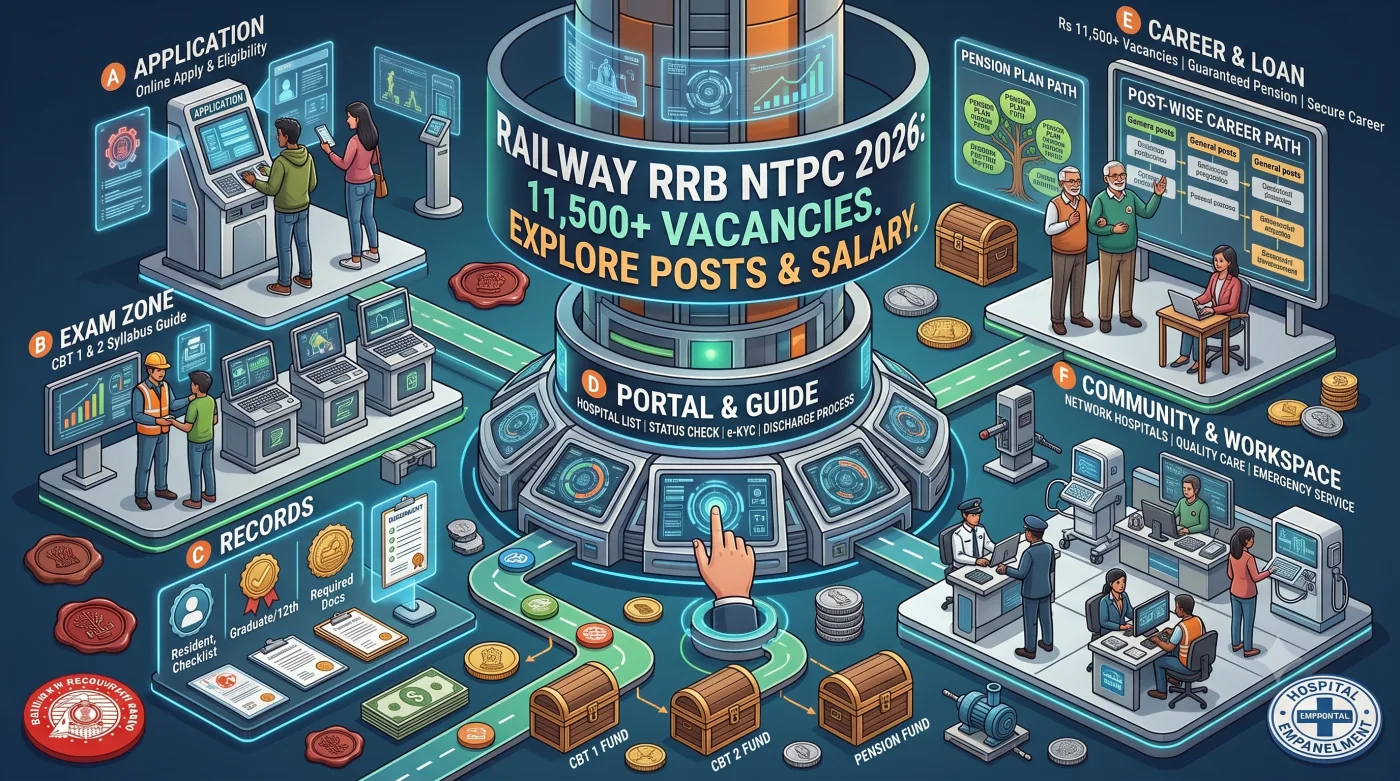
1. Legislative Framework & Operational Overview of Railway RRB NTPC 2026
The Railway Recruitment Board Non-Technical Popular Categories Examination (RRB NTPC 2026) is one of the most widely subscribed mass employment examinations across the globe, conducted under the aegis of the Railway Recruitment Control Board (RRCB), Ministry of Railways, Government of India. The examination serves as the direct pipeline for induction into critical traffic operations, revenue management, commercial booking, accounting administration, and train operations across all 17 Zonal Railways and Production Units spanning the Indian Railway network.
Every edition of the Centralized Employment Notice (CEN) for NTPC attracts over 1.25 crore applicants across 21 Railway Recruitment Boards (RRBs). The 2026 notification offers more than 11,558+ combined vacancies categorized into two distinct recruitment tiers: Graduate Level Cadres (Pay Level 5 and Level 6) and Undergraduate Level Cadres (10+2 Higher Secondary Pass - Pay Level 2 and Level 3). Appointments made through this examination offer competitive 7th Central Pay Commission compensation, lifelong Indian Railways pension benefits (under NPS), comprehensive medical coverage in Railway Hospitals under the Central Government Health Scheme/Railway Medical Rules, residential quarters, free railway travel passes (PTOs), and fast-track departmental promotional avenues into Group 'B' Gazetted railway officer ranks.
📢 रेलवे भर्ती बोर्ड गैर-तकनीकी लोकप्रिय श्रेणियां (RRB NTPC 2026): आधिकारिक सारांश
भारतीय रेल मंत्रालय के रेलवे भर्ती नियंत्रण बोर्ड (RRCB) द्वारा 21 आरआरबी जोन्स (जैसे- पटना, प्रयागराज, कोलकाता, मुंबई, भोपाल आदि) में 11,558 से अधिक पदों पर भर्ती हेतु केंद्रीकृत रोजगार अधिसूचना (CEN) जारी की गई है। इस भर्ती में स्नातक स्तर पर स्टेशन मास्टर (Station Master), गुड्स ट्रेन मैनेजर (Goods Train Manager) तथा 12वीं पास स्तर पर कमर्शियल कम टिकट क्लर्क, जूनियर क्लर्क कम टाइपिस्ट जैसे पदों पर चयन किया जाएगा। आवेदन की संपूर्ण प्रक्रिया रेलवे के एकीकृत डिजिटल पोर्टल rrbapply.gov.in के माध्यम से संचालित की जा रही है।
2. Post-Wise Classification, 7th CPC Pay Scale Matrix & Career Progression
Vacancies under RRB NTPC are structured across five distinct pay levels under the 7th Central Pay Commission hierarchy. Below is an exhaustive breakdown of cadre designations, starting basic salaries, monthly gross earnings, and requisite medical standards:
| Pay Level & Category | Post Designation | Prescribed Medical Standard | Starting Basic Pay | Estimated Gross Monthly Salary (X Cities) | Key Job Profile & Responsibilities |
|---|---|---|---|---|---|
| Pay Level 6 (Graduate Posts) |
Station Master (SM) | A-2 (Strict: 6/9 without glasses, no color blindness) | ₹35,400/- | ₹68,000 - ₹75,000/- (Includes Running/Night Duty Allowances) | Overall operational management of railway stations, signaling operations, train dispatching, and passenger safety. |
| Commercial Apprentice (CA) | B-2 | ₹35,400/- | ₹62,000 - ₹68,000/- | Senior supervisory commercial inspections, passenger ticketing supervision, parcel logistics, and revenue auditing. | |
| Pay Level 5 (Graduate Posts) |
Goods Train Manager (Formerly Goods Guard) | A-2 | ₹29,200/- | ₹60,000 - ₹72,000/- (High Running Allowance of ₹4.30/km) | In-charge of freight and container train operations, safety checks, brake van inspections, and emergency train halts. |
| Senior Commercial cum Ticket Clerk (Sr. CTC) | B-2 | ₹29,200/- | ₹52,000 - ₹58,000/- | Reservation counter supervision, computerized ticketing, luggage booking, and goods parcel monitoring. | |
| Senior Clerk cum Typist | C-2 | ₹29,200/- | ₹50,000 - ₹55,000/- | Administrative ministerial documentation, establishment bills, correspondence, and staff records in DRM/Zonal HQ offices. | |
| Junior Account Assistant cum Typist (JAA) | C-2 | ₹29,200/- | ₹50,000 - ₹55,000/- | Railway budget reconciliation, contractor bill clearances, pension calculations, and financial accounting ledgers. | |
| Pay Level 3 (Undergraduate Posts) |
Commercial cum Ticket Clerk (CC/TC) | B-2 | ₹21,700/- | ₹38,000 - ₹43,000/- | Ticketing window operations, unreserved ticketing system (UTS), passenger baggage booking, and train ticket examination. |
| Pay Level 2 (Undergraduate Posts) |
Junior Clerk cum Typist | C-2 | ₹19,900/- | ₹35,000 - ₹40,000/- | General clerical entries, file dispatch, typed administrative circulars, and departmental record keeping. |
| Accounts Clerk cum Typist | C-2 | ₹19,900/- | ₹35,000 - ₹40,000/- | Data entry of railway expenditure vouchers, internal audit registers, and payroll disbursements under FA&CAO. | |
| Trains Clerk (TC) | A-3 | ₹19,900/- | ₹36,000 - ₹41,000/- | Recording wagon numbers, freight train formations in marshalling yards, and rolling stock inventory documentation. |
*Note: Gross salary estimates are computed for 'X' Class cities (metropolises) incorporating 50% Dearness Allowance (DA), 30% House Rent Allowance (HRA), and Transport Allowance (TA). For Running Staff (Station Master and Goods Train Manager), gross pay is substantially higher due to Kilometer Running Allowance (KMA), National Holiday Allowance (NHA), and Night Duty Allowance (NDA).
3. Statutory Eligibility Standards: Age Limits, Relaxations & Academic Benchmarks
Candidates must ensure compliance with the following mandatory eligibility thresholds evaluated as on the official cut-off date:
A. Academic Educational Qualifications
- For Graduate Cadre Posts (Station Master, Goods Train Manager, Sr. Clerk, JAA, Commercial Apprentice): A Bachelor's Degree in any discipline from a recognized University or Institution incorporated by an Act of the Central or State Legislature in India. Final year candidates whose results are awaited on the application closing date are NOT eligible to apply.
- For Undergraduate Posts (Commercial cum Ticket Clerk, Accounts Clerk, Junior Clerk, Trains Clerk): Must have successfully passed 12th (+2 Stage) Higher Secondary Examination or equivalent from a recognized State/Central Board with not less than 50% marks in aggregate. The requirement of 50% marks is relaxed for Scheduled Castes (SC), Scheduled Tribes (ST), Persons with Benchmark Disabilities (PwBD), and Ex-Servicemen.
B. Crucial Age Limits & Central Government Relaxation Matrix
The Ministry of Railways granted a special 3-year age relaxation beyond standard limits as a one-time relief measure across both Graduate and Undergraduate notifications:
| Recruitment Category | Standard Age Bracket | Permissible Upper Age Limit (Inclusive of 3-Year Relaxation) |
|---|---|---|
| Undergraduate Posts (12th Pass) - General / UR / EWS | 18 to 30 Years | 18 to 33 Years |
| Graduate Posts (Degree Holders) - General / UR / EWS | 18 to 33 Years | 18 to 36 Years |
| OBC (Non-Creamy Layer) Candidates | +3 Years Relaxation | Up to 36 Years (12th Pass) / Up to 39 Years (Graduate) |
| SC / ST Candidates | +5 Years Relaxation | Up to 38 Years (12th Pass) / Up to 41 Years (Graduate) |
| Persons with Benchmark Disabilities (PwBD - UR) | +10 Years Relaxation | Up to 43 Years (12th Pass) / Up to 46 Years (Graduate) |
| Ex-Servicemen (ESM) | Service Rendered + 3 Years | Calculated by deducting actual military service from chronological age |
⚠️ महत्वपूर्ण विधिक सूचना: रेलवे ए-2 (A-2) मेडिकल फिटनेस एवं दृष्टि मानक (Medical Standard Alert)
भारतीय रेलवे में स्टेशन मास्टर (Station Master) एवं गुड्स ट्रेन मैनेजर (Goods Guard) के पदों पर चयन हेतु मेडिकल जांच अत्यंत कठोर होती है। इन पदों के लिए A-2 मेडिकल श्रेणी अनिवार्य है:
- दूर दृष्टि (Distant Vision): बिना चश्मे के (Without Glasses) दोनों आंखों की दृष्टि 6/9, 6/9 होना अनिवार्य है। यदि आपने लेसिक सर्जरी (LASIK Surgery) कराई है, तो रेलवे मेडिकल बोर्ड द्वारा जांच में पकड़े जाने पर सीधे अनफिट (Disqualified) कर दिया जाएगा।
- वर्णांधता (Color Blindness): कलर ब्लाइंड अथवा रतौंधी (Night Blindness) से पीड़ित अभ्यर्थी स्टेशन मास्टर और गार्ड पदों के लिए पूरी तरह अयोग्य हैं।
- उपाय: यदि आपकी आंखें कमजोर हैं और आप चश्मा लगाते हैं, तो फॉर्म भरते समय जूनियर क्लर्क, सीनियर क्लर्क, जूनियर अकाउंट असिस्टेंट अथवा कमर्शियल क्लर्क (Medical Standard C-2 / B-2) को अपनी पहली प्राथमिकता (1st Post Preference) चुनें, जहां चश्मा पूर्णतः मान्य है।
4. Multi-Stage Selection Process Architecture
The recruitment methodology under RRB NTPC involves four sequential stages designed to evaluate general cognitive proficiency, specialized subject knowledge, psychomotor operational reflexes, and document authenticity:
- First Stage Computer Based Test (CBT-1): A common preliminary screening test for all notified posts to shortlist candidates for Stage-2.
- Second Stage Computer Based Test (CBT-2): Separate CBT-2 examinations conducted for each respective Pay Level (Level 2, Level 3, Level 5, and Level 6). Candidates shortlisted for multiple levels appear in separate CBT-2 exams.
- Skill Tests (Post-Specific):
- Computer Based Aptitude Test (CBAT): Mandatory only for candidates opting for the post of Station Master (Level 6).
- Typing Skill Test (TST): Mandatory for Senior Clerk cum Typist, Junior Account Assistant cum Typist, Junior Clerk cum Typist, and Accounts Clerk cum Typist.
- No Skill Test: Posts like Commercial cum Ticket Clerk and Goods Train Manager proceed directly from CBT-2 to Document Verification!
- Document Verification (DV) & Comprehensive Medical Examination: Equal to the number of vacancies (1:1 ratio based on merit score in CBT-2 plus skill tests where applicable).
5. Detailed Examination Pattern & Marking Scheme (CBT-1 vs CBT-2)
Both examination stages utilize standardized objective multiple-choice questions administered via secure computer terminals:
Stage-1 Computer Based Test (CBT-1) Pattern (Common for All Posts)
| Test Subject Domain | Total Questions | Maximum Marks | Exam Duration | Negative Marking Penalty |
|---|---|---|---|---|
| General Awareness (Current Affairs, History, Science, Static GK) | 40 Questions | 40 Marks | 90 Minutes (120 Minutes for PwBD with Scribe) |
1/3rd (-0.33 Marks) deducted for each incorrect response |
| Mathematics (Arithmetic & Advanced Quant) | 30 Questions | 30 Marks | ||
| General Intelligence and Reasoning | 30 Questions | 30 Marks | ||
| Total (CBT-1 Screening) | 100 Questions | 100 Marks | 90 Minutes | Qualifying / Screening Filter |
Stage-2 Computer Based Test (CBT-2) Pattern (Post-Level Specific)
Candidates are shortlisted for CBT-2 at a ratio of 1:15 (15 times the total vacancies in each category for that specific pay level). The duration remains 90 minutes, but the question count increases to 120:
| Test Subject Domain | Total Questions | Maximum Marks | Exam Duration | Negative Marking Penalty |
|---|---|---|---|---|
| General Awareness | 50 Questions | 50 Marks | 90 Minutes (120 Minutes for PwBD with Scribe) |
1/3rd (-0.33 Marks) deducted for each incorrect response |
| Mathematics | 35 Questions | 35 Marks | ||
| General Intelligence and Reasoning | 35 Questions | 35 Marks | ||
| Total (CBT-2 Final Merit) | 120 Questions | 120 Marks | 90 Minutes | 100% Counts Towards Final Merit |
🧮 रेलवे नॉर्मलाइजेशन फॉर्मूला (Percentile Score & Normalization Methodology)
भारतीय रेलवे द्वारा विभिन्न शिफ्टों के प्रश्न पत्रों के कठिनाई स्तर को संतुलित करने के लिए परसेंटाइल-आधारित नॉर्मलाइजेशन फॉर्मूला (Percentile-Based Normalization) का उपयोग किया जाता है। इसके तहत किसी शिफ्ट में प्राप्त अंकों की तुलना उसी शिफ्ट के उच्चतम एवं औसत अंकों के आधार पर की जाती है। नॉर्मलाइजेशन के उपरांत तैयार अंतिम स्कोर कार्ड में अभ्यर्थी का रॉ स्कोर (Raw Marks), प्रो-रेटेड स्कोर (Pro-rated Marks) और अंतिम नॉर्मलाइज्ड परसेंटाइल स्पष्ट रूप से प्रदर्शित होता है।
6. Exhaustive Subject-Wise Syllabus Breakdown
Aspirants must structure their study schedule strictly based on the prescribed curriculum notified by the Railway Recruitment Boards:
A. Mathematics (30 Qs in CBT-1 / 35 Qs in CBT-2)
- Number System: Bodmas, Decimals, Fractions, LCM and HCF, Divisibility Rules, Prime Factorization, Surds and Indices, Rational and Irrational Numbers.
- Arithmetic: Ratio and Proportions, Percentages, Mensuration (Area, Perimeter, Surface Area, Volume of Cone, Cylinder, Sphere), Time and Work, Pipes and Cisterns, Time and Distance, Problems on Trains, Relative Speed, Simple and Compound Interest, Profit and Loss, Discount, Partnership.
- Advanced Mathematics: Elementary Algebra (Linear equations, Quadratic equations), Geometry (Triangles, Circles, Tangents, Polygons), Trigonometry (Trigonometric ratios, Standard values, Heights and Distances), Elementary Statistics (Calculation of Mean, Median, Mode, Standard Deviation, Variance).
B. General Intelligence and Reasoning (30 Qs in CBT-1 / 35 Qs in CBT-2)
- Analogies, Completion of Number and Alphabetical Series, Coding and Decoding, Mathematical Operations, Similarities and Differences, Relationships (Blood Relations), Analytical Reasoning, Syllogism, Jumbling, Venn Diagrams, Puzzle Solving, Data Sufficiency, Statement-Conclusion, Statement-Courses of Action, Decision Making, Maps, Interpretation of Graphs.
C. General Awareness (40 Qs in CBT-1 / 50 Qs in CBT-2)
- Current Events of National and International Importance: Major government initiatives, Summits, Bilateral treaties, Defense developments, Sports champions, Awards, Books and Authors.
- General Science & Life Science: Physics, Chemistry, Biology up to 10th standard CBSE level with strong focus on human physiology, nutrition, diseases, chemical formulas, and everyday physical laws.
- History of India and Freedom Struggle: Ancient Indus Valley Civilization, Vedic Period, Buddhism/Jainism, Mauryan & Gupta Empires, Medieval Delhi Sultanate & Mughal administration, 1857 Revolt, Indian National Congress sessions, Gandhian era movements, Partition and Independence.
- Physical, Social and Economic Geography of India and World: River systems, Mountain passes, National Parks, Mineral distribution, Soil types, Census 2011 demographics, Railway Zones and Headquarter locations.
- Indian Polity and Governance: Constitution of India, Fundamental Rights and Duties, Directive Principles, Parliamentary system, Supreme Court, President and Governor powers, Election Commission, CAG, NITI Aayog.
- Indian Railways Specific Knowledge: History of Indian Railways, Vande Bharat and Bullet train projects, Dedicated Freight Corridors (DFCCIL), Railway production units (CLW, DLW, RCF, ICF).
7. Computer Based Aptitude Test (CBAT) for Station Master Candidates
Candidates qualifying CBT-2 for Station Master (Level 6) must appear for the Computer Based Aptitude Test (CBAT). CBAT consists of 5 distinct Test Batteries designed to assess cognitive speed, directional orientation, spatial visualization, and psychomotor reflexes:
- Intelligence Test: Identifying embedded geometric patterns and classification logic under severe time constraints.
- Selective Attention Test: Rapid summation of odd numbers while ignoring distractions or identifying congruent visual sets.
- Spatial Scanning Test: Finding the shortest route between two stations on a complex track map without touching obstacles.
- Information Ordering Test: Algorithmic level-wise tracking of operational process flowcharts.
- Personality Test: Evaluation of stress handling, safety mindset, leadership, and crisis management decisions.
🔴 सीबीएटी (CBAT) में अनिवार्य टी-स्कोर (T-Score of 42 in Each Battery)
स्टेशन मास्टर पद के लिए यह नियम अत्यंत कठोर है कि अभ्यर्थी को प्रत्येक टेस्ट बैटरी (Each of the 5 Batteries) में कम से कम 42 का टी-स्कोर (T-Score) प्राप्त करना अनिवार्य है। यदि कोई अभ्यर्थी 4 बैटरियों में 60 स्कोर करता है लेकिन 5वीं बैटरी में उसका टी-स्कोर 41.9 रह जाता है, तो वह स्टेशन मास्टर पद की दौड़ से तुरंत बाहर हो जाएगा। सीबीएटी में कोई आरक्षण छूट नहीं मिलती। स्टेशन मास्टर की अंतिम मेरिट सूची में 70% वेटेज CBT-2 के अंकों का तथा 30% वेटेज CBAT के अंकों का जोड़कर मेरिट तैयार की जाती है।
8. Typing Skill Test (TST) Standards & Exemption Guidelines
For clerical and accounting posts (Senior Clerk, Junior Accounts Assistant, Junior Clerk, Accounts Clerk), qualifying the Typing Skill Test is mandatory:
- English Typing Speed: Minimum 30 Words Per Minute (WPM) on a standard computer keyboard without spell-check or editing aids.
- Hindi Typing Speed: Minimum 25 Words Per Minute (WPM) using either Kruti Dev or Mangal font (Inscript keyboard layout).
- Test Duration: Exactly 10 Minutes.
- Permissible Errors: A maximum of 5% errors of total words typed are ignored. Any error beyond 5% is penalized by subtracting 10 times the excess errors from the total words typed.
- Exemption for PwBD: Candidates permanently incapacitated from typing due to blindness, low vision, locomotor disability, or cerebral palsy are granted full exemption upon submitting an official disability certificate from a Medical Board.
9. Comprehensive List of 21 Railway Recruitment Boards (RRB Zone Directory)
Candidates can apply to ONLY ONE RRB throughout the application process. Multiple applications across different RRBs lead to automatic cancellation:
| Railway Recruitment Board | Jurisdiction Railway Zone | Official RRB Portal Link |
|---|---|---|
| RRB Ahmedabad | Western Railway (WR) | www.rrbahmedabad.gov.in |
| RRB Ajmer | North Western Railway (NWR) & WCR | www.rrbajmer.gov.in |
| RRB Prayagraj (Allahabad) | North Central Railway (NCR) & NR | www.rrbald.gov.in |
| RRB Bengaluru (Bangalore) | South Western Railway (SWR) | www.rrbbnc.gov.in |
| RRB Bhopal | West Central Railway (WCR) & WR | www.rrbbhopal.gov.in |
| RRB Bhubaneswar | East Coast Railway (ECoR) | www.rrbbbs.gov.in |
| RRB Bilaspur | South East Central Railway (SECR) | www.rrbbilaspur.gov.in |
| RRB Chandigarh | Northern Railway (NR) | www.rrbcdg.gov.in |
| RRB Chennai | Southern Railway (SR) | www.rrbchennai.gov.in |
| RRB Gorakhpur | North Eastern Railway (NER) | www.rrbgkp.gov.in |
| RRB Guwahati | Northeast Frontier Railway (NFR) | www.rrbguwahati.gov.in |
| RRB Jammu-Srinagar | Northern Railway (NR) | www.rrbjammu.nic.in |
| RRB Kolkata | Eastern Railway (ER) & South Eastern (SER) | www.rrbkolkata.gov.in |
| RRB Malda | Eastern Railway (ER) & NFR | www.rrbmalda.gov.in |
| RRB Mumbai | Central Railway (CR) & WR | www.rrbmumbai.gov.in |
| RRB Muzaffarpur | East Central Railway (ECR) | www.rrbmuzaffarpur.gov.in |
| RRB Patna | East Central Railway (ECR) | www.rrbpatna.gov.in |
| RRB Ranchi | South Eastern Railway (SER) & ECR | www.rrbranchi.gov.in |
| RRB Secunderabad | South Central Railway (SCR) | www.rrbsecunderabad.nic.in |
| RRB Siliguri | Northeast Frontier Railway (NFR) | www.rrbsiliguri.gov.in |
| RRB Thiruvananthapuram | Southern Railway (SR) | www.rrbthiruvananthapuram.gov.in |
🚆 तैयारी की स्वर्णिम रणनीति: रेलवे एनटीपीसी में सुनिश्चित सफलता के मूलमंत्र
रेलवे एनटीपीसी में चयन हेतु स्पीड और एक्यूरेसी (Speed & Accuracy) सबसे निर्णायक तत्व हैं। गणित और रीजनिंग में 100% एक्यूरेसी बनाए रखने के लिए रोजाना 50-50 प्रश्नों का अभ्यास करें तथा सामान्य अध्ययन (GA) में विज्ञान, भारतीय रेलवे का इतिहास, संविधान और पिछले 1 वर्ष के करेंट अफेयर्स पर विशेष पकड़ बनाएं। सीबीएटी साइको टेस्ट और टाइपिंग टेस्ट की तैयारी को परीक्षा के अंतिम दिनों तक टालने की भूल न करें; आज ही से अपने लक्ष्य के प्रति समर्पित होकर अध्ययन शुरू करें!
10. In-Depth Operational Profile & Responsibilities of Station Master & Goods Guard
Understanding the statutory operational requirements of Indian Railways' primary safety and traffic management cadres enables aspirants to appreciate the rigorous testing and medical standards enforced during recruitment:
A. Station Master: The Nerve Center of Railway Station Operations
The Station Master (SM - Pay Level 6) is the administrative and operational head of a railway station, bearing direct legal responsibility for the safe, punctual, and collision-free movement of passenger and freight trains within station limits:
- Signaling & Train Control Operations: Station Masters operate complex electronic Panel Interlocking (PI), Route Relay Interlocking (RRI), and Solid State Interlocking (SSI) consoles. Every route setting, track circuit clearance, and signal indication (Green, Double Yellow, Yellow, Red) is electronically or mechanically locked under strict fail-safe protocols.
- Absolute Block System Adherence: Under the General and Subsidiary Rules (G&SR) of Indian Railways, an SM cannot grant "Line Clear" to an approaching train until the preceding train has completely cleared the block section and the tail lamp/Last Vehicle (LV) board is physically verified.
- Emergency Incident Management: During rail fractures, overhead equipment (OHE) wire tripping, signal failures, or derailments, the Station Master coordinates immediate track isolation, imposes Emergency Caution Orders, alerts Railway Protection Force (RPF), and directs Accident Relief Trains (ART) and Medical Relief Vans (MRV).
- Commercial and Passenger Interface: At medium and smaller stations, the Station Master also supervises booking offices, parcel handling, passenger grievance redressal, and station cleanliness.
B. Goods Train Manager (Formerly Goods Guard): Guardian of Freight Corridors
The Goods Train Manager (Pay Level 5) is the joint-in-charge of freight operations alongside the Locomotive Pilot. Stationed inside the Brake Van (BV) at the extreme rear of trains measuring up to 700 meters and carrying loads exceeding 4,000 gross tonnes:
- Brake Power Certificate (BPC) Verification: Prior to departure from railway yards, the Goods Train Manager must jointly inspect the entire rake with train examiners (TXR) to ensure that the effective Brake Power percentage exceeds statutory operating thresholds (typically 85% to 90% for vacuum/air brake rakes).
- En-Route Continuity & Tail Lamp Vigilance: The Train Manager continuously monitors the train formation during motion for hot axles (hot axle box emits smoke/sparks), hanging parts, shifting cargo, and air pressure leakages via the brake pipe pressure gauge.
- Kilometer Running Allowance (KMA) Financial Benefits: Because the Goods Train Manager belongs to the operational 'Running Staff' category, they are entitled to generous running allowances currently pegged at approximately ₹4.30 per kilometer traveled. Train Managers clocking 3,000 to 5,000 kilometers per month earn an additional ₹15,000 to ₹25,000 monthly over and above their basic salary and DA.
🚆 भारतीय रेलवे रनिंग स्टाफ के विशेषाधिकार एवं भत्ते (Running Staff Special Allowances)
भारतीय रेलवे में गुड्स ट्रेन मैनेजर (गार्ड) और लोको पायलट को 'रर्निंग स्टाफ' (Running Staff) का विशेष विधिक दर्जा प्राप्त है। इसके तहत उन्हें सामान्य कर्मचारियों की तुलना में कई विशिष्ट वित्तीय लाभ मिलते हैं:
- किलोमीटर रनिंग अलाउंस (KMA): ट्रेन संचालन के दौरान तय की गई दूरी के आधार पर प्रति किलोमीटर ₹4.30 का अतिरिक्त भुगतान।
- आउटस्टेशन डिटेंशन अलाउंस (Outstation Detention Allowance): अपने गृह मुख्यालय (Home Depot) से दूर दूसरे स्टेशन के रनिंग रूम में 16 घंटे से अधिक रुकने पर विशेष भत्ता।
- पेंशन एवं ग्रेच्युटी में 55% का अतिरिक्त वेटेज: सेवानिवृत्ति (Retirement) के समय पेंशन और ग्रेच्युटी की गणना करते समय मूल वेतन (Basic Pay) में 55% रनिंग अलाउंस जोड़कर अंतिम भुगतान तय किया जाता है, जिससे उनकी पेंशन सामान्य कर्मचारियों से काफी अधिक बनती है।
11. Complete Step-by-Step Registration & Form Fill Process on rrbapply.gov.in
The Ministry of Railways streamlined all recruitment portals into a single unified cloud portal at https://rrbapply.gov.in/. Completing the online application requires precise execution across five standardized phases:
Phase 1: Creating an Account (Unified User Profile)
- Navigate to
https://rrbapply.gov.in/and click on "Apply" > "Create an Account". - Specify Country of Nationality (India), Full Legal Name as recorded on Matriculation (10th) Certificate, Father's Name, Mother's Name, Gender, and Date of Birth (DD/MM/YYYY).
- Enter active personal Email Address and Mobile Number. Generate and authenticate separate OTPs for both.
- Create a secure login password and submit. The system issues a unique Registration ID that remains valid for all future railway recruitment notifications (NTPC, Group D, ALP, Technician, RPF).
Phase 2: Entering Personal Particulars & Reservation Categories
- Log in using your registered Mobile/Email and Password.
- Input Marital Status, Religion, Mother Tongue, Choice of Examination Language (English, Hindi, Assamese, Bengali, Gujarati, Kannada, Konkani, Malayalam, Manipuri, Marathi, Odia, Punjabi, Tamil, Telugu, Urdu).
- Provide two permanent visible personal identification marks (e.g., "A scar on left forehead", "A black mole on right shoulder").
- Select Community Category: UR / SC / ST / OBC (Non-Creamy Layer) / EWS. If applying under OBC-NCL, provide Certificate Number, Issuing Authority, and Issue Date.
Phase 3: Educational Qualifications & Post Preference Matrix
- Select Matriculation (10th) Board, State, Roll Number, and Year of Passing.
- For Undergraduate posts, input 12th Standard Board, Stream, Roll Number, and aggregate percentage.
- For Graduate posts, add Bachelor's Degree details: Degree Name, University Name, Year of Passing, and final Percentage/CGPA.
- Post Preference Ordering: Carefully arrange your preferences among all eligible posts in your selected RRB Zone (e.g., 1st: Station Master, 2nd: Goods Train Manager, 3rd: Sr. Commercial Clerk, 4th: Sr. Clerk cum Typist, etc.).
Phase 4: Bank Account Details for Fee Refund
This is a critical step: enter your personal Savings Bank Account Details: Beneficiary Name, Account Number, Bank Name, and IFSC Code. Upon appearing in CBT-1, the refundable fee (₹400 for General/OBC and ₹250 for reserved categories) will be disbursed directly into this designated bank account through electronic clearing.
Phase 5: Digital Photograph, Signature & Final Submission
- Upload a sharp, color passport photograph taken within the last 30 days against a plain white background (File size: 30 KB to 70 KB in JPG/JPEG format). Hats, dark sunglasses, or selfies are rejected by automated optical filters.
- Upload scanned signature in running handwriting (NOT in capital letters) on white paper with black/blue ink (File size: 30 KB to 70 KB).
- Review the preview summary carefully, confirm the declaration, and proceed to the integrated SBI e-Pay / UPI payment gateway to pay the prescribed application fee.
- Save and securely print the finalized acknowledgment application form displaying the barcode and transaction reference number.
12. RRB Zone Selection Strategy: High Cutoff vs Low Cutoff Zones Analysis
Because candidates are restricted to choosing ONLY ONE RRB, strategic zone selection plays a vital role in determining qualification margins:
| Zone Competitiveness Tier | Railway Recruitment Boards (RRBs) | Historical CBT-1 Normalized Cutoff Range (UR) | Key Strategic Factors & Analysis |
|---|---|---|---|
| Tier-1: High Competition Zones | RRB Patna, RRB Prayagraj (Allahabad), RRB Chandigarh, RRB Kolkata, RRB Ranchi | 78 - 86 Marks | Extremely high applicant density from North and Eastern India; highest cutoffs in country. Requires 90%+ percentile performance. |
| Tier-2: Moderate Competition Zones | RRB Ajmer, RRB Bhopal, RRB Bilaspur, RRB Mumbai, RRB Secunderabad, RRB Gorakhpur | 70 - 77 Marks | Balanced vacancy count with moderate applicant density. Ideal for well-prepared aspirants seeking stable cutoff benchmarks. |
| Tier-3: Lower Competition Zones | RRB Malda, RRB Siliguri, RRB Guwahati, RRB Jammu-Srinagar, RRB Muzaffarpur, RRB Thiruvananthapuram | 62 - 69 Marks | Geographical distance or regional factors result in lower applicant-to-vacancy ratios. Provides significantly higher probability of clearing cutoff thresholds. |
User Discussion & Comments (0)
No comments yet. Be the first to leave a comment below!
Leave a Comment / Ask a Question: