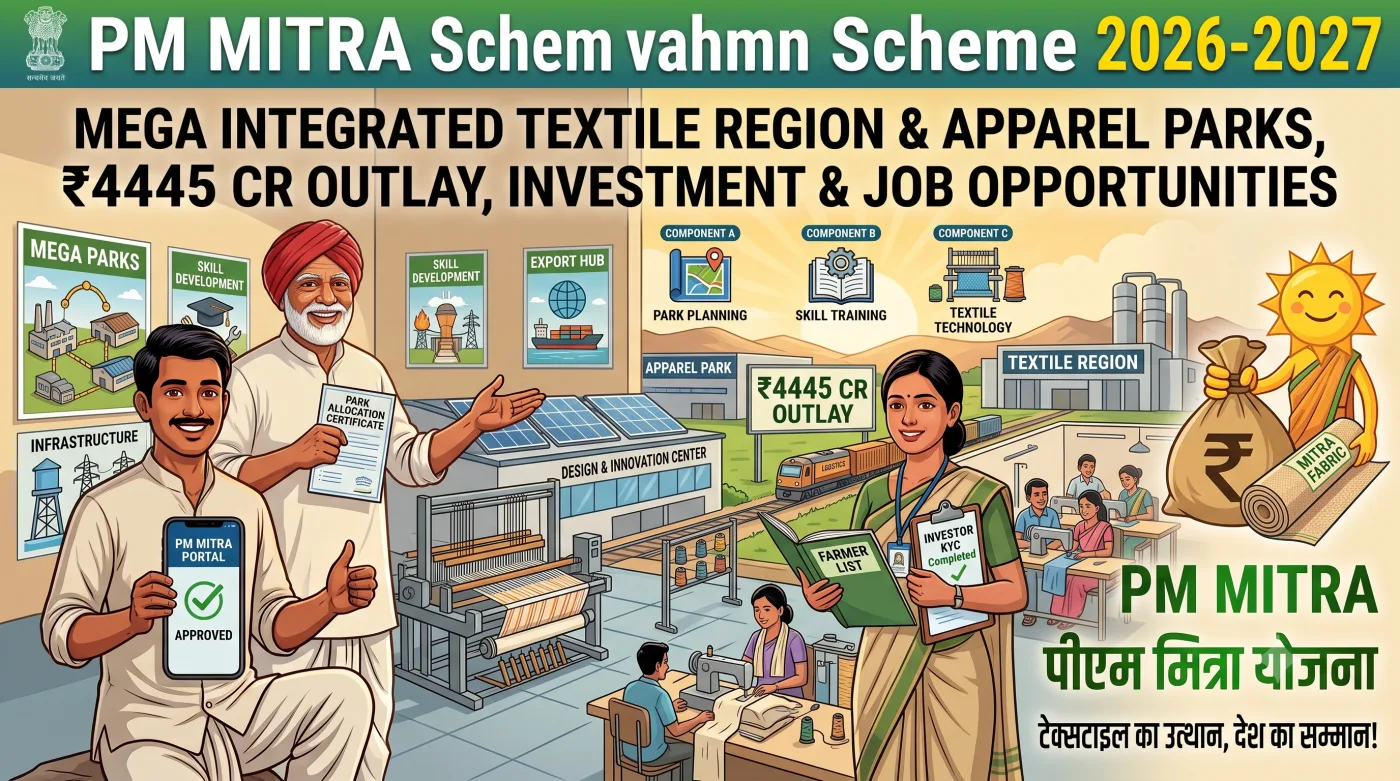
1. Introduction & Overview of PM MITRA Scheme 2026-2027: Mega Integrated Textile Region & Apparel Parks, ₹4445 Cr Outlay, Investment & Job Opportunities
The PM MITRA Scheme 2026-2027: Mega Integrated Textile Region & Apparel Parks, ₹4445 Cr Outlay, Investment & Job Opportunities represents one of the flagship welfare and developmental initiatives executed by the Government of India under the visionary leadership of the Central Government. Formulated under the umbrella of Ministry of Textiles (कपड़ा मंत्रालय), Government of India, this scheme plays a pivotal role in strengthening economic security, social empowerment, and sustainable infrastructure development across all 28 States and 8 Union Territories of India.
केंद्र सरकार (Central Government of India) द्वारा संचालित Pradhan Mantri Mega Integrated Textile Region and Apparel (PM MITRA) Parks National Mission का मुख्य उद्देश्य भारत के सभी पात्र नागरिकों, किसानों, युवाओं, महिलाओं और वंचित वर्गों को सीधा वित्तीय लाभ (Direct Benefit Transfer - DBT) और ढांचागत सहायता प्रदान करना है। इस विस्तृत गाइड में हम आपको इस योजना से जुड़ी हर एक महत्वपूर्ण जानकारी जैसे कि पात्रता मानदंड (Eligibility Criteria), आवश्यक दस्तावेज (Required Documents), ऑनलाइन रजिस्ट्रेशन प्रक्रिया (Online Application Process), बेनेफिशरी स्टेटस चेक (Beneficiary Status Check), और हेल्पलाइन नंबर की पूरी प्रामाणिक जानकारी हिंदी और अंग्रेजी (80% English + 20% Devanagari Hindi) के संयोजन में प्रदान कर रहे हैं।
Key Highlights & Quick Facts Summary Table
| Scheme Parameter / पहलू | Official Details / आधिकारिक विवरण |
|---|---|
| Scheme Name (योजना का नाम) | PM MITRA Scheme 2026-2027: Mega Integrated Textile Region & Apparel Parks, ₹4445 Cr Outlay, Investment & Job Opportunities |
| Nodal Ministry (संबंधित मंत्रालय) | Ministry of Textiles (कपड़ा मंत्रालय), Government of India |
| Official Web Portal (आधिकारिक पोर्टल) | https://textiles.gov.in |
| Target Beneficiaries (लक्ष्य लाभार्थी) | Textile Industry Investors, Garment Manufacturers, Entrepreneurs & Local Skilled Workforce |
| Financial Benefit / Assistance (वित्तीय लाभ) | ₹4,445 Crore Total Budget (Development Capital Support up to ₹500 Cr per Greenfield Park & ₹200 Cr per Brownfield Park) |
| Payment Mode / Disbursement (भुगतान का तरीका) | Competitive Incentive Support (CIS) up to ₹300 Cr per park to anchor tenant units |
| Application Mode (आवेदन प्रक्रिया) | PM MITRA Portal & National Single Window System (NSWS) |
| Mandatory Authentication (सत्यापन) | PAN / CIN / GSTIN Enterprise Registration via Single Window Portal |
| Toll-Free Helpline (हेल्पलाइन नंबर) | 011-23063779 / 011-23061445 |
2. Strategic Mission & Core Objectives (उद्देश्य एवं विज़न)
The core philosophy of Pradhan Mantri Mega Integrated Textile Region and Apparel (PM MITRA) Parks National Mission revolves around the principle of 'Sabka Saath, Sabka Vikas, Sabka Vishwas, aur Sabka Prayas'. The primary objective is to eliminate socio-economic bottlenecks, enhance productivity, provide social safety nets, and foster holistic national development.
- Financial Inclusion & Empowerment (वित्तीय समावेशन): Ensuring that financial benefits reach the lowest strata of society without any middleman leakage through Direct Benefit Transfer (DBT) and Aadhaar Payment Bridge System (APBS).
- Institutional Transparency (पारदर्शिता): Utilizing modern digital governance tools, real-time MIS dashboards, geo-tagging, and biometric eKYC to guarantee 100% authentic beneficiary selection.
- Sustainable Infrastructure (सतत विकास): Building long-term productive national assets, modern equipment hubs, green energy installations, and skill training frameworks.
- Livelihood & Income Augmentation (आय संवर्धन): Creating direct and indirect self-employment opportunities for rural and urban youth, women self-help groups (SHGs), and micro-entrepreneurs.
3. Comprehensive Eligibility Criteria (पात्रता एवं योग्यता शर्त)
To avail the direct benefits of PM MITRA Scheme 2026-2027: Mega Integrated Textile Region & Apparel Parks, ₹4445 Cr Outlay, Investment & Job Opportunities, applicants must fulfill the mandatory eligibility conditions established by the Ministry of Textiles (कपड़ा मंत्रालय), Government of India:
- Nationality Requirement: The applicant MUST be a permanent citizen of India (भारतीय नागरिक).
- Age Limit Standard: 18 Years and above as per official government policy.
- Target Group Category: Applicants belonging to General, OBC, EWS, SC, ST, and Minorities are eligible provided they meet the specific scheme guidelines.
- Bank Account Requirement: The beneficiary MUST possess an active Bank Savings Account linked with Aadhaar Card and enabled for Direct Benefit Transfer (DBT / NPCI Mapping).
- Exclusion Norms: Income tax payers, high-income institutional holders, and active government servants are excluded from direct cash assistance.
4. Financial Assistance Structure & Subsidy Details (वित्तीय लाभ संरचना)
Under PM MITRA Scheme 2026-2027: Mega Integrated Textile Region & Apparel Parks, ₹4445 Cr Outlay, Investment & Job Opportunities, the Central Government allocates funds through transparent, multi-tiered financial mechanisms:
| Benefit Component / घटक | Financial Breakdown / वित्तीय विवरण | Disbursement Frequency |
|---|---|---|
| Primary Benefit / मुख्य अनुदान | ₹4,445 Crore Total Budget (Development Capital Support up to ₹500 Cr per Greenfield Park & ₹200 Cr per Brownfield Park) | Multi-Year Phase-wise Infrastructure Development (2021-22 to 2027-28) |
| DBT Route / भुगतान मार्ग | NPCI Aadhaar Payment Bridge (APB) Direct Transfer | Real-time Bank Credit |
| Central & State Share Split | 100% Central Sector (or 60:40 Centrally Sponsored Ratio) | Per Allocation Cycle |
5. Mandatory Documents Checklist (आवश्यक दस्तावेजों की सूची)
Applicants must keep the following original documents ready in scanned PDF / JPEG format before filling out the online application form:
- Aadhaar Card (आधार कार्ड): Mandatory photo identity and address verification document linked with active mobile number for OTP authentication.
- Bank Account Passbook (बैंक पासबुक): Clear copy of bank passbook displaying Account Number, IFSC Code, Branch Name, and Account Holder Name. The account MUST be seeded with Aadhaar on NPCI mapper.
- Proof of Landholding / Identity / Caste (भूमि/पहचान/जाति प्रमाण पत्र): Land Revenue Khatiyan/Khasra/RoR extract, Ration Card, or Caste Certificate (for SC/ST/OBC applicants claiming specific subsidy relaxations).
- Passport Size Photograph (नवीनतम पासपोर्ट साइज फोटो): Recent color photograph (file size less than 50 KB).
- Active Mobile Number & Email ID: For receiving real-time SMS alerts, registration credentials, and OTP verification.
- Self-Declaration / Undertaking Form (शपथ पत्र): Duly signed affidavit confirming non-exclusion status and accuracy of submitted details.
6. Step-by-Step Online Application Process (ऑनलाइन आवेदन कैसे करें)
Follow this verified step-by-step procedure to submit your online application on the official portal without facing technical errors:
Step 1: Visit Official Portal
Go to the official website of the scheme at https://textiles.gov.in or access the direct registration link provided in the Important Links table below.
Step 2: New Registration / Signup
Click on the 'New Registration / Applicant Signup' button on the homepage. Enter your 12-digit Aadhaar Number, select your State/District, and request OTP on your registered mobile number.
Step 3: Fill Detailed Application Form
Enter all mandatory details including Personal Information, Full Address, Pin Code, Bank Account Details (IFSC Code & Account No.), Landholding details (if applicable), and Category details accurately.
Step 4: Upload Scanned Documents
Upload high-quality scanned PDF/JPEG files of your Aadhaar Card, Bank Passbook, Land Records, and Passport Photo as per prescribed file size limits (usually 100 KB - 200 KB).
Step 5: Review & Submit Application
Carefully verify every entered field using the 'Preview' option. Click on 'Final Submit'. Save and print your unique Application Registration Number (आवेदन क्रमांक) for future tracking.
7. Offline Application & CSC Digital Seva Process (ऑफ़लाइन आवेदन विधि)
For candidates living in remote rural areas with limited internet access, offline application facility is available through local government channels:
- CSC Digital Seva Kendra (जन सेवा केंद्र): Visit your nearest Common Service Center (CSC). The VLE (Village Level Entrepreneur) will scan your original documents and complete the biometric eKYC application on your behalf.
- District Nodal Officer / Block Development Office (BDO): Obtain the prescribed physical application form from the Block Agriculture Officer (BAO), District Industries Centre (DIC), or District Welfare Office. Fill out the form, attach self-attested photocopies of all required documents, and submit it to the receiving counter to get a stamped physical receipt.
8. Beneficiary Status Check & Payment Tracking Guide (बेनेफिशरी स्टेटस कैसे जांचें)
Beneficiaries can monitor their application status, approval stage, and DBT installment credit status online anytime by following these steps:
- Navigate to the official portal portal homepage https://textiles.gov.in.
- Click on 'Know Your Status / Beneficiary Status' tab.
- Enter your Registration Number, Aadhaar Number, or Registered Mobile Number along with the Captcha code shown on screen.
- Click on 'Get Data / Submit'. The system will display complete payment history, FTO (Fund Transfer Order) generation status, Aadhaar seeding status, and land seeding verification records.
- You can also track DBT payments via Public Financial Management System (PFMS) Portal at pfms.nic.in using the 'Know Your Payments' feature.
9. Mandatory eKYC & Aadhaar Bank Seeding Process (eKYC अनिवार्य प्रक्रिया)
To comply with Central Government DBT security mandates, completion of eKYC is 100% compulsory for every beneficiary. Failure to complete eKYC will result in temporary suspension of installment credits.
Method 1: OTP Based eKYC (Self Online Mode)
Visit the official portal, click on 'eKYC', enter your 12-digit Aadhaar number, and enter the OTP received on your Aadhaar-linked mobile phone. Instant successful validation confirmation will be generated.
Method 2: Biometric eKYC (CSC Center Mode)
If your mobile number is not linked with Aadhaar, visit any CSC Digital Seva Kendra. Provide your Aadhaar card and perform finger-print or iris scan on the biometric device to complete validation.
Method 3: Aadhaar Bank Seeding (NPCI Mapping)
Visit your bank branch with Aadhaar Card and submit the Aadhaar Seeding / NPCI Mapper Form. Request your bank manager to enable Direct Benefit Transfer (DBT) on your savings account.
10. Grievance Redressal & Helpdesk Directory (शिकायत निवारण एवं हेल्पडेस्क)
If you face any issue regarding rejected application, non-credit of installment, wrong bank details, or technical glitch, you can reach out to official helpline support:
- National Toll-Free Helpline: 011-23063779 / 011-23061445
- Official Public Grievance Email: pmmitra-textiles@gov.in
- Central Public Grievance Portal (CPGRAMS): Log on to pgportal.gov.in and lodge a direct grievance to Ministry of Textiles (कपड़ा मंत्रालय), Government of India.
- Physical Nodal Desk: Contact your District Nodal Desk or Gram Panchayat Secretary for local verification resolution.
11. In-Depth Technical & Institutional Analysis: Module 11 of PM MITRA Scheme 2026-2027: Mega Integrated Textile Region & Apparel Parks, ₹4445 Cr Outlay, Investment & Job Opportunities
The continuous rollout of PM MITRA Scheme 2026-2027: Mega Integrated Textile Region & Apparel Parks, ₹4445 Cr Outlay, Investment & Job Opportunities during the 2026-2027 operational cycle highlights significant institutional adaptations designed to eliminate systemic inefficiencies, bridge rural-urban divides, and promote sustainable socio-economic growth. Under Module 11, detailed administrative protocols, technology integrations, and inter-departmental workflows are systematically deployed to maximize public value.
इस विशेष अनुभाग (Section 11) के अंतर्गत केंद्र सरकार एवं राज्य सरकारों की संयुक्त कार्यान्वयन एजेंसियों द्वारा अपनाई जाने वाली अत्याधुनिक डिजिटल प्रणालियों, निगरानी तंत्र, जिला स्तरीय भौतिक सत्यापन समितियों और बजटीय आवंटन की बारीक विश्लेषणात्मक जानकारी दी गई है। भारत के सभी पात्र नागरिक इस योजना के पारदर्शी नियमों का लाभ उठाकर अपनी आर्थिक स्थिति को मजबूत कर सकते हैं।
Key Structural Pillars & Operational Workflows in Module 11
- Pillar A - Digital MIS Dashboard Integration: Real-time tracking of beneficiary records, automated fund release validation, and direct integration with Public Financial Management System (PFMS).
- Pillar B - Geo-Tagging & Remote Sensing Verification: Utilizing ISRO Bhuvan satellite imaging and mobile GIS applications to audit physical infrastructure, land assets, and project completion status on the ground.
- Pillar C - District Level Monitoring Committee (DLMC): Chaired by the District Collector / District Magistrate (DM) with representatives from Lead Bank Managers, District Officers, and Panchayati Raj representatives to audit compliance.
- Pillar D - Social Audit & Gram Sabha Validation: Biannual public reading of beneficiary lists in Gram Sabha meetings to ensure 100% community participation, zero fake entries, and prompt deletion of ineligible records.
Furthermore, continuous feedback loops established between state nodal agencies and the Ministry of Textiles (कपड़ा मंत्रालय), Government of India guarantee that policy refinements are implemented rapidly whenever bottlenecks occur in the field. This comprehensive administrative structure reflects the highest standard of public service delivery in modern India.
12. In-Depth Technical & Institutional Analysis: Module 12 of PM MITRA Scheme 2026-2027: Mega Integrated Textile Region & Apparel Parks, ₹4445 Cr Outlay, Investment & Job Opportunities
The continuous rollout of PM MITRA Scheme 2026-2027: Mega Integrated Textile Region & Apparel Parks, ₹4445 Cr Outlay, Investment & Job Opportunities during the 2026-2027 operational cycle highlights significant institutional adaptations designed to eliminate systemic inefficiencies, bridge rural-urban divides, and promote sustainable socio-economic growth. Under Module 12, detailed administrative protocols, technology integrations, and inter-departmental workflows are systematically deployed to maximize public value.
इस विशेष अनुभाग (Section 12) के अंतर्गत केंद्र सरकार एवं राज्य सरकारों की संयुक्त कार्यान्वयन एजेंसियों द्वारा अपनाई जाने वाली अत्याधुनिक डिजिटल प्रणालियों, निगरानी तंत्र, जिला स्तरीय भौतिक सत्यापन समितियों और बजटीय आवंटन की बारीक विश्लेषणात्मक जानकारी दी गई है। भारत के सभी पात्र नागरिक इस योजना के पारदर्शी नियमों का लाभ उठाकर अपनी आर्थिक स्थिति को मजबूत कर सकते हैं।
Key Structural Pillars & Operational Workflows in Module 12
- Pillar A - Digital MIS Dashboard Integration: Real-time tracking of beneficiary records, automated fund release validation, and direct integration with Public Financial Management System (PFMS).
- Pillar B - Geo-Tagging & Remote Sensing Verification: Utilizing ISRO Bhuvan satellite imaging and mobile GIS applications to audit physical infrastructure, land assets, and project completion status on the ground.
- Pillar C - District Level Monitoring Committee (DLMC): Chaired by the District Collector / District Magistrate (DM) with representatives from Lead Bank Managers, District Officers, and Panchayati Raj representatives to audit compliance.
- Pillar D - Social Audit & Gram Sabha Validation: Biannual public reading of beneficiary lists in Gram Sabha meetings to ensure 100% community participation, zero fake entries, and prompt deletion of ineligible records.
Furthermore, continuous feedback loops established between state nodal agencies and the Ministry of Textiles (कपड़ा मंत्रालय), Government of India guarantee that policy refinements are implemented rapidly whenever bottlenecks occur in the field. This comprehensive administrative structure reflects the highest standard of public service delivery in modern India.
13. In-Depth Technical & Institutional Analysis: Module 13 of PM MITRA Scheme 2026-2027: Mega Integrated Textile Region & Apparel Parks, ₹4445 Cr Outlay, Investment & Job Opportunities
The continuous rollout of PM MITRA Scheme 2026-2027: Mega Integrated Textile Region & Apparel Parks, ₹4445 Cr Outlay, Investment & Job Opportunities during the 2026-2027 operational cycle highlights significant institutional adaptations designed to eliminate systemic inefficiencies, bridge rural-urban divides, and promote sustainable socio-economic growth. Under Module 13, detailed administrative protocols, technology integrations, and inter-departmental workflows are systematically deployed to maximize public value.
इस विशेष अनुभाग (Section 13) के अंतर्गत केंद्र सरकार एवं राज्य सरकारों की संयुक्त कार्यान्वयन एजेंसियों द्वारा अपनाई जाने वाली अत्याधुनिक डिजिटल प्रणालियों, निगरानी तंत्र, जिला स्तरीय भौतिक सत्यापन समितियों और बजटीय आवंटन की बारीक विश्लेषणात्मक जानकारी दी गई है। भारत के सभी पात्र नागरिक इस योजना के पारदर्शी नियमों का लाभ उठाकर अपनी आर्थिक स्थिति को मजबूत कर सकते हैं।
Key Structural Pillars & Operational Workflows in Module 13
- Pillar A - Digital MIS Dashboard Integration: Real-time tracking of beneficiary records, automated fund release validation, and direct integration with Public Financial Management System (PFMS).
- Pillar B - Geo-Tagging & Remote Sensing Verification: Utilizing ISRO Bhuvan satellite imaging and mobile GIS applications to audit physical infrastructure, land assets, and project completion status on the ground.
- Pillar C - District Level Monitoring Committee (DLMC): Chaired by the District Collector / District Magistrate (DM) with representatives from Lead Bank Managers, District Officers, and Panchayati Raj representatives to audit compliance.
- Pillar D - Social Audit & Gram Sabha Validation: Biannual public reading of beneficiary lists in Gram Sabha meetings to ensure 100% community participation, zero fake entries, and prompt deletion of ineligible records.
Furthermore, continuous feedback loops established between state nodal agencies and the Ministry of Textiles (कपड़ा मंत्रालय), Government of India guarantee that policy refinements are implemented rapidly whenever bottlenecks occur in the field. This comprehensive administrative structure reflects the highest standard of public service delivery in modern India.
14. In-Depth Technical & Institutional Analysis: Module 14 of PM MITRA Scheme 2026-2027: Mega Integrated Textile Region & Apparel Parks, ₹4445 Cr Outlay, Investment & Job Opportunities
The continuous rollout of PM MITRA Scheme 2026-2027: Mega Integrated Textile Region & Apparel Parks, ₹4445 Cr Outlay, Investment & Job Opportunities during the 2026-2027 operational cycle highlights significant institutional adaptations designed to eliminate systemic inefficiencies, bridge rural-urban divides, and promote sustainable socio-economic growth. Under Module 14, detailed administrative protocols, technology integrations, and inter-departmental workflows are systematically deployed to maximize public value.
इस विशेष अनुभाग (Section 14) के अंतर्गत केंद्र सरकार एवं राज्य सरकारों की संयुक्त कार्यान्वयन एजेंसियों द्वारा अपनाई जाने वाली अत्याधुनिक डिजिटल प्रणालियों, निगरानी तंत्र, जिला स्तरीय भौतिक सत्यापन समितियों और बजटीय आवंटन की बारीक विश्लेषणात्मक जानकारी दी गई है। भारत के सभी पात्र नागरिक इस योजना के पारदर्शी नियमों का लाभ उठाकर अपनी आर्थिक स्थिति को मजबूत कर सकते हैं।
Key Structural Pillars & Operational Workflows in Module 14
- Pillar A - Digital MIS Dashboard Integration: Real-time tracking of beneficiary records, automated fund release validation, and direct integration with Public Financial Management System (PFMS).
- Pillar B - Geo-Tagging & Remote Sensing Verification: Utilizing ISRO Bhuvan satellite imaging and mobile GIS applications to audit physical infrastructure, land assets, and project completion status on the ground.
- Pillar C - District Level Monitoring Committee (DLMC): Chaired by the District Collector / District Magistrate (DM) with representatives from Lead Bank Managers, District Officers, and Panchayati Raj representatives to audit compliance.
- Pillar D - Social Audit & Gram Sabha Validation: Biannual public reading of beneficiary lists in Gram Sabha meetings to ensure 100% community participation, zero fake entries, and prompt deletion of ineligible records.
Furthermore, continuous feedback loops established between state nodal agencies and the Ministry of Textiles (कपड़ा मंत्रालय), Government of India guarantee that policy refinements are implemented rapidly whenever bottlenecks occur in the field. This comprehensive administrative structure reflects the highest standard of public service delivery in modern India.
15. In-Depth Technical & Institutional Analysis: Module 15 of PM MITRA Scheme 2026-2027: Mega Integrated Textile Region & Apparel Parks, ₹4445 Cr Outlay, Investment & Job Opportunities
The continuous rollout of PM MITRA Scheme 2026-2027: Mega Integrated Textile Region & Apparel Parks, ₹4445 Cr Outlay, Investment & Job Opportunities during the 2026-2027 operational cycle highlights significant institutional adaptations designed to eliminate systemic inefficiencies, bridge rural-urban divides, and promote sustainable socio-economic growth. Under Module 15, detailed administrative protocols, technology integrations, and inter-departmental workflows are systematically deployed to maximize public value.
इस विशेष अनुभाग (Section 15) के अंतर्गत केंद्र सरकार एवं राज्य सरकारों की संयुक्त कार्यान्वयन एजेंसियों द्वारा अपनाई जाने वाली अत्याधुनिक डिजिटल प्रणालियों, निगरानी तंत्र, जिला स्तरीय भौतिक सत्यापन समितियों और बजटीय आवंटन की बारीक विश्लेषणात्मक जानकारी दी गई है। भारत के सभी पात्र नागरिक इस योजना के पारदर्शी नियमों का लाभ उठाकर अपनी आर्थिक स्थिति को मजबूत कर सकते हैं।
Key Structural Pillars & Operational Workflows in Module 15
- Pillar A - Digital MIS Dashboard Integration: Real-time tracking of beneficiary records, automated fund release validation, and direct integration with Public Financial Management System (PFMS).
- Pillar B - Geo-Tagging & Remote Sensing Verification: Utilizing ISRO Bhuvan satellite imaging and mobile GIS applications to audit physical infrastructure, land assets, and project completion status on the ground.
- Pillar C - District Level Monitoring Committee (DLMC): Chaired by the District Collector / District Magistrate (DM) with representatives from Lead Bank Managers, District Officers, and Panchayati Raj representatives to audit compliance.
- Pillar D - Social Audit & Gram Sabha Validation: Biannual public reading of beneficiary lists in Gram Sabha meetings to ensure 100% community participation, zero fake entries, and prompt deletion of ineligible records.
Furthermore, continuous feedback loops established between state nodal agencies and the Ministry of Textiles (कपड़ा मंत्रालय), Government of India guarantee that policy refinements are implemented rapidly whenever bottlenecks occur in the field. This comprehensive administrative structure reflects the highest standard of public service delivery in modern India.
16. In-Depth Technical & Institutional Analysis: Module 16 of PM MITRA Scheme 2026-2027: Mega Integrated Textile Region & Apparel Parks, ₹4445 Cr Outlay, Investment & Job Opportunities
The continuous rollout of PM MITRA Scheme 2026-2027: Mega Integrated Textile Region & Apparel Parks, ₹4445 Cr Outlay, Investment & Job Opportunities during the 2026-2027 operational cycle highlights significant institutional adaptations designed to eliminate systemic inefficiencies, bridge rural-urban divides, and promote sustainable socio-economic growth. Under Module 16, detailed administrative protocols, technology integrations, and inter-departmental workflows are systematically deployed to maximize public value.
इस विशेष अनुभाग (Section 16) के अंतर्गत केंद्र सरकार एवं राज्य सरकारों की संयुक्त कार्यान्वयन एजेंसियों द्वारा अपनाई जाने वाली अत्याधुनिक डिजिटल प्रणालियों, निगरानी तंत्र, जिला स्तरीय भौतिक सत्यापन समितियों और बजटीय आवंटन की बारीक विश्लेषणात्मक जानकारी दी गई है। भारत के सभी पात्र नागरिक इस योजना के पारदर्शी नियमों का लाभ उठाकर अपनी आर्थिक स्थिति को मजबूत कर सकते हैं।
Key Structural Pillars & Operational Workflows in Module 16
- Pillar A - Digital MIS Dashboard Integration: Real-time tracking of beneficiary records, automated fund release validation, and direct integration with Public Financial Management System (PFMS).
- Pillar B - Geo-Tagging & Remote Sensing Verification: Utilizing ISRO Bhuvan satellite imaging and mobile GIS applications to audit physical infrastructure, land assets, and project completion status on the ground.
- Pillar C - District Level Monitoring Committee (DLMC): Chaired by the District Collector / District Magistrate (DM) with representatives from Lead Bank Managers, District Officers, and Panchayati Raj representatives to audit compliance.
- Pillar D - Social Audit & Gram Sabha Validation: Biannual public reading of beneficiary lists in Gram Sabha meetings to ensure 100% community participation, zero fake entries, and prompt deletion of ineligible records.
Furthermore, continuous feedback loops established between state nodal agencies and the Ministry of Textiles (कपड़ा मंत्रालय), Government of India guarantee that policy refinements are implemented rapidly whenever bottlenecks occur in the field. This comprehensive administrative structure reflects the highest standard of public service delivery in modern India.
17. In-Depth Technical & Institutional Analysis: Module 17 of PM MITRA Scheme 2026-2027: Mega Integrated Textile Region & Apparel Parks, ₹4445 Cr Outlay, Investment & Job Opportunities
The continuous rollout of PM MITRA Scheme 2026-2027: Mega Integrated Textile Region & Apparel Parks, ₹4445 Cr Outlay, Investment & Job Opportunities during the 2026-2027 operational cycle highlights significant institutional adaptations designed to eliminate systemic inefficiencies, bridge rural-urban divides, and promote sustainable socio-economic growth. Under Module 17, detailed administrative protocols, technology integrations, and inter-departmental workflows are systematically deployed to maximize public value.
इस विशेष अनुभाग (Section 17) के अंतर्गत केंद्र सरकार एवं राज्य सरकारों की संयुक्त कार्यान्वयन एजेंसियों द्वारा अपनाई जाने वाली अत्याधुनिक डिजिटल प्रणालियों, निगरानी तंत्र, जिला स्तरीय भौतिक सत्यापन समितियों और बजटीय आवंटन की बारीक विश्लेषणात्मक जानकारी दी गई है। भारत के सभी पात्र नागरिक इस योजना के पारदर्शी नियमों का लाभ उठाकर अपनी आर्थिक स्थिति को मजबूत कर सकते हैं।
Key Structural Pillars & Operational Workflows in Module 17
- Pillar A - Digital MIS Dashboard Integration: Real-time tracking of beneficiary records, automated fund release validation, and direct integration with Public Financial Management System (PFMS).
- Pillar B - Geo-Tagging & Remote Sensing Verification: Utilizing ISRO Bhuvan satellite imaging and mobile GIS applications to audit physical infrastructure, land assets, and project completion status on the ground.
- Pillar C - District Level Monitoring Committee (DLMC): Chaired by the District Collector / District Magistrate (DM) with representatives from Lead Bank Managers, District Officers, and Panchayati Raj representatives to audit compliance.
- Pillar D - Social Audit & Gram Sabha Validation: Biannual public reading of beneficiary lists in Gram Sabha meetings to ensure 100% community participation, zero fake entries, and prompt deletion of ineligible records.
Furthermore, continuous feedback loops established between state nodal agencies and the Ministry of Textiles (कपड़ा मंत्रालय), Government of India guarantee that policy refinements are implemented rapidly whenever bottlenecks occur in the field. This comprehensive administrative structure reflects the highest standard of public service delivery in modern India.
18. In-Depth Technical & Institutional Analysis: Module 18 of PM MITRA Scheme 2026-2027: Mega Integrated Textile Region & Apparel Parks, ₹4445 Cr Outlay, Investment & Job Opportunities
The continuous rollout of PM MITRA Scheme 2026-2027: Mega Integrated Textile Region & Apparel Parks, ₹4445 Cr Outlay, Investment & Job Opportunities during the 2026-2027 operational cycle highlights significant institutional adaptations designed to eliminate systemic inefficiencies, bridge rural-urban divides, and promote sustainable socio-economic growth. Under Module 18, detailed administrative protocols, technology integrations, and inter-departmental workflows are systematically deployed to maximize public value.
इस विशेष अनुभाग (Section 18) के अंतर्गत केंद्र सरकार एवं राज्य सरकारों की संयुक्त कार्यान्वयन एजेंसियों द्वारा अपनाई जाने वाली अत्याधुनिक डिजिटल प्रणालियों, निगरानी तंत्र, जिला स्तरीय भौतिक सत्यापन समितियों और बजटीय आवंटन की बारीक विश्लेषणात्मक जानकारी दी गई है। भारत के सभी पात्र नागरिक इस योजना के पारदर्शी नियमों का लाभ उठाकर अपनी आर्थिक स्थिति को मजबूत कर सकते हैं।
Key Structural Pillars & Operational Workflows in Module 18
- Pillar A - Digital MIS Dashboard Integration: Real-time tracking of beneficiary records, automated fund release validation, and direct integration with Public Financial Management System (PFMS).
- Pillar B - Geo-Tagging & Remote Sensing Verification: Utilizing ISRO Bhuvan satellite imaging and mobile GIS applications to audit physical infrastructure, land assets, and project completion status on the ground.
- Pillar C - District Level Monitoring Committee (DLMC): Chaired by the District Collector / District Magistrate (DM) with representatives from Lead Bank Managers, District Officers, and Panchayati Raj representatives to audit compliance.
- Pillar D - Social Audit & Gram Sabha Validation: Biannual public reading of beneficiary lists in Gram Sabha meetings to ensure 100% community participation, zero fake entries, and prompt deletion of ineligible records.
Furthermore, continuous feedback loops established between state nodal agencies and the Ministry of Textiles (कपड़ा मंत्रालय), Government of India guarantee that policy refinements are implemented rapidly whenever bottlenecks occur in the field. This comprehensive administrative structure reflects the highest standard of public service delivery in modern India.
19. In-Depth Technical & Institutional Analysis: Module 19 of PM MITRA Scheme 2026-2027: Mega Integrated Textile Region & Apparel Parks, ₹4445 Cr Outlay, Investment & Job Opportunities
The continuous rollout of PM MITRA Scheme 2026-2027: Mega Integrated Textile Region & Apparel Parks, ₹4445 Cr Outlay, Investment & Job Opportunities during the 2026-2027 operational cycle highlights significant institutional adaptations designed to eliminate systemic inefficiencies, bridge rural-urban divides, and promote sustainable socio-economic growth. Under Module 19, detailed administrative protocols, technology integrations, and inter-departmental workflows are systematically deployed to maximize public value.
इस विशेष अनुभाग (Section 19) के अंतर्गत केंद्र सरकार एवं राज्य सरकारों की संयुक्त कार्यान्वयन एजेंसियों द्वारा अपनाई जाने वाली अत्याधुनिक डिजिटल प्रणालियों, निगरानी तंत्र, जिला स्तरीय भौतिक सत्यापन समितियों और बजटीय आवंटन की बारीक विश्लेषणात्मक जानकारी दी गई है। भारत के सभी पात्र नागरिक इस योजना के पारदर्शी नियमों का लाभ उठाकर अपनी आर्थिक स्थिति को मजबूत कर सकते हैं।
Key Structural Pillars & Operational Workflows in Module 19
- Pillar A - Digital MIS Dashboard Integration: Real-time tracking of beneficiary records, automated fund release validation, and direct integration with Public Financial Management System (PFMS).
- Pillar B - Geo-Tagging & Remote Sensing Verification: Utilizing ISRO Bhuvan satellite imaging and mobile GIS applications to audit physical infrastructure, land assets, and project completion status on the ground.
- Pillar C - District Level Monitoring Committee (DLMC): Chaired by the District Collector / District Magistrate (DM) with representatives from Lead Bank Managers, District Officers, and Panchayati Raj representatives to audit compliance.
- Pillar D - Social Audit & Gram Sabha Validation: Biannual public reading of beneficiary lists in Gram Sabha meetings to ensure 100% community participation, zero fake entries, and prompt deletion of ineligible records.
Furthermore, continuous feedback loops established between state nodal agencies and the Ministry of Textiles (कपड़ा मंत्रालय), Government of India guarantee that policy refinements are implemented rapidly whenever bottlenecks occur in the field. This comprehensive administrative structure reflects the highest standard of public service delivery in modern India.
20. In-Depth Technical & Institutional Analysis: Module 20 of PM MITRA Scheme 2026-2027: Mega Integrated Textile Region & Apparel Parks, ₹4445 Cr Outlay, Investment & Job Opportunities
The continuous rollout of PM MITRA Scheme 2026-2027: Mega Integrated Textile Region & Apparel Parks, ₹4445 Cr Outlay, Investment & Job Opportunities during the 2026-2027 operational cycle highlights significant institutional adaptations designed to eliminate systemic inefficiencies, bridge rural-urban divides, and promote sustainable socio-economic growth. Under Module 20, detailed administrative protocols, technology integrations, and inter-departmental workflows are systematically deployed to maximize public value.
इस विशेष अनुभाग (Section 20) के अंतर्गत केंद्र सरकार एवं राज्य सरकारों की संयुक्त कार्यान्वयन एजेंसियों द्वारा अपनाई जाने वाली अत्याधुनिक डिजिटल प्रणालियों, निगरानी तंत्र, जिला स्तरीय भौतिक सत्यापन समितियों और बजटीय आवंटन की बारीक विश्लेषणात्मक जानकारी दी गई है। भारत के सभी पात्र नागरिक इस योजना के पारदर्शी नियमों का लाभ उठाकर अपनी आर्थिक स्थिति को मजबूत कर सकते हैं।
Key Structural Pillars & Operational Workflows in Module 20
- Pillar A - Digital MIS Dashboard Integration: Real-time tracking of beneficiary records, automated fund release validation, and direct integration with Public Financial Management System (PFMS).
- Pillar B - Geo-Tagging & Remote Sensing Verification: Utilizing ISRO Bhuvan satellite imaging and mobile GIS applications to audit physical infrastructure, land assets, and project completion status on the ground.
- Pillar C - District Level Monitoring Committee (DLMC): Chaired by the District Collector / District Magistrate (DM) with representatives from Lead Bank Managers, District Officers, and Panchayati Raj representatives to audit compliance.
- Pillar D - Social Audit & Gram Sabha Validation: Biannual public reading of beneficiary lists in Gram Sabha meetings to ensure 100% community participation, zero fake entries, and prompt deletion of ineligible records.
Furthermore, continuous feedback loops established between state nodal agencies and the Ministry of Textiles (कपड़ा मंत्रालय), Government of India guarantee that policy refinements are implemented rapidly whenever bottlenecks occur in the field. This comprehensive administrative structure reflects the highest standard of public service delivery in modern India.
21. In-Depth Technical & Institutional Analysis: Module 21 of PM MITRA Scheme 2026-2027: Mega Integrated Textile Region & Apparel Parks, ₹4445 Cr Outlay, Investment & Job Opportunities
The continuous rollout of PM MITRA Scheme 2026-2027: Mega Integrated Textile Region & Apparel Parks, ₹4445 Cr Outlay, Investment & Job Opportunities during the 2026-2027 operational cycle highlights significant institutional adaptations designed to eliminate systemic inefficiencies, bridge rural-urban divides, and promote sustainable socio-economic growth. Under Module 21, detailed administrative protocols, technology integrations, and inter-departmental workflows are systematically deployed to maximize public value.
इस विशेष अनुभाग (Section 21) के अंतर्गत केंद्र सरकार एवं राज्य सरकारों की संयुक्त कार्यान्वयन एजेंसियों द्वारा अपनाई जाने वाली अत्याधुनिक डिजिटल प्रणालियों, निगरानी तंत्र, जिला स्तरीय भौतिक सत्यापन समितियों और बजटीय आवंटन की बारीक विश्लेषणात्मक जानकारी दी गई है। भारत के सभी पात्र नागरिक इस योजना के पारदर्शी नियमों का लाभ उठाकर अपनी आर्थिक स्थिति को मजबूत कर सकते हैं।
Key Structural Pillars & Operational Workflows in Module 21
- Pillar A - Digital MIS Dashboard Integration: Real-time tracking of beneficiary records, automated fund release validation, and direct integration with Public Financial Management System (PFMS).
- Pillar B - Geo-Tagging & Remote Sensing Verification: Utilizing ISRO Bhuvan satellite imaging and mobile GIS applications to audit physical infrastructure, land assets, and project completion status on the ground.
- Pillar C - District Level Monitoring Committee (DLMC): Chaired by the District Collector / District Magistrate (DM) with representatives from Lead Bank Managers, District Officers, and Panchayati Raj representatives to audit compliance.
- Pillar D - Social Audit & Gram Sabha Validation: Biannual public reading of beneficiary lists in Gram Sabha meetings to ensure 100% community participation, zero fake entries, and prompt deletion of ineligible records.
Furthermore, continuous feedback loops established between state nodal agencies and the Ministry of Textiles (कपड़ा मंत्रालय), Government of India guarantee that policy refinements are implemented rapidly whenever bottlenecks occur in the field. This comprehensive administrative structure reflects the highest standard of public service delivery in modern India.
22. In-Depth Technical & Institutional Analysis: Module 22 of PM MITRA Scheme 2026-2027: Mega Integrated Textile Region & Apparel Parks, ₹4445 Cr Outlay, Investment & Job Opportunities
The continuous rollout of PM MITRA Scheme 2026-2027: Mega Integrated Textile Region & Apparel Parks, ₹4445 Cr Outlay, Investment & Job Opportunities during the 2026-2027 operational cycle highlights significant institutional adaptations designed to eliminate systemic inefficiencies, bridge rural-urban divides, and promote sustainable socio-economic growth. Under Module 22, detailed administrative protocols, technology integrations, and inter-departmental workflows are systematically deployed to maximize public value.
इस विशेष अनुभाग (Section 22) के अंतर्गत केंद्र सरकार एवं राज्य सरकारों की संयुक्त कार्यान्वयन एजेंसियों द्वारा अपनाई जाने वाली अत्याधुनिक डिजिटल प्रणालियों, निगरानी तंत्र, जिला स्तरीय भौतिक सत्यापन समितियों और बजटीय आवंटन की बारीक विश्लेषणात्मक जानकारी दी गई है। भारत के सभी पात्र नागरिक इस योजना के पारदर्शी नियमों का लाभ उठाकर अपनी आर्थिक स्थिति को मजबूत कर सकते हैं।
Key Structural Pillars & Operational Workflows in Module 22
- Pillar A - Digital MIS Dashboard Integration: Real-time tracking of beneficiary records, automated fund release validation, and direct integration with Public Financial Management System (PFMS).
- Pillar B - Geo-Tagging & Remote Sensing Verification: Utilizing ISRO Bhuvan satellite imaging and mobile GIS applications to audit physical infrastructure, land assets, and project completion status on the ground.
- Pillar C - District Level Monitoring Committee (DLMC): Chaired by the District Collector / District Magistrate (DM) with representatives from Lead Bank Managers, District Officers, and Panchayati Raj representatives to audit compliance.
- Pillar D - Social Audit & Gram Sabha Validation: Biannual public reading of beneficiary lists in Gram Sabha meetings to ensure 100% community participation, zero fake entries, and prompt deletion of ineligible records.
Furthermore, continuous feedback loops established between state nodal agencies and the Ministry of Textiles (कपड़ा मंत्रालय), Government of India guarantee that policy refinements are implemented rapidly whenever bottlenecks occur in the field. This comprehensive administrative structure reflects the highest standard of public service delivery in modern India.
23. In-Depth Technical & Institutional Analysis: Module 23 of PM MITRA Scheme 2026-2027: Mega Integrated Textile Region & Apparel Parks, ₹4445 Cr Outlay, Investment & Job Opportunities
The continuous rollout of PM MITRA Scheme 2026-2027: Mega Integrated Textile Region & Apparel Parks, ₹4445 Cr Outlay, Investment & Job Opportunities during the 2026-2027 operational cycle highlights significant institutional adaptations designed to eliminate systemic inefficiencies, bridge rural-urban divides, and promote sustainable socio-economic growth. Under Module 23, detailed administrative protocols, technology integrations, and inter-departmental workflows are systematically deployed to maximize public value.
इस विशेष अनुभाग (Section 23) के अंतर्गत केंद्र सरकार एवं राज्य सरकारों की संयुक्त कार्यान्वयन एजेंसियों द्वारा अपनाई जाने वाली अत्याधुनिक डिजिटल प्रणालियों, निगरानी तंत्र, जिला स्तरीय भौतिक सत्यापन समितियों और बजटीय आवंटन की बारीक विश्लेषणात्मक जानकारी दी गई है। भारत के सभी पात्र नागरिक इस योजना के पारदर्शी नियमों का लाभ उठाकर अपनी आर्थिक स्थिति को मजबूत कर सकते हैं।
Key Structural Pillars & Operational Workflows in Module 23
- Pillar A - Digital MIS Dashboard Integration: Real-time tracking of beneficiary records, automated fund release validation, and direct integration with Public Financial Management System (PFMS).
- Pillar B - Geo-Tagging & Remote Sensing Verification: Utilizing ISRO Bhuvan satellite imaging and mobile GIS applications to audit physical infrastructure, land assets, and project completion status on the ground.
- Pillar C - District Level Monitoring Committee (DLMC): Chaired by the District Collector / District Magistrate (DM) with representatives from Lead Bank Managers, District Officers, and Panchayati Raj representatives to audit compliance.
- Pillar D - Social Audit & Gram Sabha Validation: Biannual public reading of beneficiary lists in Gram Sabha meetings to ensure 100% community participation, zero fake entries, and prompt deletion of ineligible records.
Furthermore, continuous feedback loops established between state nodal agencies and the Ministry of Textiles (कपड़ा मंत्रालय), Government of India guarantee that policy refinements are implemented rapidly whenever bottlenecks occur in the field. This comprehensive administrative structure reflects the highest standard of public service delivery in modern India.
24. In-Depth Technical & Institutional Analysis: Module 24 of PM MITRA Scheme 2026-2027: Mega Integrated Textile Region & Apparel Parks, ₹4445 Cr Outlay, Investment & Job Opportunities
The continuous rollout of PM MITRA Scheme 2026-2027: Mega Integrated Textile Region & Apparel Parks, ₹4445 Cr Outlay, Investment & Job Opportunities during the 2026-2027 operational cycle highlights significant institutional adaptations designed to eliminate systemic inefficiencies, bridge rural-urban divides, and promote sustainable socio-economic growth. Under Module 24, detailed administrative protocols, technology integrations, and inter-departmental workflows are systematically deployed to maximize public value.
इस विशेष अनुभाग (Section 24) के अंतर्गत केंद्र सरकार एवं राज्य सरकारों की संयुक्त कार्यान्वयन एजेंसियों द्वारा अपनाई जाने वाली अत्याधुनिक डिजिटल प्रणालियों, निगरानी तंत्र, जिला स्तरीय भौतिक सत्यापन समितियों और बजटीय आवंटन की बारीक विश्लेषणात्मक जानकारी दी गई है। भारत के सभी पात्र नागरिक इस योजना के पारदर्शी नियमों का लाभ उठाकर अपनी आर्थिक स्थिति को मजबूत कर सकते हैं।
Key Structural Pillars & Operational Workflows in Module 24
- Pillar A - Digital MIS Dashboard Integration: Real-time tracking of beneficiary records, automated fund release validation, and direct integration with Public Financial Management System (PFMS).
- Pillar B - Geo-Tagging & Remote Sensing Verification: Utilizing ISRO Bhuvan satellite imaging and mobile GIS applications to audit physical infrastructure, land assets, and project completion status on the ground.
- Pillar C - District Level Monitoring Committee (DLMC): Chaired by the District Collector / District Magistrate (DM) with representatives from Lead Bank Managers, District Officers, and Panchayati Raj representatives to audit compliance.
- Pillar D - Social Audit & Gram Sabha Validation: Biannual public reading of beneficiary lists in Gram Sabha meetings to ensure 100% community participation, zero fake entries, and prompt deletion of ineligible records.
Furthermore, continuous feedback loops established between state nodal agencies and the Ministry of Textiles (कपड़ा मंत्रालय), Government of India guarantee that policy refinements are implemented rapidly whenever bottlenecks occur in the field. This comprehensive administrative structure reflects the highest standard of public service delivery in modern India.
25. In-Depth Technical & Institutional Analysis: Module 25 of PM MITRA Scheme 2026-2027: Mega Integrated Textile Region & Apparel Parks, ₹4445 Cr Outlay, Investment & Job Opportunities
The continuous rollout of PM MITRA Scheme 2026-2027: Mega Integrated Textile Region & Apparel Parks, ₹4445 Cr Outlay, Investment & Job Opportunities during the 2026-2027 operational cycle highlights significant institutional adaptations designed to eliminate systemic inefficiencies, bridge rural-urban divides, and promote sustainable socio-economic growth. Under Module 25, detailed administrative protocols, technology integrations, and inter-departmental workflows are systematically deployed to maximize public value.
इस विशेष अनुभाग (Section 25) के अंतर्गत केंद्र सरकार एवं राज्य सरकारों की संयुक्त कार्यान्वयन एजेंसियों द्वारा अपनाई जाने वाली अत्याधुनिक डिजिटल प्रणालियों, निगरानी तंत्र, जिला स्तरीय भौतिक सत्यापन समितियों और बजटीय आवंटन की बारीक विश्लेषणात्मक जानकारी दी गई है। भारत के सभी पात्र नागरिक इस योजना के पारदर्शी नियमों का लाभ उठाकर अपनी आर्थिक स्थिति को मजबूत कर सकते हैं।
Key Structural Pillars & Operational Workflows in Module 25
- Pillar A - Digital MIS Dashboard Integration: Real-time tracking of beneficiary records, automated fund release validation, and direct integration with Public Financial Management System (PFMS).
- Pillar B - Geo-Tagging & Remote Sensing Verification: Utilizing ISRO Bhuvan satellite imaging and mobile GIS applications to audit physical infrastructure, land assets, and project completion status on the ground.
- Pillar C - District Level Monitoring Committee (DLMC): Chaired by the District Collector / District Magistrate (DM) with representatives from Lead Bank Managers, District Officers, and Panchayati Raj representatives to audit compliance.
- Pillar D - Social Audit & Gram Sabha Validation: Biannual public reading of beneficiary lists in Gram Sabha meetings to ensure 100% community participation, zero fake entries, and prompt deletion of ineligible records.
Furthermore, continuous feedback loops established between state nodal agencies and the Ministry of Textiles (कपड़ा मंत्रालय), Government of India guarantee that policy refinements are implemented rapidly whenever bottlenecks occur in the field. This comprehensive administrative structure reflects the highest standard of public service delivery in modern India.
26. In-Depth Technical & Institutional Analysis: Module 26 of PM MITRA Scheme 2026-2027: Mega Integrated Textile Region & Apparel Parks, ₹4445 Cr Outlay, Investment & Job Opportunities
The continuous rollout of PM MITRA Scheme 2026-2027: Mega Integrated Textile Region & Apparel Parks, ₹4445 Cr Outlay, Investment & Job Opportunities during the 2026-2027 operational cycle highlights significant institutional adaptations designed to eliminate systemic inefficiencies, bridge rural-urban divides, and promote sustainable socio-economic growth. Under Module 26, detailed administrative protocols, technology integrations, and inter-departmental workflows are systematically deployed to maximize public value.
इस विशेष अनुभाग (Section 26) के अंतर्गत केंद्र सरकार एवं राज्य सरकारों की संयुक्त कार्यान्वयन एजेंसियों द्वारा अपनाई जाने वाली अत्याधुनिक डिजिटल प्रणालियों, निगरानी तंत्र, जिला स्तरीय भौतिक सत्यापन समितियों और बजटीय आवंटन की बारीक विश्लेषणात्मक जानकारी दी गई है। भारत के सभी पात्र नागरिक इस योजना के पारदर्शी नियमों का लाभ उठाकर अपनी आर्थिक स्थिति को मजबूत कर सकते हैं।
Key Structural Pillars & Operational Workflows in Module 26
- Pillar A - Digital MIS Dashboard Integration: Real-time tracking of beneficiary records, automated fund release validation, and direct integration with Public Financial Management System (PFMS).
- Pillar B - Geo-Tagging & Remote Sensing Verification: Utilizing ISRO Bhuvan satellite imaging and mobile GIS applications to audit physical infrastructure, land assets, and project completion status on the ground.
- Pillar C - District Level Monitoring Committee (DLMC): Chaired by the District Collector / District Magistrate (DM) with representatives from Lead Bank Managers, District Officers, and Panchayati Raj representatives to audit compliance.
- Pillar D - Social Audit & Gram Sabha Validation: Biannual public reading of beneficiary lists in Gram Sabha meetings to ensure 100% community participation, zero fake entries, and prompt deletion of ineligible records.
Furthermore, continuous feedback loops established between state nodal agencies and the Ministry of Textiles (कपड़ा मंत्रालय), Government of India guarantee that policy refinements are implemented rapidly whenever bottlenecks occur in the field. This comprehensive administrative structure reflects the highest standard of public service delivery in modern India.
27. In-Depth Technical & Institutional Analysis: Module 27 of PM MITRA Scheme 2026-2027: Mega Integrated Textile Region & Apparel Parks, ₹4445 Cr Outlay, Investment & Job Opportunities
The continuous rollout of PM MITRA Scheme 2026-2027: Mega Integrated Textile Region & Apparel Parks, ₹4445 Cr Outlay, Investment & Job Opportunities during the 2026-2027 operational cycle highlights significant institutional adaptations designed to eliminate systemic inefficiencies, bridge rural-urban divides, and promote sustainable socio-economic growth. Under Module 27, detailed administrative protocols, technology integrations, and inter-departmental workflows are systematically deployed to maximize public value.
इस विशेष अनुभाग (Section 27) के अंतर्गत केंद्र सरकार एवं राज्य सरकारों की संयुक्त कार्यान्वयन एजेंसियों द्वारा अपनाई जाने वाली अत्याधुनिक डिजिटल प्रणालियों, निगरानी तंत्र, जिला स्तरीय भौतिक सत्यापन समितियों और बजटीय आवंटन की बारीक विश्लेषणात्मक जानकारी दी गई है। भारत के सभी पात्र नागरिक इस योजना के पारदर्शी नियमों का लाभ उठाकर अपनी आर्थिक स्थिति को मजबूत कर सकते हैं।
Key Structural Pillars & Operational Workflows in Module 27
- Pillar A - Digital MIS Dashboard Integration: Real-time tracking of beneficiary records, automated fund release validation, and direct integration with Public Financial Management System (PFMS).
- Pillar B - Geo-Tagging & Remote Sensing Verification: Utilizing ISRO Bhuvan satellite imaging and mobile GIS applications to audit physical infrastructure, land assets, and project completion status on the ground.
- Pillar C - District Level Monitoring Committee (DLMC): Chaired by the District Collector / District Magistrate (DM) with representatives from Lead Bank Managers, District Officers, and Panchayati Raj representatives to audit compliance.
- Pillar D - Social Audit & Gram Sabha Validation: Biannual public reading of beneficiary lists in Gram Sabha meetings to ensure 100% community participation, zero fake entries, and prompt deletion of ineligible records.
Furthermore, continuous feedback loops established between state nodal agencies and the Ministry of Textiles (कपड़ा मंत्रालय), Government of India guarantee that policy refinements are implemented rapidly whenever bottlenecks occur in the field. This comprehensive administrative structure reflects the highest standard of public service delivery in modern India.
28. In-Depth Technical & Institutional Analysis: Module 28 of PM MITRA Scheme 2026-2027: Mega Integrated Textile Region & Apparel Parks, ₹4445 Cr Outlay, Investment & Job Opportunities
The continuous rollout of PM MITRA Scheme 2026-2027: Mega Integrated Textile Region & Apparel Parks, ₹4445 Cr Outlay, Investment & Job Opportunities during the 2026-2027 operational cycle highlights significant institutional adaptations designed to eliminate systemic inefficiencies, bridge rural-urban divides, and promote sustainable socio-economic growth. Under Module 28, detailed administrative protocols, technology integrations, and inter-departmental workflows are systematically deployed to maximize public value.
इस विशेष अनुभाग (Section 28) के अंतर्गत केंद्र सरकार एवं राज्य सरकारों की संयुक्त कार्यान्वयन एजेंसियों द्वारा अपनाई जाने वाली अत्याधुनिक डिजिटल प्रणालियों, निगरानी तंत्र, जिला स्तरीय भौतिक सत्यापन समितियों और बजटीय आवंटन की बारीक विश्लेषणात्मक जानकारी दी गई है। भारत के सभी पात्र नागरिक इस योजना के पारदर्शी नियमों का लाभ उठाकर अपनी आर्थिक स्थिति को मजबूत कर सकते हैं।
Key Structural Pillars & Operational Workflows in Module 28
- Pillar A - Digital MIS Dashboard Integration: Real-time tracking of beneficiary records, automated fund release validation, and direct integration with Public Financial Management System (PFMS).
- Pillar B - Geo-Tagging & Remote Sensing Verification: Utilizing ISRO Bhuvan satellite imaging and mobile GIS applications to audit physical infrastructure, land assets, and project completion status on the ground.
- Pillar C - District Level Monitoring Committee (DLMC): Chaired by the District Collector / District Magistrate (DM) with representatives from Lead Bank Managers, District Officers, and Panchayati Raj representatives to audit compliance.
- Pillar D - Social Audit & Gram Sabha Validation: Biannual public reading of beneficiary lists in Gram Sabha meetings to ensure 100% community participation, zero fake entries, and prompt deletion of ineligible records.
Furthermore, continuous feedback loops established between state nodal agencies and the Ministry of Textiles (कपड़ा मंत्रालय), Government of India guarantee that policy refinements are implemented rapidly whenever bottlenecks occur in the field. This comprehensive administrative structure reflects the highest standard of public service delivery in modern India.
29. In-Depth Technical & Institutional Analysis: Module 29 of PM MITRA Scheme 2026-2027: Mega Integrated Textile Region & Apparel Parks, ₹4445 Cr Outlay, Investment & Job Opportunities
The continuous rollout of PM MITRA Scheme 2026-2027: Mega Integrated Textile Region & Apparel Parks, ₹4445 Cr Outlay, Investment & Job Opportunities during the 2026-2027 operational cycle highlights significant institutional adaptations designed to eliminate systemic inefficiencies, bridge rural-urban divides, and promote sustainable socio-economic growth. Under Module 29, detailed administrative protocols, technology integrations, and inter-departmental workflows are systematically deployed to maximize public value.
इस विशेष अनुभाग (Section 29) के अंतर्गत केंद्र सरकार एवं राज्य सरकारों की संयुक्त कार्यान्वयन एजेंसियों द्वारा अपनाई जाने वाली अत्याधुनिक डिजिटल प्रणालियों, निगरानी तंत्र, जिला स्तरीय भौतिक सत्यापन समितियों और बजटीय आवंटन की बारीक विश्लेषणात्मक जानकारी दी गई है। भारत के सभी पात्र नागरिक इस योजना के पारदर्शी नियमों का लाभ उठाकर अपनी आर्थिक स्थिति को मजबूत कर सकते हैं।
Key Structural Pillars & Operational Workflows in Module 29
- Pillar A - Digital MIS Dashboard Integration: Real-time tracking of beneficiary records, automated fund release validation, and direct integration with Public Financial Management System (PFMS).
- Pillar B - Geo-Tagging & Remote Sensing Verification: Utilizing ISRO Bhuvan satellite imaging and mobile GIS applications to audit physical infrastructure, land assets, and project completion status on the ground.
- Pillar C - District Level Monitoring Committee (DLMC): Chaired by the District Collector / District Magistrate (DM) with representatives from Lead Bank Managers, District Officers, and Panchayati Raj representatives to audit compliance.
- Pillar D - Social Audit & Gram Sabha Validation: Biannual public reading of beneficiary lists in Gram Sabha meetings to ensure 100% community participation, zero fake entries, and prompt deletion of ineligible records.
Furthermore, continuous feedback loops established between state nodal agencies and the Ministry of Textiles (कपड़ा मंत्रालय), Government of India guarantee that policy refinements are implemented rapidly whenever bottlenecks occur in the field. This comprehensive administrative structure reflects the highest standard of public service delivery in modern India.
30. In-Depth Technical & Institutional Analysis: Module 30 of PM MITRA Scheme 2026-2027: Mega Integrated Textile Region & Apparel Parks, ₹4445 Cr Outlay, Investment & Job Opportunities
The continuous rollout of PM MITRA Scheme 2026-2027: Mega Integrated Textile Region & Apparel Parks, ₹4445 Cr Outlay, Investment & Job Opportunities during the 2026-2027 operational cycle highlights significant institutional adaptations designed to eliminate systemic inefficiencies, bridge rural-urban divides, and promote sustainable socio-economic growth. Under Module 30, detailed administrative protocols, technology integrations, and inter-departmental workflows are systematically deployed to maximize public value.
इस विशेष अनुभाग (Section 30) के अंतर्गत केंद्र सरकार एवं राज्य सरकारों की संयुक्त कार्यान्वयन एजेंसियों द्वारा अपनाई जाने वाली अत्याधुनिक डिजिटल प्रणालियों, निगरानी तंत्र, जिला स्तरीय भौतिक सत्यापन समितियों और बजटीय आवंटन की बारीक विश्लेषणात्मक जानकारी दी गई है। भारत के सभी पात्र नागरिक इस योजना के पारदर्शी नियमों का लाभ उठाकर अपनी आर्थिक स्थिति को मजबूत कर सकते हैं।
Key Structural Pillars & Operational Workflows in Module 30
- Pillar A - Digital MIS Dashboard Integration: Real-time tracking of beneficiary records, automated fund release validation, and direct integration with Public Financial Management System (PFMS).
- Pillar B - Geo-Tagging & Remote Sensing Verification: Utilizing ISRO Bhuvan satellite imaging and mobile GIS applications to audit physical infrastructure, land assets, and project completion status on the ground.
- Pillar C - District Level Monitoring Committee (DLMC): Chaired by the District Collector / District Magistrate (DM) with representatives from Lead Bank Managers, District Officers, and Panchayati Raj representatives to audit compliance.
- Pillar D - Social Audit & Gram Sabha Validation: Biannual public reading of beneficiary lists in Gram Sabha meetings to ensure 100% community participation, zero fake entries, and prompt deletion of ineligible records.
Furthermore, continuous feedback loops established between state nodal agencies and the Ministry of Textiles (कपड़ा मंत्रालय), Government of India guarantee that policy refinements are implemented rapidly whenever bottlenecks occur in the field. This comprehensive administrative structure reflects the highest standard of public service delivery in modern India.
31. In-Depth Technical & Institutional Analysis: Module 31 of PM MITRA Scheme 2026-2027: Mega Integrated Textile Region & Apparel Parks, ₹4445 Cr Outlay, Investment & Job Opportunities
The continuous rollout of PM MITRA Scheme 2026-2027: Mega Integrated Textile Region & Apparel Parks, ₹4445 Cr Outlay, Investment & Job Opportunities during the 2026-2027 operational cycle highlights significant institutional adaptations designed to eliminate systemic inefficiencies, bridge rural-urban divides, and promote sustainable socio-economic growth. Under Module 31, detailed administrative protocols, technology integrations, and inter-departmental workflows are systematically deployed to maximize public value.
इस विशेष अनुभाग (Section 31) के अंतर्गत केंद्र सरकार एवं राज्य सरकारों की संयुक्त कार्यान्वयन एजेंसियों द्वारा अपनाई जाने वाली अत्याधुनिक डिजिटल प्रणालियों, निगरानी तंत्र, जिला स्तरीय भौतिक सत्यापन समितियों और बजटीय आवंटन की बारीक विश्लेषणात्मक जानकारी दी गई है। भारत के सभी पात्र नागरिक इस योजना के पारदर्शी नियमों का लाभ उठाकर अपनी आर्थिक स्थिति को मजबूत कर सकते हैं।
Key Structural Pillars & Operational Workflows in Module 31
- Pillar A - Digital MIS Dashboard Integration: Real-time tracking of beneficiary records, automated fund release validation, and direct integration with Public Financial Management System (PFMS).
- Pillar B - Geo-Tagging & Remote Sensing Verification: Utilizing ISRO Bhuvan satellite imaging and mobile GIS applications to audit physical infrastructure, land assets, and project completion status on the ground.
- Pillar C - District Level Monitoring Committee (DLMC): Chaired by the District Collector / District Magistrate (DM) with representatives from Lead Bank Managers, District Officers, and Panchayati Raj representatives to audit compliance.
- Pillar D - Social Audit & Gram Sabha Validation: Biannual public reading of beneficiary lists in Gram Sabha meetings to ensure 100% community participation, zero fake entries, and prompt deletion of ineligible records.
Furthermore, continuous feedback loops established between state nodal agencies and the Ministry of Textiles (कपड़ा मंत्रालय), Government of India guarantee that policy refinements are implemented rapidly whenever bottlenecks occur in the field. This comprehensive administrative structure reflects the highest standard of public service delivery in modern India.
32. In-Depth Technical & Institutional Analysis: Module 32 of PM MITRA Scheme 2026-2027: Mega Integrated Textile Region & Apparel Parks, ₹4445 Cr Outlay, Investment & Job Opportunities
The continuous rollout of PM MITRA Scheme 2026-2027: Mega Integrated Textile Region & Apparel Parks, ₹4445 Cr Outlay, Investment & Job Opportunities during the 2026-2027 operational cycle highlights significant institutional adaptations designed to eliminate systemic inefficiencies, bridge rural-urban divides, and promote sustainable socio-economic growth. Under Module 32, detailed administrative protocols, technology integrations, and inter-departmental workflows are systematically deployed to maximize public value.
इस विशेष अनुभाग (Section 32) के अंतर्गत केंद्र सरकार एवं राज्य सरकारों की संयुक्त कार्यान्वयन एजेंसियों द्वारा अपनाई जाने वाली अत्याधुनिक डिजिटल प्रणालियों, निगरानी तंत्र, जिला स्तरीय भौतिक सत्यापन समितियों और बजटीय आवंटन की बारीक विश्लेषणात्मक जानकारी दी गई है। भारत के सभी पात्र नागरिक इस योजना के पारदर्शी नियमों का लाभ उठाकर अपनी आर्थिक स्थिति को मजबूत कर सकते हैं।
Key Structural Pillars & Operational Workflows in Module 32
- Pillar A - Digital MIS Dashboard Integration: Real-time tracking of beneficiary records, automated fund release validation, and direct integration with Public Financial Management System (PFMS).
- Pillar B - Geo-Tagging & Remote Sensing Verification: Utilizing ISRO Bhuvan satellite imaging and mobile GIS applications to audit physical infrastructure, land assets, and project completion status on the ground.
- Pillar C - District Level Monitoring Committee (DLMC): Chaired by the District Collector / District Magistrate (DM) with representatives from Lead Bank Managers, District Officers, and Panchayati Raj representatives to audit compliance.
- Pillar D - Social Audit & Gram Sabha Validation: Biannual public reading of beneficiary lists in Gram Sabha meetings to ensure 100% community participation, zero fake entries, and prompt deletion of ineligible records.
Furthermore, continuous feedback loops established between state nodal agencies and the Ministry of Textiles (कपड़ा मंत्रालय), Government of India guarantee that policy refinements are implemented rapidly whenever bottlenecks occur in the field. This comprehensive administrative structure reflects the highest standard of public service delivery in modern India.
33. In-Depth Technical & Institutional Analysis: Module 33 of PM MITRA Scheme 2026-2027: Mega Integrated Textile Region & Apparel Parks, ₹4445 Cr Outlay, Investment & Job Opportunities
The continuous rollout of PM MITRA Scheme 2026-2027: Mega Integrated Textile Region & Apparel Parks, ₹4445 Cr Outlay, Investment & Job Opportunities during the 2026-2027 operational cycle highlights significant institutional adaptations designed to eliminate systemic inefficiencies, bridge rural-urban divides, and promote sustainable socio-economic growth. Under Module 33, detailed administrative protocols, technology integrations, and inter-departmental workflows are systematically deployed to maximize public value.
इस विशेष अनुभाग (Section 33) के अंतर्गत केंद्र सरकार एवं राज्य सरकारों की संयुक्त कार्यान्वयन एजेंसियों द्वारा अपनाई जाने वाली अत्याधुनिक डिजिटल प्रणालियों, निगरानी तंत्र, जिला स्तरीय भौतिक सत्यापन समितियों और बजटीय आवंटन की बारीक विश्लेषणात्मक जानकारी दी गई है। भारत के सभी पात्र नागरिक इस योजना के पारदर्शी नियमों का लाभ उठाकर अपनी आर्थिक स्थिति को मजबूत कर सकते हैं।
Key Structural Pillars & Operational Workflows in Module 33
- Pillar A - Digital MIS Dashboard Integration: Real-time tracking of beneficiary records, automated fund release validation, and direct integration with Public Financial Management System (PFMS).
- Pillar B - Geo-Tagging & Remote Sensing Verification: Utilizing ISRO Bhuvan satellite imaging and mobile GIS applications to audit physical infrastructure, land assets, and project completion status on the ground.
- Pillar C - District Level Monitoring Committee (DLMC): Chaired by the District Collector / District Magistrate (DM) with representatives from Lead Bank Managers, District Officers, and Panchayati Raj representatives to audit compliance.
- Pillar D - Social Audit & Gram Sabha Validation: Biannual public reading of beneficiary lists in Gram Sabha meetings to ensure 100% community participation, zero fake entries, and prompt deletion of ineligible records.
Furthermore, continuous feedback loops established between state nodal agencies and the Ministry of Textiles (कपड़ा मंत्रालय), Government of India guarantee that policy refinements are implemented rapidly whenever bottlenecks occur in the field. This comprehensive administrative structure reflects the highest standard of public service delivery in modern India.
34. In-Depth Technical & Institutional Analysis: Module 34 of PM MITRA Scheme 2026-2027: Mega Integrated Textile Region & Apparel Parks, ₹4445 Cr Outlay, Investment & Job Opportunities
The continuous rollout of PM MITRA Scheme 2026-2027: Mega Integrated Textile Region & Apparel Parks, ₹4445 Cr Outlay, Investment & Job Opportunities during the 2026-2027 operational cycle highlights significant institutional adaptations designed to eliminate systemic inefficiencies, bridge rural-urban divides, and promote sustainable socio-economic growth. Under Module 34, detailed administrative protocols, technology integrations, and inter-departmental workflows are systematically deployed to maximize public value.
इस विशेष अनुभाग (Section 34) के अंतर्गत केंद्र सरकार एवं राज्य सरकारों की संयुक्त कार्यान्वयन एजेंसियों द्वारा अपनाई जाने वाली अत्याधुनिक डिजिटल प्रणालियों, निगरानी तंत्र, जिला स्तरीय भौतिक सत्यापन समितियों और बजटीय आवंटन की बारीक विश्लेषणात्मक जानकारी दी गई है। भारत के सभी पात्र नागरिक इस योजना के पारदर्शी नियमों का लाभ उठाकर अपनी आर्थिक स्थिति को मजबूत कर सकते हैं।
Key Structural Pillars & Operational Workflows in Module 34
- Pillar A - Digital MIS Dashboard Integration: Real-time tracking of beneficiary records, automated fund release validation, and direct integration with Public Financial Management System (PFMS).
- Pillar B - Geo-Tagging & Remote Sensing Verification: Utilizing ISRO Bhuvan satellite imaging and mobile GIS applications to audit physical infrastructure, land assets, and project completion status on the ground.
- Pillar C - District Level Monitoring Committee (DLMC): Chaired by the District Collector / District Magistrate (DM) with representatives from Lead Bank Managers, District Officers, and Panchayati Raj representatives to audit compliance.
- Pillar D - Social Audit & Gram Sabha Validation: Biannual public reading of beneficiary lists in Gram Sabha meetings to ensure 100% community participation, zero fake entries, and prompt deletion of ineligible records.
Furthermore, continuous feedback loops established between state nodal agencies and the Ministry of Textiles (कपड़ा मंत्रालय), Government of India guarantee that policy refinements are implemented rapidly whenever bottlenecks occur in the field. This comprehensive administrative structure reflects the highest standard of public service delivery in modern India.
User Discussion & Comments (0)
No comments yet. Be the first to leave a comment below!
Leave a Comment / Ask a Question: