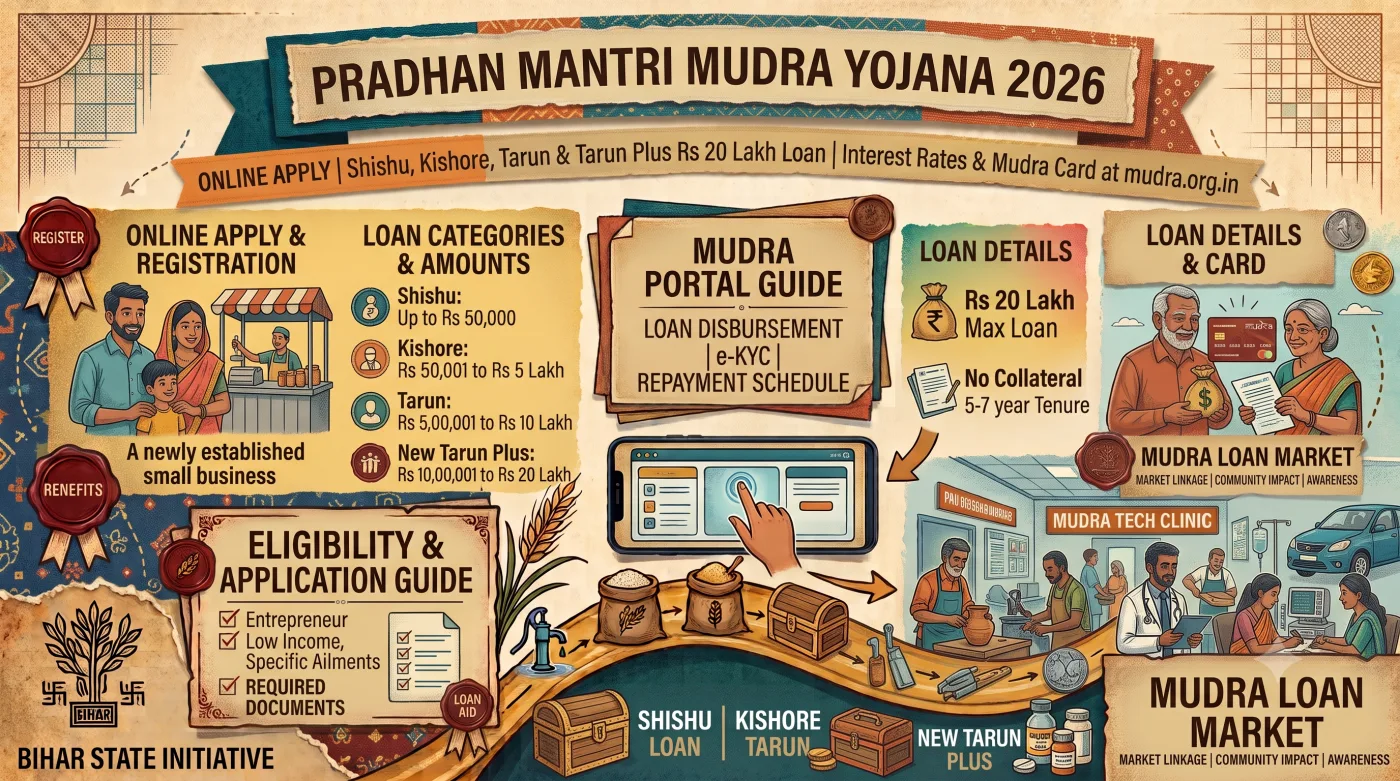
Introduction: Powering India’s Grassroots Entrepreneurs with PMMY 2026
The Pradhan Mantri Mudra Yojana (PMMY 2026) represents the most transformative micro-credit revolution in modern Indian financial history. Formally launched by the Government of India under the aegis of the Department of Financial Services (DFS), Ministry of Finance, this flagship national mission was architected to address the chronic credit famine strangling the nation’s vast, dynamic informal enterprise ecosystem. By delivering over ₹27 Lakh Crore in cumulative micro-loans across more than 48 Crore loan accounts since its inception, PMMY has effectively transformed millions of job seekers into prosperous, self-reliant job creators (रोजगार मांगने वाले से रोजगार देने वाले) under the national vision of Aatmanirbhar Bharat.
Before the advent of PMMY, micro-enterprises—such as small grocery kirana shopkeepers, roadside food stall vendors, vegetable aggregators, village artisans, tailoring boutiques, repair workshop mechanics, and small manufacturing workshops—were systematically redlined by formal commercial banking institutions. Lacking land deeds to pledge as mortgage collateral, audited corporate balance sheets, and sophisticated chartered accountant reports, these vulnerable micro-entrepreneurs were left at the mercy of rapacious informal moneylenders charging usurious compounding interest rates ranging from 36% to over 120% per annum. PMMY permanently dismantled this structural financial apartheid by mandating that scheduled commercial banks, regional rural banks, non-banking financial companies (NBFCs), and microfinance institutions (MFIs) disburse 100% collateral-free institutional business loans backed by a sovereign central credit guarantee.
📢 केंद्रीय बजट 2024-2026 ऐतिहासिक घोषणा: तरुण प्लस श्रेणी में ₹20 लाख तक ऋण
केंद्रीय वित्त मंत्रालय द्वारा वित्तीय वर्ष 2024-2026 के राष्ट्रीय बजट में प्रधानमंत्री मुद्रा योजना के दायरे का ऐतिहासिक विस्तार करते हुए चौथी नई श्रेणी 'तरुण प्लस' (Tarun Plus) को औपचारिक रूप से अधिसूचित किया गया है। जिन उद्यमियों ने पूर्व में तरुण श्रेणी के तहत ₹10 लाख तक का ऋण लेकर उसे समय पर और सफलतापूर्वक चुका दिया है, वे अब अपने व्यवसाय को राष्ट्रीय स्तर पर विस्तारित करने हेतु ₹20 लाख तक का कोलेटरल-फ्री (बिना किसी गारंटी के) ऋण प्राप्त कर सकते हैं। यह ऋण 'क्रेडिट गारंटी फंड फॉर माइक्रो यूनिट्स' (CGFMU) के 100% गारंटी कवर के अंतर्गत प्रदान किया जाता है।
The Four Pillars of Mudra Loans: Shishu, Kishore, Tarun & Tarun Plus
The lending architecture of PMMY is structured across four distinct growth tiers aligned with the business maturity lifecycle of micro-enterprises:
| Mudra Loan Tier | Loan Sanction Quantum | Target Entrepreneur Profile | Standard Repayment Tenor | Collateral & Processing Fee Norms |
|---|---|---|---|---|
| Shishu (शिशु ऋण) | Up to ₹50,000/- | First-time entrepreneurs, home-based startups, street vendors, small tea/snack stalls, vegetable carts, and mobile repair kiosks. | Up to 3 to 5 Years | Zero Collateral. Zero Processing Fee (Mandatory RBI exemption). |
| Kishore (किशोर ऋण) | Above ₹50,000/- up to ₹5,00,000/- | Operational micro-businesses needing working capital, inventory purchases, light machinery (e.g. lathe machines, commercial ovens, tailoring units). | Up to 5 Years | Zero Collateral. Nominal processing fee (0.50% or waived by public banks). |
| Tarun (तरुण ऋण) | Above ₹5,00,000/- up to ₹10,00,000/- | Established small enterprises expanding operational capacity, opening multiple retail branches, or purchasing commercial delivery vehicles. | Up to 5 to 7 Years | Zero Collateral. Up to 0.50% processing fee. Audited balance sheets preferred. |
| NEW Tarun Plus (तरुण प्लस ऋण) | Above ₹10,00,000/- up to ₹20,00,000/- | Proven entrepreneurs who have successfully repaid previous Tarun loans and are scaling up into small-scale industrial manufacturing or export hubs. | Up to 7 Years | Zero Collateral (Covered under expanded CGFMU sovereign guarantee). |
Credit Guarantee Fund for Micro Units (CGFMU): Why Banks Cannot Demand Collateral
A frequent grievance voiced by common citizens is that local bank managers demand residential property papers, agricultural land mortgages, or fixed deposit collateral before approving business loans. Under the statutory framework governing PMMY, demanding third-party collateral or property mortgages is strictly prohibited by Reserve Bank of India (RBI) circulars:
- National Credit Guarantee Cover (CGFMU): The Central Government established the Credit Guarantee Fund for Micro Units (CGFMU), administered by the National Credit Guarantee Trustee Company (NCGTC). This institutional trust guarantees repayment of all eligible Mudra loans disbursed by member lending institutions.
- First-Loss Sovereign Absorption: If an unforeseen commercial downturn causes an enterprise to default, the CGFMU trust reimburses up to 75% to 85% of the net defaulted principal directly to the bank. Consequently, the commercial lending institution bears negligible financial risk, eradicating the legal justification for demanding physical collateral from borrowers.
- RBI Grievance Escalation: If any bank branch manager insists on property collateral for a loan up to ₹10 Lakh (or ₹20 Lakh under Tarun Plus), the applicant can immediately file a formal regulatory complaint before the Banking Ombudsman and the Lead District Manager (LDM), citing RBI Circular No.
FIDD.CO.Plan.BC.54/04.09.01/2014-15.
⚠️ बैंक गारंटी एवं अवैध मांग संबंधी कानूनी चेतावनी (Zero Collateral Mandate)
प्रधानमंत्री मुद्रा योजना के तहत ₹10 लाख (तरुण प्लस में ₹20 लाख) तक के किसी भी ऋण के लिए बैंक प्रबंधक द्वारा किसी भी प्रकार की अचल संपत्ति (मकान, जमीन, दुकान की रजिस्ट्री), सोने के आभूषण या किसी तीसरे व्यक्ति की गारंटी (Guarantor) मांगना गैर-कानूनी है। यदि कोई बैंक मैनेजर कोलेटरल के बिना लोन देने से मना करे या किसी दलाल के जरिए कमीशन मांगे, तो तत्काल बैंक के जोनल ऑफिस, भारतीय रिज़र्व बैंक के बैंकिंग लोकपाल (Banking Ombudsman at cms.rbi.org.in), या केंद्रीय शिकायत पोर्टल pgportal.gov.in पर लिखित शिकायत दर्ज करें।
Permissible Business Activities: What Can You Finance Under PMMY?
Mudra loans are sanctioned strictly for non-farm, income-generating micro and small enterprises engaged in manufacturing, processing, trading, and allied service activities:
1. Manufacturing & Processing Enterprises
Small food processing units (flour mills, spice grinding, mustard oil expellers, bakeries, pickle and papad making), textile garment stitching workshops, powerloom weaving, wooden furniture carpentry, metal fabrication, agricultural tool manufacturing, packaging box making, and brick kilns.
2. Service Sector & Community Enterprises
Beauty salons and unisex hair grooming parlors, fitness gymnasiums, dry cleaning and laundry services, computerized coaching and tutoring centers, diagnostic path labs, mobile and laptop hardware repair workshops, automobile service garages, and courier logistics franchises.
3. Trading & Retail Commercial Establishments
Neighborhood grocery kirana stores, stationery and book shops, electrical and hardware outlets, medical and pharmaceutical pharmacies, apparel and readymade garment boutiques, wholesale agricultural seed/fertilizer distribution depots, and retail electronic appliance showrooms.
4. Commercial Transport Vehicles (Transport Sector)
Purchase of commercial transport vehicles generating operational business revenue—including auto-rickshaws, e-rickshaws, small commercial pick-up goods carriers (e.g. Tata Ace, Mahindra Bolero Maxi Truck), three-wheeler tempos, passenger taxis, and water transport boats.
5. Agri-Allied Activities (Convergence with Rural Enterprises)
While direct crop cultivation is funded via Kisan Credit Cards (KCC), commercial activities allied to agriculture are 100% eligible under PMMY: commercial dairy farming, chilled milk chilling centers, poultry farming, commercial goat and sheep rearing, piggery units, modern aquaculture fish farming, apiary honey processing, and agro-service hiring centers.
The Mudra Debit Card: Hassle-Free Working Capital Overdraft
Managing the daily operating expenses of a retail or service business requires flexible cash flow access rather than a rigid term loan. PMMY provides this liquidity through the innovative Mudra Card (मुद्रा डेबिट कार्ड):
- RuPay Digital Debit Integration: The Mudra Card is a pre-activated RuPay debit card linked directly to your business Cash Credit (CC) or Overdraft (OD) bank account.
- Interest Levied Only on Utilized Funds: If your business is sanctioned a ₹2,00,000 working capital limit but you withdraw only ₹30,000 to purchase raw material inventory, interest is calculated strictly on the ₹30,000 drawn for the exact number of days it remains outstanding, NOT on the total ₹2,00,000 sanction.
- Real-Time Revolving Credit: As customers pay your daily sales revenue into your bank account, your outstanding balance decreases, automatically reducing daily interest charges and restoring your full withdrawal limit for subsequent purchase cycles.
- Nationwide ATM & POS Access: The Mudra Card can be swiped at any retail merchant Point of Sale (POS) machine, used for e-commerce wholesale orders, or utilized at any domestic ATM across India for emergency cash withdrawals.
Interest Rate Structure & Special Women Empowerment Concessions
Interest rates on Mudra loans are deregulated by the Reserve Bank of India, meaning each lending bank determines its interest rate based on its marginal cost of funds-based lending rate (MCLR) or external benchmark lending rate (EBLR), tempered by the borrower's risk profile:
| Lending Institution Category | Typical Interest Rate Range (p.a.) | Special Subsidies / Rebates |
|---|---|---|
| Public Sector Banks (SBI, PNB, BoB, Canara) | 8.40% to 10.50% (Lowest & Most Concessional) | Zero processing fees on Shishu; processing fee waiver camps. |
| Regional Rural Banks (Gramin Banks) | 9.00% to 11.25% | Tailored for rural agri-allied, dairy, and artisanal micro-units. |
| Private Commercial Banks (HDFC, ICICI, Axis) | 10.50% to 14.00% | Faster digital turnaround times for urban commercial traders. |
| Microfinance Institutions (MFIs) & NBFCs | 14.00% to 22.00% | Doorstep weekly/monthly group collection models for unbanked borrowers. |
| Mudra Mahila Udyami Scheme (Women Entrepreneurs) | Special 0.25% Interest Rate Rebate | Non-Banking Financial Companies (NBFCs) and banks reduce lending rates by 25 basis points for 100% women-owned enterprises. |
Step-by-Step Guide: How to Apply Online at Jan Samarth & Udyami Mitra
Borrowers can apply directly through the Government of India’s unified digital credit portal without visiting bank branches repeatedly:
- Step 1: Access Jan Samarth Portal: Open your web browser and navigate to the official portal at
jansamarth.in. - Step 2: Select Business Activity Loan: On the homepage hero menu, click on 'Business Activity Loan' and click 'Check Eligibility'.
- Step 3: Answer Basic Enterprise Questionnaire:
- Select business type: Handloom, Artisan, Street Vendor, or Other Business.
- Select proposed activity: New Startup or Existing Running Business.
- Select your gender, social caste category (General / OBC / SC / ST), and minority status.
- Enter your location: Rural or Urban.
- Enter estimated total project cost and your personal margin money contribution (e.g. 10% to 15%).
- The portal algorithm calculates your eligible loan amount and displays 'Pradhan Mantri Mudra Yojana (PMMY)'.
- Step 4: Digital Registration & Document Upload:
- Register with your mobile number and authenticate via OTP.
- Upload digital copies of your Aadhaar Card, PAN Card, and latest 6 months bank account statement (in PDF format).
- Upload Proof of Business Address (Udyam Aadhaar Registration Certificate, GST certificate, Trade License, or Shop & Establishment registration).
- Submit projected sales turnover or project report detailing proposed machinery/equipment purchases.
- Step 5: Compare Bank Offers & Digital Approval: The system displays digital sanction offers from multiple banks operating in your pincode (e.g., State Bank of India, Bank of Baroda, PNB). Choose your preferred bank branch and click 'Apply'.
- Step 6: In-Principle Digital Sanction: The portal issues an instantaneous Digital In-Principle Approval Letter. The local bank branch manager contacts you within 72 hours for physical verification of business premises, post which the loan amount is disbursed directly into your business account.
How to Apply for SBI Instant e-Mudra Loan (Up to ₹50,000 in 5 Minutes)
For existing savings or current account holders of State Bank of India requiring immediate Shishu seed capital up to ₹50,000, SBI offers an entirely automated, paperless e-Mudra Digital Loan:
- Visit the dedicated SBI portal at
emudra.sbi.co.in:8044/emudraon your computer or mobile browser. - Enter your active 10-digit mobile number, SBI savings/current account number, and desired loan amount (up to ₹50,000).
- Authenticate via mobile OTP. Enter your Udyam Registration Number (MSME Udyam certificate).
- Provide your 12-digit Aadhaar number and check the UIDAI consent box. Authenticate via the Aadhaar OTP sent to your registered mobile.
- Review the electronic loan agreement on screen. Execute digital signature via Aadhaar e-Sign.
- Upon successful verification, the loan amount (up to ₹50,000) is credited instantly to your SBI bank account within 3 to 5 minutes, ready for immediate withdrawal via ATM or UPI.
Comprehensive Document Checklist for Mudra Applicants
Submitting a clean, complete document dossier prevents unnecessary loan processing delays:
| Document Classification | Mandatory Documents Required | Key Verification Checklist |
|---|---|---|
| Proof of Identity (KYC) | Aadhaar Card, PAN Card, Voter ID, or Passport | Name and date of birth must match identically across Aadhaar and PAN records. |
| Proof of Residence | Aadhaar Card, latest electricity bill, municipal property tax receipt, or registered rent agreement | Must verify permanent residence within the bank branch's local service area. |
| Proof of Business Identity | Udyam Registration Certificate (Free online at udyamregistration.gov.in), Trade License, GST Registration, FSSAI license (for food units) | Udyam registration is mandatory for all MSME classifications under central directives. |
| Financial Documents | Last 6 to 12 months bank account passbook / statements; 2 years Income Tax Returns (ITR) with computation (mandatory for Tarun & Tarun Plus above ₹5 Lakh) | Must demonstrate regular operating cash inflows and healthy average monthly balance. |
| Project Report & Machinery Quotations | Detailed Project Report (DPR) detailing projected sales, expenses, and net profit margins; formal proforma invoices / quotations from authorized machinery suppliers | Loan funds for machinery are disbursed directly to equipment suppliers via RTGS/NEFT to prevent fund diversion. |
Common Reasons for Mudra Loan Rejection & Expert Recovery Strategies
Navigating bank underwriting scrutiny requires addressing potential disqualifications proactively:
| Rejection Reason | Root Cause Analysis | Recommended Strategic Remedy |
|---|---|---|
| Adverse CIBIL / Credit Bureau Score (Below 650) | Past defaults, settled credit card balances, or delayed consumer loan EMIs | Obtain a free CIBIL credit report; clear all outstanding overdue balances; obtain formal 'No Dues Certificates' (NDC) and wait 60 days for credit bureau score refreshing. |
| Unviable Business Project Report (DPR) | Unrealistic sales projections, negative cash flows, or zero profit margin calculations | Prepare a realistic, conservative 3-year cash flow statement demonstrating a Debt Service Coverage Ratio (DSCR) above 1.50 with assistance from an accountant. |
| Absence of Business Proof (No Udyam Certificate) | Operating as an unregistered informal entity without commercial paper trail | Register your enterprise within 10 minutes on udyamregistration.gov.in for free using your Aadhaar number to obtain a valid MSME registration certificate. |
| Multiple Simultaneous Loan Inquiries | Applying across 5 different banks within the same week triggers hard credit inquiries | Apply exclusively through the unified jansamarth.in single-window portal, which channels your inquiry to selected banks without damaging your credit score. |
| Geographic Service Area Dispute | Business premise located outside the statutory operational radius of the bank branch | Always select the specific public sector bank branch physically closest to your commercial workshop or shop location. |
Working Capital Sizing: The Nayak Committee 20% Turnover Formula
When applying for working capital limits (Cash Credit / Overdraft) under Mudra Kishore or Tarun, bank credit officers evaluate loan requests using the Reserve Bank of India-mandated Nayak Committee Norms for micro and small enterprises:
| Financial Assessment Component | Standard Regulatory Percentage | Practical Illustrative Example (Annual Turnover: ₹25,00,000) |
|---|---|---|
| Projected Annual Sales Turnover | 100% Projected Sales Base | ₹25,00,000 / year (~₹2,08,333 / month) |
| Total Working Capital Requirement | 25% of Projected Annual Turnover | ₹6,25,000 (Calculated operating inventory & receivables) |
| Promoter's Margin Money Contribution | 5% of Projected Annual Turnover | ₹1,25,000 (Contributed by the entrepreneur from own savings) |
| Bank Maximum Working Capital Limit (Mudra) | 20% of Projected Annual Turnover | ₹5,00,000/- (Sanctioned under Mudra Kishore/Tarun) |
Applying this scientific 20% formula allows micro-entrepreneurs to justify their loan quantum objectively to bank branch managers without appearing arbitrary or speculative.
Sector-Specific Business Project Templates for Mudra Financing
To assist aspiring entrepreneurs in drafting viable Detailed Project Reports (DPR), review these four practical micro-business models frequently financed by public sector banks:
1. Commercial Dairy Farming Unit (10 Crossbred Milking Cows)
- Capital Expenditure (Term Loan): Purchase of 10 high-yielding Murrah buffaloes or HF crossbred cows @ ₹70,000 each = ₹7,00,000; construction of modern ventilated cattle shed with concrete floor and feeding mangers = ₹1,50,000; electric automated milking machine and chaff cutter = ₹50,000. Total Capital Cost: ₹9,00,000.
- Working Capital (Mudra Card): Cattle feed, green fodder cultivation, veterinary medicines, and vaccinations = ₹1,00,000.
- Total Project Cost: ₹10,00,000 (Financed under Mudra Tarun: ₹8,50,000 bank loan + ₹1,50,000 promoter margin).
- Projected Monthly Economics: Average 120 liters daily milk yield sold @ ₹55/liter = ₹1,98,000 monthly revenue. Deducting feed/labor costs (₹1,15,000) and bank EMI (₹18,500) leaves a healthy net family profit of ₹64,500 per month.
2. Boutique Designer Apparel & Tailoring Studio
- Capital Expenditure: 3 computerized high-speed sewing machines = ₹90,000; 1 multi-thread interlock machine = ₹35,000; industrial fabric cutting table and vacuum ironing station = ₹45,000; interior retail display fixtures and mannequins = ₹80,000. Total Capital Cost: ₹2,50,000.
- Working Capital: Designer silk/cotton fabrics, threads, embroidery laces, zippers, and packaging = ₹1,50,000.
- Total Project Cost: ₹4,00,000 (Financed under Mudra Kishore: ₹3,40,000 bank loan + ₹60,000 promoter margin).
- Projected Monthly Economics: Custom stitching and bridal wear sales yielding ₹1,20,000 monthly revenue, delivering an average net monthly profit of ₹42,000 post loan repayment.
3. Multi-Brand Automobile Two-Wheeler Service Center
- Capital Expenditure: 2 hydraulic two-wheeler service lifts = ₹1,20,000; high-pressure automated vehicle washing pump with water recycling tank = ₹60,000; computerized engine oil drainer and pneumatic wrench compressor = ₹80,000; diagnostic OBD scanner and battery charger = ₹40,000. Total: ₹3,00,000.
- Working Capital: Engine oil drums, genuine spare parts inventory (spark plugs, brake pads, drive chains, filters) = ₹2,00,000.
- Total Project Cost: ₹5,00,000 (Financed under Mudra Kishore: ₹4,25,000 bank loan + ₹75,000 promoter margin).
- Projected Monthly Economics: Servicing 15 bikes daily @ ₹350 labor + spare parts margins generates over ₹1,60,000 monthly revenue, resulting in a sustainable net monthly operating income of ₹55,000.
The Credit Escalator: PM-SVANidhi to Mudra to Stand-Up India
The Ministry of Finance has engineered a structured, progressive National Credit Ladder allowing micro-enterprises to systematically scale up institutional borrowing as their commercial scale expands:
| Credit Stage / Program | Target Enterprise Scale | Sanction Loan Quantum | Key Strategic Benefit |
|---|---|---|---|
| Stage 1: PM SVANidhi | Informal Urban Street Vendors & Hawkers | ₹10,000 (1st tranche) -> ₹20,000 -> ₹50,000 | Establishes first-time digital banking credit history with 7% interest subsidy and cashback. |
| Stage 2: Mudra Shishu | Micro-Enterprises & Home Startups | Up to ₹50,000/- | Zero collateral, zero processing fee seed capital. |
| Stage 3: Mudra Kishore & Tarun | Growing Small Retailers, Workshops & Agri-Units | ₹50,001 up to ₹10,00,000/- | Equipment purchase, working capital Mudra Card, commercial expansion. |
| Stage 4: NEW Mudra Tarun Plus | Proven Micro-Enterprises Scaling Up | ₹10,00,001 up to ₹20,00,000/- | High-quantum working capital backed by expanded CGFMU guarantee. |
| Stage 5: Stand-Up India | Greenfield Enterprises (SC/ST & Women Entrepreneurs) | ₹10,00,000 up to ₹1,00,00,000 (₹1 Crore) | Large-scale manufacturing and commercial services. |
📈 क्रेडिट एस्केलेटर: छोटे व्यवसाय से बड़े उद्योग की ओर (Graduation Strategy)
भारत सरकार का मुख्य उद्देश्य यह है कि कोई भी व्यापारी जीवन भर 'शिशु' श्रेणी में न रहे। यदि आप ₹50,000 का पहला ऋण लेकर अपनी सभी किस्तें ईमानदारी से चुकाते हैं, तो आपका बैंक स्वतः आपको ₹5 लाख का 'किशोर' ऋण प्रदान करता है। किशोर ऋण के सफल पुनर्भुगतान के बाद आप ₹10 लाख के 'तरुण' और अंततः ₹20 लाख के 'तरुण प्लस' श्रेणी में पहुंच जाते हैं। इस प्रकार एक छोटी सी चाय की दुकान 5 से 7 वर्षों में एक बड़े रेस्टोरेंट या बेकरी उद्योग में बदल सकती है।
CIBIL Score Restoration & Credit Health Guide for Micro-Borrowers
A damaged CIBIL score is the single most common roadblock resulting in loan rejection. Entrepreneurs can restore their creditworthiness by following these actionable protocols:
- Download Free Official Credit Bureau Reports: The Reserve Bank of India mandates that every citizen is entitled to one free full credit report annually from each of the four credit bureaus (TransUnion CIBIL, Equifax, Experian, and CRIF High Mark). Review your report for clerical errors, incorrectly reported overdue balances, or accounts falsely marked as 'Written-Off'.
- Resolve Disputed Accounts (Settlement vs Closure): If a previous retail loan or credit card was settled for a partial amount, the bureau marks the status as 'Settled', which penalizes your score for 7 years. Approach the concerned lending bank, pay the remaining waiver balance, and request an official 'Closed / Zero Dues' status update.
- Maintain Credit Utilization Below 30%: If you possess a credit card or Mudra overdraft card with a ₹1,00,000 limit, never maintain continuous balances exceeding ₹30,000 (30% utilization ratio). Maxing out credit limits signals financial distress to credit algorithms.
- Eliminate Multiple Loan Inquiries: Avoid submitting loan applications on multiple commercial loan comparison apps simultaneously. Every hard inquiry deducts 5 to 10 points from your CIBIL score.
- 60-Day Score Healing Window: Once past liabilities are settled, maintain consistent on-time payments on utilities and remaining EMIs for 60 to 90 days. The CIBIL score typically rebounds by 50 to 120 points, qualifying your business for instant Mudra approval.
📑 प्रोजेक्ट रिपोर्ट (DPR) तैयार करते समय ध्यान रखने योग्य बातें (DPR Drafting Tips)
बैंक में मुद्रा लोन का आवेदन करते समय एक स्पष्ट 'विस्तृत परियोजना रिपोर्ट' (Detailed Project Report) संलग्न करें। इसमें स्पष्ट बताएं कि आप खरीदे जाने वाले उपकरण (Machinery) से कितना दैनिक उत्पादन करेंगे, कच्चा माल कहां से लाएंगे, उत्पाद किसे बेचेंगे, तथा बिजली, किराया और मजदूरी काटने के बाद बैंक की मासिक ईएमआई (EMI) चुकाने के लिए कितना शुद्ध मुनाफा बचेगा। यदि बैंक मैनेजर को यह विश्वास हो जाए कि आपका व्यवसाय हर माह ईएमआई से कम से कम डेढ़ गुना (1.5x DSCR) शुद्ध मुनाफा कमाएगा, तो लोन बिना किसी बाधा के स्वीकृत हो जाता है।
National Toll-Free Helplines & Lead District Banking Contacts
If you face unreasonable bank refusals, delays exceeding statutory turnaround times, or unauthorized commission demands, contact the official regulatory authorities:
- National PMMY Toll-Free Helpline:
1800-180-1111/1800-11-0001 - State-Wise PMMY Support Helplines: Available in all regional languages across public sector lead banks.
- Mudra Official Web Portal:
https://www.mudra.org.in/ - Jan Samarth Unified Application Portal:
https://www.jansamarth.in/ - RBI Banking Ombudsman Online Complaint Portal (CMS):
https://cms.rbi.org.in/
💡 उद्यमी जागरूकता संदेश (Zero Bribery & Middlemen Advisory)
प्रधानमंत्री मुद्रा योजना के तहत ऋण प्राप्त करने के लिए किसी भी बिचौलिए, लोन एजेंट या फर्जी वित्तीय सलाहकार के झांसे में न आएं जो कमीशन या 'फाइल चार्ज' के बदले लोन पास कराने का दावा करते हों। मुद्रा लोन पूरी तरह पारदर्शी है और केवल आधिकारिक बैंकों द्वारा सीधे स्वीकृत किया जाता है। आवेदन करने हेतु केवल jansamarth.in या udyamimitra.in पोर्टल का ही उपयोग करें अथवा सीधे अपनी नजदीकी बैंक शाखा के मुख्य प्रबंधक (Branch Manager) से संपर्क करें।
User Discussion & Comments (0)
No comments yet. Be the first to leave a comment below!
Leave a Comment / Ask a Question: