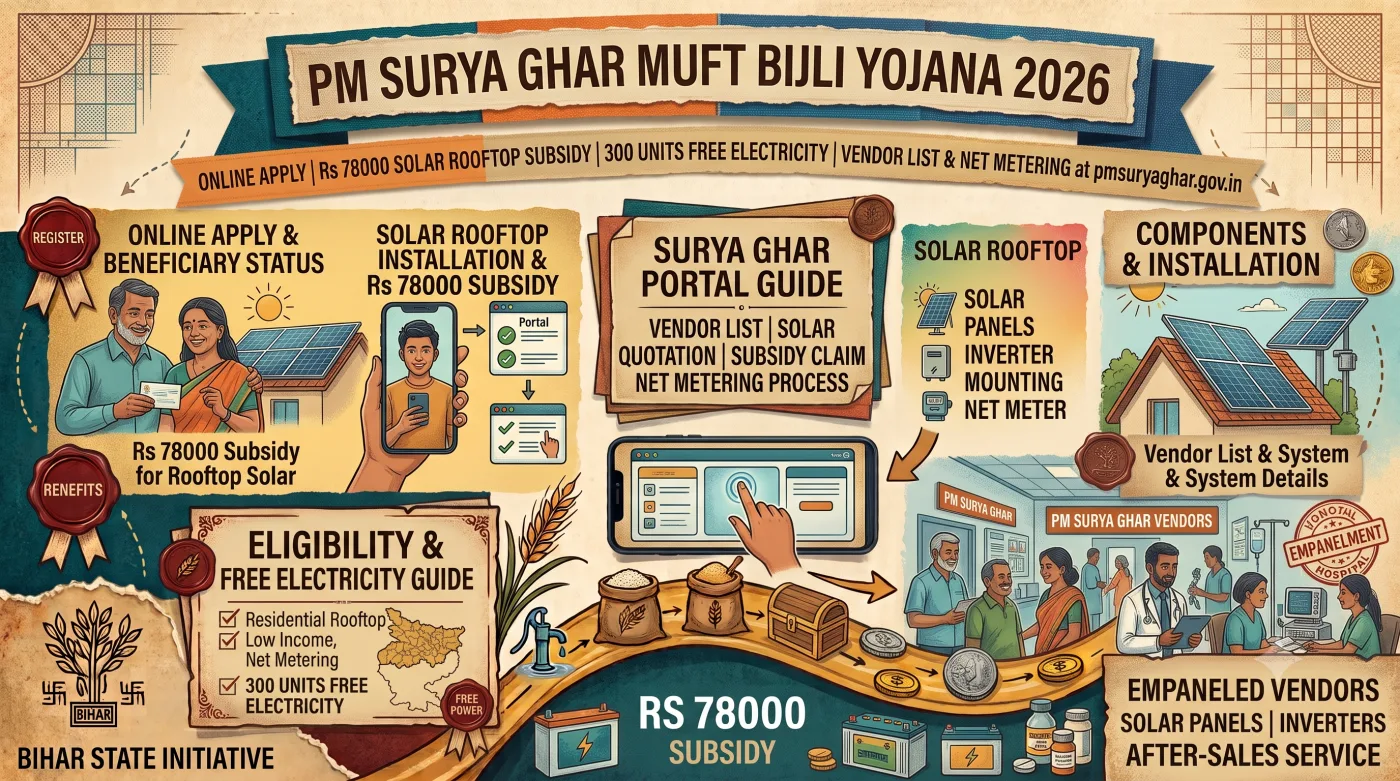
Introduction: The Clean Energy Revolution of PM Surya Ghar 2026
The PM Surya Ghar Muft Bijli Yojana 2026 marks a revolutionary paradigm shift in India's green energy policy and household economy. Formally sanctioned by the Union Cabinet under the visionary leadership of the Government of India with a historic budgetary outlay of ₹75,021 Crore, this monumental program aims to illuminate 1 Crore Indian homes with grid-connected rooftop solar energy installations. By transforming traditional electricity consumers into decentralized green energy producers—popularly termed "Prosumers" (उत्पादक और उपभोक्ता)—the scheme delivers up to 300 units of free electricity every month to millions of middle-class and economically vulnerable households while providing direct financial subsidies of up to ₹78,000/- credited directly to the beneficiary's bank account via Direct Benefit Transfer (DBT).
For decades, escalating monthly electricity tariffs, fuel surcharges, regulatory asset levies, and scorching summer peak demands have squeezed household family budgets across Indian cities and rural districts alike. Running domestic appliances—such as ceiling fans, LED lighting, desert coolers, refrigerators, television sets, washing machines, and air conditioners—frequently results in debilitating monthly electric utility bills ranging from ₹2,000 to over ₹6,000. PM Surya Ghar permanently eradicates this recurring recurring financial drain. By harnessing the abundant tropical solar radiation available across the Indian subcontinent, a standard 2 kW or 3 kW residential rooftop solar system generates surplus zero-emission electricity that powers the home during daytime hours while feeding unconsumed power back into the local power utility grid through bidirectional Net Metering, driving monthly electricity bills down to absolute zero.
📢 राष्ट्रीय सौर ऊर्जा क्रांति (PM Surya Ghar 2026 Key Highlights)
प्रधानमंत्री सूर्य घर मुफ्त बिजली योजना के अंतर्गत केंद्र सरकार 1 किलोवाट पर ₹30,000, 2 किलोवाट पर ₹60,000, तथा 3 किलोवाट या उससे अधिक क्षमता पर ₹78,000 की एकमुश्त सीधी सब्सिडी (Direct Benefit Transfer - DBT) सीधे आपके बैंक खाते में जमा कराती है। इसके अतिरिक्त, उत्तर प्रदेश, गुजरात, महाराष्ट्र जैसे कई राज्य ₹30,000 तक की अतिरिक्त राज्य सब्सिडी (State Top-Up) भी दे रहे हैं। शेष बची राशि के लिए देश के प्रमुख सरकारी व निजी बैंक 'जन समर्थ पोर्टल' के माध्यम से बिना किसी गारंटी के मात्र 7% की रियायती ब्याज दर पर आसान लोन उपलब्ध करा रहे हैं।
Subsidy Slab Matrix: Capacity, Capital Cost & Government Assistance
The financial assistance framework under PM Surya Ghar is scientifically calibrated against typical household monthly power consumption patterns and rooftop surface availability:
| Solar System Capacity | Suitable Monthly Consumption | Estimated Generation per Month | Approx. Benchmark Cost | Central Government Subsidy (DBT) | Net Out-of-Pocket / Bank Loan |
|---|---|---|---|---|---|
| 1 kW System | 0 to 150 Units / Month | 120 - 130 Units | ₹50,000 - ₹55,000 | ₹30,000/- | ₹20,000 - ₹25,000 (or ₹0 with state top-up) |
| 2 kW System | 150 to 300 Units / Month | 240 - 260 Units | ₹1,00,000 - ₹1,10,000 | ₹60,000/- | ₹40,000 - ₹50,000 (Loan EMI ~₹850/mo) |
| 3 kW System | Above 300 Units / Month | 360 - 400 Units | ₹1,45,000 - ₹1,60,000 | ₹78,000/- (Max Cap) | ₹67,000 - ₹82,000 (Loan EMI ~₹1,400/mo) |
| RWA / Group Housing (>3 kW to 500 kW) | Common Services (Lifts/Pumps) | 120 Units / kW / Month | Market Determined | ₹18,000 per kW (Up to 500 kW) | Funded by Society Maintenance Corpus |
How Net Metering Works: Turning Your Electric Meter Backwards
The core technological marvel making PM Surya Ghar financially revolutionary is the bidirectional Net Meter (नेट मीटरिंग) system. Traditional domestic meters strictly measure power flowing from the utility company (DISCOM) into your home. A bidirectional Net Meter measures electrical energy flowing in both directions:
- Daytime Solar Harvest: Between 08:00 AM and 05:00 PM, your rooftop photovoltaic panels convert sunlight into Direct Current (DC) electricity. A high-efficiency Grid-Tied Inverter immediately converts this DC into alternating current (AC) synchronized with the grid voltage and frequency.
- Direct Domestic Consumption: The solar electricity directly runs your running home appliances (refrigerators, ceiling fans, computers, washing machines, and AC units) in real time without drawing power from the utility grid.
- Surplus Grid Export: If your solar panels generate 4 kW of power at 01:00 PM while your home is consuming only 1.5 kW, the remaining 2.5 kW surplus electricity is exported into the local DISCOM electrical grid through the net meter, causing your import meter units to decrease or register solar export credits.
- Nighttime Grid Consumption: After sundown, your home draws standard electricity from the utility grid to power evening lights and appliances.
- Monthly Net Energy Settlement: At the end of the billing cycle, the DISCOM subtracts your exported solar units from your imported grid units. If you imported 280 units and exported 300 units, your net electricity consumption is ZERO units. Your monthly bill is reduced to only statutory fixed connection charges, and surplus export units are credited forward into subsequent billing cycles or compensated monetarily.
⚠️ ऑन-ग्रिड सिस्टम एवं ग्रिड सुरक्षा चेतावनी (Grid-Tied Anti-Islanding Rule)
पीएम सूर्य घर योजना के तहत स्थापित सौर संयंत्र ग्रिड-टाइड (Grid-Connected) होते हैं, जिनमें सामान्यतः महंगी और रखरखाव वाली केमिकल बैटरी (Battery Bank) की आवश्यकता नहीं होती है। सुरक्षा नियमों (Anti-Islanding Protection) के अनुसार, यदि डिस्कॉम की मुख्य बिजली लाइन में पावर कट (विद्युत कटौती) होता है, तो लाइनमैन की जान की सुरक्षा हेतु सोलर इन्वर्टर स्वतः ग्रिड में बिजली भेजना बंद कर देता है। यदि आपको बिजली कटौती के दौरान भी पावर बैकअप चाहिए, तो आप आधुनिक हाइब्रिड इन्वर्टर (Hybrid Inverter with Emergency Backup) स्थापित कर सकते हैं।
Eligibility Criteria: Who Can Apply for PM Surya Ghar in 2026?
To guarantee that subsidies reach genuine residential citizens rather than commercial factories, the Ministry of New and Renewable Energy enforces clear qualifying parameters:
- Indian Citizenship & Residential Property: The applicant must be an Indian citizen possessing legal ownership rights or legitimate long-term tenancy over a residential dwelling with a durable, structurally sound pucca roof.
- Active Domestic Electricity Connection: The household must possess an active, metered domestic/residential electricity connection (LT Domestic Tariff) issued by the local power distribution utility (DISCOM). Commercial or industrial electricity connections are not eligible for residential subsidies.
- Roof Shadow-Free Area: The applicant must have sufficient unshaded rooftop space directly exposed to sunlight:
- For 1 kW: Minimum 100 to 120 Square Feet shadow-free area.
- For 2 kW: Minimum 200 to 220 Square Feet shadow-free area.
- For 3 kW: Minimum 300 to 350 Square Feet shadow-free area.
- One Subsidy Per Household Rule: Under central guidelines, capital subsidy is restricted to one residential electricity consumer meter per household to prevent duplicate exploitation of national public funds.
- Existing Solar Status: The applicant must not have previously claimed a central financial assistance (CFA) capital subsidy under Phase-I or Phase-II Rooftop Solar programs for the same electricity consumer connection.
Jan Samarth Portal: 7% Collateral-Free Bank Financing
Recognizing that upfront capital costs can deter middle-class and rural families, the Government of India integrated the PM Surya Ghar scheme with the National Credit Portal (Jan Samarth - jansamarth.in), partnering with leading commercial banks including State Bank of India (SBI), Punjab National Bank (PNB), Bank of Baroda, Canara Bank, and HDFC Bank:
- Subsidized Interest Rate: Loans are sanctioned at an attractive concessional rate pegged at the prevailing Repo Rate + 0.5% (currently approximately 7.0% per annum).
- Zero Collateral / Third-Party Guarantee: The loan is completely collateral-free. The installed solar rooftop equipment itself serves as the sole hypothecated security.
- High Loan Margin: Banks finance up to 90% to 95% of the net benchmark project cost. The homeowner contributes a minimal margin of just 5% to 10%.
- Comfortable Repayment Tenor: Borrowers can repay the loan over flexible tenors extending up to 10 years (120 months).
- EMI Less than Monthly Electric Savings: For a 2 kW system costing ~₹1,05,000 with a ₹60,000 central subsidy, the net financed principal is only ~₹45,000. At 7% interest over 5 years, the monthly EMI is approximately ₹890/-—which is significantly lower than the family’s previous monthly electricity bill of ₹2,500/-, resulting in net positive cash flow from month one.
Step-by-Step Guide: How to Apply Online at pmsuryaghar.gov.in
Citizen registration on the National Portal for Rooftop Solar is fully automated and paperless:
- Step 1: Access the National Portal: Open your browser and navigate to
pmsuryaghar.gov.in. - Step 2: Citizen Registration: On the homepage hero section, click on 'Apply for Rooftop Solar'.
- Select your State (e.g., Uttar Pradesh, Bihar, Maharashtra, Rajasthan, etc.).
- Select your Electricity Distribution Company (DISCOM) from the dropdown list.
- Enter your exact Consumer Account Number (CA Number / Consumer ID) printed on your electricity bill. Click 'Next'.
- Enter your active 10-digit mobile number and email ID. Authenticate via OTP.
- Step 3: Login & Submit Application Form:
- Log in using your registered mobile number and OTP.
- Fill in residential address, pincode, proposed solar capacity (e.g., 2 kW or 3 kW), and current sanction load.
- Upload a clear scanned copy of your latest monthly electricity utility bill (in PDF or JPG format under 2 MB).
- Submit the form. The system automatically transmits your request to your local DISCOM engineering division for Technical Feasibility Approval (TFR).
- Step 4: Technical Feasibility Approval: Within 15 working days, the DISCOM verifies local distribution transformer (DTR) capacity. Once approved, you receive an automated SMS and email notification confirming feasibility.
- Step 5: Select Registered Empanelled Vendor:
- Log back into the portal and browse the list of MNRE Empanelled Registered Solar Vendors operating within your district.
- Contact 2 to 3 vendors to compare panel brands (Mono PERC / TopCon), inverter warranties, and structural fabrication quality.
- Select your preferred vendor and sign the model bilateral agreement on the portal.
- Step 6: Physical Installation & Work Submission: The vendor completes panel mounting, inverter wiring, AC/DC protection boxes, and earthing lightning arresters on your roof. The vendor uploads the detailed equipment serial numbers, inverter test reports, and geo-tagged photographs on the portal.
- Step 7: DISCOM Inspection & Net Meter Installation: The DISCOM Junior Engineer (JE) conducts a physical field inspection to verify equipment compliance with MNRE DCR norms and installs the bidirectional Net Meter. The DISCOM issues a digital Commissioning Certificate.
- Step 8: Submit Bank Details & Receive DBT Subsidy:
- Enter your active bank account number and IFSC code (must be in the name of the electricity consumer).
- Upload a cancelled cheque or bank passbook copy showing clear account details.
- The National Fund Transfer Module validates your details with PFMS and deposits the central subsidy (up to ₹78,000) directly into your bank account within 30 days.
Component Specifications & Quality Norms (DCR Solar Panels)
To safeguard consumer investments and bolster indigenous manufacturing under Make in India, the Ministry of New and Renewable Energy enforces strict mandatory component guidelines:
| Solar Equipment Component | Mandatory Technical Specification | Standard Statutory Warranty |
|---|---|---|
| Solar Photovoltaic Modules | ALMM-Approved, High-Efficiency Mono-Crystalline PERC or TopCon (DCR - Domestic Content Requirement) | 10 to 12 Years Product Warranty + 25 Years Linear Power Output Warranty (Min 80% output at 25 yrs) |
| Grid-Tied String Inverter | High-efficiency (>97%) MPPT Inverter complying with IEC 61683 / IEC 62109 safety standards with WiFi monitoring | 5 to 7 Years Comprehensive Manufacturer Replacement Warranty |
| Mounting Structure | Hot-Dip Galvanized Iron (HDGI) or high-grade Anodized Aluminum with minimum 80-micron coating, wind-resistant up to 150 km/h | 5 Years Mechanical Durability & Anti-Rust Warranty |
| Electrical Protection | Dedicated AC Distribution Box (ACDB) and DC Distribution Box (DCDB) with Type-II Surge Protection Devices (SPD) and MCBs | Full system integration and commissioning compliance |
| System Earthing & Lightning | 3 Dedicated Chemical Earthing Pits (Panel body earthing, Inverter earthing, and Lightning Arrester rod) with copper-bonded electrodes | Resistance value below 5 Ohms verified by DISCOM engineer |
State-by-State Top-Up Subsidies: Maximizing Your Savings
In addition to the central government's ₹78,000 financial assistance, several proactive state governments have introduced lucrative State Top-Up Subsidies that make rooftop solar virtually cost-free for low-income households:
- Uttar Pradesh (UP Solar Policy): The Uttar Pradesh New and Renewable Energy Development Agency (UPNEDA) grants an additional ₹15,000 per kW up to a maximum of ₹30,000. Combined with the central subsidy of ₹78,000, a 3 kW system in UP receives a total non-repayable grant of ₹1,08,000/-.
- Gujarat (Surya Gujarat Integration): Gujarat offers state top-up incentives for residential consumers, alongside rapid 7-day DISCOM turnaround for net meter installation and robust net billing settlements through GUVNL/DGVCL/UGVCL/MGVCL.
- Madhya Pradesh & Maharashtra: State energy agencies offer accelerated processing and waived meter testing fees for residential prosumers under the unified single-window portal.
- Bihar (BREDA): The Bihar Renewable Energy Development Agency provides dedicated technical assistance and village awareness camps facilitating joint financing through regional rural banks.
Financial Return on Investment (ROI) & Payback Period Calculation
Investing in a residential rooftop solar system under PM Surya Ghar delivers some of the highest risk-adjusted financial returns in the entire retail market, far outstripping bank fixed deposits and gold investments:
| Economic Metric | 2 kW System Case Study | 3 kW System Case Study |
|---|---|---|
| Total Capital Cost (Approx.) | ₹1,05,000 | ₹1,50,000 |
| Central DBT Subsidy | - ₹60,000 | - ₹78,000 |
| Net Cost Paid by Homeowner | ₹45,000 | ₹72,000 |
| Monthly Electricity Generated | 250 Units | 380 Units |
| Monthly Financial Bill Savings (@ ₹7.50/unit) | ₹1,875 per month | ₹2,850 per month |
| Annual Financial Savings | ₹22,500 per year | ₹34,200 per year |
| Simple Payback Period (100% Breakeven) | 2.0 Years (24 Months) | 2.1 Years (25 Months) |
| Free Electricity Lifespan Post-Payback | 23 Years of 100% Free Power | 23 Years of 100% Free Power |
| Cumulative 25-Year Net Profit | Over ₹5,00,000 Savings | Over ₹7,80,000 Savings |
Environmental Impact: Reducing Household Carbon Footprint
Beyond unmatched personal financial savings, installing a rooftop solar plant directly advances India's ambitious international commitments under the United Nations COP climate accords and the national Panchamrit targets of achieving 500 GW of non-fossil electricity capacity by 2030:
- Carbon Dioxide Abatement: A standard 3 kW residential rooftop solar system offsets approximately 3.5 to 4.2 metric tons of carbon dioxide (CO2) emissions every year, equivalent to preventing the combustion of over 1.8 tons of coal in thermal power plants.
- Tree Plantation Equivalency: Operating a residential solar plant for its 25-year design lifespan delivers the ecological benefits equivalent to planting and nurturing over 120 mature forest trees.
- Conservation of Water Resources: Thermal coal power plants consume millions of liters of freshwater daily for cooling towers. Generating solar electricity on your terrace utilizes zero water for power generation, preserving critical groundwater tables.
Solar Technology Comparison: Poly vs Mono PERC vs TopCon N-Type
Selecting the appropriate photovoltaic cell architecture determines energy generation efficiency over the 25-year operational lifespan of your rooftop solar installation:
| Photovoltaic Technology | Cell Efficiency Range | Temperature Coefficient | Space Requirement (per kW) | Degradation Rate & Performance |
|---|---|---|---|---|
| Polycrystalline (Legacy Tech) | 15% to 17% | -0.40% / °C (High performance drop in summer heat) | 120 - 140 Sq. Ft. | High initial Light-Induced Degradation (LID); phased out under modern MNRE ALMM guidelines. |
| Mono-Crystalline PERC (Standard) | 20% to 21.5% | -0.35% / °C (Balanced thermal stability) | 90 - 100 Sq. Ft. | Passive Emitter and Rear Cell (PERC) layer reflects unabsorbed light back into the silicon wafer, generating high yield even in diffused morning/evening sunlight. |
| TopCon N-Type (Next-Gen Technology) | 22% to 24.5% | -0.30% / °C (Superior hot-climate performance) | 75 - 85 Sq. Ft. | Tunnel Oxide Passivated Contact (TopCon) utilizes ultra-thin oxide layers and phosphorus-doped N-type silicon wafers. Zero LID, superior bifaciality, and 30-year warranty. |
Inverter Typologies: On-Grid String vs Microinverters vs Hybrid Systems
The solar inverter is the electronic brain of your rooftop solar plant. Depending on your home’s architecture and grid reliability, three inverter configurations are deployed:
1. On-Grid String Inverters (Most Common & Cost-Effective)
In standard string architectures, all rooftop solar panels are wired in series forming one or two 'strings' connected to a single wall-mounted central inverter. String inverters offer high operational efficiency (>98%), low initial capital investment, and simple maintenance. However, if partial shade falls on a single panel (e.g., from an adjacent water tank or chimney), the electrical resistance of that shaded panel can disproportionately restrict the power output of the entire string.
2. Microinverter Architectures (Maximum Shading Tolerance)
Under a microinverter system, an individual miniaturized inverter is mounted directly behind each solar panel. Every panel operates as an autonomous power station with its own dedicated Maximum Power Point Tracker (MPPT). Shading on one panel has zero impact on neighboring panels. Microinverters operate at safe low DC voltages (below 60V), eliminating the fire hazards of high-voltage DC roof conduits, though at a 25% to 35% higher initial capital cost.
3. Hybrid Solar Inverter Systems (Grid-Tied + Battery Energy Storage)
For areas facing frequent grid load-shedding and power cuts, modern hybrid inverters combine bidirectional net metering grid-export capabilities with an integrated lithium-ferro-phosphate (LFP) battery storage bank. During grid failure, the hybrid inverter disconnects from the utility grid within 20 milliseconds (preventing anti-islanding dangers) and continues powering essential domestic loads (lights, fans, internet routers, refrigerators) without interruption.
🔌 राज्य डिस्कॉम एकीकरण एवं नेट मीटरिंग समयसीमा (DISCOM Turnaround Time)
केंद्रीय विद्युत मंत्रालय (Ministry of Power) के 'Electricity (Rights of Consumers) Rules' के अनुसार, प्रत्येक राज्य डिस्कॉम (DISCOM) को छत पर सोलर लगाने हेतु 15 दिनों के भीतर तकनीकी स्वीकृति (Feasibility Approval) तथा इंस्टॉलेशन पूरा होने के 15 दिनों के भीतर नेट मीटर स्थापित करना कानूनी रूप से अनिवार्य है। यदि कोई डिस्कॉम अधिकारी अनावश्यक देरी करता है या सुविधा शुल्क (घूस) मांगता है, तो आप 'उपभोक्ता शिकायत निवारण फोरम' (CGRF) या राज्य विद्युत नियामक आयोग (SERC) में सीधे ऑनलाइन शिकायत दर्ज कर सकते हैं।
DISCOM Integration Matrix: State Distribution Utilities Covered
PM Surya Ghar is integrated with all major power distribution utilities across India, including:
- Uttar Pradesh: UPPCL (DVVNL, MVVNL, PVVNL, PuVVNL, KESCO) via UPNEDA single-window portal.
- Delhi NCR: BSES Rajdhani, BSES Yamuna, and Tata Power DDL.
- Maharashtra: MSEDCL (Mahavitaran) and Adani Electricity Mumbai.
- Gujarat: GUVNL (DGVCL, MGVCL, PGVCL, UGVCL) and Torrent Power.
- Bihar: South Bihar Power Distribution (SBPDCL) & North Bihar Power Distribution (NBPDCL).
- Rajasthan: JVVNL (Jaipur), AVVNL (Ajmer), and JdVVNL (Jodhpur).
- Madhya Pradesh: MPPKVVCL (Indore/Jabalpur) and MPMKVVCL (Bhopal).
- Haryana & Punjab: DHBVN, UHBVN, and PSPCL.
- Southern States: BESCOM (Karnataka), TANGEDCO (Tamil Nadu), APCPDCL (Andhra Pradesh), and TSSPDCL (Telangana).
Electrical Safety, Chemical Earthing Pits & Fire Protection Norms
High-voltage rooftop electrical installations require stringent mechanical and fire safety safeguards. Non-negotiable engineering mandates under MNRE guidelines include:
- Triple Chemical Earthing Pits: The installation must feature three completely separate earthing electrode pits backfilled with conductive bentonite or carbon compound to maintain soil resistivity below 5 Ohms throughout dry summers:
- Pit 1 (DC Earthing): Dedicated exclusively to earthing the aluminum frames of the solar modules and mounting structure.
- Pit 2 (Inverter AC Earthing): Dedicated to the metal casing and neutral terminal of the grid-tied inverter.
- Pit 3 (Lightning Arrester - LA Earthing): Connected directly via heavy copper or galvanized strip to an active early streamer emission (ESE) or conventional Franklin lightning arrester installed at the highest rooftop point.
- Surge Protection Devices (SPD): The DC Distribution Box (DCDB) and AC Distribution Box (ACDB) must incorporate high-speed Type-II Surge Protection Devices capable of diverting lightning voltage spikes away from household home appliances into the ground within nanoseconds.
- UV-Resistant Double-Insulated Solar DC Cables: Standard household PVC wiring must NEVER be used on rooftops. Installers must deploy cross-linked polyolefin (XLPO) double-insulated solar cables rated for 1,000V DC, resistant to ultraviolet weathering, extreme rain, and rodent chewing.
⚡ विद्युत सुरक्षा एवं अर्थिंग मानक (Crucial Safety Alert)
छत पर सोलर पैनल लगवाते समय अर्थिंग (Earthing) में कभी भी समझौता न करें। बहुत से अप्रमाणित स्थानीय वेल्डर पैसे बचाने के लिए तीनों अर्थिंग को एक ही गड्ढे में जोड़ देते हैं या पानी के पाइप से बांध देते हैं। यह बेहद खतरनाक है और आकाशीय बिजली (Lightning Strike) गिरने पर आपके घर के सभी महंगे उपकरण (TV, AC, फ्रिज) जल सकते हैं तथा डिस्कॉम का जेई निरीक्षण में आपका कनेक्शन रिजेक्ट कर देगा। सुनिश्चित करें कि वेंडर कम से कम 3 अलग-अलग केमिकल अर्थिंग रॉड जमीन में गाड़े।
Rooftop Structural Engineering: Wind Load Resilience & Waterproofing
Mounting heavy photovoltaic panels and steel ballast structures on residential terraces demands rigorous structural compliance under the Bureau of Indian Standards (BIS) and Indian Standard Wind Code (IS 875 Part 3):
- Design Wind Speed Resistance (150 km/h to 200 km/h): India’s coastal belts (such as Gujarat, Odisha, Andhra Pradesh, and West Bengal) experience severe cyclonic wind speeds exceeding 140 to 180 km/h. Mounting frames must utilize hot-dip galvanized cold-formed steel sections with a minimum zinc coating thickness of 80 microns (approx. 550 g/m2) or 6000-series structural aluminum alloys. The structure must be aerodynamically tilted between 10 degrees and 15 degrees to optimize solar yield while preventing catastrophic uplift forces.
- Terrace Waterproofing Integrity: Traditional anchor bolting can rupture waterproofing tar felt membranes, leading to ceiling dampness. High-standard installations deploy non-penetrating modular pre-cast concrete ballast blocks (RCC dead weights) engineered to withstand maximum shear wind stress without drilling a single mechanical anchor into the roof slab. Where anchor bolting is unavoidable, technicians must inject marine-grade polyurethane or elastomeric silicon sealants into every drill hole.
- Parapet and Elevated Walkway Clearance: To allow routine terrace usage, vendors can construct elevated super-structures with 6 to 8 feet of vertical ground clearance, effectively creating an attractive solar terrace gazebo that provides shaded recreational outdoor space while generating continuous green power.
Comprehensive Vendor Audit Checklist: How to Avoid Substandard Installers
With thousands of new solar agencies mushrooming nationwide, residential consumers must exercise rigorous due diligence before finalizing contractual work orders:
| Due Diligence Parameter | Standard of Verification | Consumer Caution Note |
|---|---|---|
| National Portal Empanelment | Verify that the vendor's active registration appears on the official pmsuryaghar.gov.in DISCOM vendor directory. |
Never sign contracts with sub-contractors or local electricians claiming to work 'under' a registered vendor without written authorization. |
| ALMM Solar Module Certificates | Inspect manufacturer DCR flash test reports and ALMM enlistment serial numbers for each individual panel delivered. | Reject panels delivered without individual barcode stickers laminated beneath the front tempered glass. |
| BIS / IEC Inverter Certifications | Confirm grid-tied inverter compliance with IS 16221, IS 16169 (anti-islanding), and IEC 62109 safety test standards. | Uncertified inverters will be rejected by the DISCOM Junior Engineer during net meter inspection. |
| Comprehensive 5-Year Maintenance (CMC) | The model bilateral agreement mandates that the vendor provides 5 Years of Free Comprehensive Maintenance. | Ensure the written contract explicitly covers replacement of faulty connectors, AC/DC fuses, and biannual structural inspections at zero service charge. |
Tariff Accounting Models: Net Metering vs Net Billing vs Gross Metering
Depending on the specific regulatory framework notified by your State Electricity Regulatory Commission (SERC), solar financial credits are settled under one of three accounting mechanisms:
1. True Net Metering (Most Favorable to Consumers)
Under true net metering, every kilowatt-hour (unit) of solar electricity exported into the grid offsets one unit of imported grid electricity on a strictly 1:1 basis, regardless of time-of-day tariff variations. For instance, if you import 350 units at ₹7.00/unit (₹2,450) and export 300 units, you pay only for the net balance of 50 units (₹350). True net metering is universally mandated for residential installations up to 10 kW under central PM Surya Ghar guidelines.
2. Net Billing / Net Feed-in Mechanism
Under net billing, imported grid electricity is charged at the retail domestic slab tariff (e.g., ₹7.50/unit), while surplus exported solar electricity is credited at the state's average power purchase cost (APPC) or regulatory feed-in rate (typically ₹2.50 to ₹3.50/unit). While slightly less profitable than true net metering, it still dramatically curtails domestic electricity expenses.
3. Gross Metering (Commercial & Large-Scale Utility Model)
Under gross metering, all solar energy generated on the roof is directly exported into the utility grid at a fixed feed-in tariff, and all domestic energy consumed is billed separately at standard retail commercial rates. Gross metering is generally restricted to commercial complexes, factories, and institutions, and is not applicable to residential PM Surya Ghar prosumers.
📊 मासिक बिल गणना एवं बचत उदाहरण (Real-World Billing Scenario)
यदि आपके घर का औसत बिजली बिल ₹3,000 प्रति माह (लगभग 400 यूनिट खपत) आता है, तो 3 kW का सोलर प्लांट लगाने के बाद आपका उत्पादन 360 से 400 यूनिट प्रति माह होगा। नेट मीटरिंग के कारण आपका उपभोग शून्य यूनिट हो जाएगा और आपको केवल न्यूनतम निर्धारित चार्ज (Fixed Meter Rent / Electricity Duty approx ₹150-250) ही देना होगा। इस प्रकार आप प्रति वर्ष ₹33,000 से अधिक की सीधी बचत करेंगे।
Common Rejections, Installation Mistakes & Expert Tips
Avoid costly installation delays by adhering to these practical consumer safeguards:
| Common Mistake / Rejection Reason | Negative Impact | Recommended Expert Prevention |
|---|---|---|
| Purchasing Non-DCR Solar Modules | 100% Subsidy Disqualification (MNRE rejects non-domestic solar cells) | Ensure vendor explicitly guarantees DCR-compliant (Domestic Content Requirement) modules certified under the ALMM list on the portal invoice. |
| Name Mismatch (Electricity Bill vs Bank Account) | DBT subsidy transfer fails on PFMS portal validation | The bank account number entered on the portal must belong to the exact individual whose name is registered on the electricity utility bill. |
| Inadequate Earthing Pits (less than 3 pits) | DISCOM Junior Engineer rejects technical commissioning report | Insist that the vendor excavates three separate earthing pits with chemical bentonite compound and copper-bonded electrodes as per CEA guidelines. |
| Rooftop Shadow Obstructions (Water Tanks/Trees) | Drastic 30% to 50% drop in daily solar generation | Perform shadow analysis at 09:00 AM, 12:00 PM, and 04:00 PM; elevate mounting structures on parapets if high water tanks cast shadows. |
| Unapproved Vendor Agreement | Work not recognized by national portal | Select and link your vendor exclusively through the official pmsuryaghar.gov.in portal dashboard before paying any advance token. |
Virtual Net Metering (VNM) & Group Net Metering for Urban Apartments
One of the most persistent historical dilemmas of urban renewable energy has been the exclusion of multi-story apartment dwellers. High-rise flat owners pay hefty electricity bills but possess zero individual terrace ownership, as rooftop terraces in high-rise societies are classified as common undivided shares (UDS). Under the modernized PM Surya Ghar guidelines, two groundbreaking regulatory frameworks have unlocked clean solar power for urban flat owners:
1. Virtual Net Metering (VNM - वर्चुअल नेट मीटरिंग)
Under Virtual Net Metering, a collective rooftop solar photovoltaic plant is installed on the common terrace or clubhouse roof of a housing society. However, instead of connecting the power to a single common utility meter, the energy exported to the grid is digitally apportioned and credited among the individual domestic electricity meters of participating flat residents according to their pre-agreed ownership percentages. For example, if a 50 kW society plant generates 6,000 units in a month and an apartment owner holds a 5% cooperative entitlement share, 300 solar export units are credited directly to their personal electricity bill, slashing their domestic household bill without requiring any separate physical wires running down the building facade.
2. Group Net Metering (GNM - ग्रुप नेट मीटरिंग)
Group Net Metering is designed for consumers who own multiple electricity service connections within the same DISCOM distribution license jurisdiction (such as an individual owning a residential house, a separate rental annex, and a small shop). Surplus solar energy exported from the residential rooftop solar plant is first offset against the primary connection; any remaining unutilized credit is automatically adjusted against the electricity bills of the owner's other service connection numbers, maximizing overall utility bill elimination.
Seasonal Generation Variations: Summer Peak vs Monsoon Dip vs Winter Curve
Understanding the seasonal meteorological dynamics of solar radiation across the Indian subcontinent allows prosumers to accurately budget their annual energy consumption and net metering banking balances:
| Season / Months | Solar Insolation Levels (kWh/m2/day) | Typical 3 kW Daily Generation | Grid Interaction Dynamics |
|---|---|---|---|
| Summer Peak (March to June) | 6.0 to 7.2 kWh/m2/day (Clear blue skies, 11-12 sunlight hours) | 14 to 17 Units / Day | Massive surplus generation during the day offsets continuous night-time air conditioning (AC) electricity consumption. |
| Monsoon Season (July to September) | 3.0 to 4.2 kWh/m2/day (Dense cloud cover, intermittent rain) | 6 to 9 Units / Day | Frequent cloud cover reduces direct radiation. However, rainfall naturally washes accumulated dust off the panels, restoring peak light transmittance. |
| Post-Monsoon Autumn (October - November) | 5.2 to 6.0 kWh/m2/day (Optimal cell operating temperatures) | 12 to 14 Units / Day | Moderate ambient temperatures prevent panel overheating, maximizing crystalline silicon semiconductor efficiency. |
| Winter Season (December to February) | 4.0 to 5.0 kWh/m2/day (Shorter daylight hours, morning fog) | 9 to 12 Units / Day | In northern plains (Delhi, UP, Punjab, Bihar), dense morning radiation fog temporarily depresses early generation until 11:00 AM. |
Scientific System Sizing Engineering: Mathematical Formulas
To prevent over-investing in unnecessary solar capacity or under-sizing your plant, engineers utilize the following standardized formula to calculate exact rooftop solar capacity requirements:
Recommended Solar Capacity (kW) = [Annual Electricity Consumption (kWh) / 365 Days] / 4.0 Peak Sun Hours
For example, if an Indian family consumes 3,600 units (kWh) of electricity annually (averaging 300 units per month):
- Daily average consumption =
3,600 / 365 = 9.86 kWh/day. - Applying average Indian solar insolation of 4.0 peak equivalent sun hours:
9.86 / 4.0 = 2.46 kW. - Adding an engineering safety margin of 15% to compensate for cabling and inverter conversion losses:
2.46 × 1.15 = 2.83 kW. - Therefore, a standard 3.0 kW grid-tied solar system is the mathematically ideal capacity to guarantee 100% net bill elimination.
📐 तकनीकी क्षमता चयन एवं इनवर्टर साइजिंग गाइड (Engineering Advisory)
सोलर प्लांट लगवाते समय हमेशा ध्यान रखें कि आपके इनवर्टर की क्षमता (Inverter Rating in kVA) आपके सोलर पैनलों की कुल डीसी क्षमता (Total Panel DC Wattage) के 100% से 115% के अनुपात में होनी चाहिए। यदि आप भविष्य में 1 या 2 अतिरिक्त पैनल जोड़ना चाहते हैं, तो हमेशा उच्च क्षमता का MPPT इनवर्टर (जैसे 3 kW पैनल के लिए 3.3 kW या 3.6 kW इनवर्टर) ही लगवाएं। इससे भविष्य में बिना इनवर्टर बदले आसानी से क्षमता विस्तार किया जा सकता है।
Maintenance & Cleaning Tips to Maximize Solar Generation
Solar photovoltaic modules are static solid-state devices with no moving parts, requiring minimal maintenance. However, simple routine upkeep ensures maximum daily power output:
- Fortnightly Dust Cleaning: Accumulated environmental dust, vehicular exhaust soot, and bird droppings form an opaque layer over the tempered glass, reducing power generation by 10% to 25%. Wash the panels every 10 to 15 days using clean tap water and a soft microfiber sponge or rubber wiper early in the morning before panels heat up.
- Never Use Harsh Chemicals or Abrasives: Avoid hard detergents, caustic soda, or wire brushes that can scratch the anti-reflective coating on the glass surface.
- Monitor Mobile App Daily: All modern grid-tied inverters include built-in WiFi data loggers. Check your smartphone inverter app daily to confirm normal generation curves (smooth bell curve on clear sunny days).
- Bi-Annual Electrical Inspection: Once every six months, inspect cable conduit glands, check that MC4 connectors remain firmly locked and water-tight, and verify that earthing terminal connections show no rust or corrosion.
Convergence with PM-KUSUM: Solarizing Rural Feeder Lines
In rural agricultural heartlands, PM Surya Ghar converges synergistically with the Pradhan Mantri Kisan Urja Suraksha evam Utthaan Mahabhiyan (PM-KUSUM). While PM Surya Ghar targets domestic residential consumption, PM-KUSUM Component-C solarizes agricultural water tube wells and dedicated rural power distribution feeders. Under this convergence framework:
- Daytime Reliable Agricultural Power: Solarized 11 kV rural feeders guarantee 8 hours of uninterrupted, high-voltage daytime electricity for agricultural irrigation pumps, eradicating hazardous nocturnal watering in snake-infested fields.
- Dual-Income Prosumer Farmers: Rural farmers installing residential rooftop solar under PM Surya Ghar and solarizing tube wells under PM-KUSUM can eliminate both domestic lighting bills and diesel irrigation expenditure, saving upwards of ₹60,000 annually per farm family.
- Feeder-Level Technical Stability: Decentralized solar feeding into rural substations drastically reduces transmission line losses (AT&C losses) and stabilizes voltage fluctuations, protecting rural household electronics from burnout.
Solar Technical Glossary: Essential Engineering Concepts for Consumers
Familiarity with standard photovoltaic terminology protects buyers from unscrupulous sales jargon:
| Technical Term | Engineering Definition | Practical Significance for Homeowner |
|---|---|---|
| Peak Sun Hours (PSH) | Equivalent hours per day when solar irradiance averages 1,000 Watts per square meter. | India receives an average of 4.5 to 5.5 PSH daily, determining daily kilowatt-hour generation. |
| Maximum Power Point Tracking (MPPT) | Electronic DC-to-DC conversion technology optimizing the match between solar arrays and utility grid voltage. | Modern MPPT inverters harvest 20% to 30% more energy during overcast or partially shaded conditions. |
| Bifaciality Factor | The ratio of rear-side solar power generation relative to front-side irradiance (typically 70% to 80%). | Bifacial panels installed on white-painted or reflective mosaic tile terraces produce up to 15% bonus power from reflected albedo light. |
| Temperature Coefficient of Pmax | The percentage loss in power output for every 1°C rise in solar cell operating temperature above standard testing condition (25°C). | N-Type TopCon panels boast superior temperature coefficients (-0.30%/°C), outperforming standard Poly panels (-0.42%/°C) in extreme 45°C Indian summer heatwaves. |
| Anti-Islanding Protection | Mandatory safety disconnect mechanism within the grid-tied inverter. | In the event of a grid power failure, the inverter ceases power export within 2 seconds, preventing electrocution hazards for grid repair linemen. |
State-by-State DISCOM Online Net Metering Application Directory
Each participating state provides a dedicated digital integration link for processing PM Surya Ghar technical feasibility and net metering:
| State / UT | Primary Electricity Distribution Utilities (DISCOMs) | Dedicated Nodal Agency / State Portal |
|---|---|---|
| Uttar Pradesh | DVVNL, MVVNL, PVVNL, PuVVNL, KESCO | UPNEDA (upneda.org.in / uppcl.org) |
| Delhi (NCT) | BSES Rajdhani (BRPL), BSES Yamuna (BYPL), Tata Power DDL | Delhi Solar Portal (solar.delhi.gov.in) |
| Maharashtra | MSEDCL (Mahavitaran), Adani Electricity, Tata Power Mumbai | MahaUrja / MEDA (mahadiscom.in/solar) |
| Gujarat | DGVCL, MGVCL, PGVCL, UGVCL, Torrent Power | Surya Gujarat Portal (suryagujarat.guvnl.in) |
| Bihar | South Bihar Power (SBPDCL), North Bihar Power (NBPDCL) | BREDA Solar Portal (breda.bih.nic.in) |
| Rajasthan | Jaipur Discom (JVVNL), Jodhpur Discom, Ajmer Discom | RRECL Single Window (energy.rajasthan.gov.in) |
| Madhya Pradesh | MP East, MP West, MP Central Power Discoms | MP Urja Vikas Nigam (mprenewable.nic.in) |
| Haryana | DHBVN, UHBVN | HAREDA (hareda.gov.in) |
| Punjab | PSPCL (Punjab State Power Corporation) | PEDA Solar Net Metering (pspcl.in) |
| West Bengal | WBSEDCL, CESC Kolkata | WBREDA Portal (wbsedcl.in) |
सोलर लगाने से पहले की 10 महत्वपूर्ण सावधानियां (Consumer Checklist)
घर की छत पर रूफटॉप सोलर सिस्टम स्थापित करते समय किसी भी तकनीकी अथवा आर्थिक नुकसान से बचने के लिए निम्नलिखित 10 अनिवार्य जांच अवश्य करें:
- छत का धूप विश्लेषण (Shadow Analysis): सुनिश्चित करें कि सुबह 9 बजे से शाम 4 बजे तक छत पर किसी भी पेड़, पानी की टंकी या पड़ोसी की दीवार की छाया न पड़ती हो।
- छत की भार वहन क्षमता (Roof Structural Strength): सुनिश्चित करें कि आपकी छत का कंक्रीट स्लैब सोलर पैनल और स्ट्रक्चर का वजन (लगभग 15-20 किलोग्राम प्रति वर्ग मीटर) आसानी से संभाल सके।
- स्वीकृत विद्युत भार (Sanctioned Load Check): यदि आपके घर का स्वीकृत भार 2 kW है और आप 3 kW सोलर लगाना चाहते हैं, तो पहले अपने बिजली विभाग (DISCOM) से भार वृद्धि (Load Enhancement) कराएं।
- पंजीकृत वेंडर का चयन (Empanelled Vendor Only): कभी भी किसी स्थानीय अप्रमाणित इलेक्ट्रीशियन से काम न कराएं। केवल
pmsuryaghar.gov.inपर सूचीबद्ध अधिकृत वेंडर से ही अनुबंध करें। - डीसीआर प्रमाणित पैनल (DCR Modules Mandatory): सब्सिडी केवल भारत में निर्मित DCR सोलर मॉड्यूल पर ही मिलती है। इनवॉइस पर DCR सर्टिफिकेट और ALMM रजिस्ट्रेशन नंबर स्पष्ट होना चाहिए।
- तीन अलग-अलग केमिकल अर्थिंग (Triple Earthing Mandatory): पैनल बॉडी, इनवर्टर तथा तड़ित चालक (Lightning Arrester) के लिए 3 अलग-अलग अर्थिंग गड्ढे खुदवाएं।
- हॉट-डिप गैल्वेनाइज्ड स्ट्रक्चर (80 Micron HDGI): स्ट्रक्चर ऐसा होना चाहिए जिसमें कभी जंग न लगे और वह 150 किमी/घंटे की आंधी में भी सुरक्षित टिका रहे।
- बिजली बिल और बैंक खाते का नाम (Name Matching): जिस व्यक्ति के नाम पर बिजली का मीटर है, उसी के नाम का बैंक खाता और कैंसिल्ड चेक पोर्टल पर अपलोड करें।
- 5 वर्ष की निःशुल्क मेंटेनेंस (Free 5-Year CMC): वेंडर से 5 साल की लिखित व्यापक रखरखाव गारंटी (Comprehensive Maintenance Contract) अनिवार्य रूप से लें।
- बिचौलियों को नकद भुगतान न करें (Zero Cash to Middlemen): केंद्र सरकार की सब्सिडी (₹78,000 तक) सीधे आपके बैंक खाते में आएगी, किसी भी एजेंट को कमीशन न दें।
Battery Energy Storage Systems (BESS): Lead-Acid vs Lithium-Ion LFP
While the standard PM Surya Ghar installation is an on-grid grid-tied solar system without chemical batteries, millions of homeowners residing in areas plagued by recurring nocturnal power outages opt to integrate decentralized Battery Energy Storage Systems (BESS) with hybrid solar inverters. Evaluating battery chemistry choices determines system longevity, safety, and cycle economy:
| Battery Storage Technology | Usable Depth of Discharge (DoD) | Standard Cycle Life (80% Capacity) | Round-Trip Energy Efficiency | Maintenance & Safety Profile |
|---|---|---|---|---|
| Tubular Flooded Lead-Acid | 50% (Deeper discharge causes rapid plate sulfation) | 1,200 to 1,500 Cycles (~3 to 4 Years) | 75% to 80% (High internal resistive heat loss) | Requires quarterly distilled water topping; releases corrosive acidic fumes during heavy charging; heavy floor footprint. |
| Lithium Iron Phosphate (LiFePO4 / LFP) | 90% to 95% (Near full capacity utilization) | 4,000 to 6,000 Cycles (~10 to 15 Years) | 95% to 98% (Minimal heat dissipation) | 100% maintenance-free sealed wall-mounted unit; integrated Battery Management System (BMS) prevents thermal runaway and short-circuits. |
For a typical 3 kW residential solar installation, pairing a 5 kWh LFP lithium battery module provides approximately 4 to 6 hours of continuous backup for ceiling fans, LED lights, WiFi routers, and a 250-liter refrigerator during prolonged blackout emergencies, ensuring absolute electrical self-sufficiency day and night.
Agri-Voltaics & Urban Terrace Gardening Under Solar Structures
A burgeoning architectural trend among urban homeowners is the synergistic integration of Rooftop Agri-Voltaics—the co-location of shade-tolerant terrace kitchen gardening beneath elevated solar mounting super-structures. Installing solar panels on 7-foot to 8-foot high elevated pergolas yields profound dual benefits:
- Natural Microclimate Panel Cooling: High ambient terrace heat can push solar silicon cell temperatures above 65°C, causing an 8% to 12% drop in electrical efficiency. Potted terrace plants continuously transpire moisture into the ambient air, creating a cool microclimate beneath the panels that lowers cell temperature by 4°C to 7°C, directly boosting electrical energy harvest.
- Sunlight Optimization for Shade-Loving Greens: Tropical summer sunshine in India is often excessively harsh for delicate vegetable crops. The semi-shaded canopy beneath elevated solar arrays provides the perfect diffused sunlight for growing organic coriander, mint, spinach, lettuce, capsicum, and medicinal herbs.
- Terrace Insulation: The double-layered canopy of solar panels and potted vegetation blocks direct solar thermal radiation from penetrating the top-floor concrete ceiling slab, lowering indoor bedroom temperatures by 3°C to 5°C and drastically reducing air conditioner electricity demand.
Solar Inverter Error Codes & Instant Troubleshooting Protocol
Modern microprocessor-controlled grid-tied inverters display standardized operational fault codes on their liquid crystal display (LCD) panels or smartphone WiFi apps. Understanding these diagnostic codes empowers homeowners to resolve minor hiccups without waiting days for service technicians:
| Standard Error Code | Diagnostic Description | Root Cause Analysis | Immediate Corrective Action |
|---|---|---|---|
| Error Code E01 / Grid Out | Grid Voltage / Frequency Fault | The utility DISCOM power line has experienced an outage or voltage has surged beyond statutory limits (e.g. >270V or below 180V). | Verify if neighboring houses have electricity. Inverter will automatically reconnect 60 seconds after stable grid voltage resumes. |
| Error Code E02 / Iso Error | PV Insulation Resistance Low | Moisture ingress inside DC conduit pipes, damaged cable insulation, or wet debris bridging panel frames to ground during monsoons. | Inspect rooftop DC wiring for rodent cuts or waterlogged junction boxes; dry connections and reseal with waterproof heat-shrink tubing. |
| Error Code E03 / DC High | PV Array Over-Voltage | The open-circuit voltage (Voc) of the solar panel string exceeds the maximum voltage limit of the inverter on freezing winter mornings. | Vendor must reconfigure string wiring from single series into two parallel strings to lower string voltage within MPPT window. |
| Error Code E04 / Over Temp | Inverter Internal Overheating | Inverter heat sink fins are clogged with dust or the unit was installed in direct afternoon sunlight without a protective rain/sun shade. | Clean cooling fan and aluminum heat sink fins with soft brush; install a simple sheet metal awning above the inverter to block direct sun. |
🔧 नियमित जांच एवं सुरक्षित संचालन दिशानिर्देश (Quarterly Maintenance Protocol)
प्रत्येक तीन माह में एक बार अपने सोलर इनवर्टर के एसी/डीसी रोटरी आइसोलेटर स्विच (Rotary Isolator Switch) को बंद करके फिर से चालू करें ताकि कॉन्टैक्ट्स पर कार्बन न जमे। इसके साथ ही, अपने घर के मुख्य डिस्ट्रीब्यूशन बॉक्स में लगे 30mA आरसीसीबी (RCCB / ELCB) टेस्ट बटन को दबाकर ट्रिपिंग की जांच करें। यदि वर्षा ऋतु में अर्थिंग गड्ढों के आसपास की मिट्टी सूख जाती है, तो उनमें 5 लीटर पानी डालें ताकि अर्थ रेजिस्टेंस 5 ओम से नीचे बना रहे।
Solar Map of India: State-Wise Solar Insolation & Optimal Tilt Angles
The geographical diversity of the Indian subcontinent creates distinct solar insolation profiles across different climatic zones. Maximizing kilowatt-hour (kWh) generation requires calibrating the mechanical tilt angle of the solar array precisely according to the geographic latitude of your home:
| Geographic Region & Representative States | Annual Solar Insolation (kWh/m2/day) | Recommended Fixed Tilt Angle | Estimated Annual 3 kW Generation |
|---|---|---|---|
| Western Arid Belt (Rajasthan, Gujarat, Western MP) | 5.5 to 6.2 kWh/m2/day (Over 325 clear sunny days annually) | 24° to 27° True South | 4,500 to 4,800 Units / Year (Highest yield in India) |
| Deccan Plateau & Southern Peninsula (Maharashtra, Karnataka, AP, Tamil Nadu) | 5.0 to 5.6 kWh/m2/day (High year-round ambient temperatures) | 12° to 18° True South | 4,200 to 4,500 Units / Year (Very consistent month-to-month curve) |
| Northern Gangetic Plains (UP, Bihar, Haryana, Punjab, Delhi NCR) | 4.6 to 5.2 kWh/m2/day (Winter morning fog, extreme summer sun) | 28° to 32° True South | 3,900 to 4,200 Units / Year (Steep summer peaks with winter dip) |
| Eastern & Coastal Belts (Odisha, West Bengal, Coastal AP) | 4.4 to 5.0 kWh/m2/day (High maritime humidity, monsoon rainfall) | 19° to 22° True South | 3,800 to 4,100 Units / Year (Requires cyclonic wind-rated structures) |
| Himalayan & North-Eastern States (Assam, Meghalaya, HP, Uttarakhand) | 3.8 to 4.5 kWh/m2/day (Mountain topography, diffused valley radiation) | 30° to 35° True South | 3,300 to 3,600 Units / Year (Steep tilt ensures natural snow shedding) |
A cardinal engineering rule in rooftop solar installation is orientation: panels in the northern hemisphere must face True South (भौगोलिक दक्षिण दिशा) to capture maximum solar azimuth trajectories from sunrise to sunset. Installing panels facing East or West causes an immediate 15% to 22% reduction in cumulative annual power harvest.
Standard Operating Procedure (SOP) for Resident Welfare Associations (RWAs)
Housing societies, cooperative housing societies, and apartment complexes possess immense shared terrace surface areas ideal for large-scale green energy transitions. MNRE provides targeted central financial assistance of ₹18,000 per kW up to a maximum aggregate capacity of 500 kW per residential complex:
- General Body Meeting (GBM) Resolution: The RWA managing committee must convene a formal general body meeting and pass a certified special resolution with a minimum 51% majority approving the installation of a rooftop solar plant on common society terraces.
- Common Utility Meter Audit: The RWA conducts an energy audit of all shared common utility electricity meters—including elevator traction motors, basement parking illumination, water pressure booster pumps, swimming pool filtration plants, and perimeter security lighting.
- Structural Load Assessment: A registered structural engineer inspects the high-rise building terrace slab to verify that dead weight and dynamic wind load parameters comply with National Building Code (NBC) standards.
- RWA Portal Registration: The designated RWA office-bearer registers on
pmsuryaghar.gov.inunder the 'Resident Welfare Association / Group Housing Society' category, entering the society registration certificate, PAN card, and common electricity meter numbers. - Tendering & Vendor Award: The RWA invites bids from empanelled solar EPC contractors, selecting vendors based on five-year uptime guarantees, remote SCADA monitoring consoles, and quality of balance of systems (BOS).
- Drastic Maintenance Charge Reduction: Installing a 100 kW common solar system yields approximately 12,000 units of electricity per month, saving an average housing society over ₹1,10,000 in monthly power bills and directly reducing the monthly maintenance fees levied on individual flat residents.
Real-World Billing Invoice Reconciliation: Annual Banking Settlement
To demystify how electric utilities calculate net bills over an entire twelve-month cycle, consider the audited financial trajectory of a real Indian residential prosumer in Uttar Pradesh with a 3 kW grid-tied solar plant:
| Billing Cycle Month | Grid Import (Units Consumed) | Solar Export (Units Sent to Grid) | Net Monthly Balance | Cumulative Banked Credit (Units) | Final Electricity Bill Amount Paid |
|---|---|---|---|---|---|
| April | 280 Units | 390 Units | -110 Units (Surplus) | +110 Units Banked | ₹185 (Fixed Meter Rent Only) |
| May (Summer Peak) | 480 Units (Heavy AC) | 410 Units | +70 Units (Deficit) | +40 Units Banked (110 - 70) | ₹185 (Offset from Banked Units) |
| June (High Heat) | 510 Units (Heavy AC) | 380 Units | +130 Units (Deficit) | 0 Units Banked (40 offset, 90 billable) | ₹860 (Only for net 90 units) |
| July (Monsoon) | 320 Units | 260 Units | +60 Units (Deficit) | 0 Units Banked | ₹635 (Bill for 60 units + fixed charge) |
| October (Autumn) | 210 Units | 370 Units | -160 Units (Surplus) | +160 Units Banked | ₹185 (Fixed Meter Rent Only) |
| March (Settlement) | 220 Units | 380 Units | -160 Units (Surplus) | Annual Net Zero Achieved! | ₹185 (Zero Energy Charges for the Year) |
💡 वित्तीय ऑडिट निष्कर्ष (Economic Summary)
उपरोक्त वास्तविक बिलिंग विश्लेषण से स्पष्ट है कि गर्मियों में एसी (AC) चलने के कारण होने वाले अतिरिक्त बिजली उपभोग की भरपाई वसंत, शरद और सर्दियों में बनने वाली सरप्लस सोलर बिजली (Banked Units) द्वारा स्वतः हो जाती है। इस प्रकार उपभोक्ता को वर्ष भर केवल न्यूनतम मीटर किराया (Fixed Charges) ही देना पड़ता है, जिससे सामान्य ₹40,000 का वार्षिक बिजली बिल घटकर मात्र ₹2,200 रह जाता है।
Official Helpdesks, Grievance Portals & National Contact Numbers
For technical guidance, vendor dispute escalation, or subsidy status inquiries, contact authorized MNRE helplines:
- National PM Surya Ghar Toll-Free Helpline:
15555(Available 09:00 AM to 06:00 PM, Monday to Saturday) - Alternate National Solar Support Helpline:
1800-180-3333 - Official PM Surya Ghar Web Portal:
https://pmsuryaghar.gov.in/ - Ministry of New and Renewable Energy (MNRE) Portal:
https://mnre.gov.in/ - National Portal Technical Support Email:
support-pmsuryaghar@gov.in
💡 उपभोक्ता जागरूकता संदेश (Consumer Protection Advisory)
प्रधानमंत्री सूर्य घर योजना के अंतर्गत सब्सिडी प्राप्त करने के लिए किसी भी अनधिकृत बिचौलिए या अनाधिकृत सोलर डीलर को नकद भुगतान न करें। केवल pmsuryaghar.gov.in पोर्टल पर सूचीबद्ध पंजीकृत वेंडरों (Empanelled Vendors) से ही कार्य कराएं तथा वेंडर को भुगतान चेक, आरटीजीएस (RTGS) या डिजिटल माध्यम से ही करें। केंद्र सरकार की सब्सिडी सीधे आपके अपने बैंक खाते में डीबीटी (DBT) द्वारा जमा होगी, वेंडर को सब्सिडी का पैसा लेने का कोई कानूनी अधिकार नहीं है।
User Discussion & Comments (0)
No comments yet. Be the first to leave a comment below!
Leave a Comment / Ask a Question: