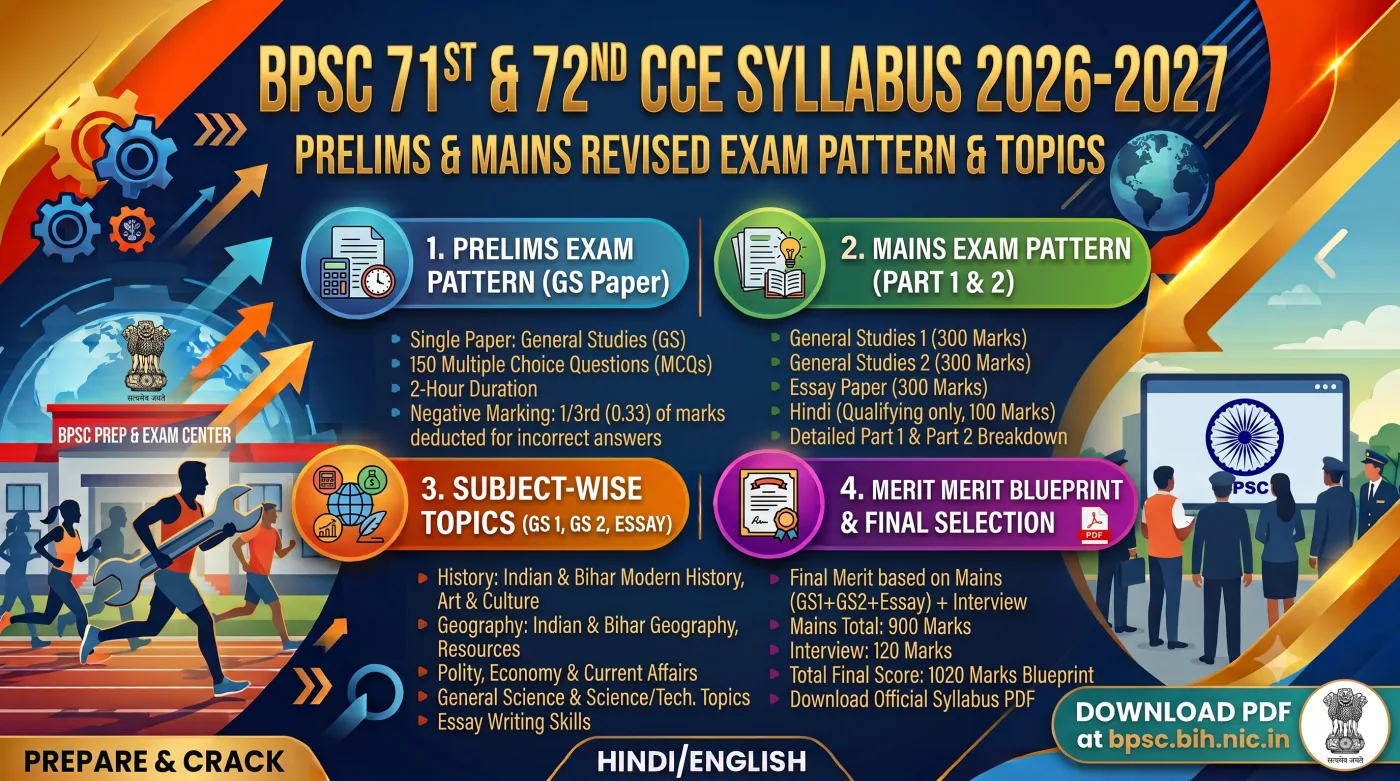
1. Executive Overview: BPSC Combined Competitive Examination (CCE) Framework
The Bihar Public Service Commission (BPSC / बिहार लोक सेवा आयोग) conducts the prestigious Combined Competitive Examination (CCE) to recruit top-tier civil servants, police commanders, revenue administrators, and municipal executives into the permanent state civil service of Bihar. The modern BPSC examination pattern represents an authoritative, highly analytical three-tier evaluation system aligned with contemporary UPSC civil services standards:
- Stage 1: Preliminary Examination (Screening / Qualifying - 150 Marks): A 2-hour offline objective test testing General Studies with strict 1/3rd (0.33) negative marking and a standardized 4-option structure (A, B, C, D). Eliminates 90% of applicants to shortlist approximately 10 times the vacancies for Stage 2.
- Stage 2: Main Written Examination (Descriptive Analytical - 900 Merit Marks + Qualifying Modules):
- General Hindi (100 Marks, 3 Hours): Qualifying in nature (minimum 30% marks required; not counted in merit ranking).
- General Studies Paper 1 (300 Marks, 3 Hours): Modern Indian & Bihar History, Art & Culture, Current Events, and Statistical Analysis (Counted in Merit).
- General Studies Paper 2 (300 Marks, 3 Hours): Indian & Bihar Polity, Economy & Geography of India & Bihar, and Application of Science & Technology (Counted in Merit).
- Essay Paper (300 Marks, 3 Hours): Three comprehensive essays covering philosophical themes, national/international issues, and Bihar-specific regional proverbs (Counted in Merit).
- Optional Subject (100 Marks, 2 Hours, MCQ Format): Purely qualifying; not counted in final merit compilation.
- Stage 3: Personality Test / Interview (120 Marks): Comprehensive in-person oral evaluation conducted by BPSC Interview Boards in Patna to evaluate administrative temperament, ethical clarity, leadership presence, and deep grasp of Bihar's developmental realities.
- Final Selection Merit Ranking: Computed out of 1,020 Marks [GS-1 (300) + GS-2 (300) + Essay (300) + Interview (120)].
| Recruitment Dimension | Official Specification & Examination Details |
|---|---|
| Exam Conducting Authority | Bihar Public Service Commission (BPSC / बिहार लोक सेवा आयोग, पटना) |
| Flagship Services Recruited | Bihar Administrative Service (BAS / SDO), Bihar Police Service (BPS / DSP), Bihar Financial Service (CTO), Revenue Officer (CO), Block Development Officer (BDO) |
| Educational Qualification | Bachelor's Degree (Graduation) in any discipline from a Recognized University |
| Mode of Examination | Stage 1: Offline Pen-Paper OMR Sheet | Stage 2: Offline Conventional Descriptive Answer Booklets |
| Prelims Total Questions & Marks | 150 Objective Questions carrying 150 Marks (1 Mark per question) |
| Prelims Duration & Options Format | 120 Minutes (2 Hours) | Standard 4 Options (A, B, C, D) without Option E |
| Prelims Negative Marking | 1/3rd (0.33) Marks Deducted per incorrect response |
| Final Selection Merit Score Ceiling | 1,020 Marks [Mains Merit (900 Marks) + Interview (120 Marks)] |
| Qualifying Papers in Mains | General Hindi (30% passing) & MCQ Optional Subject (Category qualifying benchmarks) |
| Official Commission Portal | bpsc.bih.nic.in |
2. Preliminary Examination Pattern & Subject-Wise Marks Weightage
The single-shift BPSC Prelims tests breadth of knowledge, historical memory, scientific intuition, and contemporary awareness. With 1/3rd negative marking, accuracy and calculated elimination are vital:
| Subject Domain / Component | Core Curriculum Scope | Approximate Questions | Maximum Marks | Optimal Time Allocation |
|---|---|---|---|---|
| 1. General Science (सामान्य विज्ञान) | NCERT Class 9th & 10th Physics, Chemistry, Biology | 30 Questions | 30 Marks | 20 - 22 Minutes |
| 2. Current Affairs (समसामयिक घटनाएं) | National, International & Bihar State Current Events | 30 Questions | 30 Marks | 18 - 20 Minutes |
| 3. History of India & Ancient Bihar | Ancient, Medieval, Modern History & National Movement | 30 - 35 Questions | 30 - 35 Marks | 25 - 28 Minutes |
| 4. Geography of India & Bihar | Physical, Economic Geography, Rivers, Minerals, Census 2011 | 15 - 20 Questions | 15 - 20 Marks | 15 - 18 Minutes |
| 5. Indian Polity & Economy (राजव्यवस्था व अर्थव्यवस्था) | Constitution, Governance, Bihar Economy & Post-1947 Changes | 15 - 20 Questions | 15 - 20 Marks | 15 - 18 Minutes |
| 6. Role of Bihar in Freedom Struggle | 1857 Revolt, Kunwar Singh, Champaran, 1942 Movement | 10 - 15 Questions | 10 - 15 Marks | 10 - 12 Minutes |
| 7. General Mental Ability (मानसिक योग्यता) | Arithmetic, Reasoning, Number Series, Logic Puzzles | 10 Questions | 10 Marks | 15 - 18 Minutes |
| Total Prelims Examination | Composite 150 Objective Questions | 150 Questions | 150 Marks | 120 Minutes (2 Hours) |
3. Comprehensive Mains Examination Pattern & 1,020 Marks Blueprint
The BPSC Main Written Examination is conducted across multiple consecutive days in 3-hour descriptive sessions:
| Paper Name | Subject Content / Component | Maximum Marks | Duration | Evaluation Status |
|---|---|---|---|---|
| Paper 1: General Hindi (सामान्य हिन्दी) | Essay (30 M), Grammar (30 M), Syntax (25 M), Precis Writing (15 M) | 100 Marks | 3 Hours | Qualifying Only: Minimum 30% marks (30/100) mandatory. Not added to merit. |
| Paper 2: General Studies Paper 1 (GS-1) | Section 1: Modern History & Indian/Bihar Art (114 M) Section 2: Current Affairs (114 M) Section 3: Statistical Analysis & Graphs (72 M) |
300 Marks | 3 Hours | Merit Deciding: Added to final merit compilation. |
| Paper 3: General Studies Paper 2 (GS-2) | Section 1: Indian & Bihar Polity (114 M) Section 2: Economy & Geography of India/Bihar (114 M) Section 3: Role & Impact of Science & Tech (72 M) |
300 Marks | 3 Hours | Merit Deciding: Added to final merit compilation. |
| Paper 4: Essay Paper (निबंध) | Section 1: General Philosophical / Social Issue (100 M) Section 2: National / Global Polity / Economy Issue (100 M) Section 3: Bihar-Specific Cultural & Regional Proverbs (100 M) |
300 Marks | 3 Hours | Merit Deciding: Critical rank booster added to final merit. |
| Paper 5: Optional Subject (ऐच्छिक विषय) | One discipline chosen by candidate from approved list of 34 subjects | 100 Marks (MCQ) | 2 Hours | Qualifying Only: UR: 40%, BC: 36.5%, EBC: 34%, SC/ST/Women/PwD: 32%. Not added to merit. |
| Stage 3: Personality Test (Interview) | Oral Board Interview in Patna evaluating administrative personality | 120 Marks | Approx. 25 - 35 Mins | Merit Deciding: Added to final merit compilation. |
| Final Selection Merit Grand Total | GS-1 (300) + GS-2 (300) + Essay (300) + Interview (120) | 1,020 Marks | - | Determines Rank & Cadre Allocation |
4. Deep Subject-Wise Syllabus Breakdown (Prelims & Mains)
Component 1: Preliminary Examination Micro-Syllabus
- General Science (सामान्य विज्ञान): Questions on General Science cover general appreciation and understanding of science, including matters of everyday observation and experience, as expected from an educated person who has not made a special study of any scientific discipline. Emphasis is on Class 9-10 NCERT Physics (motion, optics, electricity), Chemistry (acids-bases, periodic properties, everyday chemical reactions), and Biology (human physiology, nutrition, diseases, genetics).
- History of India and Salient Features of the History of Bihar:
- Ancient Period: Indus Valley Civilization, Vedic society, Emergence of Mahajanapadas with deep focus on Magadha Empire (Haryanka, Shishunaga, Nanda, Maurya, and Gupta dynasties), Rise of Buddhism and Jainism (Rajgir, Vaishali, Bodh Gaya, Nalanda and Vikramshila Universities).
- Medieval Period: Advent of Turks, Delhi Sultanate, Sur Dynasty (Sher Shah Suri's administrative and revenue reforms, Rohtas Fort, Grand Trunk Road), Mughal rule in Bihar.
- Modern Period & Freedom Struggle: British East India Company expansion (Battle of Buxar 1764), 1857 Revolt in Bihar (Role of Babu Veer Kunwar Singh of Jagdishpur), Tribal uprisings (Santhal Rebellion of 1855 under Sidhu-Kanhu; Munda Ulgulan under Birsa Munda), Formation of separate Bihar Province (1912), Champaran Satyagraha (1917 - Gandhi's first civil disobedience in India), Kisan Sabha Movement (Swami Sahjanand Saraswati), Non-Cooperation Movement, Civil Disobedience Movement, 1942 Quit India Movement (Azad Dasta of Jayaprakash Narayan, Secretariat firing martyr heroes), and post-independence JP Movement (Total Revolution / संपूर्ण क्रांति).
- Geography of India and Major River Systems of Bihar:
- Physical, social, and economic geography of India; Major agricultural crops and mineral-producing regions.
- Bihar Geography: Geographical location ($24^\circ 20' 10'' \text{ N}$ to $27^\circ 31' 15'' \text{ N}$ latitude), Physical divisions (Shiwalik foothills, Northern Plains, Southern Plains, Southern Plateau margin), Drainage network of Ganga river and tributaries (North: Ghaghara, Gandak, Burhi Gandak, Bagmati, Kamla-Balan, Kosi, Mahananda; South: Karmanasa, Son, Punpun, Falgu, Kiul, Badua), Climate of Bihar (Agro-Climatic Zones I, II, III-A, III-B), Natural hazards (Floods in North Bihar, Drought in South Bihar), Soils of Bihar (Piedmont swamp soil, Terai soil, Alluvial Khadar & Bangar soils, Karail-Kewal soils), Forest cover (Valmiki National Park, Kaimur Wildlife Sanctuary, Kanwar Lake bird sanctuary), Mineral deposits (Limestone in Rohtas, Pyrites in Amjhore, Mica in Nawada).
- Census 2011 Demography: Population (10.41 crore), Density (1,106 per sq km - highest in India), Sex ratio (918), Child sex ratio (935), Literacy rate (Overall: 61.8%; Male: 71.2%; Female: 51.5%), High and low literacy districts (Rohtas vs Purnia).
- Indian Polity & Economy and Major Changes in Bihar Post-Independence:
- Indian Constitution: Preamble, Fundamental Rights, Directive Principles of State Policy, Union Executive (President, Prime Minister), Union Parliament, State Executive (Governor, Chief Minister), State Legislature, Supreme Court and High Courts (Patna High Court), Panchayati Raj (73rd and 74th Amendments, 50% reservation for women in Bihar Panchayats).
- Indian & Bihar Economy: National income parameters, Inflation, RBI monetary policy, NITI Aayog multi-dimensional poverty index (MPI), Green Revolution, Agricultural road maps of Bihar (Agri Road Map 1, 2, 3, and 4), Industrial promotion policy of Bihar, Ethanol production promotion policy, Chief Minister Saat Nischay-2 flagship development schemes.
- General Mental Ability (10 Questions): Arithmetic computations, Number series, Coding-decoding, Blood relations, Direction test, Analogies, Basic permutations and combinations, Venn diagrams, and logical deductions.
Component 2: Mains General Studies Paper 1 (GS-1 - 300 Marks, 3 Hours)
GS-1 carries three distinct sections evaluated out of 300 marks:
Section 1: Modern History of India and Indian Culture (114 Marks - 3 Questions):
- History of the country with special reference to Bihar from about the middle of the nineteenth century:
- Introduction and expansion of Western education (including technical education) in Bihar from 1858 to 1947.
- Bihar's role in the freedom struggle of India: Santhal Uprising of 1855, 1857 Revolt with special reference to Babu Veer Kunwar Singh, Champaran Satyagraha of 1917, Non-Cooperation Movement, Civil Disobedience Movement, and 1942 Quit India Movement (Azad Dasta).
- Role of peasants and tribal movements in Bihar: All India Kisan Sabha, Bakasht movement, Swami Sahjanand Saraswati, Birsa Munda movement.
- Salient features of Art and Architecture of Bihar:
- Mauryan Art & Architecture (मौर्य कला): Court art (Ashokan monolithic pillars, polished capitals, Sarnath lion capital, Barabar rock-cut caves) vs Folk art (Didarganj Yakshi polished sandstone sculpture).
- Pala Art and Architecture (पाल कला): Bronze sculptures (Dhiman and Bitpalo master sculptors), Stone sculptures (black basalt from Rajmahal hills), Terracotta plaques, Nalanda and Vikramshila Mahavihara architectural plans, Manuscript miniature paintings.
- Patna Qalam Painting (पटना कलम शैली): Company school derivative, miniature water color technique, painting on handmade paper, bone, and mica; depiction of common bazaar scenes, artisans, woodcutters, washermen; famous artists (Sewak Ram, Hulas Lal, Mahadev Lal).
- Madhubani / Mithila Painting (मधुबनी चित्रकला): Line drawings, natural pigments, Kohbar and Bhitti chitra, themes from Ramayana, Krishna Leela, and flora-fauna.
- Thinkers and Philosphers: Critical analysis of thoughts and philosophies of Mahatma Gandhi (Satyagraha, Swaraj, trusteeship), Jawaharlal Nehru (Democratic socialism, secularism, non-alignment, scientific temper), and Rabindranath Tagore (Humanism, universalism, aesthetic education, critique of aggressive nationalism).
Section 2: Current Events of National and International Importance (114 Marks - 3 Questions):
- International multilateral forums: G20, BRICS, SCO, Quad, ASEAN, United Nations Security Council reforms.
- India's neighborhood foreign policy: Relations with Nepal, Bangladesh, Sri Lanka, Bhutan, Maldives, China, Pakistan.
- Global geopolitical conflicts and their economic repercussions on India (energy security, supply chain resilience).
- Major national socio-economic policies, constitutional amendments, and landmark Supreme Court verdicts.
Section 3: Statistical Analysis, Graphs, and Diagrams (72 Marks - 2 Questions of 36 Marks each):
- Testing the candidate's ability to draw common-sense conclusions from information presented in statistical, graphical, or diagrammatic form and to point out deficiencies, limitations, or inconsistencies therein.
- Data Interpretation from: Two-Way Tables, Bar Charts (Simple, Sub-divided, Multiple), Line Graphs (Single and Multi-variable), Pie Charts (Single and Comparative degree/percentage circles), and Mixed Graphs.
- Standard mathematical calculations: Percentage increase/decrease, ratios, averages, weighted indices, and rate of growth.
Component 3: Mains General Studies Paper 2 (GS-2 - 300 Marks, 3 Hours)
Section 1: Indian Polity (114 Marks - 3 Questions):
- Constitutional Framework: Preamble, Basic Structure doctrine, Fundamental Rights vs DPSP harmony, Fundamental Duties.
- Federal System & Center-State Relations: Cooperative, competitive, and fiscal federalism; Role, functions, and discretionary powers of the State Governor under Article 163 and Article 356 controversies.
- Executive & Legislative Functioning: Prime Minister and Cabinet, Chief Minister and State Council of Ministers, Parliament and State Legislature, decline in legislative productivity, anti-defection law (Tenth Schedule).
- Judiciary: Judicial Review, Judicial Activism, Public Interest Litigation (PIL), Collegium system vs NJAC, judicial pendency.
- Political Dynamics of Bihar: Role of Caste, Religion, and Regionalism in Bihar electoral politics; Coalition governance dynamics; Pressure groups and civil society; Criminalization of politics and electoral reforms.
- Panchayati Raj & Urban Local Bodies: 73rd and 74th Amendments, devolution of funds, functions, and functionaries; 50% reservation for women in Bihar Panchayats and its socio-political impact on grassroots governance.
Section 2: Indian Economy and Geography of India (114 Marks - 3 Questions):
- Indian Economy: Planning in India, NITI Aayog's strategy, Resource mobilization, Monetary and Fiscal policies, GST implementation, Inflation management, Banking sector reforms, Foreign direct investment (FDI).
- Agriculture & Rural Development in Bihar: Agriculture Road Maps (1 to 4), Climate-resilient agriculture, Crop diversification, Organic farming, Jal-Jeevan-Hariyali mission, Irrigation infrastructure, Flood management in North Bihar and Drought mitigation in South Bihar.
- Industrialization & Employment in Bihar: Status of agro-based industries (sugar, makhana, food processing, jute), Ethanol production policy, Bihar Industrial Investment Promotion Policy, Challenges of migration, MSME development, Skill development programs (Kushal Yuva Karyakram).
- Poverty, Inequality & Human Development: NITI Aayog Multi-Dimensional Poverty Index (Bihar's performance), Public Distribution System (PDS), Food security, Health and education infrastructure in Bihar, Women empowerment initiatives (Jeevika / Bihar Rural Livelihoods Project).
- Geography of India & Bihar: Physical divisions, River inter-linking projects, Soil degradation, Urbanization trends, Industrial corridors (Amritsar-Kolkata Industrial Corridor passing through Dobhi/Gaya).
Section 3: Role and Impact of Science & Technology (72 Marks - 2 Questions of 36 Marks each):
- Application of Science and Technology in resolving socio-economic challenges of Bihar:
- Disaster Management: Using Remote Sensing, GIS, and Satellite Early Warning Systems for real-time flood monitoring, flood forecasting, and embankment maintenance along Kosi and Gandak rivers.
- Agriculture & Food Security: Biotechnology, Genetically modified crops, Tissue culture, Drip and sprinkler precision irrigation, Drone technology in crop health assessment and pesticide spraying.
- Renewable Energy: Solar energy initiatives, Floating solar power plants in Bihar, Biomass and biofuel production from agricultural residue.
- Health & Sanitation: Telemedicine in primary health centers (PHCs), Digital diagnostic tools, Waste water treatment, Bioremediation of polluted rivers.
- Governance & Urban Planning: e-Governance platforms, Artificial Intelligence (AI) in citizen service delivery, Smart city initiatives in Patna, Muzaffarpur, Bhagalpur, and Bihar Sharif.
- Cyber Security & Digital Infrastructure: Securing state data centers, digital payment networks, and combating cyber financial fraud.
Component 4: Mains Essay Paper (निबंध - 300 Marks, 3 Hours)
The Essay paper is split into three mandatory sections (100 marks each). Candidates write three comprehensive essays (approx. 700 to 800 words each):
| Essay Section | Thematic Scope & Question Nature | Maximum Marks | Illustrative Sample Themes |
|---|---|---|---|
| Section 1 (खंड 1) | Philosophical, Sociological, Educational, Ethical & Abstract Concepts | 100 Marks | "Education is not the learning of facts, but the training of the mind to think"; "Human development vs Material growth"; "Character of a nation is reflected in its treatment of women". |
| Section 2 (खंड 2) | National & International Polity, Economic Governance, Technology & Environment | 100 Marks | "Artificial Intelligence: Blessing or Existential Threat to Employment"; "Federalism in the Era of One Nation Initiatives"; "Climate Change and Global South Responsibilities". |
| Section 3 (खंड 3) | Bihar-Specific Regional Culture, Rural Traditions & Folk Proverbs | 100 Marks | Bhojpuri, Maithili, and Magahi proverbs (e.g., "धोबिया के कुकुर, न घर के न घाट के"; "अगिला खेती आगे-आगे, पछिला खेती भागे-भागे"; "बिना काज के बजनिया") analyzed in modern administrative context. |
5. Personality Test / Interview (120 Marks) Assessment Matrix
Candidates who achieve qualifying scores across GS-1, GS-2, and Essay papers equal to roughly 2.5 times the vacancies are summoned for the Personality Test at BPSC Headquarters in Patna:
| Evaluation Parameter | Board Assessment Criteria | Strategic Preparation Guidance |
|---|---|---|
| Administrative Temperament | Impartiality, constitutional ethics, composure under cross-examination, situational problem-solving. | Practice structured, balanced responses without taking extreme ideological stances. |
| Knowledge of Bihar State | Grasp of Bihar's history, geographical vulnerabilities, industrial potential, caste dynamics, and state schemes. | Thorough revision of Bihar Budget, Economic Survey, and landmark initiatives like Saat Nischay and Jeevika. |
| Academic Background & Hobbies | Application of candidate's undergraduate discipline (Engineering, Arts, Medicine, Commerce) to governance. | Prepare practical linkages explaining how your graduation subject aids district administration. |
| Current Socio-Political Affairs | Clarity on ongoing national debates, judicial rulings, foreign policy moves, and ethical administrative dilemmas. | Read two national newspapers daily and form well-reasoned, constitutional perspectives. |
6. Standard Recommended Textbooks & Authentic Study Resources
| Subject Domain | Standard Recommended Books | Author / Publisher | Utility in BPSC Preparation |
|---|---|---|---|
| Modern History & Freedom Struggle | A Brief History of Modern India + India's Struggle for Independence | Spectrum (Rajiv Ahir) / Bipan Chandra | Comprehensive coverage of 1857 Revolt, Gandhian era, tribal revolts, and constitutional developments |
| Bihar Special History & Culture | Bihar Ek Parichay (बिहार एक परिचय) / KBC Nano Bihar | Dr. Imtiaz Ahmad & Rajnish Kumar / KBC Nano | Indispensable for ancient Magadha, Mauryan, Pala art, Patna Qalam, and Bihar's role in freedom movement |
| Indian Polity & Governance | Indian Polity (भारतीय राजव्यवस्था) | M. Laxmikanth (McGraw Hill) | Foundational mastery over constitutional articles, judiciary, Governor's powers, and Panchayati Raj |
| Indian Economy & Bihar Economy | Indian Economy + Latest Bihar Economic Survey & Budget | Nitin Singhania / Ramesh Singh + Finance Dept Govt of Bihar | Essential for quoting authentic macroeconomic statistics and agriculture road map data in GS-2 |
| Statistical Analysis & Graphs | BPSC Sankhyiki (Statistical Analysis Chapterwise Solved) | L.K. Jha / Youth Competition Times (YCT) | Practice sets on two-way tables, pie charts, and line graphs to guarantee 72/72 in GS-1 Section 3 |
| Science & Technology | Science and Technology in India | Ravi P. Agrahari (McGraw Hill) | Application of biotechnology, remote sensing, AI, renewable energy, and disaster management |
7. 180-Day Integrated Prelims-Cum-Mains Scientific Study Routine
- Phase 1: Foundation Building & GS Answer Writing (Months 1 to 3):
- Spend 3 hours daily on Modern Indian & Bihar History and Art forms (Mauryan, Pala, Patna Qalam). Write one 38-mark descriptive answer daily.
- Spend 3 hours daily on Indian Polity and Economy from Laxmikanth and Bihar Economic Survey.
- Practice 1 hour daily on Statistical Analysis (DI) to ensure complete mastery over line graphs and pie charts.
- Spend 1 hour on daily current affairs notes from The Hindu / Indian Express and Dainik Jagran (National Edition).
- Phase 2: Essay Writing & Advanced Mains Consolidation (Month 4):
- Write two full-length 700-word essays every weekend (one on general philosophy/polity and one on a Bihar regional proverb).
- Create comprehensive notes on Science & Technology applications to flood control, drought, agriculture, and health in Bihar.
- Review General Hindi grammar and precis writing to eliminate any risk of disqualification in Paper 1.
- Phase 3: Dedicated Prelims Acceleration (Months 5 and 6):
- Shift focus to Prelims objective MCQ speed drills: Practice 100 MCQs daily across General Science, History, and Bihar GK.
- Memorize Bihar Census 2011 facts, district rankings, rivers, wildlife sanctuaries, and state budget schemes.
- Attempt 2 full-length 150-question Prelims OMR mock tests weekly under strict 120-minute timed conditions with 1/3rd negative marking penalty.
- Analyze unforced errors: Strictly eliminate wild guessing. If you cannot eliminate at least two options, leave the question blank.
8. BPSC Mains Answer Writing Architecture & 38-Mark Question Structuring
In BPSC Mains GS-1 and GS-2, full-length analytical questions carry 38 marks each (or short-answer clusters totaling 38 marks). Top scorers follow a structured 5-part answer architecture:
| Answer Component | Recommended Word Budget | Content & Structural Focus | Examiner Impact |
|---|---|---|---|
| 1. Introduction (भूमिका) | 40 - 50 Words | Define the core concept, provide historical or constitutional context, and state the central thesis clearly. | Establishes academic clarity and direct engagement with the question. |
| 2. Core Theoretical Analysis | 150 - 180 Words | Address the primary demand of the prompt using crisp sub-headings, bulleted arguments, and constitutional articles / historical citations. | Demonstrates syllabus depth and analytical reasoning. |
| 3. Visual Framework (Diagram / Flowchart) | Visual Schematic | Include a labeled map of Bihar (for geography/floods), a constitutional flowchart (for federalism/governor), or an artistic sketch (for Mauryan pillars/Patna Qalam). | Differentiates your script from thousands of plain text copies; yields +2 to +4 bonus marks. |
| 4. Bihar-Specific Contextualization | 100 - 120 Words | Ground the answer in Bihar's ground realities: Quote recent figures from the Bihar Economic Survey, cite flagship schemes (Saat Nischay-2, Jeevika), or reference ground administrative challenges. | Proves readiness for state administrative leadership. |
| 5. Conclusion (निष्कर्ष) | 40 - 50 Words | Forward-looking, balanced, pragmatic synthesis offering constructive administrative solutions aligned with sustainable development goals (SDGs). | Leaves an impactful, positive final impression before score awarding. |
9. List of 34 Approved Optional Subjects in BPSC Mains (MCQ Qualifying Format)
Candidates must choose one optional subject from the following 34 disciplines for the 100-mark objective qualifying paper:
| Subject Discipline Group | Approved Optional Subjects Available | Examination Nature |
|---|---|---|
| Humanities & Social Sciences | History, Geography, Political Science & International Relations (PSIR), Sociology, Public Administration, Economics, Philosophy, Psychology. | 100 Objective Multiple Choice Questions (MCQs), 2 Hours duration. |
| Languages & Literature | Hindi Language & Literature, English Language & Literature, Urdu Language & Literature, Maithili, Sanskrit, Persian, Arabic, Pali, Prakrit, Bengali. | Qualifying in nature (UR: 40%, BC: 36.5%, EBC: 34%, SC/ST/Women: 32%). Marks NOT added to final merit. |
| Science & Engineering | Physics, Chemistry, Botany, Zoology, Mathematics, Statistics, Geology, Agriculture, Animal Husbandry & Veterinary Science, Civil Engineering, Mechanical Engineering, Electrical Engineering. | Standard graduate-level objective evaluation. |
| Commerce & Law | Commerce & Accountancy, Management, Labour and Social Welfare (LSW), Law. | Objective evaluation. |
10. Premier Civil Service Cadres, Designations & Pay Scale Matrix
Successful candidates are allocated to permanent state services according to their final rank out of 1,020 marks and submitted preference choices:
| Cadre Service Name | Entry Designation & Administrative Role | 7th CPC Pay Scale | Promotional Ceiling |
|---|---|---|---|
| Bihar Administrative Service (BAS) | Sub-Divisional Officer (SDO) / Deputy Collector / Senior Executive Magistrate | Level-9 (GP 5400) ₹53,100 - ₹1,67,800 |
Induction into Indian Administrative Service (IAS) → District Magistrate (DM) / Secretary to Govt |
| Bihar Police Service (BPS) | Deputy Superintendent of Police (DSP / एसडीपीओ) | Level-9 (GP 5400) ₹53,100 - ₹1,67,800 |
Induction into Indian Police Service (IPS) → Superintendent of Police (SP) / DIG / IG |
| Bihar Financial Service | Commercial Tax Officer (CTO / राज्य कर पदाधिकारी) | Level-9 (GP 5400) ₹53,100 - ₹1,67,800 |
Joint Commissioner of State Taxes → Additional Commissioner |
| Bihar Rural Development Service | Block Development Officer (BDO / प्रखण्ड विकास पदाधिकारी) | Level-7 (GP 4600) ₹44,900 - ₹1,42,400 |
Deputy Development Commissioner (DDC) → Project Director DRDA |
| Bihar Revenue Service | Revenue Officer (RO / Circle Officer - अंचल अधिकारी) | Level-7 (GP 4600) ₹44,900 - ₹1,42,400 |
Deputy Collector Land Reforms (DCLR) → Additional Collector (Revenue) |
11. Historical Cut-Off Trends: Prelims (Out of 150) & Mains (Out of 1020)
Analyzing recent cut-off benchmarks provides vital perspective on the competitive standards enforced by BPSC:
| Community Category | Prelims Cut-Off Range (1/3rd Negative, 150 Marks) | Mains Written Cut-Off Range (Out of 900 Marks) | Final Selection Cut-Off Range (Out of 1,020 Marks) |
|---|---|---|---|
| General / Unreserved (Male) | 91.0 - 95.0 Marks | 440 - 460 Marks | 530 - 555 Marks |
| General / Unreserved (Female) | 84.0 - 88.0 Marks | 430 - 450 Marks | 515 - 538 Marks |
| Economically Weaker Section (EWS) | 87.0 - 91.0 Marks | 425 - 445 Marks | 510 - 530 Marks |
| Backward Class (BC) | 88.0 - 92.0 Marks | 430 - 450 Marks | 518 - 538 Marks |
| Extremely Backward Class (EBC) | 86.0 - 90.0 Marks | 415 - 435 Marks | 498 - 520 Marks |
| Scheduled Caste (SC) | 79.0 - 83.0 Marks | 390 - 410 Marks | 470 - 495 Marks |
| Scheduled Tribe (ST) | 76.0 - 80.0 Marks | 395 - 415 Marks | 475 - 500 Marks |
12. Concluding Strategic Guidance for Future Bihar Administrators
The Bihar Combined Competitive Examination is the ultimate test of academic endurance, analytical depth, and empathetic understanding of the grassroots challenges facing Bihar. In the reformed exam structure, cramming facts is completely obsolete. Success belongs to aspirants who can synthesize historical perspective, economic data from the Bihar Economic Survey, constitutional principles, and technological solutions into articulate, structured descriptive answers and insightful essays. Approach your preparation not as a burden, but as intellectual training for your future role as an administrative officer entrusted with the transformation of Bihar! (बिहार प्रशासनिक सेवा में चयन आपकी गहरी समझ, निरंतर उत्तर लेखन और अटूट संकल्प से ही संभव है। पूरे समर्पण के साथ अध्ययन करें और अपने प्रशासनिक लक्ष्य को प्राप्त करें!)
User Discussion & Comments (0)
No comments yet. Be the first to leave a comment below!
Leave a Comment / Ask a Question: