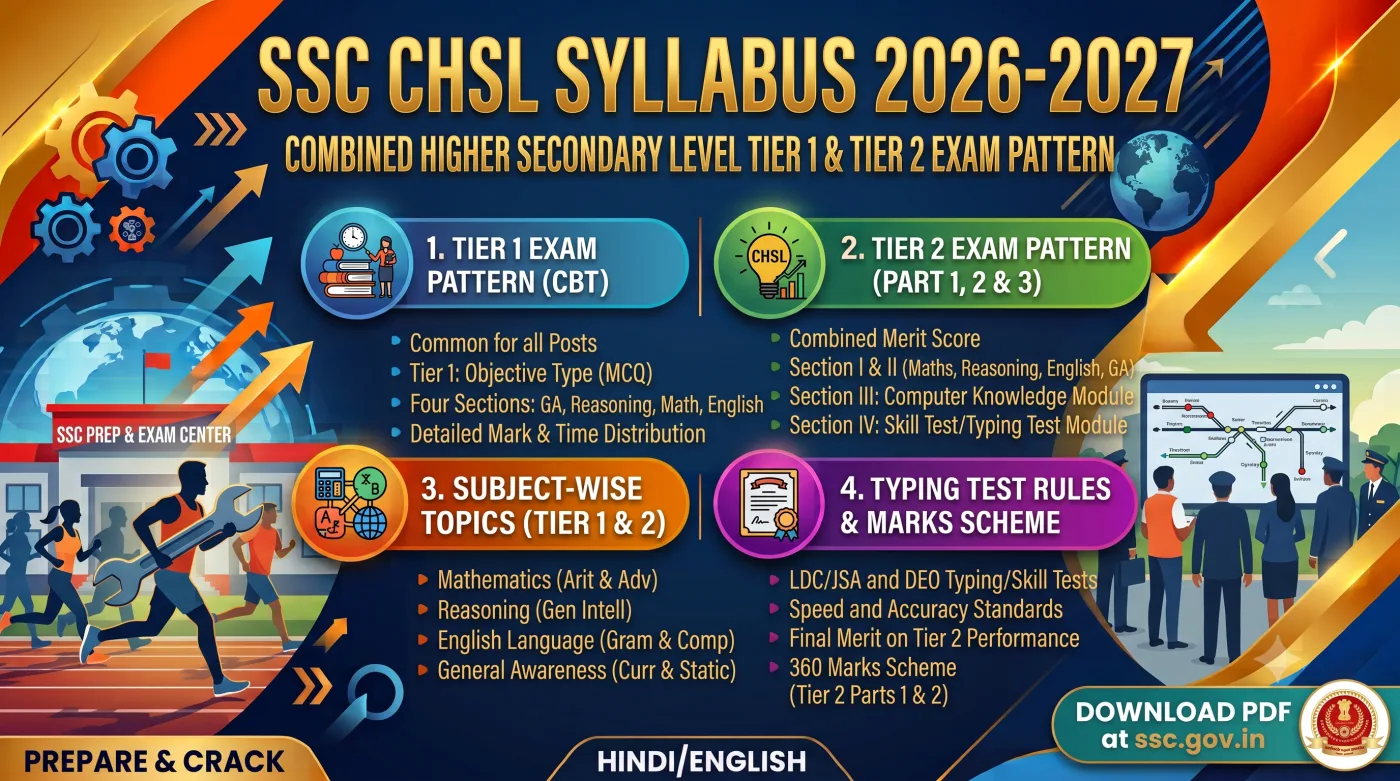
1. Executive Overview: SSC CHSL (10+2) Examination Framework
The Staff Selection Commission Combined Higher Secondary (10+2) Level Examination (SSC CHSL) is the largest intermediate-level competitive gateway in India. It recruits thousands of young aspirants directly into administrative desk cadres across central government ministries, constitutional bodies, defense establishments, and central tribunals:
- Tier-1 Examination (Computer Based Screening Test - 200 Marks): A 60-minute objective evaluation of English Language, General Intelligence, Quantitative Aptitude, and General Awareness. Tier-1 is strictly qualifying in nature.
- Tier-2 Examination (Merit Deciding Examination - 360 Marks + Qualifying Modules):
- Session-I (2 Hours 15 Minutes): Section-I (Maths + Reasoning = 180 Marks) and Section-II (English + General Awareness = 180 Marks) decide 100% of the candidate's final all-India ranking out of 360 Marks.
- Section-III Module-I: Computer Knowledge Test (15 Qs, 45 Marks, 15 minutes, qualifying nature).
- Session-II (Skill Test / Typing Test Module):
- Part A: Skill Test for DEO / DEO Grade A (15 minutes).
- Part B: Typing Test for LDC / JSA (10 minutes - 35 WPM English or 30 WPM Hindi).
- Departmental Document Verification: Conducted directly by the allocated user ministry/department upon final nomination by the Commission.
| Recruitment Dimension | Official Specification & Examination Details |
|---|---|
| Exam Conducting Authority | Staff Selection Commission (SSC / कर्मचारी चयन आयोग, नई दिल्ली) |
| Notified Cadres | Lower Division Clerk (LDC), Junior Secretariat Assistant (JSA), Data Entry Operator (DEO / DEO Grade A) |
| Educational Qualification | 12th Standard (10+2 Intermediate) Pass from a Recognized Board / University |
| Mode of Examination | Computer Based Test (CBT - ऑनलाइन कंप्यूटर आधारित परीक्षा) |
| Tier-1 Nature & Duration | Screening Only (100 Questions / 200 Marks / 60 Minutes) |
| Final Merit Score Ceiling | 360 Marks (Section-I: 180 Marks + Section-II: 180 Marks of Tier-2 Paper-I) |
| Tier-1 Negative Marking | 0.50 Marks deducted per incorrect response (1/4th penalty) |
| Tier-2 Negative Marking | 1.00 Mark deducted per incorrect response (1/3rd penalty per 3-mark question) |
| Qualifying Modules | Computer Knowledge Test (15 Qs / 45 M) & Typing / Skill Test Module |
| Official Commission Portal | ssc.gov.in |
2. Comprehensive Tier-1 Examination Pattern & Sectional Blueprint
Tier-1 evaluates speed, foundational calculation ability, and grammatical precision across four subjects. All questions carry equal marks (+2 for correct, -0.50 for wrong):
| Subject Domain / Section | Prescribed Curriculum Standard | Number of Questions | Maximum Marks | Optimal Time Allocation |
|---|---|---|---|---|
| 1. English Language | Basic Knowledge of Grammar, Vocabulary & Comprehension | 25 Questions | 50 Marks | 10 - 12 Minutes |
| 2. General Intelligence | Verbal, Non-Verbal & Analytical Reasoning | 25 Questions | 50 Marks | 12 - 14 Minutes |
| 3. Quantitative Aptitude | Basic Arithmetic Skill, Algebra & Mensuration | 25 Questions | 50 Marks | 24 - 26 Minutes |
| 4. General Awareness | Static GK, Current Affairs & General Science | 25 Questions | 50 Marks | 6 - 8 Minutes |
| Total Tier-1 Test | Composite 100 Objective Questions | 100 Questions | 200 Marks | 60 Minutes (1 Hour) |
3. Detailed Tier-2 Examination Pattern & 360 Marks Scoring Blueprint
Tier-2 is the sole determinant of final selection merit ranking and cadre allocation:
| Session | Section & Module | Subject Domains Included | Questions | Marks | Duration |
|---|---|---|---|---|---|
| Session-I (2 Hours 15 Mins) Compulsory for All Posts |
Section-I (Merit Module) |
Module-I: Mathematical Abilities | 30 Questions | 90 Marks | 1 Hour (60 Minutes) |
| Module-II: Reasoning and General Intelligence | 30 Questions | 90 Marks | |||
| Section-II (Merit Module) |
Module-I: English Language and Comprehension | 40 Questions | 120 Marks | 1 Hour (60 Minutes) |
|
| Module-II: General Awareness | 20 Questions | 60 Marks | |||
| Section-III (Qualifying) |
Module-I: Computer Knowledge Module | 15 Questions | 45 Marks | 15 Minutes | |
| Session-II (Skill Test Module) |
Section-III (Qualifying) |
Part A: Skill Test for DEO / DEO Grade A | Data Entry Speed Test | Qualifying | 15 Minutes |
| Part B: Typing Test for LDC / JSA | 35 WPM (English) / 30 WPM (Hindi) | Qualifying | 10 Minutes |
Critical Rule: Total Merit Marks = Section-I (180) + Section-II (180) = 360 Marks. Candidates failing to secure the minimum qualifying marks in the Computer Module or failing the typing test are disqualified completely!
4. Subject-Wise Comprehensive Syllabus Breakdown (Tier 1 & Tier 2)
Module 1: Mathematical Abilities & Quantitative Aptitude
- Number Systems: Computation of Whole Number, Decimal and Fractions, Relationship between numbers, Divisibility rules, Unit digit, Remainder theorem, Surds and indices.
- Fundamental Arithmetical Operations:
- Percentages and fractional conversions ($1/6 = 16.66\%$, $1/8 = 12.5\%$, $1/12 = 8.33\%$).
- Ratio and Proportion, Square roots, Averages, Simple Interest and Compound Interest ($CI - SI$ difference formulas).
- Profit and Loss, Discount, Successive discounts, Partnership business, Mixture and Allegation.
- Time and Distance, Relative speed, Trains crossing bridges, Boats and streams.
- Time and Work, Men-days formula ($M_1 D_1 H_1 = M_2 D_2 H_2$), Pipes and cisterns.
- Algebra: Basic algebraic identities of School Algebra and Elementary surds, Graphs of Linear Equations.
- Geometry: Familiarity with elementary geometric figures and facts: Triangle and its various kinds of centres (Incentre, Circumcentre, Orthocentre, Centroid), Congruence and similarity of triangles, Circle and its chords, tangents, angles subtended by chords of a circle, common tangents to two or more circles.
- Mensuration: Triangle, Quadrilaterals, Regular Polygons, Circle, Right Prism, Right Circular Cone, Right Circular Cylinder, Sphere, Hemispheres, Rectangular Parallelepiped, Regular Right Pyramid with triangular or square base.
- Trigonometry: Trigonometric ratios, Degree and Radian measures, Standard identities ($\sin^2\theta + \cos^2\theta = 1$, $1 + \tan^2\theta = \sec^2\theta$), Heights and Distances (simple problems only).
- Statistics and Probability (Tier-2 Specific): Use of Tables and Graphs: Histogram, Frequency polygon, Bar-diagram, Pie-chart; Measures of central tendency: Mean, Median, Mode; Standard deviation; Calculation of simple probabilities.
Module 2: Reasoning and General Intelligence
- Verbal Reasoning: Semantic Analogy, Symbolic/Number Analogy, Figural Analogy, Semantic Classification, Symbolic/Number Classification, Figural Classification, Semantic Series, Number Series, Figural Series, Problem Solving, Word Building, Coding & de-coding, Numerical Operations, Symbolic Operations, Trends, Space Orientation, Space Visualization, Venn Diagrams, Drawing inferences, Punched hole/pattern-folding & unfolding.
- Critical Reasoning: Critical thinking, Emotional Intelligence, Social Intelligence, Statement-Arguments, Statement-Assumptions, Statement-Conclusions, Cause and Effect analysis.
- Non-Verbal Reasoning: Figural pattern completion, Embedded figures, Mirror and water images, Paper folding and cutting, Cube and dice (opposite faces).
Module 3: English Language and Comprehension
- Grammar & Usage: Spot the Error, Fill in the Blanks, Subject-Verb Agreement, Rules of Nouns, Pronouns, Adjectives, Adverbs, Prepositions, Conjunctions, and Conditionals.
- Vocabulary Mastery: Synonyms/Homonyms, Antonyms, Spellings/detecting mis-spelt words, Idioms & Phrases, One word substitution.
- Sentence Improvement: Improvement of Sentences, Active/Passive Voice of verbs, Conversion into Direct/Indirect narration.
- Sentence Ordering: Shuffling of Sentence parts (PQRS / Para Jumbles), Shuffling of Sentences in a passage.
- Comprehension Mastery: Cloze Passage, Comprehension Passage (to test comprehension, three or more paragraphs are given and questions are asked based on these; at least one paragraph is a simple story or dialogue and the other two paragraphs are on current socio-economic affairs or scientific topics).
Module 4: General Awareness
- Current Affairs: National and international events, Government schemes, Summits, Science and space missions (ISRO), Defense exercises, Sports tournaments, Books and Authors, Awards and Honors.
- History of India: Ancient India, Medieval India, Modern India, Freedom Struggle, 1857 Revolt, Gandhian movements.
- Geography: Physical geography of India, River systems, Climate, Soil, Minerals, National Parks, World geography essentials.
- Indian Polity & Constitution: Making of the Constitution, Fundamental Rights and Duties, Directive Principles, President, Parliament, Judiciary, Important Amendments.
- Economics: Basics of Indian economy, Five Year Plans, NITI Aayog, Budget, Inflation, Banking system, Foreign trade.
- General Science: Class 10 standard Physics, Chemistry, and Biology fundamentals.
Module 5: Computer Knowledge Module (Tier-2 Section-III - 15 Qs, 45 Marks)
- Computer Basics: Organization of a computer system, Central Processing Unit (CPU), Input/Output devices, Computer memory (RAM, ROM, Cache), Secondary storage, Windows Explorer, Keyboard shortcuts.
- Software Applications: Windows Operating System basics, Microsoft Office Suite: MS Word (document creation, formatting, tables), MS Excel (spreadsheets, basic formulas, cell referencing), MS PowerPoint (slide creation, transitions).
- Working with Internet and E-mails: Web browsing and searching, Downloading and uploading files, Managing an e-mail account, e-Banking services.
- Basics of Networking and Cyber Security: Networking devices, Network topologies, Protocols (TCP/IP, HTTP, FTP, SMTP), Network security threats (Hacking, Virus, Worms, Trojan Horse, Phishing, Malware, Spyware), Antivirus software, Firewalls.
5. Typing & Skill Test Standards for LDC, JSA & DEO Posts
Module-II of Section-III is the qualifying Skill Test / Typing Test conducted on computer consoles:
| Cadre Post Name | Test Type & Medium | Prescribed Typing Speed Standard | Duration & Evaluation Benchmark |
|---|---|---|---|
| Lower Division Clerk (LDC) / JSA | English Typing Test | 35 Words Per Minute (WPM) (Approx. 10,500 Key Depressions Per Hour) |
10 Minutes: Maximum permissible errors: UR 7% | Reserved Categories 10% |
| Lower Division Clerk (LDC) / JSA | Hindi Typing Test | 30 Words Per Minute (WPM) (Approx. 9,000 Key Depressions Per Hour) |
10 Minutes: Mangal or Inscript font on computer. Permissible errors: UR 7% | Reserved 10% |
| Data Entry Operator (DEO / DEO Gr A) In C&AG / Ministries |
Data Entry Speed Test (DEST) | 15,000 Key Depressions Per Hour (Approx. 3,750 Key Depressions in 15 mins) |
15 Minutes: Maximum permissible errors: UR 5% | Reserved 7% |
| Data Entry Operator (DEO) In other Departments |
Data Entry Speed Test (DEST) | 8,000 Key Depressions Per Hour (Approx. 2,000 Key Depressions in 15 mins) |
15 Minutes: Permissible errors: UR 7% | Reserved 10% |
6. Post Hierarchy & Salary Matrix under SSC CHSL
| Designation / Post Name | Pay Level (7th CPC) | Basic Pay Scale | Approx. Monthly Gross Salary | Key Departments & Ministries |
|---|---|---|---|---|
| Data Entry Operator Grade 'A' | Level-4 | ₹25,500 - ₹81,100 | ₹38,000 - ₹44,000 | Comptroller and Auditor General of India (C&AG) |
| Data Entry Operator (DEO) | Level-4 / Level-5 | ₹25,500 - ₹92,300 | ₹38,000 - ₹48,000 | Ministry of Consumer Affairs, Food & Public Distribution |
| Lower Division Clerk (LDC) | Level-2 | ₹19,900 - ₹63,200 | ₹30,000 - ₹35,000 | Central Secretariat, Armed Forces HQ, CBI, Intelligence Bureau, Election Commission |
| Junior Secretariat Assistant (JSA) | Level-2 | ₹19,900 - ₹63,200 | ₹30,000 - ₹35,000 | Central Administrative Tribunal, Central Passport Organisation (MEA), ITAT |
7. Standard Recommended Study Books & Resources
| Subject Domain | Standard Recommended Books | Author / Publication | Preparation Utility |
|---|---|---|---|
| Quantitative Aptitude | Arithmetic for General Competitions + Play with Advanced Maths | Rakesh Yadav / Abhinay Sharma | Conceptual clarity in arithmetic shortcuts, percentages, profit-loss, algebra, and geometry |
| English Language | Plinth to Paramount (Vol 1 & 2) + Word Power Made Easy | Neetu Singh (KD Campus) / Norman Lewis | Grammar rules mastery, vocabulary root words, active-passive voice, and cloze tests |
| General Intelligence | Pinnacle SSC Reasoning Chapterwise Solved Papers | Pinnacle Publications | Extensive practice of latest TCS pattern reasoning and critical inference questions |
| General Awareness | Lucent Samanya Gyan + Pinnacle SSC GS Chapterwise | Lucent / Pinnacle Publications | Static GK consolidation alongside topic-wise PYQ analysis from 2018 onwards |
| Computer Knowledge | Computer Knowledge for SSC Exams | Kiran / Arihant Publications | Hardware, networking, shortcuts, MS Office commands, and cyber security fundamentals |
8. 120-Day Scientific Master Study Routine to Score 310+ in Tier-2
- Phase 1: Foundation & Sectional Mastery (Days 1 to 50):
- Spend 2.5 hours daily on Mathematics: Focus on arithmetic speed, ratio, percentages, profit & loss, algebra, and geometry.
- Spend 2 hours daily on English: Study one grammar rule chapter every 2 days, read newspaper editorials for 20 minutes, and memorize 25 vocabulary words daily.
- Spend 1.5 hours daily on Reasoning: Practice 40 questions daily across coding, analogies, and syllogism.
- Spend 1 hour daily on General Awareness and NCERT science.
- Crucial Typing Practice: Dedicate 20 minutes daily to computer typing software (e.g., TypingMaster / Sony Typing Tutor) to comfortably reach 40+ WPM in English or 35+ WPM in Hindi.
- Phase 2: Tier-1 CBT Mock Drills (Days 51 to 80):
- Attempt one full-length 100-question Tier-1 mock test every alternate day in 55 minutes.
- Analyze negative marking mistakes carefully. Maintain a mistake notebook for recurring arithmetic calculation slips and grammar traps.
- Dedicate 30 minutes every weekend to Computer Knowledge chapters to guarantee clearing Section-III qualifying benchmarks.
- Phase 3: Tier-2 Full Simulation & Typing Perfection (Days 81 to 120):
- Attempt full-length Tier-2 Paper-I mock tests (Section-I: 1 hr + Section-II: 1 hr + Computer: 15 mins) twice a week on a computer.
- Practice typing continuous 10-minute and 15-minute passages containing numbers, capital letters, and punctuation marks to ensure error rates remain strictly below 4%.
- Stop reading new topics during the final 10 days. Revise mathematical formula sheets, grammar rules, and current affairs compilations exclusively.
8. Official Typing Test Mistake Evaluation Manual (Full vs Half Mistakes)
The Staff Selection Commission implements an exact algorithmic methodology to evaluate typed passages during the Module-II Typing / Skill Test. Understanding what constitutes a Full Mistake versus a Half Mistake is paramount to keeping your total error percentage below the prescribed 7% (UR) or 10% (Reserved) threshold:
| Mistake Classification | Typing Error Category | Concrete Practical Examples | Penalty Impact on Score |
|---|---|---|---|
| Full Mistakes (पूर्ण त्रुटियां) | Omission of a Word (शब्द का छूटना) | Skipping an entire word or figure present in the master text passage. | Deducts 1 Full Word Penalty |
| Substitution of a Word (गलत शब्द प्रतिस्थापन) | Typing a wrong word in place of the printed word in the master text. | Deducts 1 Full Word Penalty | |
| Addition of a Word (अतिरिक्त शब्द जोड़ना) | Typing an extra word not present in the original printed passage. | Deducts 1 Full Word Penalty | |
| Incomplete Word (अधूरा शब्द) | Leaving a word unfinished or truncated before pressing the spacebar. | Deducts 1 Full Word Penalty | |
| Half Mistakes (अर्ध त्रुटियां) | Spacing Error (स्थान त्रुटि) | Omitting space between two words (e.g., 'ofthe' instead of 'of the') or inserting unwanted space within a single word. | Deducts 0.5 Word Penalty |
| Capitalization Error (अक्षर आकार त्रुटि) | Typing a lowercase letter where a capital is required (e.g., 'india' instead of 'India'), or vice-versa. | Deducts 0.5 Word Penalty | |
| Punctuation Error (विराम चिन्ह त्रुटि) | Omitting or incorrectly inserting commas, full stops, hyphens, or quotation marks. | Deducts 0.5 Word Penalty | |
| Transposition Error (अक्षर क्रम त्रुटि) | Reversing the sequence of letters within a word (e.g., typing 'hte' instead of 'the'). | Deducts 0.5 Word Penalty |
Mathematical Formula for Percentage of Errors:
The Commission computes the candidate's net error percentage on computer using the following standardized mathematical equation:
$$\text{Percentage of Errors (\%)} = \left(\frac{\text{Total Full Mistakes} + (\text{Total Half Mistakes} \times 0.5)}{\text{Total Words in the Master Passage}}\right) \times 100$$
For instance, if the master text has 350 words, and a candidate commits 10 full mistakes and 8 half mistakes, the total error count is $10 + (8 \times 0.5) = 14$ mistakes. The percentage error is $\frac{14}{350} \times 100 = 4.0\%$. Since $4.0\% \le 7\%$, the candidate qualifies the typing test!
9. Cadre Job Profiles & Career Promotion Ladders
Joining the central civil services as an LDC, JSA, or DEO under SSC CHSL opens doors to regular time-scale promotions and departmental examinations:
| Cadre Post Name | Primary Administrative Duties | Workplace Environment | Promotional Pathway Milestones |
|---|---|---|---|
| Lower Division Clerk (LDC) | File diary, dispatch, drafting routine office memos, docketing communications, maintaining inward/outward registers. | Attached to Central Secretariat, CBI, Intelligence Bureau, and Armed Forces Headquarters. | Upper Division Clerk (UDC / Level-4) → Assistant / Section Officer (Level-7 via LDCE Exam) |
| Junior Secretariat Assistant (JSA) | Managing official digital records, e-Office document processing, drafting non-confidential letters, administrative filing. | Ministries such as External Affairs, Law & Justice, Central Administrative Tribunals. | Senior Secretariat Assistant (SSA / Level-4) → Assistant Section Officer (ASO / Level-7) |
| Data Entry Operator (DEO Grade A) | Data compilation, entry of audit files, statistical data processing, managing database spreadsheets and records. | Offices under Comptroller & Auditor General (CAG) and Ministry of Consumer Affairs. | DEO Grade B (Level-5) → DEO Grade C (Level-6) → Data Entry Manager (Level-7) |
10. Historical Cut-Off Trends & Tier-2 Safe Target Blueprint
Because SSC CHSL Tier-2 is evaluated out of 360 marks, candidates must establish realistic score targets across community categories based on recent recruitment trends:
| Community Category | Tier-1 Screening Cut-Off Range (Out of 200) | Tier-2 Safe Score for LDC/JSA (Out of 360) | Tier-2 Safe Score for DEO Grade A (Out of 360) | Computer Module Safe Target (Out of 45) |
|---|---|---|---|---|
| General / Unreserved (UR) | 152 - 158 Marks | 295 - 308 Marks | 318 - 328 Marks | 27+ Marks |
| Other Backward Classes (OBC) | 150 - 156 Marks | 290 - 302 Marks | 312 - 322 Marks | 24+ Marks |
| Economically Weaker Section (EWS) | 145 - 152 Marks | 285 - 298 Marks | 308 - 318 Marks | 24+ Marks |
| Scheduled Caste (SC) | 132 - 140 Marks | 265 - 275 Marks | 288 - 298 Marks | 20+ Marks |
| Scheduled Tribe (ST) | 122 - 130 Marks | 250 - 262 Marks | 275 - 285 Marks | 18+ Marks |
| Ex-Servicemen (ESM) | 98 - 108 Marks | 210 - 225 Marks | 235 - 248 Marks | 18+ Marks |
11. SSC Multi-Shift Normalization & Equating Methodology Explained
Because the Computer Based Examination is conducted across dozens of testing sessions nationwide, question papers inevitably exhibit marginal fluctuations in difficulty. SSC resolves this using its landmark Mean-Standard Deviation Normalization Formula:
| Formula Variable | Mathematical Representation | Operational Impact on Candidate Marks |
|---|---|---|
| $\widehat{M}_{ij}$ | Normalized marks of $j^{th}$ candidate in $i^{th}$ shift | The final score printed on the candidate's official scorecard. |
| $\bar{M}_t^g$ | Average marks of top 0.1% candidates across all shifts combined | Establishes the supreme nationwide benchmark. |
| $M_q^g$ | Sum of mean and standard deviation across all shifts | Normalizes national baseline performance. |
| $\bar{M}_{ti}$ | Average marks of top 0.1% candidates in the candidate's specific shift | Quantifies shift difficulty: lower averages result in upward scaling of marks. |
| $M_{iq}$ | Sum of mean marks and standard deviation of candidate's shift | Compensates candidates who faced exceptionally tough papers. |
12. Online Option-cum-Preference Window & Departmental Document Verification
Under the modern SSC recruitment architecture:
- Digital Preference Submission: After the conclusion of Tier-2 and prior to final results, the Commission opens a dedicated online window on
ssc.gov.in. Candidates must submit their preferences for all participating ministries, departments, and offices. Candidates who fail to submit online preferences are strictly eliminated from consideration. - Merit-cum-Preference Allocation: System generates final recommendation lists based on normalized Tier-2 marks (out of 360) matched against vacancies and candidate preferences.
- Direct Departmental DV: Selected candidates are summoned directly by their allocated ministry/department for verification of original Class 10/12 certificates, caste credentials, and medical fitness certificates before joining letters are issued.
13. Detailed Topic-Wise Question Weightage & Difficulty Matrix (Tier-1 & Tier-2)
Analyzing recent SSC CHSL examination shifts reveals consistent patterns in subject-wise question distribution. Candidates should prioritize high-yield areas during their revisions:
| Subject Domain | Core Chapter / Topic Focus | Tier-1 Questions (out of 25) | Tier-2 Questions | Expected Difficulty Level |
|---|---|---|---|---|
| Quantitative Aptitude | Arithmetic (Percentages, Profit-Loss, Ratio, Time & Work, Speed) | 12 - 14 Questions | 14 - 16 Questions | Moderate (Calculation-intensive) |
| Advanced Maths (Algebra, Trigonometry, Geometry, Mensuration) | 8 - 10 Questions | 10 - 12 Questions | Moderate to Tough (Concept-driven) | |
| Statistics & Probability (Mean, Median, Mode, Dice/Cards) | 0 - 1 Question | 2 - 3 Questions | Easy to Moderate | |
| Number System & Simplification (BODMAS, Surds, Divisibility) | 2 - 3 Questions | 2 - 3 Questions | Easy (Speed check) | |
| English Language | Vocabulary (Synonyms, Antonyms, One Word, Idioms, Spelling) | 9 - 10 Questions | 14 - 16 Questions | Moderate (Direct recall) |
| Grammar (Spotting Errors, Sentence Improvement, Fillers) | 6 - 8 Questions | 10 - 12 Questions | Moderate (Rule application) | |
| Voice & Narration (Active-Passive & Direct-Indirect) | 2 - 3 Questions | 5 - 6 Questions | Easy to Moderate (Rule-based) | |
| Comprehension & Cloze Test (Unseen Passages & Para Jumbles) | 5 - 7 Questions | 10 - 12 Questions | Moderate (Contextual inference) | |
| General Intelligence | Verbal Logic (Analogies, Series, Coding-Decoding, Blood Relations) | 15 - 17 Questions | 16 - 18 Questions | Easy to Moderate |
| Critical Reasoning (Statement-Assumptions, Inferences) | 1 - 2 Questions | 4 - 6 Questions | Moderate to Tricky | |
| Non-Verbal (Paper folding, Mirror images, Embedded, Dice) | 6 - 8 Questions | 6 - 8 Questions | Easy (Visual recognition) | |
| General Awareness | Static GK (History, Geography, Polity, Art & Culture, Classical Dance) | 12 - 14 Questions | 10 - 12 Questions | Moderate to High depth |
| General Science (Physics, Chemistry, Biology Class 9-10) | 5 - 6 Questions | 4 - 5 Questions | Moderate (NCERT based) | |
| Current Affairs (National events, Schemes, Sports, Summits) | 5 - 7 Questions | 4 - 5 Questions | Recent 6-8 months focus |
14. Professional Typing Ergonomics & Finger Placement Mastery
Achieving 35 WPM in English or 30 WPM in Hindi within a strict 10-minute countdown requires systematic muscular conditioning and proper keyboard posture:
- Home Row Discipline: Never resort to "two-finger hunt-and-peck" typing. Place the fingers of your left hand on
A-S-D-Fand right hand onJ-K-L-;. Your index fingers must rest comfortably on the tactile indicator bumps of keysFandJ. - Eye-on-Screen Focus: Look solely at the master passage displayed on the top half of your computer screen; never gaze down at the physical keyboard. Typing errors multiply whenever a candidate looks away from the screen.
- Punctuation & Number Row Drills: SSC master passages always include numerical years, decimal percentages, hyphens, and inverted commas. Dedicate 10 minutes of daily typing drills exclusively to the upper number row (
1through0) and special symbols (! @ # $ % & * ( ) - _ , .). - Keyboard Hardware Familiarity: SSC test centers use standard USB membrane keyboards with varying key travel and tactile stiffness. Practice on basic OEM keyboards (e.g., standard Dell or HP wired keyboards) rather than soft laptop keyboards to build muscle endurance.
15. Tie-Breaking Hierarchy in SSC CHSL Final Merit Ranking
Whenever two or more candidates obtain identical total normalized marks in Tier-2 Paper-I (out of 360 marks), the Commission resolves the tie strictly through the following sequential criteria:
- Marks in Section-I of Tier-2 Paper-I: Candidate with higher combined marks in Mathematical Abilities and Reasoning & General Intelligence is placed higher in rank.
- Marks in Section-II of Tier-2 Paper-I: If the tie persists, marks obtained in English Language & Comprehension and General Awareness are compared.
- Date of Birth (Seniority in Age): Older candidate is given precedence and placed higher in the selection merit list.
- Alphabetical Order: If the tie remains unresolved, candidates are arranged in alphabetical order of their full registered names.
16. Special Physical Standards for Border Roads Organisation (BRO) LDC Posts
Candidates opting for Lower Division Clerk (LDC) in the Border Roads Organisation (BRO / सीमा सड़क संगठन) must note that BRO is a specialized male-only cadre under the Ministry of Defence with mandatory physical efficiency benchmarks:
| Region / State Category | Minimum Height | Chest Measurement Standard | Minimum Weight |
|---|---|---|---|
| Western Himalayan Region (J&K, Himachal, Uttarakhand) | 158 cms | 75 cms (5 cms minimum expansion) | 47.5 kg |
| Eastern Himalayan Region (Sikkim, North-East States) | 152 cms | 75 cms (5 cms minimum expansion) | 47.5 kg |
| Plain Regions (UP, Bihar, Punjab, Haryana, Rajasthan) | 162.5 cms | 76 cms (5 cms minimum expansion) | 50 kg |
| Southern Region (AP, Telangana, Karnataka, Tamil Nadu, Kerala) | 157 cms | 76 cms (5 cms minimum expansion) | 50 kg |
| Gorkhas & ST Candidates | 152 cms | 75 cms (5 cms minimum expansion) | 47.5 kg |
BRO Physical Test: Male candidates for BRO LDC must complete a One Mile (1,600 Meters) Run within 10 Minutes. Female candidates and PwBD candidates are not eligible for BRO posts.
17. Concluding Strategic Advice for CHSL Aspirants
Cracking the SSC Combined Higher Secondary Level (10+2) examination is a monumental achievement that establishes a secure, respectable, and progressive career in the central government at a young age. Success requires a balanced triumvirate: flawless arithmetic calculation speed, sharp English grammatical comprehension, and dependable daily typing practice. Do not ignore computer literacy and typing speed until after Tier-1, because qualifying both is mandatory for appointment. Treat this syllabus as your daily operational charter, practice previous year papers with relentless discipline, and secure your place as an officer of the Government of India! (एसएससी सीएचएसएल में सफलता आपकी निरंतर मेहनत, गति और अनुशासन का परिणाम है। सही दिशा में प्रयास करें और विजय प्राप्त करें!)
User Discussion & Comments (0)
No comments yet. Be the first to leave a comment below!
Leave a Comment / Ask a Question: