SSC GD Constable Answer Key 2026-2027: Comprehensive Executive Overview
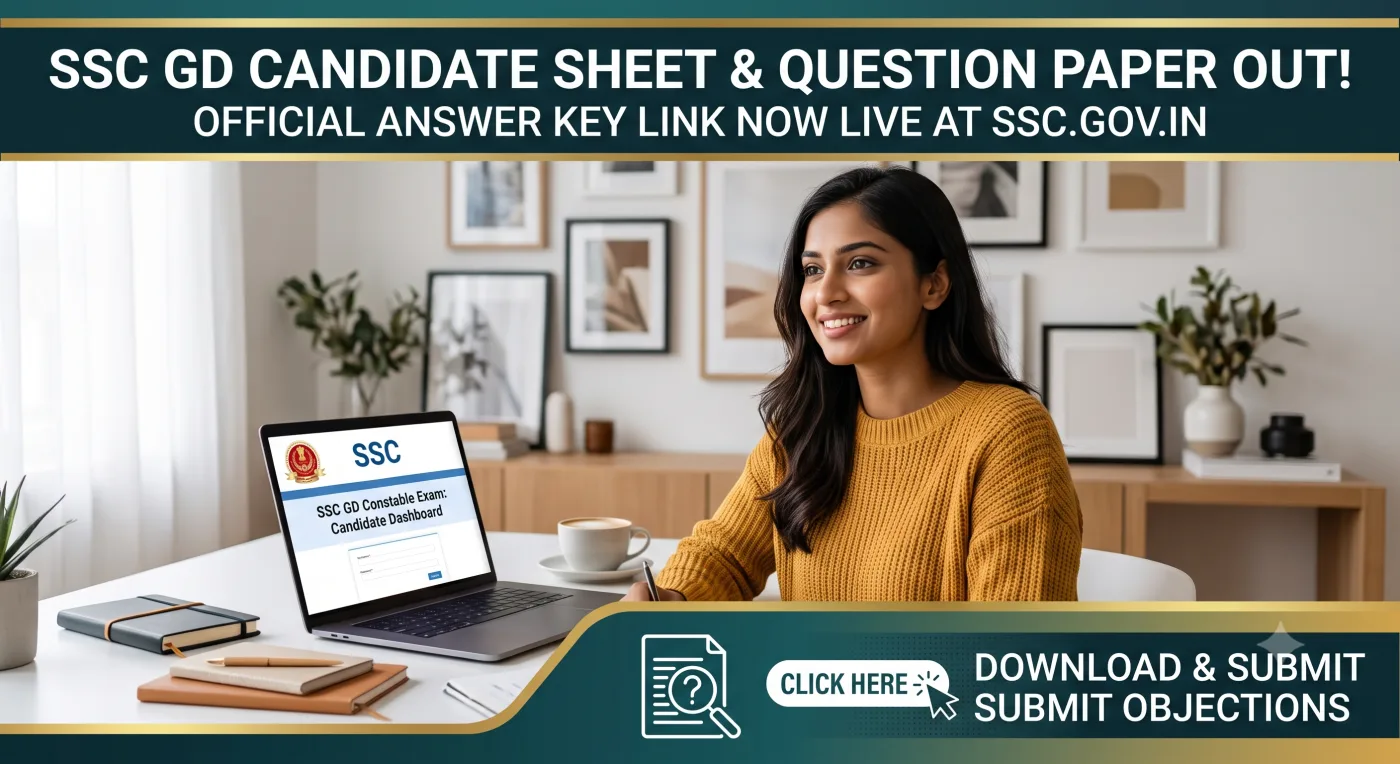
The Staff Selection Commission (SSC) administers the mega nationwide Computer Based Examination (CBE) for the recruitment of General Duty (GD) Constables across Central Armed Police Forces (CAPFs—BSF, CISF, CRPF, SSB, ITBP, AR) and SSF. Following the successful culmination of the multi-day computer examination, the Commission releases the Tentative Answer Key along with the Candidate Response Sheet on its upgraded central web portal (ssc.gov.in).
This official release represents the most critical milestone in the candidate assessment lifecycle. It empowers millions of paramilitary aspirants across India to cross-examine their chosen responses against the official answer keys formulated by subject matter experts. Candidates can accurately calculate their Raw Examination Score, predict normalized percentiles, estimate qualification prospects for the Physical Standard Test (PST) and Physical Efficiency Test (PET), and formally lodge online representations/objections against any erroneous questions or flawed answer keys.
📌 कर्मचारी चयन आयोग जीडी कांस्टेबल उत्तर कुंजी मुख्य सारांश (Key Takeaways)
एसएससी जीडी कांस्टेबल भर्ती परीक्षा समाप्त होने के उपरांत आयोग अपनी आधिकारिक वेबसाइट ssc.gov.in पर टेंटेटिव आंसर की एवं रिस्पॉन्स शीट जारी करता है:
- अभ्यर्थी अपने रोल नंबर (यूजर आईडी) तथा परीक्षा प्रवेश पत्र पर अंकित पासवर्ड (जन्मतिथि) की सहायता से अपनी व्यक्तिगत रिस्पॉन्स शीट डाउनलोड कर सकते हैं।
- यदि किसी प्रश्न अथवा उसके उत्तर विकल्प में कोई त्रुटि प्रतीत होती है, तो निर्धारित समय-सीमा के भीतर ₹100 प्रति प्रश्न की दर से ऑनलाइन आपत्ति (Representation/Objection) दर्ज की जा सकती है।
- यदि अभ्यर्थी की आपत्ति विषय विशेषज्ञों द्वारा वैध पाई जाती है, तो संशोधित अंतिम उत्तर कुंजी (Final Answer Key) तैयार की जाती है और आपत्तिकर्ता को शुल्क वापस कर दिया जाता है।
SSC GD Examination Architecture & Official Evaluation Matrix
Understanding the marking architecture is essential for auditing response sheets and computing raw performance metrics without statistical error. The SSC GD Computer Based Test comprises 80 multiple-choice questions carrying a cumulative weight of 160 marks:
| Test Segment | Subject Area | No. of Questions | Maximum Marks | Negative Penalty per Incorrect Q |
|---|---|---|---|---|
| Part A | General Intelligence and Reasoning | 20 Questions | 40 Marks | -0.25 Mark (or 1/8th of 2 Marks) |
| Part B | General Knowledge and General Awareness | 20 Questions | 40 Marks | -0.25 Mark |
| Part C | Elementary Mathematics | 20 Questions | 40 Marks | -0.25 Mark |
| Part D | English OR Hindi (Candidate's Opted Language) | 20 Questions | 40 Marks | -0.25 Mark |
| Cumulative Total Evaluation Benchmark | 80 Questions | 160 Marks | Total Duration: 60 Minutes | |
Mathematical Formula for Exact Raw Marks Calculation
Upon downloading your individual response sheet PDF, examine each question carefully. The response sheet displays:
- Question Content & Graphic Figures: The exact bilingual question rendered during your shift.
- Official Correct Option: Highlighted with a bright green checkmark icon (✅).
- Candidate Chosen Option: Indicated under the "Status" and "Chosen Option" panel on the right margin of each question block.
Use the standardized Commission formula to compute your raw marks:
🧮 एसएससी जीडी रॉ स्कोर गणना सूत्र (Raw Score Formula)
Raw Score = (Number of Correct Answers × 2.0) - (Number of Incorrect Answers × 0.25)
उदाहरण: यदि आपने 80 में से 68 प्रश्न हल किए, जिनमें 58 सही हैं और 10 गलत हैं, तो आपका रॉ स्कोर होगा:
(58 × 2) - (10 × 0.25) = 116 - 2.5 = 113.5 Marks (Out of 160)। अनअटेम्प्ड प्रश्नों (Unattempted) के लिए कोई अंक नहीं कटता।
Step-by-Step Tutorial: How to Download SSC GD Response Sheet & Answer Key PDF
Candidates must follow these authentic procedural instructions to access the answer key module on the Commission's DigiLM cloud architecture:
- Visit the New SSC Portal: Open your browser and navigate to the official website at ssc.gov.in.
- Navigate to the Notice Board / Answer Key Tab: Under the "Quick Links" or "Notice Board" section on the homepage, click on the active notification link titled "Uploading of Tentative Answer Keys along with Candidates' Response Sheet(s) of Constable (GD) in Central Armed Police Forces (CAPFs), SSF and Rifleman (GD) in Assam Rifles Examination".
- Open the Official Notice PDF: Read the operational dates and representation fee guidelines. Click on the direct login link embedded at the bottom of the PDF notice (usually directing to
https://ssc.digialm.com/). - Enter Examination Credentials:
- User ID: Enter your 10-digit Examination Roll Number (as printed on your original SSC GD Admit Card). Do NOT use your One-Time Registration (OTR) number.
- Password: Enter your Date of Birth in
DDMMYYYYformat (for instance, if your DOB is 15th August 2002, input15082002).
- Access Candidate Dashboard: Upon logging in, dismiss the general instruction popup. Click on the tab labeled "Candidate Response".
- Generate Response Sheet: Click on the link saying "To download your question paper for Constable GD Examination, Click here to generate it".
- Save and Print Immediately: Your full question paper with chosen options and official answers will render. Click "Print" at the top right and save the document as a secure PDF on your local device. Warning: The Commission permanently deactivates response sheet access once the objection window concludes.
How to File Online Objections / Representations Against Flawed Questions
If, after consulting standard NCERT textbooks, reference lexicons, or authoritative encyclopedias, you detect that an official answer key is incorrect or that a question possesses multiple ambiguous correct options, you are entitled to submit a formal representation:
| Objection Step | Required Action | Key Regulatory Parameter |
|---|---|---|
| 1. Objection Portal Access | Log into the DigiLM candidate dashboard and click on the "Objection" or "Representation" tab. | Active strictly within Commission announced dates (no physical letters accepted). |
| 2. Question ID Selection | Select the specific unique Question ID and Option ID displayed on your response sheet. | Cross-check the Question ID accurately; mis-identifying the ID forfeits the representation. |
| 3. Nature of Objection | Categorize the defect: (a) Incorrect Answer Key, (b) Multiple Correct Options, (c) Question Formulation Incomplete/Flawed, (d) Translation Discrepancy. | English version of question paper prevails in case of bilingual discrepancy unless specified. |
| 4. Evidence Upload | Upload scanned PDF or high-resolution JPEG proof from government publications, NCERT textbooks, or standard reference dictionaries. | Guidebooks or unofficial coaching keys are summarily rejected as authoritative proof. |
| 5. Processing Fee Payment | Deposit the non-refundable processing fee of ₹100 per challenged question via UPI, Net Banking, or Debit Card. | Unpaid representations are purged automatically and not reviewed by the expert committee. |
SSC Normalization Formula & Multi-Shift Score Equating Mechanism
Because the SSC GD examination is administered over multiple days across dozens of shifts with varying difficulty coefficients, the Commission does NOT determine merit ranks on raw marks alone. Instead, a mathematically rigorous Equi-Percentile / Modified Normalization Formula is deployed:
📐 नॉर्मलाइजेशन प्रक्रिया की कार्यप्रणाली (How Normalization Works)
कर्मचारी चयन आयोग बहु-सत्रीय परीक्षाओं में प्राप्तांकों को संतुलित करने के लिए मानक विचलन (Standard Deviation) और औसत अंकों (Mean Marks) के आधार पर जटिल सांख्यिकीय सूत्र लागू करता है।
- कठिन शिफ्ट (Hard Shift): यदि किसी शिफ्ट के सभी अभ्यर्थियों का औसत स्कोर 92 अंक रहता है, तो उस शिफ्ट के अभ्यर्थियों के रॉ स्कोर में नॉर्मलाइजेशन के बाद 8 से 14 अंकों तक की वृद्धि हो सकती है।
- सरल शिफ्ट (Easy Shift): यदि किसी शिफ्ट का औसत स्कोर 120 अंक तक पहुंच जाता है, तो उस शिफ्ट के अंकों में मामूली वृद्धि (1 से 3 अंक) होती है या अंक लगभग स्थिर रहते हैं।
- गलत प्रश्नों का प्रभाव (Accuracy Impact): नॉर्मलाइजेशन सीधे सटीकता (Accuracy Percentage) पर निर्भर नहीं करता, बल्कि उस विशिष्ट शिफ्ट के शीर्ष 0.1% अभ्यर्थियों के औसत अंकों पर आधारित होता है।
State-Wise & Category-Wise Expected Cut-Off Trends for Physical Test (PST/PET)
SSC GD cut-offs are characterized by complex geographic stratification: State-wise, Force-wise (BSF, CISF, CRPF, SSB, ITBP, AR, SSF), and Area-wise (General District, Border District, Naxal/Militancy Affected District). Based on extensive question paper analysis, historical cutoff benchmarks, and seat-to-candidate ratios (typically 8 times the vacancies shortlisted for PET/PST), the projected raw score ranges are outlined below:
| State / Region Category Tier | UR (General) Cutoff | OBC Category Cutoff | EWS Category Cutoff | SC Category Cutoff | ST Category Cutoff |
|---|---|---|---|---|---|
| High Cutoff Northern States (UP, Bihar, Haryana, Rajasthan, MP, Delhi) | 126 – 134 Marks | 122 – 130 Marks | 120 – 128 Marks | 110 – 118 Marks | 104 – 112 Marks |
| Moderate Cutoff States (Punjab, Himachal, Uttarakhand, Jharkhand, West Bengal, Odisha) | 98 – 112 Marks | 92 – 105 Marks | 88 – 100 Marks | 80 – 90 Marks | 76 – 86 Marks |
| Lower Cutoff Southern & Western States (Maharashtra, Gujarat, Karnataka, Andhra, Telangana, Kerala) | 78 – 92 Marks | 72 – 86 Marks | 68 – 80 Marks | 62 – 72 Marks | 58 – 68 Marks |
| North-Eastern & Island Territories (Assam, Meghalaya, Tripura, Nagaland, J&K, Ladakh) | 58 – 72 Marks | 52 – 65 Marks | 48 – 60 Marks | 45 – 54 Marks | 42 – 50 Marks |
| All-India Secretarial Cadre (SSF - Secretariat Security Force) | 142 – 148 Marks | 139 – 145 Marks | 138 – 144 Marks | 128 – 135 Marks | 124 – 130 Marks |
Section-Wise Question Paper Analysis & High-Yield Accuracy Review
Auditing candidate responses across examination shifts reveals clear subject-wise performance benchmarks and common pitfalls encountered during the 60-minute CBE:
| Curricular Section | Difficulty Assessment | Average Good Attempts | Key Question Trends & Observation |
|---|---|---|---|
| General Intelligence & Reasoning | Easy to Moderate | 17 – 19 Questions | Dominated by Coding-Decoding, Number Series, Syllogisms, Mirror Images, and Seating Arrangements. High scoring potential with >90% accuracy. |
| General Knowledge & Awareness | Moderate to Hard | 11 – 14 Questions | Heavy emphasis on Static GK (Classical Dances, Musical Instruments, Article 12-35 Fundamental Rights, 5-Year Plans, Census 2011, and National Schemes). |
| Elementary Mathematics | Moderate (Calculative) | 14 – 17 Questions | Questions centered on Percentages, Profit & Loss, Simple/Compound Interest, Time & Work, Mensuration (Cylinder, Cone, Sphere), and Speed-Distance-Train problems. |
| General Hindi / English | Easy | 18 – 20 Questions | Hindi paper featured direct पर्यायवाची, विलोम शब्द, मुहावरे, वाक्य त्रुटि, और 5-प्रश्नों वाला क्लोज टेस्ट (गद्यांश). Candidate accuracy exceeded 92%. |
Post-Answer Key Examination Pipeline: What Happens Next?
Once the tentative answer key objection window shuts down, the selection pipeline transitions through the following mandatory statutory phases:
- Expert Committee Review: All representations submitted by candidates are collated and submitted to independent Subject Expert Committees. If an objection is validated, the answer key is modified across all affected candidate evaluations.
- Final Answer Key Publication: The Commission publishes the Final Revised Answer Key along with the final evaluated question papers on
ssc.gov.in. No further objections or queries are entertained thereafter. - Written Exam Result & State-Wise Merit Lists: Shortlisted candidates are categorized into separate merit PDF lists (List I: Female candidates, List II: Male candidates) displaying their Roll Numbers, Category, and allocated cut-off marks.
- Physical Standard Test (PST) & Physical Efficiency Test (PET): Conducted by the Nodal Central Armed Police Force (usually CRPF). Entails:
- Male PET: 5 Kilometers race to be completed within 24 minutes.
- Female PET: 1.6 Kilometers race to be completed within 8 minutes 30 seconds.
- PST Height: 170 cm for Male (Gen/OBC/SC), 157 cm for Female. Relaxations apply for ST and Hill Tribes.
- PST Chest (Male): 80 cm unexpanded with mandatory 5 cm minimum expansion.
- Detailed Medical Examination (DME) & Document Verification (DV): Rigorous clinical screening conducted at CAPF Composite Hospitals to certify physical and medical fitness for combat roles.
Common Question Paper Discrepancies & Valid Grounds for Objection
Before investing the ₹100 representation fee, candidates must evaluate whether their objection satisfies the legal and academic criteria accepted by the Commission's expert panel:
- Ambiguous or Multiple Correct Options: If a question contains two options that are mathematically or grammatically identical, or if historical data cited in the question supports two distinct options equally under authoritative government reports, the Commission either awards full marks to all candidates who attempted either option or cancels the question entirely.
- Typographical Errors in Numbers or Equations: In Elementary Mathematics, if a sign inversion (such as printing '+' instead of '÷') renders the equation unsolvable within real numbers, submitting an objection along with step-by-step algebraic derivation guarantees that the question will be evaluated under the "Question Ignored / Cancelled" rule.
- Linguistic Translation Inversion: Under SSC examination regulations, whenever a divergence appears between the English and Hindi renderings of a question, the English version is treated as final and authoritative. However, if the error is so egregious that Hindi-medium students were systematically misled into an incorrect option, collective representations citing the Hindi phrasing frequently compel the expert committee to grant compensatory marks.
- Outdated or Superseded Current Affairs Data: Questions testing static parameters that underwent statutory revision immediately prior to the examination (such as recently updated constitutional amendments or reorganized ministerial portfolios) qualify for legitimate contestation if the official key reflects obsolete pre-amendment data.
🛡️ आपत्ति दर्ज करते समय अभ्यर्थियों द्वारा की जाने वाली 5 गंभीर गलतियां
- अनऑफिशियल कोचिंग नोट्स का उपयोग: किसी भी निजी कोचिंग संस्थान, यूट्यूब चैनल या अनधिकृत ब्लॉग के स्क्रीनशॉट को प्रमाण (Proof) के रूप में अपलोड न करें। केवल एनसीईआरटी (NCERT) पुस्तकें या भारत सरकार के गजट ही मान्य होते हैं।
- गलत प्रश्न आईडी चुनना: हमेशा अपनी रिस्पॉन्स शीट के दाहिनी ओर अंकित 10-अंकीय Question ID को ध्यानपूर्वक दर्ज करें। यदि प्रश्न आईडी गलत चुनी गई, तो आपकी फीस व्यर्थ चली जाएगी।
- अंतिम समय का इंतजार: आपत्ति दर्ज करने के अंतिम घंटे में सर्वर पर भारी ट्रैफिक के कारण पेमेंट गेटवे फेल होने का जोखिम रहता है। समय-सीमा समाप्त होने से कम से कम 24 घंटे पूर्व अपनी आपत्ति दर्ज कर लें।
Physical Standard Test (PST) & Physical Efficiency Test (PET) Parameter Matrix
Candidates scoring above the tentative cut-off marks must immediately transition their focus to physical training. Shortlisted candidates are summoned for the PET/PST conducted under the supervision of the Central Reserve Police Force (CRPF):
| Physical Parameter | Male Candidates (General / OBC / SC) | Female Candidates (General / OBC / SC) | ST Category Relaxations |
|---|---|---|---|
| Minimum Height Benchmark | 170 cm | 157 cm | Male: 162.5 cm | Female: 150.0 cm |
| Chest Measurement (Unexpanded) | 80 cm minimum | Not Applicable | Male: 76 cm minimum (5 cm expansion mandatory) |
| Chest Expansion Requirement | Minimum 5 cm expansion | Not Applicable | Minimum 5 cm expansion |
| Running Endurance Test (Race) | 5.0 Kilometers in 24 Minutes | 1.6 Kilometers in 8 Minutes 30 Seconds | Identical running distances and time durations apply |
| Ladakh Region Candidates Race | 1.6 Kilometers in 7 Minutes | 800 Meters in 5 Minutes | Special high-altitude running criteria |
Official Staff Selection Commission Candidate Support & Helpdesk Directory
Candidates encountering technical obstacles while retrieving their response sheet, experiencing debit card deductions without objection generation, or facing password mismatches can contact the Commission's zonal technical directorates:
- SSC Central Headquarters (New Delhi): Block No. 12, CGO Complex, Lodhi Road, New Delhi - 110003. Official Inquiry Helpline:
1800-309-3063| Email:helpdesk-ssc@gov.in. - SSC Northern Region (NR - Delhi, Rajasthan, Uttarakhand): Helpline: 011-24363343 | Portal:
sscnr.nic.in. - SSC Central Region (CR - Uttar Pradesh & Bihar): 21-A, Mahatma Gandhi Marg, Civil Lines, Prayagraj - 211001. Helpline: 0532-2460511, 2460514.
- SSC Eastern Region (ER - West Bengal, Odisha, Jharkhand): Nizam Palace, Kolkata. Helpline: 033-22902230.
- SSC Western Region (WR - Maharashtra, Gujarat, Goa): Pratishtha Bhawan, Mumbai. Helpline: 022-22019165.
- SSC Southern Region (SR - Tamil Nadu, Andhra Pradesh): EVK Sampath Building, Chennai. Helpline: 044-28251139.
Comparative Evaluation: Tentative Key vs. Final Key Architecture
Aspirants must comprehend the profound statutory divergence separating the provisional tentative answer key from the eventual final revised answer key:
| Assessment Parameter | Tentative Answer Key (टेंटेटिव उत्तर कुंजी) | Final Revised Answer Key (अंतिम उत्तर कुंजी) |
|---|---|---|
| Primary Regulatory Objective | Provides transparency; invites public scrutiny and student challenges on perceived ambiguities. | Freezes the academic record post-expert scrutiny; forms the immutable foundation of written results. |
| Candidate Challenge Window | Open for 4 to 5 days with ₹100 per question representation fee. | Completely closed; zero representations or RTI appeals accepted against final keys. |
| Score Calculation Role | Used solely by candidates to estimate provisional raw marks. | Directly fed into the automated computerized grading engine to generate official scorecards. |
| Portal Availability Duration | Available for approximately 5 to 7 days on candidate login dashboard. | Uploaded for approximately 30 days post result declaration on public notice board. |
Comprehensive 10-Point Scorecard Verification Checklist
While scrutinizing your downloaded SSC GD response sheet, execute this systematic 10-point audit to eliminate calculation errors:
- Verify Shift Code & Date: Ensure the examination date, test shift timing, and testing laboratory name printed at the top match your admit card stamping.
- Audit Roll Number & Candidate Name: Confirm your photographic avatar, digital signature, and unique roll number are accurately watermarked across all pages.
- Identify Correct Answers: Count the number of questions where your chosen option matches the green checkmark (✅) option selected by the Commission.
- Count Negative Deductions: Tally every question where your chosen option differs from the official answer key and multiply that total by 0.25 marks.
- Isolate Blank Unattempted Questions: Ensure questions marked as "Not Answered" carry zero penalty and zero positive marks.
- Inspect Part D Language Integrity: Verify whether your opted section (Hindi vs English) was properly recorded and evaluated according to your original application selection.
- Check for Dropped Questions: Observe if any question contains the label "Benefit to All" or "Question Ignored", which indicates full credit awarded universally.
- Save Multiple Backup Copies: Store your response sheet PDF in Google Drive, personal email, and local storage, as SSC permanently purges response sheets after the challenge window expires.
- Cross-Check NCERT References: For any disputed questions in General Science or Social Studies, locate the exact textbook page and edition number before drafting your challenge text.
- Estimate Realistic Normalized Range: Compare your raw score with past year state-wise opening and closing cut-offs to calibrate your physical stamina training schedule.
Force-Wise Cutoff Stratification: BSF, CISF, CRPF, SSB, ITBP, AR, and SSF
Candidates who calculate their raw scores using the tentative answer key frequently ask how their marks correlate with specific paramilitary force allocations. Under the Ministry of Home Affairs guidelines, force allotment depends strictly on a candidate's composite merit rank and original online application priority preferences:
| Paramilitary Force Cadre | Deployment Nature & Operational Terrain | Historical Cutoff Preference Tier | Expected Normalized Score Range |
|---|---|---|---|
| Secretariat Security Force (SSF) | VIP Secretariat Security in Central Ministries, New Delhi; zero field combat posting. | Tier 1 (Highest Cutoff across India) | 142 – 150 Marks (Out of 160) |
| Central Industrial Security Force (CISF) | Security at domestic/international airports, Delhi Metro, seaports, atomic power plants, and PSUs. | Tier 2 (Extremely High Aspirant Demand) | 132 – 142 Marks |
| Sashastra Seema Bal (SSB) | Friendly border vigil along Indo-Nepal and Indo-Bhutan international borders. | Tier 3 (High Preference) | 126 – 134 Marks |
| Indo-Tibetan Border Police (ITBP) | High-altitude mountain warfare and border vigil along Indo-China LAC (Ladakh to Arunachal). | Tier 4 (Moderate Preference) | 120 – 128 Marks |
| Assam Rifles (AR) | Sentinels of the North-East; counter-insurgency and Indo-Myanmar international border security. | Tier 5 (Regional & Cadre Variance) | 118 – 126 Marks |
| Border Security Force (BSF) | First line of defence along Indo-Pak and Indo-Bangladesh international borders; desert & riverine terrain. | Tier 6 (Standard Vacancy Volume) | 114 – 124 Marks |
| Central Reserve Police Force (CRPF) | Internal security, counter-naxal operations in Bastar/Jharkhand, riot control (RAF), counter-terror in J&K. | Tier 7 (Largest Vacancy Volume) | 110 – 120 Marks |
Detailed Medical Examination (DME) & Review Medical Examination (RME) Standards
Aspirants who clear the written examination and PST/PET must undergo an extensive medical examination governed by the Uniform Guidelines for Recruitment Medical Examination in CAPFs & AR:
- Visual Acuity Standards: Distant vision must be 6/6 in the better eye (un-aided) and 6/9 in the worse eye (un-aided) for both male and female candidates. Visual correction of any kind (spectacles, contact lenses, or surgical refractive procedures like LASIK, PRK, RK) is strictly disqualifying for General Duty combat posts.
- Color Vision Standard: Must possess CP-III by Ishihara Plates. Complete or partial color blindness (dichromacy, anomalous trichromacy) results in immediate medical rejection.
- Orthopedic & Skeletal Alignment:
- Knock Knees (Genu Valgum): The distance between the internal malleoli (inner ankle bones) must not exceed 5 cm when the candidate stands erect with knees touching.
- Flat Foot (Pes Planus): Absence of the normal medial longitudinal arch of the foot disqualifies the candidate due to reduced shock absorption during prolonged tactical marching.
- Bow Legs (Genu Varum): Severe outward bowing of the legs with distance between knees exceeding 5 cm is unacceptable.
- Carrying Angle of Elbow: Must not exceed 15 degrees in males and 20 degrees in females.
- Review Medical Examination (RME) Mechanism: Under revised Ministry of Home Affairs rules, candidates declared unfit in DME are offered the opportunity to undergo Review Medical Examination (RME) on the following working day or within 48 to 72 hours, eliminating prolonged appeals.
DigiLM Payment Gateway Troubleshooting & Transaction Verification
During the peak hours of the answer key objection window, thousands of simultaneous UPI and net banking transactions can lead to temporary gateway latency. Adhere to these protocol instructions if experiencing payment errors:
- Debit Deducted but Status Pending: If the processing fee of ₹100 is debited from your bank account but the objection tab continues to display "Payment Unsuccessful / Pending", do NOT immediately make a second payment. Allow 15 to 30 minutes for the bank settlement reconciliation cycle (NPCI-SBI/HDFC PG reconciliation).
- Verify Objection Reference ID: Log out and log back in after clearing browser cookies. Navigate to the "Submitted Objections" tab. If a unique Objection Reference ID is generated with a green tick, your challenge has been registered successfully.
- Dual Payment Redressal: In the rare circumstance where two payments are debited for the same Question ID due to server timeouts, the Commission automatically initiates an electronic reversal for the redundant transaction to the originating bank account within 7 to 10 banking days post challenge closure.
Border District & Naxal / Militancy Affected District Concessions
A defining hallmark of the SSC GD Constable examination is the provision of dedicated statutory reservations for youth residing in sensitive border and Left-Wing Extremism (LWE) affected districts across India:
| District Category Classification | Statutory Definition & Territorial Scope | Cutoff Concession Percentage | Mandatory Verification Domicile Proof |
|---|---|---|---|
| General District (सामान्य जिला) | Standard districts outside international border boundaries and unaffected by naxal militancy. | Standard State Cutoff Baseline | Standard State Permanent Resident Certificate (PRC / Domicile Certificate). |
| Border District (सीमावर्ती जिला) | Districts directly adjoining the international borders of Pakistan, China, Bangladesh, Nepal, Bhutan, and Myanmar. | 8 to 18 Marks Lower than General Area | Border Area Certificate issued by competent Revenue Authority (SDM/DM) as per Annexure VIII. |
| Naxal / Militancy Affected Area (नक्सल प्रभावित क्षेत्र) | Security Related Expenditure (SRE) notified districts in states such as Chhattisgarh, Jharkhand, Odisha, Bihar, and Andhra Pradesh. | 12 to 24 Marks Lower than General Area | Naxal/Militancy Area Certificate issued by District Magistrate/Sub-Divisional Magistrate as per Annexure IX. |
Multilingual Examination Administration in 13 Regional Languages
In alignment with the National Education Policy (NEP 2020), the Staff Selection Commission conducts the SSC GD Constable Computer Based Examination in 13 regional languages in addition to Hindi and English:
🌐 13 क्षेत्रीय भाषाओं में सीबीटी परीक्षा का आयोजन (Regional Language Support)
आयोग ने गैर-हिंदी भाषी राज्यों के ग्रामीण अभ्यर्थियों के हित में प्रश्नपत्र को 13 क्षेत्रीय भाषाओं में उपलब्ध कराया है:
- उपलब्ध भाषाएं: असमिया (Assamese), बंगाली (Bengali), गुजराती (Gujarati), कन्नड़ (Kannada), कोंकणी (Konkani), मलयालम (Malayalam), मणिपुरी (Manipuri), मराठी (Marathi), उड़िया (Odia), पंजाबी (Punjabi), तमिल (Tamil), तेलुगु (Telugu), तथा उर्दू (Urdu)।
- उत्तर कुंजी में भाषा संरेखण: अभ्यर्थी द्वारा चुनी गई विशिष्ट क्षेत्रीय भाषा में ही उसकी रिस्पॉन्स शीट पोर्टल पर प्रदर्शित होती है। यदि किसी अनुवाद में संशय हो, तो अंग्रेजी संस्करण के आधार पर ही विषय विशेषज्ञों द्वारा अंतिम निर्णय लिया जाता है।
NCC Certificate Incentive Bonus Marks in SSC GD Evaluation
Candidates possessing National Cadet Corps (NCC) certification are eligible for statutory bonus marks added to their normalized examination score, provided the certificate was claimed during initial application:
- NCC 'C' Certificate: 5% of the maximum marks of the examination (8.0 Bonus Marks added to normalized aggregate).
- NCC 'B' Certificate: 3% of the maximum marks of the examination (4.8 Bonus Marks added to normalized aggregate).
- NCC 'A' Certificate: 2% of the maximum marks of the examination (3.2 Bonus Marks added to normalized aggregate).
These incentive marks are not credited in the tentative raw score calculator but are officially awarded in the final computerized scorecard subject to physical verification during Document Verification (DV).
User Discussion & Comments (0)
No comments yet. Be the first to leave a comment below!
Leave a Comment / Ask a Question: