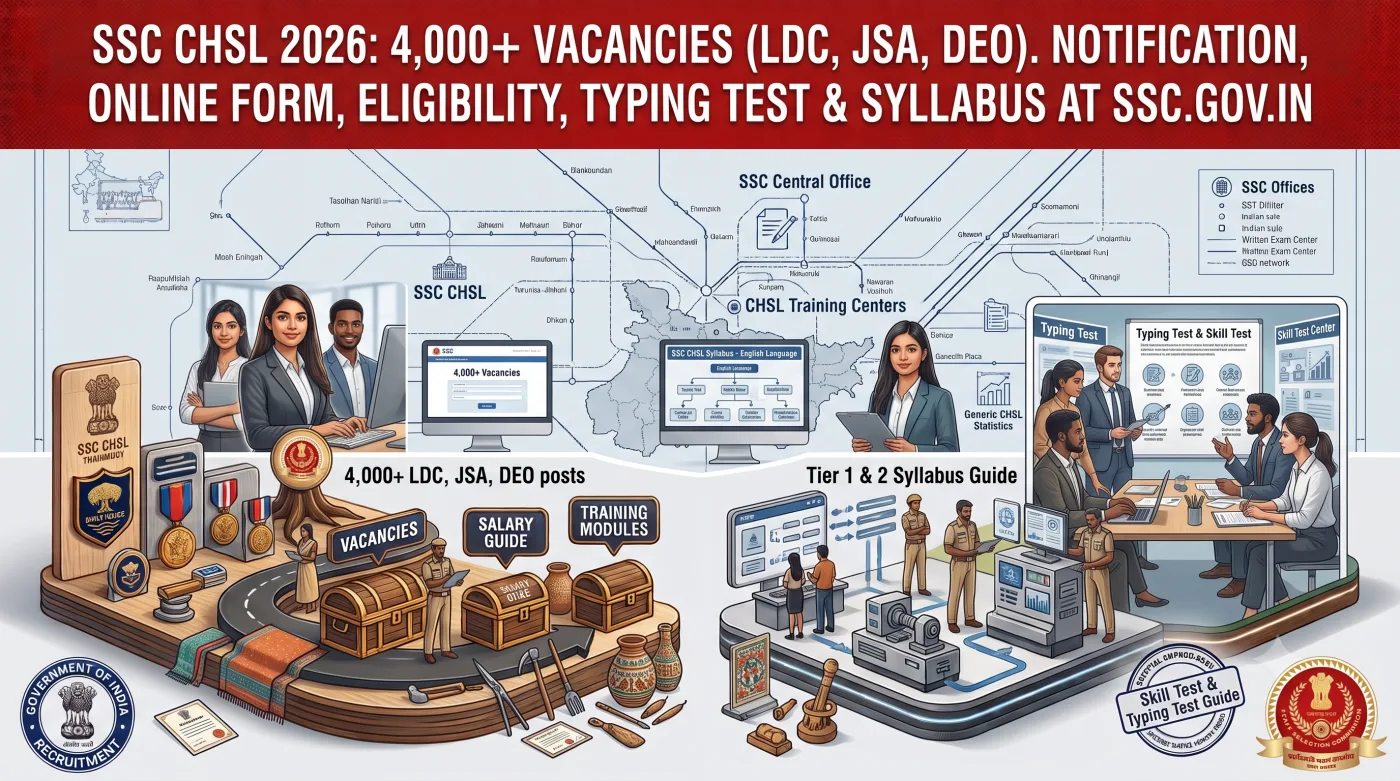
1. Legislative Framework & Operational Mandate of SSC CHSL (10+2) 2026
The Staff Selection Commission Combined Higher Secondary Level (10+2) Examination (SSC CHSL 2026) is the nation's premier recruitment channel for inducting dynamic higher secondary school graduates into essential clerical, secretarial, and data processing echelons across all Central Government Ministries, Attached Departments, Subordinate Directorates, and Constitutional Secretariats. Administered by the Staff Selection Commission (Department of Personnel and Training - DoPT), SSC CHSL bridges the career aspirations of 12th-pass youth with permanent, secure, and respected central civil service postings.
Selected candidates serve as the operational backbone of government administration, holding positions such as Lower Division Clerk (LDC) and Junior Secretariat Assistant (JSA) in prestigious headquarters including the Central Secretariat Service (CSS), Armed Forces Headquarters (AFHQ), Ministry of External Affairs (MEA), Intelligence Bureau (IB), Central Bureau of Investigation (CBI), Central Board of Direct Taxes (CBDT), Central Board of Indirect Taxes and Customs (CBIC), Election Commission of India (ECI), and Central Vigilance Commission (CVC). Highly skilled technical entrants are appointed as Data Entry Operators (DEO & DEO Grade 'A') in specialized economic and auditing directorates such as the Office of the Comptroller and Auditor General of India (CAG), Controller General of Accounts (CGA), and Ministry of Consumer Affairs.
The 2026 recruitment drive notifies more than 4,000+ vacancies, offering competitive 7th Central Pay Commission salaries across Pay Level 2 (basic pay ₹19,900/-), Pay Level 4 (basic pay ₹25,500/-), and Pay Level 5 (basic pay ₹29,200/-), alongside Central Government Health Scheme (CGHS) medical facilities, government residential accommodation, children education allowance, and structured career growth into gazetted officer cadres (Section Officer / Under Secretary) through departmental competitive examinations.
📢 कर्मचारी चयन आयोग संयुक्त उच्चतर माध्यमिक (10+2) स्तरीय परीक्षा 2026: आधिकारिक सारांश
कर्मचारी चयन आयोग (SSC) द्वारा 12वीं पास युवाओं के लिए संयुक्त उच्चतर माध्यमिक स्तरीय परीक्षा (CHSL 2026) के माध्यम से 4,000 से अधिक लोअर डिवीजन क्लर्क (LDC), जूनियर सचिवालय सहायक (JSA) तथा डाटा एंट्री ऑपरेटर (DEO) के पदों पर भर्ती निकाली जा रही है। टियर-1 परीक्षा केवल अर्हक (Qualifying) है, जबकि अंतिम चयन टियर-2 मुख्य परीक्षा (360 अंक) तथा अनिवार्य टाइपिंग टेस्ट (DEST) के आधार पर किया जाएगा। आवेदन आयोग के नए पोर्टल ssc.gov.in के माध्यम से संपन्न होगा।
2. Post-Wise Classification, 7th CPC Salary Matrix & Job Profile Breakdown
Vacancies recruited under SSC CHSL are classified into Pay Level 2, Level 4, and Level 5 under the 7th Central Pay Commission. Below is an exhaustive breakdown of cadre designations, departments, pay scales, and administrative responsibilities:
| Designated Post Nomenclature | Ministry / Department Allocation | Classification | Pay Level (7th CPC) | Basic Pay Scale | Estimated Monthly Gross Salary (X Cities) |
|---|---|---|---|---|---|
| Data Entry Operator (DEO Grade 'A') | Offices under the Comptroller and Auditor General (CAG) & Ministry of Consumer Affairs | Group 'C' Non-Gazetted | Pay Level 4 | ₹25,500 - ₹81,100/- | ₹45,000 - ₹50,000/- (High Data Management Profile) |
| Data Entry Operator (DEO) | Other Central Government Ministries & Subordinate Offices | Group 'C' Non-Gazetted | Pay Level 4 / 5 | ₹25,500 - ₹92,300/- | ₹45,000 - ₹55,000/- (Keying and verifying statistical records) |
| Lower Division Clerk (LDC) / Junior Secretariat Assistant (JSA) | Central Secretariat Service (DoPT - CSS), Armed Forces HQ (AFHQ), MEA, Home, Defense, Finance | Group 'C' Non-Gazetted | Pay Level 2 | ₹19,900 - ₹63,200/- | ₹35,000 - ₹40,000/- (General office administration, file dispatch, typing) |
| Court Clerk / Judicial Assistant | Central Administrative Tribunal (CAT), ITAT, Customs & Excise Tribunals | Group 'C' Non-Gazetted | Pay Level 2 | ₹19,900 - ₹63,200/- | ₹35,000 - ₹40,000/- (Court case records, listing of legal petitions) |
*Salary Computations for 'X' Class Metropolitan Cities (Delhi, Mumbai, Kolkata, Chennai, Bengaluru, Hyderabad): Basic Pay (Level 2: ₹19,900 / Level 4: ₹25,500) + Dearness Allowance (DA @ 50%: ₹9,950 / ₹12,750) + House Rent Allowance (HRA @ 30%: ₹5,970 / ₹7,650) + Transport Allowance (TA: ₹1,350 to ₹3,600) + DA on TA. Standard monthly deductions include NPS (10% of Basic + DA) and Central Government Employees Group Insurance Scheme (CGEGIS).
3. Statutory Eligibility Standards: Education, Age Limits & Reservations
Candidates must fulfill specific eligibility criteria reckoned as on the official cut-off date:
A. Essential Educational Qualification (As on 1st August 2026)
- For Lower Division Clerk (LDC) / Junior Secretariat Assistant (JSA): Must have passed 12th Standard (10+2) or equivalent examination from a recognized Board or University established by Law. Candidates from all streams (Arts, Science, Commerce, Vocational) are 100% eligible.
- For Data Entry Operator (DEO Grade 'A') in CAG & Ministry of Consumer Affairs: Must have passed 12th Standard in Science Stream with Mathematics as a compulsory subject from a recognized Board or equivalent.
- Final Year Candidates: Students appearing in their 12th board exams can apply provided their formal result/passing marksheet is declared and issued on or before the crucial cut-off date (1st August 2026).
B. Crucial Age Limits & Central Government Relaxation Matrix
The prescribed age bracket is 18 to 27 years as on 1st August 2026 (Candidates born not earlier than 02-08-1999 and not later than 01-08-2008):
| Reserved Category Code | Permissible Upper Age Relaxation Beyond 27 Years |
|---|---|
| Scheduled Caste (SC) / Scheduled Tribe (ST) | 5 Years (Can apply up to 32 Years of age) |
| Other Backward Classes (OBC - Non Creamy Layer) | 3 Years (Can apply up to 30 Years of age) |
| Persons with Benchmark Disabilities (PwBD - Unreserved) | 10 Years (Can apply up to 37 Years of age) |
| PwBD (OBC - Non-Creamy Layer) | 13 Years (Can apply up to 40 Years of age) |
| PwBD (SC / ST) | 15 Years (Can apply up to 42 Years of age) |
| Ex-Servicemen (ESM) | 3 Years after deduction of military service from chronological age |
| Central Govt Civilian Employees (3 Years Continuous Service) | Up to 40 Years of Age (45 Years for SC/ST) |
| Widows / Divorced Women / Legally Separated Women | Up to 35 Years of Age (40 Years for SC/ST) |
⚠️ महत्वपूर्ण विधिक सूचना: जाति प्रमाण पत्र (OBC-NCL / EWS) की क्रूशियल डेट (Crucial Date Rule)
एसएससी सीएचएसएल में आरक्षित श्रेणी का लाभ लेने वाले अभ्यर्थियों के लिए आवश्यक है कि उनके प्रमाण पत्र केंद्र सरकार के प्रारूप (Central Govt Format) में हों तथा आवेदन की अंतिम तिथि (Crucial Date) तक वैध हों:
- ओबीसी नॉन-क्रीमी लेयर प्रमाण पत्र: यह केंद्र सरकार की अधिकृत सेंट्रल लिस्ट (Central List of OBCs) के अनुसार होना चाहिए। राज्य स्तरीय पिछड़ा वर्ग प्रमाण पत्र मान्य नहीं होगा।
- ईडब्ल्यूएस प्रमाण पत्र: संबंधित वित्तीय वर्ष (Financial Year 2025-2026) की पारिवारिक आय पर आधारित होना चाहिए और सत्र 2026-2027 के लिए वैध (Valid) होना चाहिए।
- दस्तावेज सत्यापन में विसंगति: प्रमाण पत्र में कोई भी त्रुटि होने पर अभ्यर्थी को अनारक्षित (General/UR) श्रेणी में माना जाएगा, बशर्ते वह सामान्य श्रेणी की आयु सीमा और कटऑफ को पूरा करता हो।
4. Two-Tier Examination Pattern Architecture & Revised Scoring Structure
The examination architecture for SSC CHSL mirrors the modernized pattern of SSC CGL, comprising two computer-based tiers:
| Examination Tier | Testing Mode | Total Testing Marks | Role in Final Merit Selection |
|---|---|---|---|
| Tier-1 (Preliminary) | Computer Based Test (CBE - Objective) | 200 Marks (100 Qs / 60 Mins) | Qualifying in Nature Only (Marks not added to final rank) |
| Tier-2 (Mains Written) | Computer Based Test (CBE - Objective) | 360 Marks (120 Qs) | 100% Core Merit Decider (Determines Rank & Allocation) |
| Tier-2 (Skill / Typing Test) | Computer Keyboard Typing Test (DEST) | Qualifying Standard | 100% Mandatory to Qualify (Failing means Disqualification) |
A. Tier-1 Examination Pattern (Screening Filter)
Tier-1 is conducted across computer centers in multiple daily shifts. It features 100 objective questions carrying 200 marks to be solved in 60 minutes (80 minutes for scribe candidates):
| Section & Subject | Number of Questions | Maximum Marks | Negative Marking Penalty |
|---|---|---|---|
| Part I: English Language (Basic Knowledge) | 25 Questions | 50 Marks | -0.50 Marks deducted for each incorrect answer |
| Part II: General Intelligence and Reasoning | 25 Questions | 50 Marks | |
| Part III: Quantitative Aptitude (Basic Arithmetic Skills) | 25 Questions | 50 Marks | |
| Part IV: General Awareness | 25 Questions | 50 Marks | |
| Tier-1 Total | 100 Questions | 200 Marks | Duration: 60 Minutes |
B. Tier-2 Examination Pattern (Final Merit decider)
Tier-2 is conducted in two sessions on the same single day. Merit is calculated out of 360 Marks:
| Session & Duration | Section & Module | Subject Area | No. of Qs | Marks | Evaluation Weightage |
|---|---|---|---|---|---|
| Session-I (2 Hours 15 Minutes) |
Section-I (1 Hour) | Module-I: Mathematical Abilities | 30 Qs | 90 Marks (3 marks/Q) | Merit Score (Total: 360 Marks) Section-I (180) + Section-II (180). Determines candidate All-India Rank & Department. |
| Module-II: Reasoning and General Intelligence | 30 Qs | 90 Marks (3 marks/Q) | |||
| Section-II (1 Hour) | Module-I: English Language and Comprehension | 40 Qs | 120 Marks (3 marks/Q) | ||
| Module-II: General Awareness | 20 Qs | 60 Marks (3 marks/Q) | |||
| Session-I (Continued) | Section-III (15 Mins) | Module-I: Computer Knowledge Module (CKT) | 15 Qs | 45 Marks (3 marks/Q) | Qualifying in Nature Only (Mandatory to pass). |
| Session-II | Section-III Module-II | Skill Test / Typing Test (DEST) | Typing Test | Qualifying | 100% Mandatory Qualifying (Part A for DEO: 15 mins; Part B for LDC: 10 mins). |
🔴 टियर-2 में 1 अंक की नेगेटिव मार्किंग एवं कंप्यूटर टेस्ट की अनिवार्यता
टियर-2 के पेपर में प्रत्येक गलत उत्तर के लिए 1 अंक की नकारात्मक कटौती (-1 Mark Negative Marking) की जाती है (33.33% नेगेटिव मार्किंग)। इसके साथ ही निम्न दो नियमों पर विशेष ध्यान दें:
- सेक्शनल टाइमिंग: पहले 60 मिनट में केवल सेक्शन-I (Math & Reasoning) खुला रहेगा। 60 मिनट समाप्त होते ही यह लॉक हो जाएगा और सेक्शन-II (English & GA) खुल जाएगा।
- कंप्यूटर टेस्ट (CKT) में पास होना अनिवार्य: 15 प्रश्नों (45 अंक) वाले कंप्यूटर टेस्ट में न्यूनतम अर्हक अंक प्राप्त करना अनिवार्य है। भले ही आपके मुख्य विषयों में 360 में से 340 अंक हों, यदि आप कंप्यूटर में फेल होते हैं, तो पूरी उम्मीदवारी समाप्त हो जाएगी।
5. Mandatory Typing Test (DEST) Standards & Error Allowances
Because positions recruited through CHSL are ministerial office posts, computer typing proficiency is rigorously evaluated:
| Cadre Post | Testing Medium | Prescribed Typing Speed Benchmark | Test Duration | Permissible Error Percentage |
|---|---|---|---|---|
| Lower Division Clerk (LDC) / Junior Secretariat Assistant (JSA) | English Typing | Minimum 35 Words Per Minute (WPM) (Approx 10,500 Key Depressions per hour) |
10 Minutes | UR: 7% Error | OBC/EWS: 10% Error | SC/ST/PwBD: 10% Error |
| Hindi Typing | Minimum 30 Words Per Minute (WPM) (Approx 9,000 Key Depressions per hour) |
10 Minutes | UR: 7% Error | OBC/EWS: 10% Error | SC/ST/PwBD: 10% Error | |
| Data Entry Operator (DEO Grade 'A' in CAG) | English Typing | Minimum 15,000 Key Depressions Per Hour (Approx 50 WPM / 3,750 key depressions in 15 mins) |
15 Minutes | UR: 5% Error | Reserved Categories: 7% Error |
| Data Entry Operator (DEO in Other Ministries) | English Typing | Minimum 8,000 Key Depressions Per Hour (Approx 27 WPM / 2,000 key depressions in 15 mins) |
15 Minutes | UR: 5% Error | Reserved Categories: 7% Error |
*PwBD Typing Exemption: Candidates who are certified by an authorized Government Medical Board as physically permanently disabled from typing (blindness, low vision, severe locomotor disability of hands) are granted 100% exemption from the typing test upon producing Form-VIII during verification.
6. Exhaustive Subject-Wise Syllabus Breakdown (Tier 1 & Tier 2)
The academic curriculum is structured around high-school cognitive and language foundations:
A. Mathematical Abilities / Quantitative Aptitude
- Number Systems: Computation of whole numbers, decimals, fractions, relationships between numbers.
- Fundamental Arithmetical Operations: Percentages, Ratio and Proportion, Square roots, Averages, Interest (Simple and Compound), Profit and Loss, Discount, Partnership Business, Mixture and Alligation, Time and Distance, Time and Work.
- Algebra: Basic algebraic identities of school algebra, elementary surds, graphs of linear equations.
- Geometry: Triangles and their various centers, congruence and similarity of triangles, Circle and its chords, tangents, angles subtended by chords of a circle, common tangents to two or more circles.
- Mensuration: Triangle, Quadrilaterals, Regular Polygons, Circle, Right Prism, Right Circular Cone, Right Circular Cylinder, Sphere, Hemispheres, Rectangular Parallelepiped.
- Trigonometry: Trigonometric ratios, degree and radian measures, standard identities, complementary angles, Heights and Distances.
- Statistics & Probability: Use of tables and graphs (Histogram, Frequency polygon, Bar-diagram, Pie-chart), Measures of central tendency (Mean, Median, Mode), basic probability.
B. General Intelligence and Reasoning
- Semantic Analogy, Symbolic/Number Analogy, Figural Analogy, Semantic Classification, Symbolic/Number Classification, Figural Classification.
- Semantic Series, Number Series, Figural Series, Problem Solving, Word Building, Coding & Decoding, Numerical Operations, Symbolic Operations.
- Space Orientation, Space Visualization, Venn Diagrams, Drawing Inferences, Punched hole/pattern folding & unfolding, Figural Pattern completion, Embedded figures, Critical thinking, Emotional & Social Intelligence.
C. English Language and Comprehension
- Spot the Error, Fill in the Blanks, Synonyms/Homonyms, Antonyms, Spellings/detecting mis-spelt words, Idioms & Phrases, One-word substitution, Improvement of Sentences, Active/Passive Voice of verbs, Conversion into Direct/Indirect narration, Shuffling of Sentence parts in passages (Para Jumbles), Cloze Passage, Reading Comprehension passage.
D. General Awareness
- History (Ancient, Medieval, Modern India), Culture and Festivals, Geography of India (Rivers, Climate, Soils, Minerals), Economic Scene, General Policy and Indian Constitution (Articles, Fundamental Rights, Parliament, Judiciary), Scientific Research, Environmental Ecology, National and International Current Affairs (Sports, Awards, Government Welfare Schemes, Summits, Books & Authors).
E. Computer Knowledge Module (15 Questions - 45 Marks)
- Organization of a computer system, CPU, Input/Output devices, Computer memory, Memory organization, Windows Operating System basics.
- Microsoft Office: MS Word, MS Excel, MS PowerPoint basics and shortcut keys.
- Web browsing, search engines, Email protocols, Cyber security basics (Viruses, Trojans, Phishing, Firewalls).
7. Step-by-Step Online Application Process on New ssc.gov.in Portal
Completing your SSC CHSL 2026 application requires sequential execution on the new portal:
- Navigate to
https://ssc.gov.in/> Click on "Register Now" to generate your 11-digit OTR Registration Number. - Input Aadhaar number, legal name matching 10th certificate, father's name, DOB, mobile, and email. Authenticate both OTPs.
- Log into your candidate dashboard using your Registration Number and Password.
- Under "Live Examinations", find Combined Higher Secondary (10+2) Level Examination 2026 and click "Apply".
- Select three preferred examination cities within the same administrative region (e.g., Central Region: Patna, Muzaffarpur, Prayagraj).
- Select your preferred Typing Medium (English or Hindi) for Tier-2.
- Specify 12th standard educational details (Board, Roll Number, Passing Year, Percentage).
- Mandatory Live Photo Capture: Capture a real-time live photo via desktop webcam or the "MySSC" Mobile App against a plain white background with direct eye contact.
- Upload scanned signature (10 KB to 20 KB in JPG/JPEG format on white paper with black/blue ink).
- Preview the complete application form, accept declarations, pay the ₹100 fee via UPI or Debit Card (fee-exempted categories submit directly), and download the finalized application confirmation PDF.
🏆 सीएचएसएल में सफलता की मास्टर कुंजी: 35 WPM टाइपिंग एवं 300+ टियर-2 स्कोर
एसएससी सीएचएसएल 2026 में अंतिम चयन के दो मुख्य स्तंभ हैं: टियर-2 में गणित और अंग्रेजी पर मजबूत पकड़ के साथ 360 में से 300+ अंक प्राप्त करना, और लिखित परीक्षा की तैयारी के साथ-साथ रोजाना कम से कम 30 मिनट की-बोर्ड टाइपिंग का अभ्यास करना। टाइपिंग को कभी भी टियर-2 के बाद के लिए न छोड़ें; आज ही से अपने लैपटॉप या डेस्कटॉप पर 35 शब्द प्रति मिनट (WPM) की गति हासिल करने का अभ्यास प्रारंभ करें!
8. Comprehensive Typing Test (DEST) Master Blueprint & Keyboard Training Protocol
Because over 40% of candidates who achieve high scores in the Tier-2 computer exam are eliminated during the Data Entry Speed Test (DEST), mastering touch typing with surgical accuracy is mandatory:
A. Mechanical Mechanics of the 35 WPM / 30 WPM Benchmark
- Understanding Key Depressions: The Commission defines one standard word as containing 5 characters (keystrokes), including spaces. Therefore:
- English Typing (35 WPM): 35 words × 5 characters = 175 key depressions per minute. In the 10-minute test, you must type approximately 1,750 key depressions accurately.
- Hindi Typing (30 WPM): 30 words × 5 characters = 150 key depressions per minute. In 10 minutes, you must type approximately 1,500 key depressions.
- Touch Typing Discipline: Never look down at the physical keyboard while typing. Anchor your eight fingers permanently on the Home Row keys (A-S-D-F for left hand; J-K-L-; for right hand). Use index finger tactile bumps on 'F' and 'J' to maintain spatial positioning without looking.
- Managing Backspace Usage: While the Commission software permits using the backspace key to rectify errors within the current typed word, excessive backspacing destroys rhythm and consumes valuable seconds. Focus on rhythm and visual look-ahead rather than frantic typing bursts.
B. Hindi Typing Font Layouts: Mangal (Remington Gail & Inscript) vs Kruti Dev
Candidates choosing Hindi typing must understand the software input nuances:
- Remington Gail (मेशिन की-बोर्ड लेआउट): Based on traditional mechanical typewriter key configurations. It is the most popular layout among aspirants who learned typing on mechanical typewriters in coaching institutes.
- Inscript Layout (इनस्क्रिप्ट लेआउट): The standardized phonetic layout developed by the Government of India, where vowels are mapped to the left hand and consonants to the right hand. Highly intuitive for beginners.
⌨️ टाइपिंग टेस्ट में गलती की गणना एवं छूट का नियम (Error Calculation & Permissible Limit)
एसएससी सीएचएसएल के टाइपिंग टेस्ट में गलतियों को दो श्रेणियों में बांटा जाता है:
- पूर्ण गलतियां (Full Mistakes): किसी शब्द को छोड़ देना (Omission), किसी अतिरिक्त शब्द को जोड़ देना (Substitution/Addition), अथवा किसी शब्द की स्पेलिंग पूरी तरह गलत लिखना।
- अर्ध गलतियां (Half Mistakes): स्पेस की गलती (दो शब्दों के बीच स्पेस न देना या अतिरिक्त स्पेस देना), कैपिटल/स्मॉल लेटर की गलती, अथवा विराम चिह्नों (Punctuation) की अशुद्धि।
- छूट की सीमा: सामान्य वर्ग (UR) के लिए अधिकतम 7% गलतियां तथा ओबीसी/एससी/एसटी/ईडब्ल्यूएस के लिए 10% गलतियां माफ की जाती हैं। इससे अधिक गलती होने पर अभ्यर्थी को सीधे फेल (Disqualified) कर दिया जाता है।
9. Departmental Allocation Hierarchy: Best Ministries & Transfer Policies
During final post-preference submission, candidates should strategically align departmental selections with personal career goals and posting preferences:
| Cadre Post & Ministry | Work Culture & Location | Promotion Timeline to ASO / SO | Strategic Advantage |
|---|---|---|---|
| LDC / JSA in Central Secretariat (CSS / DoPT) | Permanent posting in New Delhi (North Block, South Block, Shastri Bhawan). 5-Day working week. | Fast-track promotion to Upper Division Clerk (UDC) in 5 years, then ASO via departmental LDCE exam. | High bureaucratic exposure, stable capital city life, exceptional children's education in Delhi. |
| LDC in Armed Forces HQ (AFHQ) | Ministry of Defence Secretariats in New Delhi. Highly disciplined, quiet office atmosphere. | UDC in 5 years; Section Officer in 12-15 years. | Defense canteen (CSD) smart card facilities, defense sports clubs, peaceful non-public-dealing desk job. |
| Data Entry Operator in CAG Offices | State Capital Accountant General (AG) Offices (e.g., Patna, Lucknow, Kolkata, Jaipur). | Senior Data Entry Operator (Level 5), then Assistant Audit Officer (Level 8) via SAS exam! | Highest salary tier among 12th-pass posts (Level 4/5). Opportunity to become Gazetted Officer via internal SAS exam. |
| LDC in Central Board of Direct Taxes (CBDT) & CBIC | Income Tax and GST Commissionerate offices located across all Tier-1, Tier-2, and Tier-3 cities in India. | Tax Assistant, then Senior Tax Assistant, and Inspector of Income Tax / Central Excise! | Nationwide presence; possibility of getting posted in your home district or home state. |
10. Category-Wise Cutoff Benchmarks & Target Score Analysis
To safely secure a ministerial clerk or data entry operator posting, candidates should target the following score benchmarks:
| Community Category | Tier-1 Normalized Qualifying Cutoff (Out of 200) | Tier-2 Safe Merit Score (Out of 360) | Target Percentile Benchmark |
|---|---|---|---|
| Unreserved (General / UR) | 150 - 158 Marks | 295 - 310+ Marks | 98.2+ Percentile |
| Other Backward Classes (OBC - NCL) | 148 - 155 Marks | 288 - 302+ Marks | 97.5+ Percentile |
| Economically Weaker Sections (EWS) | 145 - 152 Marks | 285 - 298+ Marks | 97.0+ Percentile |
| Scheduled Castes (SC) | 130 - 140 Marks | 260 - 275+ Marks | 91.5+ Percentile |
| Scheduled Tribes (ST) | 120 - 130 Marks | 245 - 260+ Marks | 87.0+ Percentile |
11. 6-Hour Daily Study Schedule & Subject Time-Allocation Blueprint
Balancing high accuracy in mathematical aptitude with rapid English comprehension and daily typing requires a structured daily time-table:
| Time Slot | Prescribed Subject Domain | Targeted Study Objectives & Methodology |
|---|---|---|
| 06:30 AM - 08:00 AM (90 Mins) | English Vocabulary & Editorial Reading | Read the editorial page of The Hindu / Indian Express. Memorize 25 One-Word Substitutions and 20 Idioms & Phrases daily from previous years' question banks. |
| 09:30 AM - 11:30 AM (120 Mins) | Quantitative Aptitude (Mathematics) | Concept building and solving 60-70 mixed arithmetic and advanced math questions (Geometry, Algebra, Trigonometry, Mensuration) with strict time tracking. |
| 02:00 PM - 03:30 PM (90 Mins) | General Intelligence & Reasoning | Practice logical puzzles, series, blood relations, and coding-decoding sets. Focus on eliminating calculation slips and enhancing speed. |
| 05:00 PM - 06:00 PM (60 Mins) | General Awareness & Computer Basics | Revise monthly current affairs compilation, Indian Polity articles, static GK tables, and 15 questions on MS Office and computer networking. |
| 08:30 PM - 09:15 PM (45 Mins) | Computer Typing Practice (DEST) | Type two 10-minute master passages on online typing software. Focus on maintaining 98%+ accuracy without backspacing. |
12. Final Document Verification (DV) & User Ministry Joining Protocol
Upon declaration of final merit results by the Staff Selection Commission, the formal appointment pipeline proceeds through designated user ministries:
- Abolition of SSC DV Stage: Candidates no longer report to SSC regional offices for pre-appointment document verification. The entire verification is conducted by the specific allocating Ministry (such as Ministry of Defence, Ministry of Finance, or CAG).
- Submission of Attestation & Medical Forms: Candidates receive an official Offer of Appointment (Dossier) by post and registered email. They must submit the completed Attestation Form along with a Medical Fitness Certificate issued by a District Civil Surgeon or Chief Medical Officer (CMO).
- Police Character Verification: The user department initiates character verification through the local police superintendent of the candidate's home district. Candidates must declare any past criminal history or pending judicial proceedings transparently.
- Formal Joining & Probation: Newly appointed LDC/JSA and DEO personnel report to their designated office location, complete joining formalities, and undergo a standard two-year probation period during which basic administrative and departmental procedures are imparted.
13. SSC CHSL Normalization Method, Tie-Breaking Rules & State Preference Allocation
Because the SSC CHSL Tier-1 examination is administered across multiple shifts spanning up to two full weeks, candidate score variations inevitably emerge due to minor fluctuations in question paper difficulty. To eliminate systemic bias and maintain impeccable fairness, the Staff Selection Commission applies an internationally established scientific score normalization formula based on standard deviation and mean score distribution across all testing shifts.
A. The Scientific Score Normalization Formula
The calculation of normalized marks of a candidate in their assigned shift is carried out using the standard formula approved by high-level statistical committees of the Government of India. The formula takes into account:
- The average marks of the top 0.1% candidates across all shifts of the examination.
- The sum of mean marks and standard deviation of all candidates across all shifts.
- The average marks of the top 0.1% candidates in the specific testing shift.
- The sum of mean marks and standard deviation of the specific testing shift.
- The actual raw marks scored by the candidate in that specific session.
⚖️ नॉर्मलाइजेशन एवं टाई-ब्रेकिंग आधिकारिक नियम (Statutory Tie-Breaking Guidelines)
कर्मचारी चयन आयोग (SSC) द्वारा स्पष्ट किया गया है कि किसी भी अभ्यर्थी का अंतिम परीक्षा परिणाम उनके कच्चे प्राप्तांक (Raw Score) के आधार पर नहीं, बल्कि उपर्युक्त वैज्ञानिक सूत्र द्वारा तैयार किए गए नॉर्मलाइज्ड स्कोर (Normalized Score) के आधार पर ही घोषित किया जाता है। यदि टियर-2 में दो या दो से अधिक अभ्यर्थियों के कुल प्राप्तांक बराबर होते हैं, तो टाई-ब्रेकिंग नियमों के तहत: (1) टियर-2 के सेक्शन-1 (गणित एवं रीजनिंग) में अधिक अंक पाने वाले को प्राथमिकता दी जाएगी, (2) जन्मतिथि में वरिष्ठ अभ्यर्थी को वरीयता मिलेगी, तथा (3) वर्णमाला क्रम (Alphabetical order of candidate names) का पूर्ण अनुपालन किया जाएगा।
B. State and Department Preference Allocation Strategy
Candidates must understand that departmental posting and state cadre allocation depend entirely on their Tier-2 aggregate score and their filled Post-cum-Cadre Preference Form. Unlike Central Secretariat clerical postings which remain permanently in New Delhi, clerical posts in CAG, CGA, Postal Assistant, Sorting Assistant, and Military Engineer Services (MES) are dispersed nationwide across all States and Union Territories.
- Postal Circles and Railway Mail Service: Allotment to specific postal circles (e.g., Bihar Circle, Uttar Pradesh Circle, Maharashtra Circle, Delhi Circle) is governed strictly by all-India merit rank. Candidates with high ranks secure their desired home circle postings without displacement.
- Controller General of Defence Accounts (CGDA): Command area allocations (Northern, Western, Eastern, Southern, and Central Commands) are finalized post-appointment based on departmental vacancy matrices and candidate merit scores.
- Central Administrative Offices: Postings in provincial state capital cities provide subsidized central government residential quarters, Kendriya Vidyalaya school admission quotas for dependent children, and comprehensive CGHS medical coverage.
User Discussion & Comments (0)
No comments yet. Be the first to leave a comment below!
Leave a Comment / Ask a Question: