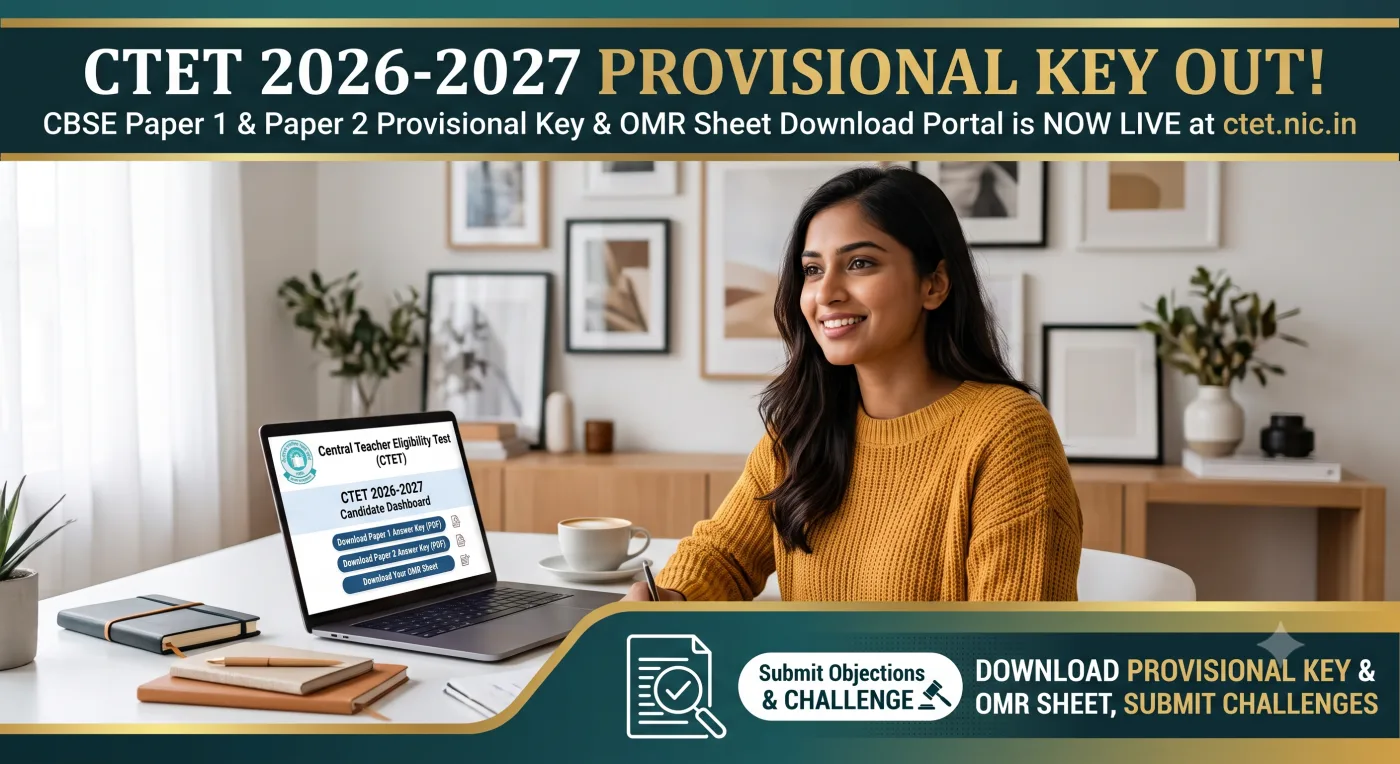
CTET Answer Key 2026-2027: Comprehensive Executive Blueprint
The Central Board of Secondary Education (CBSE) administers the Central Teacher Eligibility Test (CTET), the nationwide benchmark establishing statutory eligibility for teaching appointments across Kendriya Vidyalayas (KVS), Jawahar Navodaya Vidyalayas (NVS), Central Tibetan Schools, EMRS, and schools under Union Territory administrations. Following the completion of the pen-and-paper OMR examination, the Board officially displays the Scanned Images of OMR Answer Sheets and Provisional Answer Keys on its apex portal (ctet.nic.in).
This official release allows teaching aspirants across India to download the exact digitized replica of their marked OMR sheet, compare their filled bubbles against the master answer key formulated by CBSE's panel of educational psychometricians, compute their exact raw test score out of 150 marks, determine whether they achieve the statutory 60% (90 Marks) or 55% (82 Marks) qualifying benchmark, and formally challenge any ambiguous question through the official online grievance portal.
📌 केंद्रीय शिक्षक पात्रता परीक्षा (CTET) उत्तर कुंजी मुख्य बिंदु
सीबीएसई द्वारा आयोजित सीटीईटी परीक्षा की उत्तर कुंजी एवं ओएमआर शीट डाउनलोड करते समय निम्न वैधानिक नियमों का ध्यान रखें:
- अभ्यर्थी अपने एप्लीकेशन नंबर (Application Number) एवं जन्मतिथि (DOB) अथवा रोल नंबर द्वारा लॉगिन करके अपनी स्कैन की गई वास्तविक ओएमआर शीट डाउनलोड कर सकते हैं।
- सीबीएसई प्रत्येक चुनौती दिए गए प्रश्न के लिए ₹1,000 (एक हजार रुपये) प्रति प्रश्न का गैर-वापसी योग्य प्रोसेसिंग शुल्क लेता है।
- यदि विषय विशेषज्ञों की उच्च-स्तरीय समिति द्वारा अभ्यर्थी की चुनौती स्वीकार कर ली जाती है, तो संशोधित उत्तर के अनुसार नीतिगत निर्णय लेकर ₹1,000 का शुल्क उसी बैंक खाते में वापस (Refund) कर दिया जाता है।
- सीटीईटी परीक्षा में कोई नकारात्मक अंकन (No Negative Marking) नहीं होता है, अतः प्रत्येक सही उत्तर पर पूरा 1 अंक प्राप्त होता है।
CTET Examination Architecture & Curricular Evaluation Framework
CTET is administered in two distinct statutory tiers corresponding to educational development stages defined under National Council for Teacher Education (NCTE) regulations:
| Curricular Paper | Pedagogical Sections & Subjects Tested | Questions | Maximum Marks | Negative Penalty |
|---|---|---|---|---|
| Paper 1 (Primary Stage: Classes I to V) | Child Development and Pedagogy (CDP) | 30 MCQs | 30 Marks | Zero (0.00) |
| Mathematics (Pedagogy + Content) | 30 MCQs | 30 Marks | Zero (0.00) | |
| Environmental Studies (EVS - 6 Themes) | 30 MCQs | 30 Marks | Zero (0.00) | |
| Language I (Compulsory First Language Medium) | 30 MCQs | 30 Marks | Zero (0.00) | |
| Language II (Compulsory Second Language) | 30 MCQs | 30 Marks | Zero (0.00) | |
| Paper 1 Cumulative Total Benchmark | 150 MCQs | 150 Marks | Duration: 150 Mins | |
| Paper 2 (Elementary Stage: Classes VI to VIII) | Child Development and Pedagogy (Adolescent Focus) | 30 MCQs | 30 Marks | Zero (0.00) |
| Mathematics & Science (60 Qs) OR Social Studies/Social Science (60 Qs) | 60 MCQs | 60 Marks | Zero (0.00) | |
| Language I (Compulsory) | 30 MCQs | 30 Marks | Zero (0.00) | |
| Language II (Compulsory) | 30 MCQs | 30 Marks | Zero (0.00) | |
| Paper 2 Cumulative Total Benchmark | 150 MCQs | 150 Marks | Duration: 150 Mins | |
NCTE Statutory Passing Benchmarks & Category Qualifying Criteria
Unlike recruitment tests where candidates compete for limited vacancies against fluctuating merit cutoffs, CTET is an absolute eligibility qualifying examination. In accordance with NCTE guidelines:
| Candidate Category | Statutory Qualifying Percentage | Minimum Qualifying Score (Out of 150) | Certification Validity & Employment Scope |
|---|---|---|---|
| General (Unreserved / Open) | 60% Qualifying Mark | 90 Marks | Lifetime Validity; Eligible for all Central & State Teacher Recruitments. |
| OBC (Non-Creamy Layer) | 55% Qualifying Mark | 82.5 (Rounded to 82 Marks) | Lifetime Validity; Valid across Central & State reserved vacancies. |
| Scheduled Castes (SC) | 55% Qualifying Mark | 82 Marks | Lifetime Validity; Eligible for affirmative action recruitment quotas. |
| Scheduled Tribes (ST) | 55% Qualifying Mark | 82 Marks | Lifetime Validity; Full relaxation across central school systems. |
| Persons with Disabilities (PwD / CwSN) | 55% Qualifying Mark | 82 Marks | Lifetime Validity; Special Educator and general teacher eligibility. |
Step-by-Step Tutorial: How to Download CTET Scanned OMR Sheet & Answer Key PDF
Candidates must follow these direct instructions to retrieve their scanned OMR answer sheet and cross-reference with the master provisional key:
- Access the Official CTET Portal: Navigate to the apex portal at ctet.nic.in.
- Click on Answer Key & OMR Display Link: Under the "Candidate Activity" or "Public Notices" section, click on "View/Download OMR Sheet and Provisional Answer Key for CTET".
- Select Authentication Method: Choose either "Through Application Number and Password" or "Through Application Number and Date of Birth".
- Input Examination Credentials:
- Enter your 12-digit CTET Application Number.
- Enter your Date of Birth in Day-Month-Year dropdown selectors.
- Enter the alphanumeric Security PIN (Captcha) displayed on the page.
- Download Scanned OMR Image: Click on the link "View/Download OMR Sheet (Paper 1 / Paper 2)". A high-resolution scanned PDF or JPEG of your actual bubbled optical mark sheet will be generated. Save this immediately.
- Download Master Answer Key PDF: Click on "Download Provisional Answer Key". Select your specific Question Booklet Code (e.g., Code I, J, K, L for Paper 1; Code M, N, O, P for Paper 2).
- Audit Supplementary Language Sheets: If you opted for regional languages (e.g., Sanskrit, Urdu, Punjabi, Bengali), ensure you verify answers from the corresponding Supplementary Language Answer Key matching your Language 1 and Language 2 choices.
CBSE Answer Key Challenge Mechanism & ₹1,000 Fee Refund Policy
CBSE maintains one of the strictest challenge procedures among national examination bodies. If you detect an indisputable flaw in the provisional answer key, follow the procedure below:
| Challenge Milestone | Candidate Procedural Protocol | Statutory Legal Standard |
|---|---|---|
| 1. Challenge Window Period | Log into the CTET challenge dashboard within the 3 to 4 days window announced by CBSE. | Late representations or offline postal submissions are summarily rejected without review. |
| 2. Question & Option Selection | Select the Question Number as per the Master Question Booklet and specify the option you claim is correct. | Ensure Question Code matches your booklet; cross-code challenges are invalid. |
| 3. Authoritative Proof Submission | Upload scanned PDF citations strictly from NCERT textbooks, standard linguistic dictionaries, or published government curriculum frameworks. | Private guidebooks, coaching institute keys, or Wikipedia references are legally inadmissible. |
| 4. Non-Refundable Fee Payment | Pay ₹1,000 per challenged question via Credit Card, Debit Card, or Net Banking. | Challenging 2 questions requires ₹2,000; challenging 3 questions requires ₹3,000. |
| 5. Refund Reconciliation | If the expert committee accepts the challenge, ₹1,000 per accepted question is refunded to the candidate's originating card/account. | Candidates are advised to use their own bank card rather than a cyber cafe operator's card. |
Common Pedagogical Ambiguities & High-Frequency Dispute Archetypes
Analysis of previous CTET answer keys indicates that over 80% of candidate challenges concentrate within specific pedagogical and linguistic domains:
- Jean Piaget vs. Lev Vygotsky Theoretical Boundaries: Questions concerning the role of private speech (निजी वार्ता) versus egocentric speech (अहंकेंद्रित वार्ता) in cognitive regulation often create intense dispute when candidate options hinge on nuanced theoretical definitions.
- Lawrence Kohlberg Moral Dilemma Scenarios: Evaluating whether a child's moral decision falls under Stage 3 (Good Boy / Nice Girl orientation) or Stage 4 (Law and Order orientation) frequently leads to dual correct answers when situational vignettes lack absolute contextual clarity.
- Noam Chomsky Language Acquisition Device (LAD): In Language Pedagogy, disputes emerge regarding whether universal grammar is an innate biological capacity (Nativist perspective) or reinforced through environmental interaction (Behaviorist vs. Interactionist).
- Bilingual Translation Inversion: In Hindi-medium question papers, certain technical psychological terms (such as 'Assimilation' translated as 'आत्मसातीकरण' vs 'समावेशन') can confuse test-takers. Under CBSE rules, the English version is legally binding, but severe translational ambiguities have previously prompted CBSE to award marks to both options.
DigiLocker Digital Marksheet & Certificate Issuance Protocol
In compliance with Ministry of Electronics and Information Technology (MeitY) and NCTE guidelines, CBSE does NOT issue physical hard copies of CTET marksheets or eligibility certificates. The digital workflow is executed as follows:
📜 डिजिलॉकर डिजिटल प्रमाणपत्र डाउनलोड प्रक्रिया (DigiLocker Step-by-Step)
- सीबीएसई द्वारा परिणाम घोषित किए जाने के उपरांत सभी सफल अभ्यर्थियों के पंजीकृत मोबाइल नंबर पर डिजिलॉकर लॉगिन क्रेडेंशियल्स (यूजरनेम एवं 6-अंकीय सुरक्षा पिन) एसएमएस (SMS) द्वारा भेजे जाते हैं।
- अभ्यर्थी
digilocker.gov.inया डिजिलॉकर मोबाइल ऐप पर अपने आधार नंबर अथवा मोबाइल नंबर से लॉगिन करें। - 'Issued Documents' सेक्शन में जाएं और 'Central Board of Secondary Education, Delhi' सर्च करें।
- 'Teacher Eligibility Test Certificate' अथवा 'TET Marksheet' चुनें, अपना सीटीईटी रोल नंबर एवं उत्तीर्ण वर्ष दर्ज करें।
- डिजिटल रूप से हस्ताक्षरित (Digitally Signed with Green Checkmark) प्रमाणपत्र डाउनलोड हो जाएगा, जो आईटी एक्ट 2000 के तहत सभी सरकारी भर्तियों में भौतिक मूल प्रमाणपत्र के समान 100% कानूनी रूप से मान्य है।
Supreme Court Landmark Judgments on Teacher Eligibility (B.Ed vs D.El.Ed)
Candidates evaluating their CTET answer key must remain cognizant of the judicial framework governing teaching appointments in India:
- Devesh Sharma vs. Union of India (Supreme Court of India, August 2023): The Supreme Court quashed the NCTE notification dated 28th June 2018, ruling that Bachelor of Education (B.Ed) degree holders are ineligible for Primary School Teacher (Classes I to V / PRT) positions. Primary teaching requires specialized pedagogical training catered to early childhood, which is exclusively provided in Diploma in Elementary Education (D.El.Ed / BTC) programs.
- Operational Impact on CTET Paper 1: While B.Ed candidates may have appeared in CTET Paper 1, their certification cannot be utilized to secure Primary Teacher appointments in government schools unless statutory rules are re-legislated. B.Ed candidates possess legitimate eligibility for Upper Primary (Classes VI to VIII / TGT - Paper 2) recruitments.
OMR Bubble Scanning Integrity: Optical Evaluation Rules
CBSE processes millions of OMR response sheets using high-speed optical character recognition (OCR) and optical mark recognition (OMR) scanners. Adhere to these fundamental evaluation parameters:
| OMR Marking Anomaly | Scanner Behavior & Reading Protocol | Resulting Score Impact |
|---|---|---|
| Double Bubbling (दो गोले भरना) | Scanner detects optical reflection density on multiple circles for the same question number. | Evaluated as Ineligible (0 Marks) |
| Faint / Incomplete Darkening | Light pencil or half-filled circle failing the threshold reflectance value of 60% opacity. | Treated as Unattempted (0 Marks) |
| Use of Whitener / Correction Fluid | Chemical solvent damages paper emulsion; scanner optical lens flags surface distortion. | Risk of Complete Sheet Rejection |
| Mismatched Question Booklet Code | Candidate bubbles Code 'I' on OMR but receives Booklet Code 'J'. Answer key of Code 'I' is applied. | Total Score Distortion (Warrants Scrutiny) |
Official CBSE CTET Technical Directorate & Candidate Grievance Directory
Candidates experiencing difficulties downloading their scanned OMR sheet, noting mismatched roll numbers on the portal, or facing payment deductions without objection generation can contact the Central Board of Secondary Education:
- CTET Special Examination Unit: Central Board of Secondary Education, PS 1-2, Institutional Area, I.P. Extension, Patparganj, Delhi - 110092.
- Official Candidate Helpline Telephone:
011-22240112,011-22240108,011-22235774. - Official Support Email:
ctet.cbse@nic.in|directorctet@cbseshiksha.in. - Working Hours: Monday to Friday, 10:00 AM to 05:00 PM (Excluding Gazetted Public Holidays).
Section-Wise High-Yield Pedagogical Analysis & Scoring Potential
A systematic audit of candidate performance across previous CTET examination editions reveals distinct scoring trajectories across subjects. Aspirants should review these parameters to evaluate their raw score potential:
| Subject Segment | Theoretical Content vs Pedagogy | Average Scoring Benchmark | Core High-Yield Focus Chapters |
|---|---|---|---|
| Child Development & Pedagogy (CDP) | 15 Theory + 5 Inclusive + 10 Learning | 24 – 28 Marks | Piaget, Vygotsky, Kohlberg, Howard Gardner, CCE, Inclusive Education (RPwD Act 2016), Motivation. |
| Environmental Studies (EVS - Paper 1) | 15 NCERT Content + 15 Pedagogy | 22 – 26 Marks | Class 3-5 NCERT Themes: Animals (Sloth, Elephant), Plants (Desert Oak), Traditional Paintings (Madhubani), Map Directions. |
| Mathematics (Paper 1 & Paper 2) | 15 Content + 15 Pedagogy | 18 – 23 Marks | Van Hiele Geometric Levels, Newman's Error Analysis, Teaching Aids (Dienes blocks, Geoboard, Abacus), Numbers & Fractions. |
| Language I (Hindi / English / Regional) | 15 Passages (Prose + Poetry) + 15 Pedagogy | 23 – 27 Marks | LSRW Language Skills, Chomsky LAD, Stephen Krashen hypotheses, Remedial Teaching, Unseen Poetry figurative analysis. |
| Language II (Second Language Medium) | 15 Passages (Two Prose Passages) + 15 Pedagogy | 19 – 24 Marks | Direct factual comprehension, vocabulary in context, grammar fundamentals, BICS vs CALP differences. |
| Social Science (Paper 2) | 40 NCERT Content + 20 Pedagogy | 36 – 44 Marks (out of 60) | Classes 6-8 NCERT History (Our Pasts I-III), Geography (Resources & Development), Civics (Social & Political Life I-III). |
| Mathematics & Science (Paper 2) | 40 Content + 20 Pedagogy | 34 – 42 Marks (out of 60) | Classes 6-8 NCERT Science: Light, Heat, Electricity, Food, Materials, Microorganisms, 5E Instructional Model. |
Comparative Evaluation: CTET Qualifying Certificate vs. State TETs
Candidates holding a validated CTET certificate enjoy distinct statutory advantages compared to regional State Teacher Eligibility Tests:
- Nationwide Acceptance: A CTET certificate is universally valid for central recruitments across all 28 states and 8 Union Territories (KVS, NVS, EMRS, Army Public Schools, Sainik Schools, DSSSB Delhi).
- State Equivalence Policies: Multiple major state governments—including Bihar (BPSC TRE), Haryana, Uttar Pradesh, and Jharkhand—formally accept CTET qualification in lieu of State TET examinations, exempting candidates from appearing in separate state eligibility exams.
- Lifetime Validity: Following NCTE's landmark gazette notification, CTET certificates issued since 2011 enjoy lifetime validity, completely eliminating the earlier 7-year renewal requirement.
- Attempt Flexibility: There is no cap on the number of attempts. A candidate who has already qualified with 90 marks can re-appear indefinitely to elevate their score to 125+ marks for competitive recruitment indexing.
NEP 2020 Pedagogical Realignment & 5+3+3+4 Curricular Architecture in CTET
Under the transformative provisions of the National Education Policy (NEP 2020), the Central Board of Secondary Education has substantially re-engineered CTET question design. Instead of assessing rote memorization of definitions, questions now rigorously test situational pedagogical acumen across the four restructured developmental stages:
| Curricular Stage | Target Age & Grades | Pedagogical Focus Evaluated in CTET Questions |
|---|---|---|
| Foundational Stage (5 Years) | Ages 3 to 8 (Balvatika 1-3 + Classes 1 & 2) | Play-based, discovery-based, and multi-level activity learning. Foundational Literacy and Numeracy (FLN / NIPUN Bharat mission targets by Grade 3). |
| Preparatory Stage (3 Years) | Ages 8 to 11 (Classes 3 to 5 / Paper 1) | Gradual transition from play to interactive classroom learning; introduction of experiential science, math, reading, and creative arts. |
| Middle Stage (3 Years) | Ages 11 to 14 (Classes 6 to 8 / Paper 2) | Subject-oriented pedagogical methodology, experiential learning in science inquiry, abstract mathematical reasoning, and social sciences. |
| Secondary Stage (4 Years) | Ages 14 to 18 (Classes 9 to 12) | Multidisciplinary study, critical analytical thinking, student agency, and vocational education integration. |
Foundational Pedagogical Thinkers & Key Psychological Theoretical Frameworks
Aspirants reviewing their Child Development & Pedagogy answer keys must master the precise theoretical distinctions formulated by historical psychologists:
| Theorist & Paradigm | Fundamental Educational Hypothesis | Classic CTET Question Archetype |
|---|---|---|
| Jean Piaget (Cognitive Constructivism) | Children actively construct cognitive schemas through direct interaction with physical environment. 4 discrete stages: Sensorimotor (0-2), Preoperational (2-7), Concrete Operational (7-11), Formal Operational (11+). | Conservation of liquid volume, Centration, Egocentrism in pre-operational stage, Object permanence. |
| Lev Vygotsky (Socio-Cultural Constructivism) | Cognitive growth is mediated socially through language, culture, and collaborative dialogue. Zone of Proximal Development (ZPD), Scaffolding, and More Knowledgeable Other (MKO). | Teacher providing hints and prompts (Scaffolding), Children guiding their actions through Private Speech (निजी संवाद). |
| Lawrence Kohlberg (Moral Development) | Moral reasoning advances through 3 levels (Pre-conventional, Conventional, Post-conventional) across 6 hierarchical stages through ethical dilemma resolution. | Heinz Dilemma analysis, Good Boy-Nice Girl orientation (Stage 3), Social Contract orientation (Stage 5). |
| Howard Gardner (Multiple Intelligences) | Rejects IQ as single unitary construct. Proposes 8 autonomous modalities: Linguistic, Logical-Mathematical, Spatial, Bodily-Kinesthetic, Musical, Interpersonal, Intrapersonal, Naturalistic. | Designing differentiated multi-sensory instruction to engage students with distinct intelligence profiles. |
Assessment Paradigms: Formative, Summative & Continuous Comprehensive Evaluation (CCE)
A significant proportion of CTET challenges arise from candidate confusion regarding assessment terminologies. Adhere to these exact pedagogical definitions:
- Assessment FOR Learning (Formative Assessment): Ongoing, diagnostic evaluations conducted during the instructional process to identify student learning misconceptions, provide immediate constructive feedback, and adapt instructional design. Includes classroom quizzes, peer observation rubrics, teacher questioning, and portfolios.
- Assessment OF Learning (Summative Assessment): Comprehensive evaluation conducted at the culmination of an instructional unit, term, or academic year to grade, certify, or measure student cumulative achievement against standardized curricular benchmarks.
- Assessment AS Learning: Cultivates student metacognition and autonomous self-regulation. Students critically monitor, self-assess, and reflect upon their own learning methodologies and progress.
- Diagnostic Evaluation & Remedial Teaching: Pinpoints specific persistent learning gaps in foundational concepts, followed by personalized pedagogical remediation rather than penalizing low scores.
Right of Children to Free and Compulsory Education (RTE) Act 2009 Standards
CTET question papers regularly feature statutory questions testing compliance with mandatory RTE Act legal provisions:
| RTE Act 2009 Statutory Mandate | Primary Stage Standards (Classes 1 to 5) | Upper Primary Stage Standards (Classes 6 to 8) |
|---|---|---|
| Pupil-Teacher Ratio (PTR Norm) | 30:1 (30 students per 1 teacher; Headmaster assigned if enrolment > 150) | 35:1 (At least one teacher per classroom for Science/Math, Social Studies, Languages) |
| Minimum Working Days per Academic Year | Minimum 200 working days | Minimum 220 working days |
| Minimum Instructional Hours per Academic Year | 800 instructional hours | 1000 instructional hours |
| Teacher Work Hours per Week | Minimum 45 teaching hours including instructional preparation hours per week | |
| Prohibited Practices under Section 17 & 28 | Absolute statutory ban on corporal punishment, mental harassment, capitation fees, screening procedures for admission, and private tuition by teachers. | |
Universal Design for Learning (UDL) & RPwD Act 2016 Accommodations
Inclusive education questions in CTET are governed by the Rights of Persons with Disabilities (RPwD) Act, 2016, which recognizes 21 specified disabilities. Candidates must evaluate questions through the prism of the 3 Universal Design for Learning (UDL) pillars:
- Multiple Means of Representation (The 'WHAT' of Learning): Presenting curricular concepts through diverse multi-modal formats—visual graphics, tactile manipulatives (Braille / Taylor Frame), auditory recordings, and closed-captioned video demonstrations.
- Multiple Means of Action & Expression (The 'HOW' of Learning): Permitting learners to demonstrate mastery through alternative communication modalities—oral presentations, digital storyboards, physical models, or speech-to-text assistive technology.
- Multiple Means of Engagement (The 'WHY' of Learning): Cultivating intrinsic motivation through cooperative peer learning, autonomy in project choice, minimizing classroom threats, and graduated difficulty challenges.
- Common Learning Difficulties Addressed in CTET:
- Dyslexia: Neurological learning difficulty in reading fluency, letter reversal ('b' for 'd'), and phonological processing.
- Dyscalculia: Difficulty understanding numbers, place value concepts, mathematical symbols, and arithmetic operations.
- Dysgraphia: Impairment in fine motor skills leading to distorted handwriting, irregular spacing, and difficulty organizing written text.
- ADHD (Attention Deficit Hyperactivity Disorder): Difficulty sustaining prolonged focus, impulsivity; managed by breaking instructional activities into short, engaging sub-tasks.
Comprehensive Language Pedagogy Lexicon & Linguistic Theoretical Models
Language Pedagogy constitutes 30 marks across Language I and Language II in CTET. Disputed questions consistently test nuanced linguistic terminology:
| Linguistic Concept | Technical Pedagogical Definition | Classroom Instructional Application |
|---|---|---|
| Phoneme (स्वनिम्) | The smallest distinct sound unit in a spoken language that distinguishes one word from another (/k/, /p/, /t/). | Phonological awareness drills and sound segmentation in foundational primary grades. |
| Morpheme (रूपिम्) | The smallest meaningful grammatical unit in a language (words, prefixes, suffixes, root stems). | Teaching prefix and suffix derivation exercises to expand active student vocabulary. |
| Syntax (वाक्य विन्यास) | The structural rules and word ordering principles governing sentence construction. | Jumbled sentence reordering activities and contextual grammar analysis. |
| Semantics (अर्थ विज्ञान) | The study of linguistic meaning conveyed by words, idioms, phrases, and sentences. | Distinguishing denotative dictionary definitions from figurative or connotative poetic meanings. |
| Pragmatics (प्रयोजनमूलक भाषा) | The study of language usage within practical social and conversational contexts. | Role-playing formal workplace etiquette versus informal playground dialogues. |
| BICS vs CALP (Jim Cummins) | BICS: Basic Interpersonal Communicative Skills (Social conversation; takes 2 years); CALP: Cognitive Academic Language Proficiency (Academic discourse; takes 5-7 years). | Guiding second-language learners from playground conversational fluency toward abstract academic essay writing. |
Mathematics Pedagogy: Van Hiele Geometric Thinking & Error Diagnostics
In Mathematics Pedagogy, CBSE constructs analytical scenarios testing prospective teachers on child cognitive progression through spatial reasoning:
- Pierre van Hiele & Dina van Hiele-Geldof 5-Level Geometric Model:
- Level 0 (Visualization / Recognition): Children perceive shapes as unanalyzed visual wholes (e.g., recognizing a rectangle because "it looks like a door").
- Level 1 (Analysis / Descriptive): Children identify independent properties of shapes (e.g., all 4 sides of a square are equal, opposite sides are parallel).
- Level 2 (Abstraction / Informal Deduction): Children discern relationships between properties and classes of shapes (e.g., recognizing that every square is a rectangle).
- Level 3 (Deduction): High school geometry where students formulate formal geometric proofs using axioms and theorems.
- Level 4 (Rigor): University-level comparative analysis of non-Euclidean axiomatic systems.
- Newman's Error Analysis (NEA) 5-Step Diagnostic Protocol:
- Reading: Decoding mathematical text and vocabulary symbols.
- Comprehension: Understanding what the mathematical word problem is asking for.
- Transformation: Translating the word scenario into appropriate algebraic/arithmetic mathematical operations.
- Process Skills: Executing calculations accurately (multiplication, division, algorithms).
- Encoding: Expressing the final answer in appropriate formal mathematical units.
- Concrete Teaching-Learning Materials (TLMs) in Primary Mathematics:
- Dienes Blocks (Base-10 Blocks): Units, rods, flats, and cubes used to teach place value, addition with carrying, and subtraction with borrowing.
- Geoboard: Pegged grid board with rubber bands used to introduce perimeter, area, 2D polygons, and angles without complex formulas.
- Dot Paper (बिंदु शीट): Visual grid utilized to teach symmetry, tessellation, reflections, and rotational symmetry.
- Abacus (गिनतारा): Tactile bead frame essential for developing mental counting, place value, and assisting visually challenged learners.
Environmental Studies (EVS) Spiral Curricular Architecture & 6 Themes
CTET Paper 1 Environmental Studies integrates social science, physical sciences, and environmental education into an indivisible holistic whole structured around 6 human life themes:
| EVS Broad Curricular Theme | Sub-Themes & Core Conceptual Scope | Direct NCERT Textbook Examples Tested in Key |
|---|---|---|
| 1. Family and Friends (परिवार एवं मित्र) | Relationships, Work and Play, Animals, Plants. | Desert Oak (Australia water storage), Sloth sleeping habits (17 hours/day), Elephant herd hierarchy led by oldest female. |
| 2. Food (भोजन) | Nutrients, digestion, food preservation, traditional regional cuisines. | Ling-hu-fen (Snake dish in Hong Kong), Tapioca (Kerala boiled with coconut curry), Jaggery-Amla iron remedy for Anaemia. |
| 3. Shelter (आवास) | Types of houses adapted to climate, geography, and local materials. | Houses on bamboo stilts in Assam (heavy rain), Mud houses with thorny bushes in Rajasthan, Stone-wood houses in Leh/Ladakh. |
| 4. Water (जल) | Water cycle, water conservation, stepwells (बावड़ी), waterborne diseases. | Ghadsisar lake in Jaisalmer, Ronald Ross discovery of malaria parasite in mosquito stomach, Al-Biruni traveler account of Indian ponds. |
| 5. Travel (यात्रा) | Modes of transport, navigation, mapping direction, train tickets, time-distance. | Vallam (small wooden boat in Kerala), Train reservation ticket details (PNR, coach, berth, fare), Bachhendri Pal Mount Everest ascent. |
| 6. Things We Make and Do (चीजें जो हम बनाते हैं और करते हैं) | Traditional handicrafts, agriculture, village tools, arts. | Pochampally weaves in Telangana, Madhubani folk art in Bihar (natural dye on rice paste), Kannauj perfume industry in UP. |
Science & Social Studies Pedagogy: The 5E Constructivist Instructional Framework
For CTET Paper 2 candidates, questions regularly assess student-centric inquiry through the 5E Instructional Model developed by BSCS:
- 1. Engage (सक्रिय करना): The teacher assesses students' prior knowledge and engages them in a novel problem, curiosity puzzle, or demonstration without lecturing.
- 2. Explore (अन्वेषण करना): Students work collaboratively in lab or field activities, manipulating scientific materials, generating hypotheses, and recording empirical observations.
- 3. Explain (व्याख्या करना): Learners verbalize their observations in their own words, while the teacher introduces formal scientific vocabulary, laws, and definitions to clarify concepts.
- 4. Elaborate (विस्तार करना): Students apply their newly acquired conceptual models to unfamiliar real-world scenarios or cross-disciplinary projects to solidify deep schema retention.
- 5. Evaluate (मूल्यांकन करना): Both formative and summative self-assessment, peer assessment rubrics, and open-ended performance tasks measuring conceptual growth.
Source-Based Historical Inquiry in Social Science Pedagogy
CTET pedagogy questions reject the rote memorization of historical chronologies and dates. Instead, questions emphasize evaluating Primary Historical Sources (archaeological excavations, coins, copper plate inscriptions, and foreign traveler chronicles such as Xuanzang and Ibn Battuta) versus Secondary Sources, teaching students how historians reconstruct ancient and medieval narratives.
Digital Verification of CTET Certificates via Dynamic QR Code
Every CTET digital marksheet and qualifying certificate deposited into candidate DigiLocker repositories features an ISO-compliant high-security dynamic QR Code. When scanned by prospective appointing authorities (such as state school education directorates, KVS regional offices, or Navodaya Vidyalaya selection boards) using the official DigiLocker verification application, it instantaneously fetches verified cryptographic data directly from CBSE central repositories. This eliminates any possibility of forged documentation or delayed manual verification during state teacher appointment cycles.
User Discussion & Comments (0)
No comments yet. Be the first to leave a comment below!
Leave a Comment / Ask a Question: