Wednesday, 02 Sep 2026 | 02:40:18 PM
LATEST UPDATES
BIHAR SPECIAL: Bihar SSC Inter Level 2026 Exam Date Out | Bihar Police Constable Result Announced | Bihar Student Credit Card Scheme Apply Online!
Age Calculator Photo Resizer Physical Test
Menu Navigation

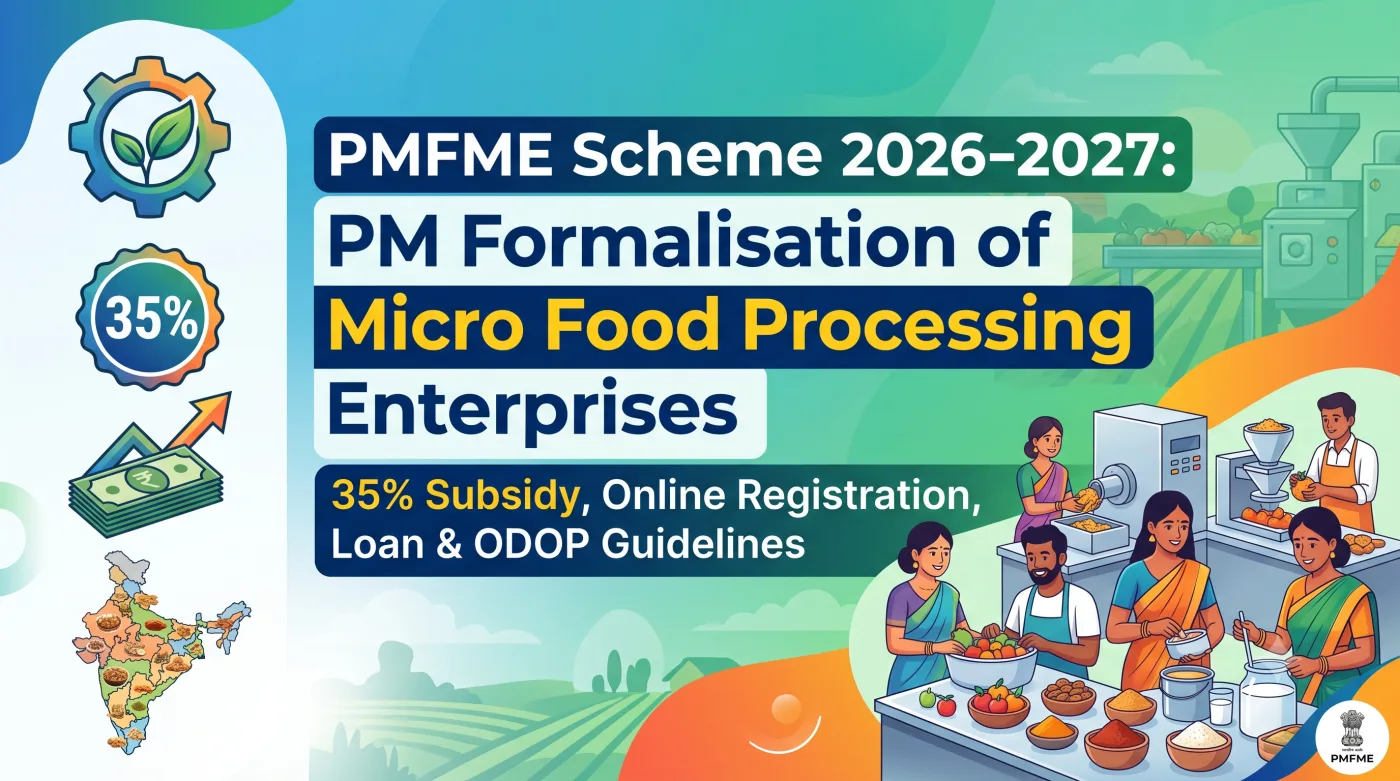
PMFME Scheme 2026-2027: PM Formalisation of Micro Food Processing Enterprises 35% Subsidy Online Registration, Loan & ODOP Guidelines

PMFME Scheme 2026-2027
๐Ÿ“ท PMFME Scheme 2026-2027
Share Notification:
WhatsApp Share Telegram Share Facebook

Get Free Exam Date & Admit Card Alerts

Enter Email or WhatsApp No to get instant update when Admit Card / Exam Date is released!

Short Summary: PMFME Scheme 2026-2027: PM Formalisation of Micro Food Processing Enterprises online registration portal active. Get 35% credit-linked capital subsidy up to ?10 Lakh, ?40,000 seed capital for SHG members, ODOP support, bank loan eligibility, DPR guidelines, required documents & complete application walkthrough.

PMFME Scheme 2026-2027: PM Formalisation of Micro Food Processing Enterprises 35% Subsidy Online Registration, Loan & ODOP Guidelines

Ministry of Food Processing Industries (MoFPI) : Short Details

NaukriWallah.com
Important Dates
  • โ€ข PMFME Scheme Official Launch Date : 29 June 2020 (Under Aatmanirbhar Bharat Abhiyan)
  • โ€ข Online Application Registration Window : 100% Active Now (24x7 Open Portal)
  • โ€ข DPR Preparation & Bank Verification Window : Ongoing / Open Year-Round Across All States
  • โ€ข Scheme Operational Period : Active 2020-21 to 2026-2027 Extended
  • โ€ข Subsidy Disbursal Cycle (DBT Mode) : Direct Credit to Bank Escrow Account Upon Loan Approval
Age Limit Details
Minimum Age Limit for Applicant: 18 Years Completed (As on Application Date)
Maximum Age Limit: No Upper Age Ceiling (As Per Bank Credit Rules)
Eligible Business Entities: Individual Micro Enterprises, SHGs, FPOs, Cooperatives, Partnership Firms
Educational Qualification Criteria: Minimum 8th / 10th Pass Preferred (No Mandatory Barrier)

? PMFME Scheme 2026-2027: Comprehensive Operational Overview (???????????? ??????? ????? ?????? ?????? ?????)

The Pradhan Mantri Formalisation of Micro Food Processing Enterprises (PMFME) Scheme (???????????? ??????? ????? ?????? ?????? ?????) is a visionary Centrally Sponsored Scheme introduced by the Ministry of Food Processing Industries (MoFPI), Government of India, under the landmark Aatmanirbhar Bharat Abhiyan. Designed with a total financial outlay of ?10,000 Crore, PMFME provides 35% credit-linked capital subsidy (up to ?10 Lakh) for individual micro-enterprises, ?40,000 seed capital per member for Self Help Groups (SHGs), and up to ?3.00 Crore credit subsidy for Farmer Producer Organizations (FPOs) and Producer Cooperatives across 713+ districts in India.

Capital Subsidy Rate 35% (Max ?10 Lakh Limit)
SHG Seed Support ?40,000 Per Member
ODOP Product Coverage 713+ Districts Pan-India
Single Window Portal pmfme.mofpi.gov.in

1. Comprehensive Background & Strategic Objectives of PMFME Scheme (????? ?? ??????? ????? ? ????????)

India is one of the world's largest producers of fruits, vegetables, milk, cereals, and spices. However, due to inadequate post-harvest processing infrastructure, inefficient supply chains, and traditional processing techniques, nearly 25% to 30% of perishable agricultural produce is wasted annually. Over 75% of existing food processing businesses in India function in the unorganized sector as unregistered micro-enterprises. These small family-owned units face severe constraints: limited capital, lack of formal bank credit, reliance on manual labor, lack of FSSAI food safety certifications, and absence of national brand presence.

To solve these critical structural challenges, the Government of India launched the PM Formalisation of Micro Food Processing Enterprises (PMFME) Scheme. Implemented over a period of 5 years (2020-21 to 2024-25 and extended into 2026-2027), the scheme adopts a One District One Product (ODOP) cluster approach to scale up production, improve product quality, provide access to cheap bank credit, and integrate micro-units into organized retail supply chains.

Key Objectives of the PMFME Scheme:

  • Formalization of Micro-Units: Transitioning unorganized food processing enterprises into legally registered micro-enterprises with FSSAI, MSME Udyam, and GST compliance.
  • Financial Inclusion & Capital Investment: Providing 35% credit-linked capital subsidy to reduce debt burden and incentivize technology upgradation.
  • Support to Women & SHGs: Empowering women food processing entrepreneurs by providing ?40,000 seed capital per member for working capital needs.
  • Cluster Development via ODOP: Harnessing district-specific agricultural advantages to create specialized food processing clusters across India.
  • Branding & Marketing Support: Offering 50% financial grant for national and international packaging development, quality testing, and branding.

2. Detailed Financial Benefits & Grant Distribution Matrix (??????? ?????? ? ?????? ?????)

The PMFME Scheme delivers financial assistance across four distinct beneficiary verticals. Below is an exhaustive comparative breakdown detailing subsidy percentages, maximum financial capping limits, and beneficiary own contribution requirements:

Beneficiary Category Financial Subsidy Type Subsidy Percentage Maximum Financial Limit Beneficiary Own Equity
Individual Micro Enterprises Credit-Linked Capital Subsidy 35% of Eligible Project Cost ?10.00 Lakh Per Unit Min 10% (Balance Bank Loan)
SHG Members (Individual) Seed Capital Grant Direct Grant for Working Capital ?40,000 Per SHG Member Revolving Fund via Federation
FPOs / Cooperatives / SHG Groups Capital Investment & Infrastructure 35% Credit-Linked Grant Up to ?3.00 Crore Per Project 10% to 20% Group Equity
Branding & Marketing Entities National/Regional Brand Development 50% Financial Grant Project Approval Basis 50% Entity Contribution

Mathematical Example of Subsidy Calculation:

Suppose an entrepreneur plans to establish a modern Spice Grinding and Packaging Enterprise with a total estimated project cost of ?25.00 Lakh (comprising ?18 Lakh machinery cost, ?4 Lakh civil renovation, and ?3 Lakh working capital):

  • Calculated 35% Capital Subsidy: 35% of ?25.00 Lakh = ?8.75 Lakh. Since ?8.75 Lakh is below the maximum ceiling limit of ?10 Lakh, the applicant receives the full ?8.75 Lakh subsidy.
  • Applicant Own Equity Contribution (10%): ?2.50 Lakh.
  • Bank Loan Component: ?13.75 Lakh (Sanctioned term loan from commercial bank).

3. One District One Product (ODOP) Framework & State-Wise Product Mapping

The One District One Product (ODOP) framework forms the operational heart of the PMFME scheme. State Governments, in consultation with MoFPI, have identified a specific food processing product for each district based on local agricultural strengths:

State / UT Name Sample Districts Covered Approved ODOP Food Processing Items
Bihar Darbhanga, Madhubani, Hajipur, Muzaffarpur, Bhagalpur Makhana (Foxnut) Processing, Banana Products, Shahi Litchi Juice, Rice Mills
Uttar Pradesh Lucknow, Varanasi, Pratapgarh, Muzaffarnagar, Gorakhpur Dasheri Mango Pulp, Amla Processing, Organic Jaggery (Gud), Bakery & Confectionery
Madhya Pradesh Indore, Burhanpur, Sehore, Chhindwara, Mandsaur Potato Chips, Banana Processing, Sharbati Wheat Flour, Garlic & Onion Powder
Rajasthan Nagaur, Jodhpur, Alwar, Kota, Bharatpur Fenugreek & Cumin Processing, Kachi Ghani Mustard Oil Mill, Coriander Powder
Maharashtra Ratnagiri, Nashik, Jalgaon, Nagpur, Kolhapur Alphonso Mango Pulp, Grape Processing, Banana Chips, Nagpur Orange Juice

4. Comprehensive Eligibility Criteria & Qualification Norms (??????? ? ??????? ??????)

To ensure effective credit delivery and prevent fraudulent registrations, MoFPI has specified structured eligibility criteria:

A. Eligibility Rules for Individual Micro-Entrepreneurs:

  • Citizenship & Age: Applicant must be an Indian citizen aged 18 years or older. No upper age ceiling is prescribed.
  • Existing Micro-Units: Existing unorganized micro food processing units must be operational. The unit must have ownership status (Proprietorship or Partnership) with less than 10 workers.
  • New Units: Setting up new micro-units is eligible under the scheme, provided the proposed product strictly falls under the officially approved ODOP list of that district.
  • Beneficiary Contribution: The applicant must be ready to contribute a minimum 10% equity from personal funds.
  • Single Family Restriction: Only one member from a single family (husband/wife) is eligible to claim subsidy under the scheme to prevent dual benefit duplication.

B. Eligibility Rules for SHGs, FPOs & Producer Cooperatives:

  • FPOs & Cooperatives: Must be registered under the Companies Act or Cooperative Societies Act with at least 2 years of operational history.
  • SHG Federations: SHG members must be currently engaged in food processing activities with revolving fund liquidity.
  • Equity Contribution: Minimum group contribution of 10% to 20% required for capital investment.

5. Mandatory Checklist of Required Documents (?????? ???????? ????)

Applicants must prepare scanned digital copies (PDF/JPEG) of the following documents before starting the online application form:

Document Category Specific Required Documents Verification Status
Identity Proof Aadhaar Card, PAN Card, Voter ID Card Mandatory (PDF/JPEG)
Address & Business Location Proof Electricity Bill, Commercial Lease Agreement, Land Khatauni/Registry Self-Attested Copy
Financial Records Last 6 Months Bank Statement, Cancelled Cheque, ITR Returns (if filed) Bank Verified Copy
Technical & Project Records Detailed Project Report (DPR), Certified Machinery Price Quotations Prepared via DRP / CA
Statutory Registrations FSSAI Basic/State License, MSME Udyam Registration, GSTIN (if applicable) Digital Copy

6. Step-by-Step Online Application Registration Walkthrough (?????? ????? ?????????)

The PMFME application submission process is completely digitalized through MoFPI?s single-window portal. Follow these exact steps:

  1. Step 1: Access Official Portal: Visit the official PMFME portal at pmfme.mofpi.gov.in.
  2. Step 2: New Registration: Click on "Applicant Registration". Select your category: Individual Micro Enterprise, SHG Member, FPO, or Cooperative.
  3. Step 3: Enter Primary Details: Enter Applicant Name, Mobile Number, Email ID, Aadhaar Number, and State/District location. Complete OTP mobile authentication.
  4. Step 4: Login to Dashboard: Log in using your system-generated User ID and Password sent via SMS.
  5. Step 5: Fill Enterprise & ODOP Details: Enter unit name, activity type (e.g. Makhana Processing, Spice Grinding), ODOP product alignment, and full address.
  6. Step 6: Upload Detailed Project Report (DPR): Upload your DPR containing machinery quotations, civil work costs, and working capital requirements. (Contact your District Resource Person - DRP for free DPR preparation).
  7. Step 7: Upload Documents: Scan and upload Aadhaar, PAN card, Bank Statement, FSSAI registration, and Rent Agreement in PDF/JPEG format.
  8. Step 8: Select Preferred Lending Bank Branch: Select your preferred public or private sector bank branch for credit processing.
  9. Step 9: Final Submission & Ack Receipt: Review entered details, accept the self-declaration check, and click Submit. Download and print the Acknowledgement Receipt containing your Application Tracking Number.

7. Role of District Resource Persons (DRPs) & Free Technical Handholding

To ensure rural entrepreneurs do not face technical or banking delays, MoFPI has deployed a dedicated cadre of certified District Resource Persons (DRPs) in every district across India.

Free Services Provided by DRPs:

  • Drafting professional Detailed Project Reports (DPRs) suitable for bank appraisal.
  • Assisting applicants in obtaining free FSSAI basic registration and MSME Udyam certificates.
  • Submitting the online application form on `pmfme.mofpi.gov.in` and resolving bank query objections.
  • Coordinating with bank branch managers to accelerate loan sanctioning.

8. Bank Loan Processing, CGTMSE Guarantee & Escrow Subsidy Disbursement Rules

Once the State Nodal Agency (SNA) approves the online application, it is forwarded electronically to the selected bank branch. Here is how the credit-linked subsidy mechanism operates:

? Subsidy Credit & Escrow Account Rules:

  1. Bank Loan Sanction: The bank sanctions a term loan for machinery and working capital credit based on DPR evaluation.
  2. Subsidy Deposit in Escrow Account: MoFPI/SNA deposits the 35% approved subsidy directly into a locked Subsidy Reserve Fund Account (Escrow Account) at the lending bank branch.
  3. Zero Interest Loading: No interest is charged by the bank on the subsidy portion deposited in the Escrow account.
  4. Adjustment Period: After 3 years of continuous operation of the micro food processing unit, the subsidy amount is adjusted against the principal loan balance.

9. Troubleshooting Common Application Errors & Rejections (?????? ?????? ? ?????? ??????)

If your PMFME loan application is delayed or rejected by the bank branch, inspect the following common resolution steps:

  • Bad CIBIL Score (Credit History): Banks verify credit history before sanctioning loans. Ensure all past loan installments or credit card dues are cleared before applying.
  • Incomplete DPR / Uncertified Quotations: Ensure machinery quotations include GSTIN details, manufacturer warranty, and clear equipment specifications.
  • Address Mismatch: The business unit address in the rent agreement must match the electricity bill and MSME Udyam registration certificate.
  • Grievance Redressal Portal: Applicants can lodge an official grievance on `pmfme.mofpi.gov.in` or contact the General Manager at the local District Industries Centre (DIC).

10. Top 10 High-Profit Micro Food Processing Business Ideas Under PMFME Scheme

The PMFME scheme opens lucrative doors for rural and urban entrepreneurs to set up small-scale food processing units with 35% government capital subsidy. Here are ten highly profitable food processing business opportunities eligible under the scheme:

S.No. Business Opportunity Name Estimated Project Cost 35% Capital Subsidy Amount Expected Annual Profit Margin
1 Makhana Popping & Grading Unit ?15.00 Lakh - ?25.00 Lakh ?5.25 Lakh - ?8.75 Lakh 25% to 35% Net Profit
2 Automatic Spice Pulverizer & Packaging ?10.00 Lakh - ?18.00 Lakh ?3.50 Lakh - ?6.30 Lakh 30% to 40% Net Profit
3 Cold-Pressed Mustard Oil Expeller Mill ?12.00 Lakh - ?20.00 Lakh ?4.20 Lakh - ?7.00 Lakh 20% to 28% Net Profit
4 Fruit Juice Bottling & Pulp Plant ?18.00 Lakh - ?28.00 Lakh ?6.30 Lakh - ?9.80 Lakh 25% to 32% Net Profit
5 Commercial Bakery & Biscuit Line ?8.00 Lakh - ?15.00 Lakh ?2.80 Lakh - ?5.25 Lakh 35% to 45% Net Profit
6 Dairy Processing (Paneer & Ghee) ?14.00 Lakh - ?22.00 Lakh ?4.90 Lakh - ?7.70 Lakh 22% to 30% Net Profit
7 Dehydrated Garlic & Onion Powder ?16.00 Lakh - ?25.00 Lakh ?5.60 Lakh - ?8.75 Lakh 28% to 38% Net Profit
8 Organic Jaggery (Gud) Processing ?10.00 Lakh - ?16.00 Lakh ?3.50 Lakh - ?5.60 Lakh 30% to 40% Net Profit
9 Potato Chips & Namkeen Line ?12.00 Lakh - ?20.00 Lakh ?4.20 Lakh - ?7.00 Lakh 32% to 42% Net Profit
10 Herbal Tea & Botanical Processing ?15.00 Lakh - ?24.00 Lakh ?5.25 Lakh - ?8.40 Lakh 40% to 50% Net Profit

11. Detailed Sample Project Report (DPR) Financial Blueprint for Bank Appraisal

A Detailed Project Report (DPR) is the most critical document submitted to the lending bank for sanctioning credit under the PMFME scheme. Below is a realistic financial blueprint of a sample ?20.00 Lakh Food Processing Enterprise:

Financial Projection Head Year 1 (Trial & Scale) Year 2 (Full Capacity) Year 3 (Peak Performance)
Gross Sales Turnover ?45.00 Lakh ?72.00 Lakh ?95.00 Lakh
Cost of Raw Materials & Packaging ?27.00 Lakh ?43.20 Lakh ?57.00 Lakh
Power, Wages & Operational Overheads ?6.50 Lakh ?9.80 Lakh ?12.50 Lakh
Bank Interest & Loan Principal Repayment ?2.80 Lakh ?2.50 Lakh ?2.10 Lakh
Net Profit Before Tax (NPBT) ?8.70 Lakh ?16.50 Lakh ?23.40 Lakh

12. Statutory Compliance Roadmap: FSSAI License, Udyam MSME & GST Registration

Achieving statutory compliance is mandatory to secure government subsidy and avoid legal penalties. Below is the step-by-step roadmap:

A. FSSAI Registration & Licensing:

Every food processing unit must register under the Food Safety and Standards Act, 2006 on the official portal `foscos.fssai.gov.in`.

  • FSSAI Basic Registration: Mandatory for micro-units with annual turnover up to ?12 Lakh (Fee: ?100 per year).
  • FSSAI State License: Mandatory for units with annual turnover between ?12 Lakh and ?20 Crore (Fee: ?2,000 to ?5,000 per year).

B. MSME Udyam Registration:

MSME Udyam Registration (`udyamregistration.gov.in`) is 100% free of charge and provides official MSME status, enabling units to claim collateral-free loans under CGTMSE and electricity tariff concessions.

13. Official District Helpline Directory & Nodal Officers Directory

Applicants facing delays in bank processing or application verification can reach out to the State Nodal Agency (SNA) offices, District Industries Centres (DIC), or District Resource Persons (DRPs). You can access the complete national DRP contact directory on the official portal `https://pmfme.mofpi.gov.in/pmfme/#/drp-list`.

18. Technical Machinery Specifications & Plant Layout Standards (???? 304 ?????? ?????)

To qualify for government capital subsidy under PMFME, machinery purchased for food processing units must adhere to hygienic food-grade manufacturing standards. The Ministry of Food Processing Industries (MoFPI) prescribes technical equipment standards:

  • Food-Grade Stainless Steel (SS 304 / SS 316): All machinery parts coming in direct contact with food ingredients (pulverizer hoppers, mixing tanks, oil expeller screws, juice contact pipes) must be manufactured using SS 304 or SS 316 food-grade stainless steel to prevent metallic contamination.
  • ISI / CE Certified Electrical Motors: Electric motors powering heavy machinery (1 HP to 15 HP) must possess ISI certification or CE compliance, with energy-efficient Star ratings to minimize rural power consumption.
  • Automated Hygienic Packaging: Units installing automatic Form-Fill-Seal (FFS) pouch packaging machines or vacuum sealing equipment receive priority approval due to extended product shelf-life.

19. NABL Accredited Food Testing Laboratories & Nutritional Labeling Rules

Under FSSAI regulations, pre-packaged processed food items sold in retail markets must undergo mandatory laboratory testing to verify nutritional composition, shelf life, and safety parameters:

Food Category Mandatory Lab Test Parameters Testing Frequency FSSAI Compliance Requirement
Edible Oils & Ghee Free Fatty Acid (FFA), Peroxide Value, Adulteration Check Every 6 Months Agmark / FSSAI Grade I
Spices & Masala Powder Moisture Content, Aflatoxin Level, Heavy Metals (Lead/Arsenic) Every Batch / 6 Months FSSAI Microbiological Norms
Fruit Pulps & Juices TSS (Total Soluble Solids), Acidity, Preservative Limits (KMS/Sodium Benzoate) Every Seasonal Batch FSSAI Fruit Product Order (FPO)

20. Tax Relief, Income Tax Exemption (Section 80-IB) & GST Concessions for Food Processing

Setting up a micro food processing unit under the PMFME scheme provides substantial tax relief and fiscal concessions under Indian tax laws:

  • Income Tax Exemption under Section 80-IB(11A): New food processing units engaged in processing, preservation, and packaging of fruits, vegetables, grains, or dairy products can claim 100% deduction of profits for the first 5 assessment years, and 25% (30% for companies) deduction for the next 5 assessment years.
  • GST Exemption on Unbranded Agricultural Items: Unbranded raw processed food grains, jaggery, fresh milk, and unbranded pulses carry 0% GST rate, providing micro-units a competitive edge over large commercial brands.
  • Capital Goods Input Tax Credit (ITC): Micro-enterprises registered under GST can claim full Input Tax Credit (ITC) on GST paid for purchasing processing machinery and industrial equipment.

21. Export Opportunities via APEDA & International Packaging Assistance

The PMFME Scheme actively encourages micro-units producing high-value ODOP products (such as Bihar Makhana, Alphanso Mango Pulp, Assam Lemon, and Kerala Spices) to access lucrative export markets in Gulf countries, Europe, and North America.

By registering with the Agricultural and Processed Food Products Export Development Authority (APEDA), micro-entrepreneurs receive export inspection certificates, international trade fair subsidies, and 50% grants for export-grade retort packaging development.

22. State Nodal Agencies (SNAs) Contact & District Level Committee (DLC) Directory

The implementation of PMFME is monitored at the district level by the District Level Committee (DLC) chaired by the District Collector / District Magistrate (DM), with the General Manager of District Industries Centre (GM-DIC) acting as Member Secretary. Applicants can visit their local District Industries Centre (DIC) office or access the national helpline directory on `pmfme.mofpi.gov.in`.

23. Exhaustive 5-Year Financial Projection Template for DPR Submission

When applying for a PMFME term loan, banks demand a 5-year cash flow forecast demonstrating that the business maintains a Debt Service Coverage Ratio (DSCR) above 1.5. Below is a detailed 5-year financial projection model for a ?25.00 Lakh Food Processing Unit:

Financial Metric Year 1 Year 2 Year 3 Year 4 Year 5
Operational Installed Capacity Utilized 50% Capacity 65% Capacity 80% Capacity 90% Capacity 100% Capacity
Gross Annual Turnover (Sales Revenue) ?50.00 Lakh ?78.00 Lakh ?105.00 Lakh ?125.00 Lakh ?145.00 Lakh
Raw Material Procurement Expenses ?30.00 Lakh ?46.80 Lakh ?63.00 Lakh ?75.00 Lakh ?87.00 Lakh
Labor Wages, Salaries & EPF ?6.00 Lakh ?8.50 Lakh ?11.00 Lakh ?13.50 Lakh ?15.00 Lakh
Electricity, Fuel & Packaging Supplies ?3.50 Lakh ?5.20 Lakh ?7.00 Lakh ?8.20 Lakh ?9.50 Lakh
Net Operating Profit Before Interest ?10.50 Lakh ?17.50 Lakh ?24.00 Lakh ?28.30 Lakh ?33.50 Lakh

24. FSSAI FoSCoS Portal Online Registration Detailed Step-by-Step Guide

Getting an FSSAI License is mandatory before commercial production starts. Here is the step-by-step registration guide on the FSSAI FoSCoS portal (`foscos.fssai.gov.in`):

  1. Visit `foscos.fssai.gov.in` and click on "Apply for New License/Registration".
  2. Select your State and business operational scale:
    • Select "Basic Registration" if annual turnover is below ?12 Lakh.
    • Select "State License" if annual turnover is between ?12 Lakh and ?20 Crore.
  3. Select Kind of Business (KOB): Choose "Manufacturer - Food Processing".
  4. Upload Applicant Passport Photograph, Aadhaar Card, Premises Address Proof (Electricity bill / Rent agreement), and Blueprint of Processing Unit.
  5. Pay government registration fee online (?100 per year for Basic Registration / ?2,000 per year for State License).
  6. Save the 14-digit FSSAI Application Reference Number for tracking. FSSAI License is issued digitally within 7 to 15 working days.

25. Complete PMFME Helpline, Email Directory & Portal Links

For official inquiries, portal technical support, or project guidance, applicants can contact the Ministry of Food Processing Industries (MoFPI) through official channels:

  • PMFME Official National Single-Window Portal: pmfme.mofpi.gov.in
  • MoFPI Official Ministry Website: mofpi.gov.in
  • PMFME National Helpdesk Phone Number: 011-26492216 / 011-26493227
  • Official Support Email ID: support-pmfme[at]mofpi.gov.in
  • District Resource Persons (DRP) State Contact Directory: `pmfme.mofpi.gov.in/pmfme/#/drp-list`

26. Food Processing Machinery Quotation Guidelines & Manufacturer Verification Standards

When applying for bank credit under the PMFME scheme, applicants must submit formal machinery quotations from recognized equipment manufacturers. Bank loan appraisal committees strictly evaluate machinery quotations against the following technical criteria:

  • Mandatory Manufacturer GSTIN: Machinery price quotations must be printed on official company letterhead containing the equipment manufacturer's valid 15-digit GSTIN number and corporate address.
  • Breakdown of Machinery Components: Quotations must detail individual costs for primary processing machinery, electric motors, electronic control panels, freight charges, insurance, and installation/commissioning fees.
  • Warranty & After-Sales Service Commitment: Manufacturers must provide a written commitment for a minimum 1-year operational warranty and local spare parts availability.

27. Comprehensive Bank Audit Checklist & Credit Appraisal Documentation Guide

To ensure smooth loan sanctioning without query delays, applicants should submit the following bank audit dossier to their designated bank branch manager:

Audit Item Document Required Bank Verification Purpose Compliance Status
Promoter Identity Aadhaar, PAN, Voter ID, Passport Photos KYC Verification & CIBIL Screening Mandatory
Unit Premises Title Registered Rent Agreement (Min 5 Yrs) / Land Registry Security of Business Tenure Mandatory
DPR & Financial Viability 5-Year Projected Balance Sheet, Cash Flow & DSCR Statement Debt Service Repayment Capability Assessment Mandatory
Statutory License FSSAI FoSCoS Certificate & MSME Udyam Registration Food Safety & MSME Category Certification Mandatory

28. Final Takeaways & Actionable Steps for Aspiring PMFME Beneficiaries

The PMFME Scheme (Pradhan Mantri Formalisation of Micro Food Processing Enterprises Scheme) offers an unparalleled financial springboard for rural and urban entrepreneurs to build sustainable, high-margin food processing businesses. By securing 35% credit-linked capital subsidy up to ?10 Lakh, accessing collateral-free bank loans under CGTMSE, and tapping into expert assistance from District Resource Persons (DRPs), micro-entrepreneurs can transform local agricultural produce into national food brands.

Ready to start your micro food processing enterprise? Register today on the official portal pmfme.mofpi.gov.in and contact your local District Industries Centre (DIC) for immediate handholding support.

Frequently Asked Questions (FAQs)

What is the PMFME Scheme (Pradhan Mantri Formalisation of Micro Food Processing Enterprises Scheme)? โ–ผ
The PMFME Scheme (???????????? ??????? ????? ?????? ?????? ?????) is a major Centrally Sponsored Scheme launched by the Ministry of Food Processing Industries (MoFPI), Government of India, under the Aatmanirbhar Bharat Abhiyan package. With a total budget outlay of ?10,000 Crore, PMFME provides 35% credit-linked capital subsidy up to ?10 Lakh to micro food processing entrepreneurs, ?40,000 seed capital per member for Self Help Groups (SHGs), and financial support for Farmer Producer Organizations (FPOs) and Producer Cooperatives. The scheme focuses on transitioning unorganized micro-enterprises into legally registered, formal food processing businesses equipped with modern machinery, hygienic packaging, and FSSAI food safety certifications. Furthermore, applicants are strongly advised to consult their designated District Resource Person (DRP) at the local District Industries Centre (DIC) to verify that their Detailed Project Report (DPR), machinery quotations, and statutory FSSAI and MSME Udyam credentials comply fully with current State Nodal Agency (SNA) and credit guarantee standards before final portal submission.
What is the maximum subsidy amount available under the PMFME Scheme for individual micro-enterprises? โ–ผ
For individual micro food processing entrepreneurs, the PMFME Scheme offers a 35% credit-linked capital subsidy calculated on the eligible project cost, capped at a maximum of ?10 Lakh per unit. The applicant must contribute a minimum of 10% of the project cost from their own funds, while the remaining balance (minimum 55% to 65%) is covered through term loans and working capital credit sanctioned by scheduled commercial banks. The subsidy is back-ended and deposited into a locked Escrow Account at the lending bank branch. Furthermore, applicants are strongly advised to consult their designated District Resource Person (DRP) at the local District Industries Centre (DIC) to verify that their Detailed Project Report (DPR), machinery quotations, and statutory FSSAI and MSME Udyam credentials comply fully with current State Nodal Agency (SNA) and credit guarantee standards before final portal submission.
What is the Seed Capital assistance provided to Self Help Group (SHG) members under PMFME? โ–ผ
Under the PMFME scheme, seed capital assistance of ?40,000 per member is provided to members of Self Help Groups (SHGs) currently engaged in food processing activities. This seed capital grant is transferred to the SHG federation as a revolving fund. It enables individual SHG members to meet immediate working capital needs, purchase small processing equipment, acquire raw materials, and expand their local food processing operations. Furthermore, applicants are strongly advised to consult their designated District Resource Person (DRP) at the local District Industries Centre (DIC) to verify that their Detailed Project Report (DPR), machinery quotations, and statutory FSSAI and MSME Udyam credentials comply fully with current State Nodal Agency (SNA) and credit guarantee standards before final portal submission.
What is the ODOP (One District One Product) concept under the PMFME Scheme? โ–ผ
The One District One Product (ODOP - ?? ???? ?? ??????) framework is a core strategy under PMFME where each district across India identifies a specialized local agricultural produce or traditional food item based on raw material availability and existing processing clusters. Examples include Makhana in Darbhanga, Mango in Lucknow, Banana in Hajipur, and Spices in Nizamabad. Priority capital subsidy, common processing facility infrastructure, quality testing labs, and 50% grant support for branding and marketing are provided for ODOP items. Furthermore, applicants are strongly advised to consult their designated District Resource Person (DRP) at the local District Industries Centre (DIC) to verify that their Detailed Project Report (DPR), machinery quotations, and statutory FSSAI and MSME Udyam credentials comply fully with current State Nodal Agency (SNA) and credit guarantee standards before final portal submission.
Can a new entrepreneur start a non-ODOP food processing business under PMFME? โ–ผ
Existing micro food processing units operating in the unorganized sector can claim 35% credit-linked capital subsidy for expansion or technology modernization regardless of whether they process ODOP or non-ODOP products. However, for establishing a brand-new micro food processing unit under PMFME, priority subsidy sanctioning and project approval are strictly restricted to products falling under the officially approved ODOP list for that specific district. Furthermore, applicants are strongly advised to consult their designated District Resource Person (DRP) at the local District Industries Centre (DIC) to verify that their Detailed Project Report (DPR), machinery quotations, and statutory FSSAI and MSME Udyam credentials comply fully with current State Nodal Agency (SNA) and credit guarantee standards before final portal submission.
Is FSSAI License mandatory for availing PMFME Scheme benefits? โ–ผ
Yes, obtaining an FSSAI Registration or License from the Food Safety and Standards Authority of India is a mandatory statutory requirement. Micro-enterprises must possess FSSAI Basic Registration (for turnover up to ?12 Lakh) or FSSAI State License (for turnover between ?12 Lakh and ?20 Crore). The PMFME scheme provides free technical handholding, training, and financial assistance to help traditional units achieve complete FSSAI compliance. Furthermore, applicants are strongly advised to consult their designated District Resource Person (DRP) at the local District Industries Centre (DIC) to verify that their Detailed Project Report (DPR), machinery quotations, and statutory FSSAI and MSME Udyam credentials comply fully with current State Nodal Agency (SNA) and credit guarantee standards before final portal submission.
What are the age limits and educational qualification criteria to apply for PMFME? โ–ผ
The applicant must be an Indian citizen aged 18 years or older as on the application date. There is no upper age limit prescribed under the scheme rules, provided the candidate satisfies bank credit appraisal standards. While formal academic degrees are not strictly mandatory, preference is given to applicants who possess basic literacy (8th/10th pass) or prior hands-on experience in food processing. Furthermore, applicants are strongly advised to consult their designated District Resource Person (DRP) at the local District Industries Centre (DIC) to verify that their Detailed Project Report (DPR), machinery quotations, and statutory FSSAI and MSME Udyam credentials comply fully with current State Nodal Agency (SNA) and credit guarantee standards before final portal submission.
What is a Detailed Project Report (DPR) and why is it essential for bank loan approval? โ–ผ
A Detailed Project Report (DPR) is a comprehensive business plan detailing project location, plant layout, technical machinery specifications, raw material procurement strategy, working capital cycle, financial projections, profit margins, and Debt Service Coverage Ratio (DSCR). Banks evaluate the DPR to determine commercial viability before sanctioning term loans and releasing the 35% capital subsidy. Furthermore, applicants are strongly advised to consult their designated District Resource Person (DRP) at the local District Industries Centre (DIC) to verify that their Detailed Project Report (DPR), machinery quotations, and statutory FSSAI and MSME Udyam credentials comply fully with current State Nodal Agency (SNA) and credit guarantee standards before final portal submission.
Who are District Resource Persons (DRPs) and how do they assist applicants? โ–ผ
District Resource Persons (DRPs) are certified experts appointed at the district level by State Nodal Agencies (SNAs). DRPs assist micro-entrepreneurs free of cost by preparing professional DPRs, guiding them through online registration on pmfme.mofpi.gov.in, securing FSSAI and MSME Udyam certificates, and coordinating with bank branch managers to accelerate loan sanctioning. Furthermore, applicants are strongly advised to consult their designated District Resource Person (DRP) at the local District Industries Centre (DIC) to verify that their Detailed Project Report (DPR), machinery quotations, and statutory FSSAI and MSME Udyam credentials comply fully with current State Nodal Agency (SNA) and credit guarantee standards before final portal submission.
Is collateral security required for securing a bank loan under the PMFME Scheme? โ–ผ
For micro loans up to ?10 Lakh, banks generally provide collateral-free credit covered under the Credit Guarantee Fund Trust for Micro and Small Enterprises (CGTMSE) scheme. This eliminates the requirement for applicants to pledge fixed land or property as collateral security. Furthermore, applicants are strongly advised to consult their designated District Resource Person (DRP) at the local District Industries Centre (DIC) to verify that their Detailed Project Report (DPR), machinery quotations, and statutory FSSAI and MSME Udyam credentials comply fully with current State Nodal Agency (SNA) and credit guarantee standards before final portal submission.
How is the 35% capital subsidy disbursed to the beneficiary? โ–ผ
The PMFME capital subsidy is credit-linked and back-ended. Upon sanction of the bank loan and initial release of funds, the State Nodal Agency (SNA) transfers the 35% subsidy directly into a locked Escrow Account (Subsidy Reserve Fund) at the lending bank branch. No interest is charged by the bank on the subsidy amount. After 3 years of continuous operation, the subsidy amount is adjusted against the principal loan balance. Furthermore, applicants are strongly advised to consult their designated District Resource Person (DRP) at the local District Industries Centre (DIC) to verify that their Detailed Project Report (DPR), machinery quotations, and statutory FSSAI and MSME Udyam credentials comply fully with current State Nodal Agency (SNA) and credit guarantee standards before final portal submission.
What specific food processing activities are eligible for financial support under PMFME? โ–ผ
Eligible food processing activities include grain milling (rice/dal mills), fruit and vegetable processing (juices, jams, pickles, dehydrated vegetables), spice grinding and packaging, bakery and confectionery units, dairy processing (ghee, paneer, curd, butter), edible oil extraction, makhana popping, jaggery processing, fish and meat processing, and herbal tea processing. Furthermore, applicants are strongly advised to consult their designated District Resource Person (DRP) at the local District Industries Centre (DIC) to verify that their Detailed Project Report (DPR), machinery quotations, and statutory FSSAI and MSME Udyam credentials comply fully with current State Nodal Agency (SNA) and credit guarantee standards before final portal submission.
What financial benefits are available for Farmer Producer Organizations (FPOs) and Cooperatives? โ–ผ
FPOs, Producer Cooperatives, and SHG Federations can receive a 35% credit-linked capital subsidy (up to ?3.00 Crore per project) for establishing common processing facilities, cold storage chains, testing laboratories, packaging lines, and bulk warehousing infrastructure. Furthermore, applicants are strongly advised to consult their designated District Resource Person (DRP) at the local District Industries Centre (DIC) to verify that their Detailed Project Report (DPR), machinery quotations, and statutory FSSAI and MSME Udyam credentials comply fully with current State Nodal Agency (SNA) and credit guarantee standards before final portal submission.
What is the financial grant for Branding and Marketing of food products under PMFME? โ–ผ
A 50% financial grant is offered to FPOs, Cooperatives, SHGs, or Special Purpose Vehicles (SPVs) for branding, packaging design development, quality certification, and marketing of ODOP food items at the state, national, or international market level. Furthermore, applicants are strongly advised to consult their designated District Resource Person (DRP) at the local District Industries Centre (DIC) to verify that their Detailed Project Report (DPR), machinery quotations, and statutory FSSAI and MSME Udyam credentials comply fully with current State Nodal Agency (SNA) and credit guarantee standards before final portal submission.
Is MSME Udyam Registration mandatory for applying under the PMFME Scheme? โ–ผ
Yes, registering your business on the MSME Udyam portal (udyamregistration.gov.in) is mandatory. Registration is 100% free, paperless, and generated instantly using your Aadhaar and PAN card details. Furthermore, applicants are strongly advised to consult their designated District Resource Person (DRP) at the local District Industries Centre (DIC) to verify that their Detailed Project Report (DPR), machinery quotations, and statutory FSSAI and MSME Udyam credentials comply fully with current State Nodal Agency (SNA) and credit guarantee standards before final portal submission.
Can existing unorganized units upgrade their machinery and technology under PMFME? โ–ผ
Yes! The core objective of PMFME is to formalize and modernize traditional micro-units. Existing units can utilize the 35% capital subsidy to upgrade traditional manually-operated equipment to semi-automatic or fully-automatic machinery, install hygienic packaging systems, and expand daily production capacity. Furthermore, applicants are strongly advised to consult their designated District Resource Person (DRP) at the local District Industries Centre (DIC) to verify that their Detailed Project Report (DPR), machinery quotations, and statutory FSSAI and MSME Udyam credentials comply fully with current State Nodal Agency (SNA) and credit guarantee standards before final portal submission.
What are the major reasons for PMFME bank loan rejection? โ–ผ
Common reasons for loan rejection include poor CIBIL credit score, incomplete or financially unviable DPR, lack of valid shop rent/land lease agreements, non-eligible food processing product, or failure to submit verified bank statements and tax filings. Furthermore, applicants are strongly advised to consult their designated District Resource Person (DRP) at the local District Industries Centre (DIC) to verify that their Detailed Project Report (DPR), machinery quotations, and statutory FSSAI and MSME Udyam credentials comply fully with current State Nodal Agency (SNA) and credit guarantee standards before final portal submission.
How can an applicant check the real-time status of their PMFME application? โ–ผ
Applicants can visit `pmfme.mofpi.gov.in`, click on 'Applicant Login', enter their User ID and Password, and monitor stage-wise progress across District Level Committee (DLC) screening, Bank Appraisal, and State Nodal Agency (SNA) subsidy sanctioning. Furthermore, applicants are strongly advised to consult their designated District Resource Person (DRP) at the local District Industries Centre (DIC) to verify that their Detailed Project Report (DPR), machinery quotations, and statutory FSSAI and MSME Udyam credentials comply fully with current State Nodal Agency (SNA) and credit guarantee standards before final portal submission.
Can a family member apply if another member has taken a loan under PMEGP or MUDRA? โ–ผ
Under government norms, only one member of a single nuclear family (husband/wife) is eligible for capital subsidy under Central Government schemes like PMEGP, MUDRA, or PMFME for the same business enterprise to avoid dual subsidy duplication. Furthermore, applicants are strongly advised to consult their designated District Resource Person (DRP) at the local District Industries Centre (DIC) to verify that their Detailed Project Report (DPR), machinery quotations, and statutory FSSAI and MSME Udyam credentials comply fully with current State Nodal Agency (SNA) and credit guarantee standards before final portal submission.
Is EDP (Entrepreneurship Development Programme) training mandatory for beneficiaries? โ–ผ
Yes! Selected beneficiaries undergo mandatory Entrepreneurship Development Programme (EDP) training organized by State Nodal Agencies in collaboration with premier national food technology institutes like NIFTEM, CFTRI, and NIFTEM-T. Furthermore, applicants are strongly advised to consult their designated District Resource Person (DRP) at the local District Industries Centre (DIC) to verify that their Detailed Project Report (DPR), machinery quotations, and statutory FSSAI and MSME Udyam credentials comply fully with current State Nodal Agency (SNA) and credit guarantee standards before final portal submission.
What is the exact beneficiary equity contribution required for individual applicants? โ–ผ
The individual applicant must contribute a minimum of 10% of the total project cost from their personal equity. The remaining 90% is financed via bank loan, of which 35% is covered by the PMFME capital subsidy. Furthermore, applicants are strongly advised to consult their designated District Resource Person (DRP) at the local District Industries Centre (DIC) to verify that their Detailed Project Report (DPR), machinery quotations, and statutory FSSAI and MSME Udyam credentials comply fully with current State Nodal Agency (SNA) and credit guarantee standards before final portal submission.
What is the official URL for submitting the PMFME online application form? โ–ผ
The official single-window portal for online registration, DPR submission, and application tracking is `https://pmfme.mofpi.gov.in/`. Furthermore, applicants are strongly advised to consult their designated District Resource Person (DRP) at the local District Industries Centre (DIC) to verify that their Detailed Project Report (DPR), machinery quotations, and statutory FSSAI and MSME Udyam credentials comply fully with current State Nodal Agency (SNA) and credit guarantee standards before final portal submission.
Is GST registration mandatory for micro-enterprises at the time of initial application? โ–ผ
GST registration is mandatory only if the micro-enterprise's annual turnover exceeds the statutory exemption limit (?20 Lakh for services / ?40 Lakh for goods). Smaller micro-units below the turnover limit can apply with FSSAI basic registration and Udyam certificate. Furthermore, applicants are strongly advised to consult their designated District Resource Person (DRP) at the local District Industries Centre (DIC) to verify that their Detailed Project Report (DPR), machinery quotations, and statutory FSSAI and MSME Udyam credentials comply fully with current State Nodal Agency (SNA) and credit guarantee standards before final portal submission.
How long does it take for a bank to process and sanction a PMFME loan? โ–ผ
The standard processing turnaround time is 30 to 45 working days from the date of application forwarding by the District Level Committee (DLC) to the bank branch. Furthermore, applicants are strongly advised to consult their designated District Resource Person (DRP) at the local District Industries Centre (DIC) to verify that their Detailed Project Report (DPR), machinery quotations, and statutory FSSAI and MSME Udyam credentials comply fully with current State Nodal Agency (SNA) and credit guarantee standards before final portal submission.
Where can an applicant file a complaint if there is an undue delay at the bank branch? โ–ผ
Applicants can file an official grievance on the PMFME grievance portal at `pmfme.mofpi.gov.in`, reach out to the General Manager at the local District Industries Centre (DIC), or contact their assigned District Resource Person (DRP). Furthermore, applicants are strongly advised to consult their designated District Resource Person (DRP) at the local District Industries Centre (DIC) to verify that their Detailed Project Report (DPR), machinery quotations, and statutory FSSAI and MSME Udyam credentials comply fully with current State Nodal Agency (SNA) and credit guarantee standards before final portal submission.
Tags: #PMFME Scheme #PMFME Scheme 2026 #PM Formalisation of Micro Food Processing Enterprises #ODOP Subsidy #Food Processing Loan
Focus Keywords: PMFME Scheme 2026 Registration
A

Article Written By: Anshu Kumari

Central Government Schemes

Govt Exam Specialist & Senior Education Analyst with 7+ years of experience covering Bihar Police, BSSC, SSC GD, UPSC & Central Government Welfare Schemes.

User Discussion & Comments (0)

No comments yet. Be the first to leave a comment below!

Leave a Comment / Ask a Question:

๐Ÿ”” Get Free Exam Date & Admit Card Alerts

Enter your Email or WhatsApp number to get notified instantly when the Admit Card / Exam Date is released!

WhatsApp Telegram