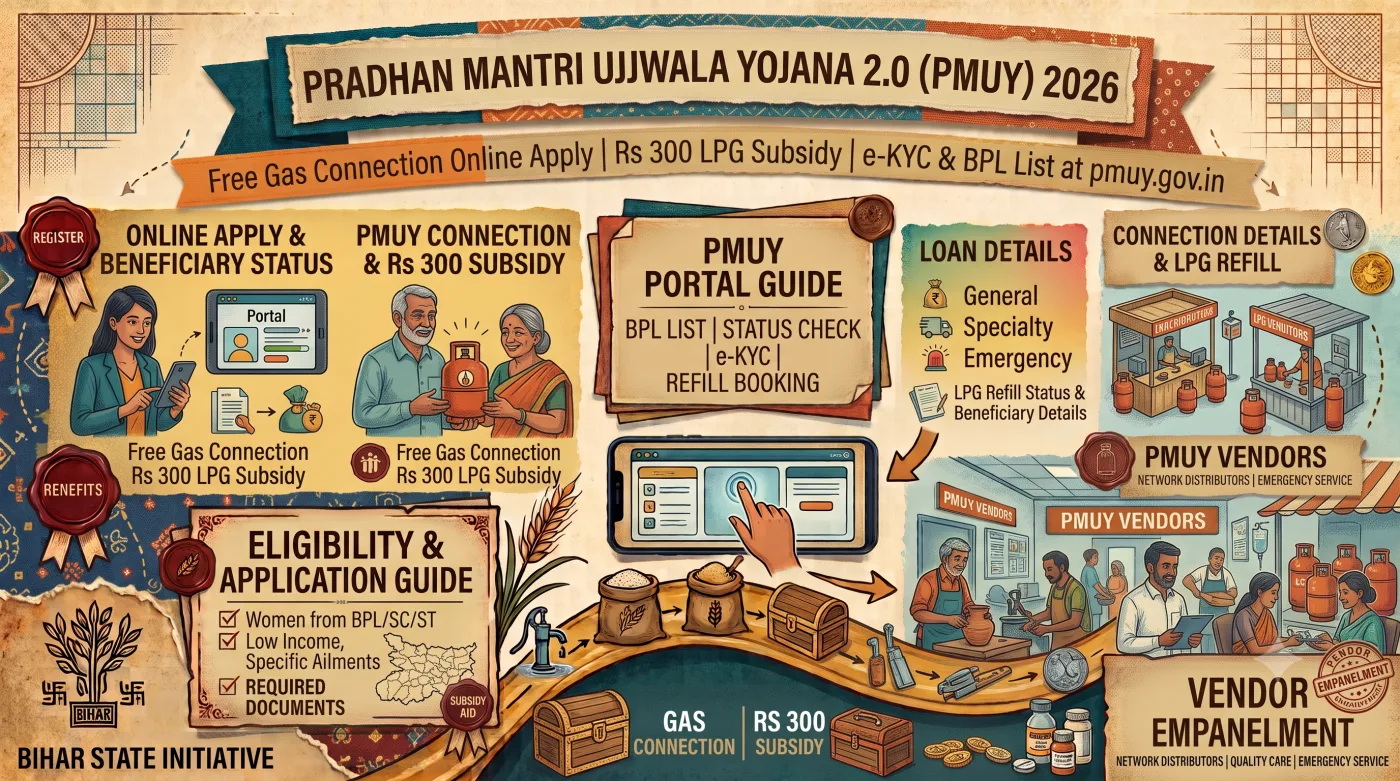
Introduction: Clean Cooking Energy and Women’s Health Revolution
The Pradhan Mantri Ujjwala Yojana (PMUY 2026) represents one of the most consequential public health and social welfare interventions in the history of developing nations. Spearheaded by the Ministry of Petroleum and Natural Gas (MoPNG), Government of India, and executed across every district by the three public sector Oil Marketing Companies (OMCs)—Indian Oil Corporation Limited (Indane), Bharat Petroleum Corporation Limited (Bharatgas), and Hindustan Petroleum Corporation Limited (HP Gas)—this transformative program was conceived with the humane objective of liberating rural women and young children from the toxic hazard of indoor air pollution caused by burning firewood, cow dung cakes, coal, and dried agricultural biomass in enclosed domestic kitchens.
According to World Health Organization (WHO) epidemiological research, inhaling the dense particulate smoke of an open traditional earthen stove (chulha) over an hour is toxicologically equivalent to smoking upwards of 400 commercial tobacco cigarettes. For decades, millions of impoverished Indian women suffered from chronic bronchitis, pulmonary edema, corneal cataracts, premature pregnancy complications, and fatal cardiopulmonary diseases as a direct consequence of cooking over damp firewood. Under the visionary leadership of the Government of India, Ujjwala 2.0 has extended clean, pressurized Liquefied Petroleum Gas (LPG) connections to over 10.35 Crore underprivileged households, achieving near-universal national LPG access while transferring an unalterable direct cylinder subsidy of ₹300/- per refill directly into women’s bank accounts.
📢 उज्ज्वला 2.0 योजना के मुख्य लाभ (PM Ujjwala 2.0 Key Entitlements 2026)
प्रधानमंत्री उज्ज्वला 2.0 योजना के तहत भारत के प्रत्येक गरीब एवं वंचित परिवार की वयस्क महिला के नाम पर शत-प्रतिशत निःशुल्क गैस कनेक्शन दिया जाता है। इस योजना में लाभार्थी महिला को 14.2 किलोग्राम का भरा हुआ पहला गैस सिलेंडर मुफ्त, दो बर्नर वाला आधुनिक गैस चूल्हा (Stove) मुफ्त, सुरक्षा पाइप और रेगुलेटर मुफ्त मिलता है। सुरक्षा निधि (Security Deposit) का ₹1,600 का पूरा खर्च केंद्र सरकार वहन करती है। इसके साथ ही, केंद्र सरकार द्वारा प्रति 14.2 किग्रा सिलेंडर रीफिल पर ₹300/- की सीधी डीबीटी सब्सिडी (DBT Subsidy) साल में 12 सिलेंडरों तक सीधे बैंक खाते में दी जा रही है।
What Makes Ujjwala 2.0 Radically Different from Phase 1?
While the initial phase of PMUY laid the national groundwork, Ujjwala 2.0 introduced three structural enhancements that eliminated the remaining bottlenecks excluding migrant workers and destitute families:
| Parameters | Ujjwala Phase 1 (Legacy 2016-2019) | Ujjwala 2.0 (Modern 2024-2026 Framework) |
|---|---|---|
| First Refill Cost | Beneficiary had to purchase first refill or take an OMC loan (EMI deducted from subsequent subsidies). | 100% Free First Refill (Zero cost, no loan burden, no EMI deductions). |
| Gas Stove (Hotplate) Cost | Beneficiary had to purchase stove or take an interest-free loan from OMCs. | 100% Free Dual-Burner ISI Stove provided free at the time of installation. |
| Address Proof for Migrants | Mandatory local ration card and local domicile proof required from home village. | Zero Local Domicile Proof Needed. Self-declaration (Annexure-I) accepted for urban migrants. |
| Target Coverage Base | Strictly tied to the static SECC 2011 Deprivation database. | Expanded to 14 multi-point deprivation categories, PMAY beneficiaries, and NFSA ration cardholders. |
| Direct DBT Subsidy per Refill | Dynamic fluctuating central subsidy. | Guaranteed ₹300/- Flat DBT Subsidy per 14.2 kg cylinder for 12 annual refills. |
Financial Subsidy Breakdown: Who Pays for Your Free Gas Connection?
To eliminate consumer doubts regarding hidden fees, the complete capital expenditure of every Ujjwala 2.0 connection is absorbed by the Government of India and the Oil Marketing Companies:
| LPG Connection Component | Standard Commercial Cost | Cost Charged to Ujjwala Beneficiary | Government / OMC Funding Mechanism |
|---|---|---|---|
| 14.2 kg Cylinder Security Deposit | ₹1,450/- | ₹0 (Free) | 100% Subsidized by Central Government Grant |
| Pressure Regulator Security Deposit | ₹150/- | ₹0 (Free) | 100% Subsidized by Central Government Grant |
| LPG Safety Hose Pipe (Suraksha Hose) | ₹100/- | ₹0 (Free) | 100% Subsidized by Central Government Grant |
| DGCC Domestic Gas Consumer Card (Blue Book) | ₹25/- | ₹0 (Free) | 100% Subsidized by Central Government Grant |
| Installation & Demonstration Inspection Charges | ₹75/- | ₹0 (Free) | 100% Subsidized by Central Government Grant |
| Two-Burner Gas Stove (ISI Mark Hotplate) | ₹1,000 - ₹1,400 | ₹0 (Free) | 100% Funded as Non-Repayable OMC Grant |
| First 14.2 kg LPG Cylinder Gas Fuel Content | ₹800 - ₹950 | ₹0 (Free) | 100% Funded as Non-Repayable OMC Grant |
| Total Financial Value Transferred to Woman Beneficiary | Over ₹3,600 to ₹4,200 | ₹0/- (ABSOLUTELY ZERO OUT-OF-POCKET EXPENSE) | Complete Public Welfare Grant |
⚠️ गैस एजेंसी एवं अवैध वसूली चेतावनी (Zero Payment Mandate)
प्रधानमंत्री उज्ज्वला 2.0 योजना के तहत नया गैस कनेक्शन लेने पर गैस एजेंसी के किसी भी कर्मचारी, हॉकर या डिलीवरी ब्वॉय को एक रुपया भी नकद नहीं देना है। सुरक्षा निधि, रेगुलेटर, पाइप, चूल्हा और पहला भरा हुआ सिलेंडर 100% मुफ्त है। यदि कोई गैस डिस्ट्रीब्यूटर कागजात जमा करने या चूल्हा देने के नाम पर ₹500 या ₹1,000 की मांग करता है, तो तुरंत भारत सरकार के पेट्रोलियम मंत्रालय की हेल्पलाइन 1906 पर अथवा सीधे पेट्रोलियम कंपनी के एरिया मैनेजर (Sales Officer) से शिकायत दर्ज करें।
Eligibility Criteria: Who Can Apply for Ujjwala 2.0 in 2026?
To guarantee that subsidized cooking energy reaches genuine impoverished households, MoPNG enforces clear statutory entitlement categories:
- Mandatory Adult Female Applicant: The applicant must be a woman who has completed at least 18 years of age. Applications submitted in the name of male family members are rejected.
- No Existing Domestic LPG Connection: There must not be any existing domestic LPG connection registered in the name of any member of the applicant’s immediate household (husband, wife, unmarried children, or dependent parents living under the same roof).
- Eligible Deprivation Categories (The 14-Point Exclusion Framework): The applicant woman must belong to at least one of the following socioeconomic categories:
- Households enrolled under the Socio-Economic and Caste Census (SECC 2011) active deprivation list.
- Beneficiaries of the Pradhan Mantri Awas Yojana (PMAY - Gramin and Urban).
- Antyodaya Anna Yojana (AAY - Pink / Yellow Ration Card) poor households.
- Scheduled Caste (SC) and Scheduled Tribe (ST) households.
- Forest Dwellers living in notified forest fringe villages.
- Most Backward Classes (MBC) households as notified by the State Government.
- People residing in River Islands (Riverine char areas) and coastal islands.
- Tea and Ex-Tea Garden tribal worker communities.
- Poor families meeting the 14-Point Poor Household Declaration (Ration cardholders with annual income within poverty parameters).
- Migrant Worker Special Category: Migrant families living in rented accommodations in industrial towns do not require local domicile or native village ration cards; a simple self-declaration of migrant status (Annexure-I) suffices.
The Migrant Worker Facility: Connection Without Local Address Proof
One of the most compassionate breakthroughs of Ujjwala 2.0 is the Migrant Worker Self-Declaration Route. Historically, millions of construction laborers, factory workers, domestic helpers, and street hawkers who migrated from rural villages in Bihar, Uttar Pradesh, Odisha, or Jharkhand to work in metro industrial hubs (such as Delhi NCR, Surat, Mumbai, Bengaluru, or Ludhiana) were denied LPG connections because their ration cards and Aadhaar addresses carried their native village credentials.
Under Ujjwala 2.0 rules:
- A migrant woman does NOT need to change her native village Aadhaar address.
- A migrant woman does NOT need a local state ration card or local police verification certificate.
- She simply signs the standardized one-page Annexure-I Migrant Self-Declaration Form declaring her current rented room address and family member composition.
- The local distributor inspects the premises and releases the free LPG cylinder and stove immediately.
Step-by-Step Guide: How to Apply Online at pmuy.gov.in
Applying for a new Ujjwala 2.0 LPG connection can be executed online from any smartphone:
- Step 1: Access the National Portal: Open your browser and navigate to
www.pmuy.gov.in. - Step 2: Navigate to Apply Online: Click on the prominent banner: 'Apply for New Ujjwala 2.0 Connection' or visit
pmuy.gov.in/ujjwala2.html. - Step 3: Select Your Preferred Gas Company: The portal presents three official links:
- Indian Oil (Indane Gas):
cx.indianoil.in - Bharat Petroleum (Bharatgas):
my.ebharatgas.com - Hindustan Petroleum (HP Gas):
myhpgas.in - Click the link for the company whose local distributor agency is closest to your home residence.
- Indian Oil (Indane Gas):
- Step 4: Complete Aadhaar e-KYC:
- Check the box agreeing to terms and select 'Ujjwala Beneficiary Connection'.
- Enter the applicant woman's 12-digit Aadhaar number and registered mobile number.
- Authenticate via the Aadhaar OTP dispatched to the mobile phone. The system automatically pulls the applicant's name, photograph, date of birth, and home address.
- Step 5: Select Distributorship Agency & Family Details:
- Select State, District, and choose your local LPG gas distributor from the agency dropdown list.
- Enter family household details: Husband’s name, children’s names, and their respective Aadhaar numbers (mandatory for de-duplication check).
- Upload proof of address (Ration Card, Voter ID, or Annexure-I Migrant Declaration).
- Step 6: Enter Bank Account Details for DBT Subsidy:
- Enter the woman applicant’s active bank account number and branch IFSC code.
- Ensure the bank account is actively seeded with Aadhaar on the NPCI mapper so that the ₹300 refill subsidy is credited smoothly.
- Step 7: Submit & Obtain Reference Number: Submit the application. Note down the generated Reference Number and download the completed application PDF. Within 7 to 10 days, your local gas agency will contact you to collect your free cylinder and stove.
LPG Safety Standards & Essential Precautionary Guidelines
Liquefied Petroleum Gas is an exceptionally clean and efficient domestic fuel, but safe domestic usage demands adherence to essential safety practices:
- Always Install Cylinder Above Floor Level: The gas stove (chulha) must ALWAYS be positioned on a raised cooking platform higher than the cylinder. The LPG cylinder must stand upright on flat floor ground; never tilt, invert, or place the cylinder horizontally on the floor.
- Kitchen Ventilation: The kitchen space must possess adequate cross-ventilation (window or ventilator) near the ceiling. Because LPG vapor is heavier than atmospheric air, any unburnt gas settles toward the floor; open floor ventilation allows leaked gas to disperse naturally.
- Use Genuine Orange Suraksha Hose: Never deploy cheap green or transparent plastic water garden pipes for gas connections. Only install the official steel-braided, flame-retardant orange Suraksha LPG Hose, and replace it every 5 years as per safety norms.
- Nighttime Safety Switch-Off: Before sleeping or leaving the house, always turn the rotary safety knob on the pressure regulator from 'ON' to 'OFF'.
- What to Do During Gas Leakage: If you detect the characteristic pungent smell of Ethyl Mercaptan (the warning odorant added to LPG):
- Do NOT strike matches or ignite lighters.
- Do NOT touch or operate any electrical light switches or appliance plugs (operating switches causes micro-sparks that can ignite gas vapors).
- Immediately turn the regulator switch to OFF and attach the safety plastic cap onto the cylinder valve.
- Open all doors and windows wide to let gas vent out.
- Evacuate the house and immediately call the National 24x7 Emergency LPG Leak Helpline: 1906.
🚨 आपातकालीन गैस रिसाव हेल्पलाइन 1906 (24x7 LPG Emergency Helpline)
यदि घर में गैस सिलेंडर से तेज रिसाव (Gas Leakage) हो रहा हो या गंध आ रही हो, तो तुरंत सभी दरवाजे-खिड़कियां खोल दें, कोई भी बिजली का स्विच न छुएं और तत्काल राष्ट्रीय टोल-फ्री आपातकालीन नंबर 1906 पर कॉल करें। यह नंबर 24 घंटे और सातों दिन चालू रहता है और निकटतम गैस एजेंसी की आपातकालीन तकनीकी टीम 15 से 30 मिनट में आपके घर पहुंचकर रिसाव को सुरक्षित रूप से बंद करती है।
The ₹300 Monthly DBT Subsidy Mechanism Explained
To shield low-income households from global crude oil and liquefied gas price shocks, the Union Cabinet enforces a continuous targeted subsidy of ₹300 per 14.2 kg cylinder refill for all PMUY beneficiaries:
- Cashless Purchase at Retail Price: The beneficiary books a cylinder refill through the automated IVRS phone number, WhatsApp, or mobile app and pays the prevailing retail market price (e.g., ₹850/-) to the delivery hawker upon doorstep cylinder receipt.
- Automated Delivery Confirmation: The delivery person scans the cylinder QR code and enters the consumer's one-time Delivery Authentication Code (DAC) into the OMC mobile app.
- Instant ₹300 DBT Credit: Within 24 to 48 hours of verified delivery, the Central Government's Direct Benefit Transfer (DBT) engine transfers ₹300/- directly into the woman beneficiary's bank account via the Public Financial Management System (PFMS).
- Effective Net Cylinder Cost: As a result of this ₹300 direct subsidy, the effective net out-of-pocket cost of a full 14.2 kg domestic LPG cylinder for an Ujjwala family drops to just ₹550/-, making clean cooking fuel vastly cheaper and healthier than burning collected firewood.
Thermodynamic Science & Emissions: LPG vs Traditional Biomass
Understanding why the Government of India launched PM Ujjwala requires examining the chemical combustion dynamics and thermal efficiencies of Liquefied Petroleum Gas compared to unprocessed solid biomass fuels:
| Cooking Energy Source | Net Calorific Heating Value | Thermal Energy Efficiency | PM2.5 Particulate Matter Emissions | Carbon Monoxide (CO) Concentration |
|---|---|---|---|---|
| LPG (Propane / Butane Blend) | 46.1 MegaJoules / kg (MJ/kg) | 55% to 65% (High thermal transfer) | Negligible (less than 0.1 g/kWh) | Near zero in well-aerated blue flame combustion. |
| Dry Forest Firewood | 15.5 to 16.5 MJ/kg | 10% to 15% (85% wasted heat dissipation) | Severe (10 to 18 g / kg combusted) | Hazardous (Exceeds 150 ppm in enclosed unventilated huts). |
| Dried Cow Dung Cakes (Uple) | 11.0 to 12.5 MJ/kg | 8% to 12% | Catastrophic (>25 g / kg combusted) | Extremely high levels of toxic polycyclic aromatic hydrocarbons (PAHs). |
| Crop Residue / Dried Stubble | 12.0 to 14.0 MJ/kg | 10% to 12% | High dense volatile smoke | Releases hazardous acrolein, formaldehyde, and benzene vapors. |
Cooking with modern LPG transfers over four times more usable thermal heat directly to cooking utensils per kilogram of fuel burned, cutting daily meal preparation time by more than half while completely eradicating toxic smoke inhalation.
Cylinder Anatomy & Five-Year Hydrostatic Pressure Testing Norms
LPG domestic cylinders are heavy-gauge welded steel pressure vessels engineered to withstand extreme physical stresses. Under the Gas Cylinders Rules and Bureau of Indian Standards (IS 3196), every commercial and domestic cylinder complies with strict technical protocols:
- Chemical Composition of LPG: Domestic LPG in India is a pressurized liquid blend of approximately 60% Butane (C4H10) and 40% Propane (C3H8). While gaseous at standard atmospheric pressure, it liquefies under moderate pressure (5 to 8 kg/cm2), allowing massive volumetric energy to be stored inside a compact portable cylinder.
- Tare Weight vs Net Weight:
- Tare Weight: The empty weight of the steel cylinder (typically stamped clearly on the stay-plate collar, ranging between 15.0 kg and 16.5 kg).
- Net Gas Content: The exact weight of pure liquefied gas filled inside, which is strictly 14.2 kg for domestic cylinders.
- Gross Delivery Weight: The total combined weight (Tare Weight + 14.2 kg). For instance, if the cylinder collar indicates a Tare Weight of 15.6 kg, the delivery scales must read exactly
15.6 + 14.2 = 29.8 kg.
- Statutory Hydrostatic Re-Testing (Test Due Date): The circular stay-plate of every cylinder carries a stamped code indicating its mandatory testing quarter and year (e.g.
A-28,B-29,C-30, orD-31). The letter corresponds to the quarter (A = Jan-March, B = April-June, C = July-Sept, D = Oct-Dec) and the number represents the calendar year. A cylinder stampedC-28must undergo mandatory factory hydrostatic pressure testing (tested at 25 kg/cm2 hydraulic pressure) before September 2028. Consumers should inspect this stamp upon delivery and reject any cylinder with an expired test date.
⚖️ उपभोक्ता सतर्कता: सिलेंडर वजन एवं टेस्ट डेट जांच (Pre-Delivery Inspection)
जब भी एलपीजी हॉकर आपके घर सिलेंडर की डिलीवरी देने आए, तो आपका यह कानूनी अधिकार है कि आप उससे वजन कांटे (Weighing Scale) पर सिलेंडर का वजन करवाएं। यदि सिलेंडर का कुल वजन उसकी कॉलर पर लिखे खाली वजन (Tare Weight) से 14.2 किलोग्राम अधिक नहीं है (अर्थात गैस की मात्रा 14.2 किग्रा से कम है), तो सिलेंडर लेने से तुरंत मना कर दें। इसके अलावा, डिलीवरी मैन से सुरक्षा कैप खोलकर लीकेज चेक करने और ओ-रिंग (O-Ring Rubber Seal) की जांच करने को कहें।
Multimodal Refill Booking: IVRS, WhatsApp, Apps & BBPS
To eliminate travel barriers for rural women who previously had to travel miles to town gas agencies, the Ministry of Petroleum has operationalized seamless digital and telecom booking channels:
| LPG Company Brand | Automated WhatsApp Booking | 24x7 Missed Call Refill Number | Official Smartphone App |
|---|---|---|---|
| Indane Gas (Indian Oil) | Send REFILL to 7588888824 |
Give Missed Call to 8454955555 | IndianOil ONE App (Google Play / App Store) |
| Bharatgas (BPCL) | Send 1 or Book to 1800224344 |
Give Missed Call to 7710955555 | Hello BPCL App |
| HP Gas (HPCL) | Send Hi to 9222201122 |
Give Missed Call to 9493602222 | HP Pay App |
| Common Digital Platforms | Bharat BillPay (BBPS), Amazon Pay, Google Pay, PhonePe, Paytm, and Umang App. | Integrated with instant Delivery Authentication Code (DAC) generation. | Instant digital receipt with automated SMS tracking. |
Socioeconomic Transformation: Time-Poverty Reduction for Rural Women
The societal dividends of PM Ujjwala extend far beyond respiratory health, triggering a profound reduction in "Time Poverty" among rural Indian women and adolescent girls:
- Elimination of Hazardous Firewood Foraging: Before Ujjwala, women in rural and tribal districts spent an average of 3 to 4 hours every single day walking 5 to 10 kilometers into dense forests and ravine scrubs to forage for combustible firewood. This exhaustive chore exposed women to snakebites, wild animal encounters, physical spinal deformities from carrying heavy headloads, and severe physical fatigue.
- Surge in Girls' School Attendance: In traditional rural families, elder adolescent daughters were routinely pulled out of secondary schools to assist their mothers with firewood collection, cattle dung cake patting, and tedious blowpipe kitchen tending. The advent of instant push-button LPG cooking has emancipated millions of young girls, directly correlating with a verified 18% increase in secondary school retention rates across rural districts.
- Productive Economic Engagement: The hours previously squandered foraging and scrubbing soot-blackened kitchen cookware are now repurposed into productive livelihoods—including participation in Self-Help Group (SHG) micro-enterprises, dairy cooperatives, tailoring, and adult literacy programs under the Deendayal Antyodaya Yojana - National Rural Livelihoods Mission (DAY-NRLM).
🌱 पर्यावरण संरक्षण एवं वनों की कटाई पर रोक (Deforestation Prevention)
प्रधानमंत्री उज्ज्वला योजना ने देश के जंगलों और हरित आवरण (Forest Cover) को बचाने में ऐतिहासिक भूमिका निभाई है। 10 करोड़ से अधिक परिवारों द्वारा लकड़ी जलाना बंद करने से प्रतिवर्ष करोड़ों टन पेड़ों की कटाई रुकी है तथा कार्बन उत्सर्जन (CO2 Emissions) में भारी गिरावट आई है। स्वच्छ ऊर्जा का यह प्रसार भारत के जलवायु परिवर्तन (Climate Action) लक्ष्यों को पूरा करने में एक सशक्त स्तंभ बन चुका है।
Composite LPG Cylinders: The Next-Gen Lightweight Fiber Glass Revolution
As part of continuous modernization, Oil Marketing Companies have introduced modern Composite LPG Cylinders as an advanced alternative to traditional heavy steel gas bottles:
| Technical Characteristic | Standard Steel Cylinder (14.2 kg) | Next-Gen Composite Cylinder (10 kg / 5 kg) |
|---|---|---|
| Tare Weight (Empty Weight) | Heavy (15.0 kg to 16.5 kg empty) | Ultra-Lightweight (Only 5.0 kg to 6.2 kg empty) |
| Total Gross Lift Weight | Approx. 30 kg (Difficult for elderly and women to lift) | Approx. 15 kg to 16 kg (50% lighter, easily portable) |
| Fuel Level Visibility | Opaque steel body; impossible to see remaining gas level. | Translucent Outer Casing: Liquid gas level is clearly visible through the body, eliminating sudden fuel run-out. |
| Blast & Fire Safety Profile | Can burst violently under prolonged external fire engulfed conditions. | 100% Explosion Proof: The composite polymer fiber weave melts under extreme fire, allowing gas to vent gradually without exploding. |
| Corrosion & Floor Staining | Bottom steel rim rusts in damp kitchens, leaving stubborn rust stains on tiled floors. | 100% Non-Corrosive composite polymer; zero rust, zero floor stains. |
While Ujjwala 2.0 initially issues standard steel cylinders, beneficiaries possess the option to upgrade to composite cylinders at their local gas distributorship by paying the marginal differential security deposit.
Mandatory Five-Year Mandatory Safety Audits by Authorized Mechanics
To ensure total kitchen fire safety across rural and urban homes, the Ministry of Petroleum mandates an institutional Mandatory Safety Inspection Audit conducted every five years for every active domestic LPG consumer:
- Authorized OMC Mechanic Verification: The inspection must be carried out exclusively by a certified, uniformed mechanic carrying a valid photo identity card issued by Indane, Bharatgas, or HP Gas.
- Comprehensive 8-Point Physical Check:
- Soap-solution bubble test on cylinder valve, pressure regulator neck, and burner nozzles to detect microscopic gas leaks.
- Inspection of the orange Suraksha hose pipe for hardening, cracks, or rodent teeth abrasions.
- Verification that the stove platform height is correctly elevated above the cylinder floor level.
- Checking that the pressure regulator locking ring snaps shut with an audible click.
- Safety Certificate & DGCC Entry: Upon successful inspection, the mechanic records the verification date in your Domestic Gas Consumer Card (DGCC Blue Book) and updates the OMC central server, ensuring continued subsidized refill delivery without interruption.
🔒 सुरक्षा सलाह: कभी भी माचिस जलाकर लीकेज चेक न करें (Crucial Safety Mandate)
बहुत से ग्रामीण उपभोक्ता गैस रिसाव की जांच करने के लिए माचिस की तीली जलाकर रेगुलेटर के पास ले जाते हैं। यह जानलेवा भूल है और इससे सिलेंडर में तुरंत आग लग सकती है। गैस रिसाव की जांच केवल और केवल साबुन के झाग वाले पानी (Soap Water Solution) से करें। यदि साबुन के पानी में बुलबुले (Bubbles) उठते हैं, तो इसका अर्थ है कि गैस लीक हो रही है। ऐसे में तुरंत रेगुलेटर बंद कर दें और अपनी गैस एजेंसी को सूचित करें।
National Toll-Free Helplines & Official Contacts
For official inquiries, agency complaints, or subsidy tracking, contact authorized petroleum ministry helplines:
- National Ujjwala Toll-Free Helpline:
1800-266-6696 - 24x7 National LPG Emergency Leak Helpline:
1906(Available 24 hours in all Indian languages) - MoPNG Centralized Citizen Helpline:
1800-233-3555 - Official PM Ujjwala Web Portal:
https://www.pmuy.gov.in/ - Indian Oil (Indane) Customer Portal:
https://cx.indianoil.in/ - Bharat Petroleum (Bharatgas) Portal:
https://my.ebharatgas.com/ - Hindustan Petroleum (HP Gas) Portal:
https://myhpgas.in/
💡 उपभोक्ता अधिकार एवं जागरूकता संदेश (Consumer Protection Advisory)
उज्ज्वला गैस कनेक्शन केवल और केवल परिवार की महिला के नाम पर ही जारी किया जाता है। जब गैस सिलेंडर की डिलीवरी आपके घर पर आए, तो डिलीवरी मैन से वजन तराजू (Weight Scale) द्वारा सिलेंडर का कुल वजन (Gross Weight = खाली सिलेंडर का वजन + 14.2 किग्रा गैस) अवश्य नपवाएं तथा नीले रंग की सुरक्षा सील (Safety Seal) की जांच करें। अपने बैंक खाते में आधार सीडिंग (Aadhaar NPCI Linkage) हमेशा एक्टिव रखें ताकि हर सिलेंडर पर मिलने वाली ₹300 की सरकारी सब्सिडी बिना किसी रुकावट के आपके खाते में आती रहे।
User Discussion & Comments (0)
No comments yet. Be the first to leave a comment below!
Leave a Comment / Ask a Question: