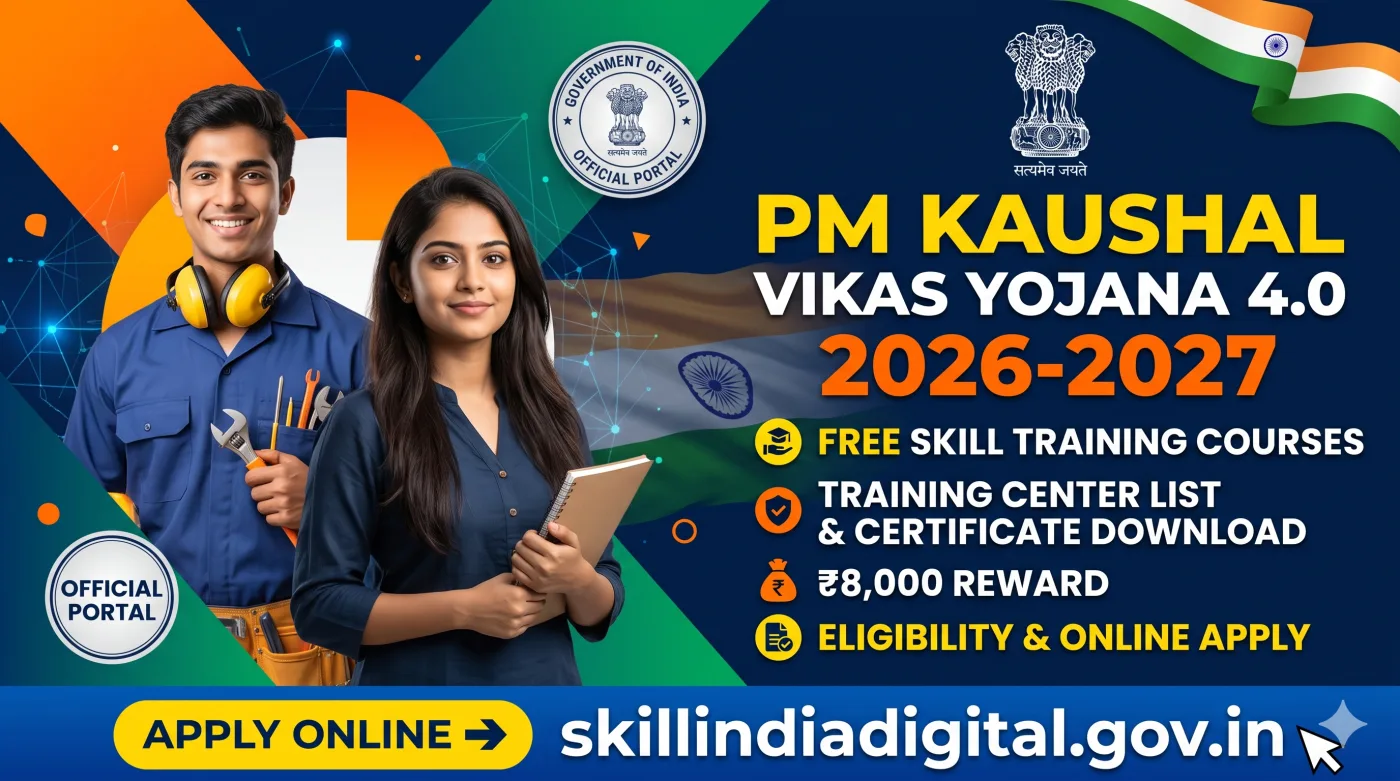
1. Executive Overview & Strategic National Vision (योजना का विज़न एवं राष्ट्रीय परिप्रेक्ष्य)
The PM Kaushal Vikas Yojana 4.0 (PMKVY 4.0) stands as a monumental flagship welfare pillar under the Government of India's overarching vision of a self-reliant, inclusive, and technologically empowered nation (Viksit Bharat @ 2047). Engineered to provide direct socio-economic equity, this transformative central initiative dismantles generational barriers, equipping citizens with robust state-backed resources, financial security, and unprecedented life opportunities.
भारत सरकार के Ministry of Skill Development & Entrepreneurship (MSDE) / NSDC द्वारा संचालित प्रधानमंत्री कौशल विकास योजना 4.0 (PMKVY 4.0) का मूल दर्शन समाज के प्रत्येक पंक्ति के अंतिम व्यक्ति (Antyodaya) तक सरकारी संसाधनों का पारदर्शी और सम्मानजनक लाभ सुनिश्चित करना है। यह योजना आधुनिक तकनीक, बायोमेट्रिक प्रमाणीकरण और प्रत्यक्ष लाभ अंतरण (DBT) के समन्वय से एक पारदर्शी व्यवस्था का निर्माण करती है।
Administered with strict operational rigor, the scheme converges with the official national portal at skillindiadigital.gov.in to offer paperless workflows, automated eligibility tracking, and accountable public service delivery across all 36 States and Union Territories.
| Core Parameter / घटक | Official Specification / आधिकारिक विवरण |
|---|---|
| Scheme Name / योजना का नाम | PM Kaushal Vikas Yojana 4.0 (PMKVY 4.0) (प्रधानमंत्री कौशल विकास योजना 4.0 (PMKVY 4.0)) |
| Nodal Ministry / नोडल मंत्रालय | Ministry of Skill Development & Entrepreneurship (MSDE) / NSDC |
| Primary Beneficiary Target / लक्षित वर्ग | Millions of Indian Youth seeking Industry 4.0 & Futuristic Vocational Skills |
| Financial Entitlement / वित्तीय लाभ | Free Industry-Aligned Training + ₹8,000 Reward + Government NSDC Skill Certificate |
| Eligible Age Criteria / पात्रता आयु सीमा | 15 to 45 Years (Youth, Dropouts, Job Seekers, Apprentices) |
| Application Mode / आवेदन का माध्यम | Online Central Portal & Pan-India Facilitation Network |
| Official Portal / आधिकारिक वेब पोर्टल | skillindiadigital.gov.in |
| National Toll-Free Helpline / हेल्पलाइन | 088000-55555 / 1800-123-9626 |
2. Financial Benefits, Grant Architecture & Outlay Slabs (वित्तीय लाभ एवं अनुदान विवरण)
The financial architecture of PM Kaushal Vikas Yojana 4.0 (PMKVY 4.0) is designed to offer maximum tangible relief and direct economic empowerment. Unlike traditional bureaucratic schemes with delayed fund releases, this program operates with stringent electronic transfer protocols, ensuring that funds are deposited directly into the beneficiary’s verified bank account without intermediary cuts.
इस योजना के तहत वित्तीय लाभ संरचना को अत्यंत सरल, पारदर्शी और सीधा बनाया गया है। (Under this scheme, the financial benefit structure is transparent, robust, and directly credited):
- Direct Benefit Transfer (प्रत्यक्ष लाभ अंतरण): Central fiscal contributions are credited directly into the Aadhaar-seeded bank account through the PFMS gateway, eliminating delays and human discretion.
- Sustained Economic Cushion (आर्थिक संबल): Entitlements under Free Industry-Aligned Training + ₹8,000 Reward + Government NSDC Skill Certificate provide families with crucial liquid support, preventing distress and fostering self-reliance.
- Zero Deductions Policy (शून्य कटौती गारंटी): No processing fees, service charges, or commission deductions are permissible at any level. Every single rupee sanctioned reaches the citizen.
- Institutional Accountability (संस्थागत जवाबदेही): Real-time SMS notifications and digital transaction UTR numbers are generated for every transaction, allowing instant tracking.
3. Comprehensive Beneficiary Eligibility Criteria (पात्रता एवं लाभार्थी चयन मानदंड)
To ensure that the benefits reach genuinely deserving citizens, the Ministry of Skill Development & Entrepreneurship (MSDE) / NSDC has notified clear, objective, and non-discriminatory eligibility criteria. Every applicant must satisfy the following fundamental parameters before initiating their registration:
- Citizenship & Residency (नागरिकता एवं निवास): The applicant must be a bona fide citizen of the Republic of India residing in any State or Union Territory.
- Prescribed Age Threshold (निर्धारित आयु सीमा): The beneficiary must fall strictly within the notified age group of 15 to 45 Years (Youth, Dropouts, Job Seekers, Apprentices) on the date of enrollment.
- Individual Banking Access (व्यक्तिगत सक्रिय बैंक खाता): The applicant must possess an active individual savings bank account in any commercial bank, Regional Rural Bank (RRB), or Post Office Payments Bank (IPPB).
- Aadhaar Identification Mandate (अनिवार्य आधार प्रमाणीकरण): A valid Aadhaar number linked with an operational mobile number is mandatory for biometric or OTP-based e-KYC.
- Socio-Economic Fit (सामाजिक-आर्थिक पात्रता): The applicant must satisfy the specific domain requirements designated for AI & Machine Learning, Robotics, Drones, IoT, Green Jobs, Solar Energy, Healthcare, Automotive.
4. Who is Ineligible? Negative Exclusion Criteria (अपात्रता एवं अपवर्जन शर्तें)
To prevent fraudulent claims, duplication, and misuse of public funds, the central operational guidelines enforce strict negative exclusion criteria. Any individual falling under the following categories is disqualified from availing benefits under PM Kaushal Vikas Yojana 4.0 (PMKVY 4.0):
- ❌ Age Ineligibility (आयु सीमा से बाहर): Individuals below the minimum age or exceeding the maximum prescribed ceiling are automatically rejected by the automated validation engine.
- ❌ Institutional Disqualification (संस्थागत अपात्रता): Claimants who have previously been blacklisted, defaulted on government credit facilities, or submitted fabricated certificates are barred.
- ❌ Duplicate Enrollments (दोहरा पंजीकरण निषेध): Attempting multiple registrations using different identity proofs or bank accounts is strictly blocked through Aadhaar de-duplication algorithms.
- ❌ Failure of Biometric Authentication (ई-केवाईसी विफलता): Accounts that fail automated demographic or biometric matching with the UIDAI database cannot be processed for fund disbursement.
5. Mandatory Document Checklist (आवश्यक दस्तावेज़ एवं पहचान पत्र सूची)
Applicants must organize and verify their documents prior to initiating the registration process. All digital uploads must be clear, legible, and match the applicant's official records perfectly:
| Document Type / दस्तावेज़ का नाम | Permissible Format / प्रारूप | Key Requirements & Guidelines / मुख्य शर्तें |
|---|---|---|
| Aadhaar Card (आधार कार्ड) | PDF / JPG (Max 200 KB) | Must have correct Name, Date of Birth, and mobile number linked for OTP validation. |
| Bank Account Passbook / Statement (बैंक पासबुक) | PDF / Clear Scan | Must clearly display Account Number, Account Holder Name, Bank Branch, and IFSC Code. Must be NPCI seeded. |
| Proof of Age & Educational Qualifications | PDF / DigiLocker Pull | 10th Certificate, School Leaving Certificate, or Degree Marksheet validating official age. |
| Identity & Address Proof (पहचान एवं निवास प्रमाण) | Voter ID / Domicile / Aadhaar | Permanent residential address within Indian territory. |
| Recent Passport Size Photograph | JPG / PNG (50 to 100 KB) | Front-facing, clear background photograph taken within the last 6 months. |
| Category / Caste Certificate (यदि लागू हो) | PDF (State Issued) | SC, ST, OBC (Non-Creamy Layer), or EWS certificate issued by a competent revenue authority (Tahsildar/SDM). |
6. Step-by-Step Online Application Walkthrough (ऑनलाइन आवेदन एवं पोर्टल पंजीकरण प्रक्रिया)
The online application protocol for PM Kaushal Vikas Yojana 4.0 (PMKVY 4.0) has been engineered to be smooth, user-friendly, and accessible via smartphones, tablets, or computers. Follow this detailed procedural walkthrough to submit your application without errors:
- Step 1 - Access the Official Portal: Open your web browser and navigate directly to the official platform at skillindiadigital.gov.in. Beware of fraudulent clone websites with .com or .org domains.
- Step 2 - New Candidate Registration: Click on the prominent "New Registration / Apply Online" button on the homepage banner.
- Step 3 - Mobile & Aadhaar OTP Verification: Enter your 10-digit active mobile number and 12-digit Aadhaar number. Complete the two-factor authentication (2FA) by submitting the One-Time Passwords received via SMS.
- Step 4 - Complete Demographic Profile: Fill in personal details including Full Name, Father's/Spouse's Name, Gender, Date of Birth, Category, and Permanent Address. Verify that spelling matches your Aadhaar Card exactly.
- Step 5 - Enter Bank Account Particulars: Provide your Savings Bank Account Number, Re-enter to confirm, and enter the Branch IFSC Code. The system will auto-populate Bank Name and Branch Address.
- Step 6 - Upload Verified Documents: Upload clean digital scans of your photograph, signature, bank passbook, and educational/category certificates within the prescribed file size limits.
- Step 7 - Review & Submit Dossier: Thoroughly review the preview screen. Ensure no spelling errors or incorrect bank digits exist. Accept the statutory self-declaration checkbox and click "Final Submit".
- Step 8 - Download Acknowledgment Receipt: Print and save the system-generated Application Form containing your unique Registration Number / Application ID for future tracking and verification.
7. Offline Application, CSC Kendra & Banking Point Route (ऑफ़लाइन एवं नागरिक सेवा केंद्र प्रक्रिया)
For rural applicants, senior citizens, and citizens with limited digital literacy or poor internet connectivity, comprehensive offline and assisted registration channels are fully operational nationwide:
- Common Service Centers (CSC / VLE): Citizens can visit their nearest Village Level Entrepreneur (VLE) at a local CSC center. VLEs assist with biometrics, document scanning, and application submission on the official portal at government-capped nominal service charges.
- Bank Branches & Customer Service Points (CSP / Bank Mitra): All nationalized public sector banks, Regional Rural Banks (Gramin Banks), and Business Correspondents provide physical registration forms and instant biometric enrollment via micro-ATMs.
- India Post Payments Bank (IPPB) & Post Offices: Grameen Dak Sevaks (GDS) and local Post Office branches provide doorstep assisted enrollment using handheld biometric terminals.
- Block & Panchayat Help Desks: Block Development Offices (BDO) and Gram Panchayat Secretariats maintain dedicated facilitation counters with physical forms and operational guidance.
8. Aadhaar Authentication, e-KYC & Mobile Linking Rules (आधार ई-केवाईसी एवं बायोमेट्रिक सत्यापन)
Aadhaar-based electronic Know Your Customer (e-KYC) is the technological backbone of central welfare governance under PM Kaushal Vikas Yojana 4.0 (PMKVY 4.0). Adherence to the following e-KYC standards is mandatory to avoid application rejection:
आधार ई-केवाईसी प्रक्रिया को समय पर पूरा करना अनिवार्य है। (Timely completion of Aadhaar e-KYC is non-negotiable):
- Demographic Consistency (नाम व जन्मतिथि समानता): The applicant's name, gender, and date of birth in bank passbooks and academic records must correspond exactly with the UIDAI Aadhaar database. Minor discrepancies in spelling lead to automated rejection by the PFMS validator.
- Active Mobile Linking (सक्रिय मोबाइल नंबर जुड़ाव): The mobile number linked to Aadhaar must remain active to receive critical OTPs, payment alerts, and verification notifications.
- Biometric Refresh (बायोमेट्रिक अपडेशन): In case fingerprint biometrics fail at Fair Price Shops, CSCs, or bank counters, applicants should visit an Aadhaar Seva Kendra to update their fingerprints and iris scans.
- Face Authentication Technology: Many modern portals now integrate UIDAI FaceRD apps, allowing applicants to complete e-KYC directly through smartphone camera scans without physical fingerprint scanners.
9. Direct Benefit Transfer (DBT), PFMS & NPCI Mapping Verification (डीबीटी बैंक सीडिंग एवं एनपीसीआई मैपिंग)
A frequent stumbling block for welfare beneficiaries across India is the confusion between a simple bank account and an NPCI Aadhaar-Seeded DBT Account. Merely linking Aadhaar for KYC does NOT automatically enable an account for government DBT transfers.
Follow these essential protocols to verify your NPCI Aadhaar Mapping status:
- Understanding NPCI Mapping: The National Payments Corporation of India (NPCI) maintains a central mapper database where one primary bank account per citizen is designated as the active recipient for all Central and State government subsidies via the Aadhaar Payment Bridge (APB) system.
- Online Status Verification: Visit the official UIDAI portal (myaadhaar.uidai.gov.in) or your bank's net-banking portal and navigate to "Bank Seeding Status". Check whether your account displays as "Active" and mapped.
- Mandatory Branch Visit for Inactive Mapping: If your status shows "Inactive" or "Not Seeded", immediately visit your home bank branch, submit the standard "Aadhaar DBT Seeding & Mandate Consent Form", and request the bank clerk to flag your account on the NPCI mapper.
- Resolve Dormant Account Blocks: Ensure your bank account has seen at least one credit or debit transaction in the last 6 months to prevent the account from slipping into "Inoperative / Dormant" status, which automatically rejects government DBT credits.
10. Beneficiary Status Check & Payment Tracking Guide (लाभार्थी स्थिति एवं भुगतान ट्रैकिंग)
Once registered, applicants can track their application validation, nodal approvals, and payment disbursement status online 24/7 without visiting government offices:
- Portal Dashboard Tracking: Log in to skillindiadigital.gov.in using your registered credentials. Your dashboard will display milestones: Application Submitted > Document Verified > Sanction Order Generated > Payment Disbursed.
- PFMS Public Tracking: Visit the Public Financial Management System portal at pfms.nic.in. Click on "Know Your Payments" or "Track DBT Details", enter your Bank Name and Account Number (or Application ID), and view exact FTO numbers, credit dates, and UTR transaction codes.
- Bank Passbook & SMS Intimation: Real-time SMS alerts are dispatched by the National Informatics Centre (NIC) and your bank immediately upon fund transfer. Regularly update your physical passbook or check mobile banking statements.
11. Comprehensive Comparative Analysis with Other Welfare Schemes (योजना का तुलनात्मक विश्लेषण)
To provide clear context on where PM Kaushal Vikas Yojana 4.0 (PMKVY 4.0) stands in the national social security framework, the following analytical matrix compares it against related government initiatives:
| Evaluation Parameter | PM Kaushal Vikas Yojana 4.0 (PMKVY 4.0) | Standard Commercial / State Alternative |
|---|---|---|
| Target Focus Area | Empowerment in AI & Machine Learning, Robotics, Drones, IoT, Green Jobs, Solar Energy, Healthcare, Automotive | Fragmented, localized, or commercially priced alternatives |
| Beneficiary Cost / Premium | Zero Cost or Heavily Subsidized Government Slabs | High market premiums, brokerage cuts, and service charges |
| Disbursement Mechanism | 100% Aadhaar-based Direct Benefit Transfer (DBT) | Cheque clearing, manual voucher approvals, or physical disbursal |
| Interstate Portability | Seamless Nationwide Portability across all 36 States/UTs | Often restricted to single district or state jurisdiction |
| Grievance Escalation | Integrated Central CPGRAMS & National Nodal Officers | Complex consumer dispute mechanisms with protracted delays |
12. Common Application Errors, Rejection Reasons & Fixes (त्रुटियाँ एवं समाधान गाइड)
Analysis of rejected applications reveals several recurring, avoidable candidate mistakes. Review this diagnostic troubleshooting guide to safeguard your application:
- ⚠️ Discrepancy in Name or Date of Birth: Even minor spelling variations (e.g., "Rakesh Kumar" vs "Rakesh Kr") trigger automatic rejection. Solution: Ensure your name on the educational marksheet, Aadhaar card, and bank passbook are 100% harmonized before applying.
- ⚠️ Unseeded / Non-NPCI Bank Accounts: Many applicants submit basic bank details without enabling Aadhaar DBT mapping. Solution: Submit the Aadhaar seeding consent form at your bank and verify on UIDAI before applying.
- ⚠️ Blurry or Truncated Document Scans: Uploading low-resolution, cut-off, or illegible photos of certificates leads to scrutiny rejection. Solution: Use a flatbed scanner or high-resolution document scanner app in a well-lit environment; maintain file size between 100 KB and 200 KB in clear PDF format.
- ⚠️ Wrong Bank IFSC Codes: Following bank mergers (e.g., Syndicate Bank into Canara Bank, Allahabad Bank into Indian Bank), old IFSC codes are invalid. Solution: Use the latest active IFSC code printed on your newly issued passbook or cheque book.
- ⚠️ Applying Through Fake Third-Party Websites: Scam websites impersonate government portals to steal sensitive data or charge unauthorized fees. Solution: Always check that the URL ends in .gov.in or .nic.in.
13. Grievance Redressal Mechanism & CPGRAMS Escalation (शिकायत निवारण एवं कानूनी प्रावधान)
The Government of India guarantees every citizen the right to prompt grievance resolution under the Citizen's Charter. If your application is unduly delayed, wrongfully rejected, or benefits are blocked, follow this time-tested escalation ladder:
- Level 1 - Scheme Helpdesk Ticket: Raise an online support ticket directly on skillindiadigital.gov.in with your Registration ID, attaching screenshot proofs of the issue. A resolution timeline of 7 working days is mandated.
- Level 2 - District Nodal Officer: Approach the District Nodal Officer or Lead District Manager (LDM) in your District Collectorate. Submit a formal written representation with application receipts.
- Level 3 - Centralized Public Grievance Redress and Monitoring System (CPGRAMS): File a high-priority grievance online at pgportal.gov.in under the Ministry of Skill Development & Entrepreneurship (MSDE) / NSDC. CPGRAMS complaints are monitored at the Joint Secretary and Prime Minister's Office (PMO) levels, compelling action within 30 days.
- Level 4 - National Consumer / Banking Ombudsman: For banking disputes involving rejected DBT credits or unauthorized deductions, file an online complaint with the Reserve Bank of India (RBI) Ombudsman at cms.rbi.org.in.
14. District & Block Level Administrative Hierarchy (प्रशासनिक संरचना एवं निगरानी तंत्र)
The effective on-ground execution of PM Kaushal Vikas Yojana 4.0 (PMKVY 4.0) is maintained through a structured, multi-tier administrative governance hierarchy ensuring strict quality control and continuous field oversight:
- National Steering Committee (राष्ट्रीय संचालन समिति): Chaired by the Secretary of the Ministry of Skill Development & Entrepreneurship (MSDE) / NSDC, responsible for national policy formulation, budgetary sanctions, and macro performance audits.
- State Level Executive Committee (राज्य स्तरीय कार्यकारी समिति): Headed by the State Chief Secretary or Principal Secretary, ensuring inter-departmental convergence and state-wide infrastructure readiness.
- District Level Monitoring Committee (जिला स्तरीय निगरानी समिति): Chaired by the District Magistrate (DM) / District Collector, actively reviewing block-wise saturation, bank branch compliance, and disposal of citizen grievances.
- Block & Village Implementation Units (प्रखण्ड एवं ग्राम पंचायत स्तर): Block Development Officers (BDO), Panchayat Secretaries, and frontline workers who conduct grassroots outreach, mobilization camps, and physical verifications.
15. Official Helpline Directory, Email Support & State Nodal Desks (आधिकारिक हेल्पलाइन एवं संपर्क विवरण)
For authentic guidance, policy clarifications, and real-time operational assistance, citizens must reach out exclusively to the official communication channels listed below:
| Support Channel / संपर्क माध्यम | Contact Details / संपर्क विवरण | Working Hours / कार्य समय |
|---|---|---|
| National Toll-Free Helpline | 088000-55555 / 1800-123-9626 | 24x7 Multi-lingual IVR & Agent Support |
| Official Portal Helpdesk | skillindiadigital.gov.in | 24x7 Web Ticket Lodgement & Tracking |
| Nodal Ministry Headquarters | Ministry of Skill Development & Entrepreneurship (MSDE) / NSDC, New Delhi - 110001 | Monday to Friday, 9:30 AM to 6:00 PM |
| CPGRAMS Grievance Portal | pgportal.gov.in | Online Central Escalation Portal |
| PFMS Payment Helpdesk | helpdesk-pfms@gov.in | 1800-118-111 | DBT Credit & Transaction Status Assistance |
16. Socio-Economic Impact & Long-Term National Transformation (सामाजिक-आर्थिक प्रभाव एवं सफलता विश्लेषण)
The macroeconomic and grassroots impact of PM Kaushal Vikas Yojana 4.0 (PMKVY 4.0) has reshaped India's socio-economic landscape. By extending institutional coverage to historically underserved communities, the initiative has systematically bridged the gap between marginalized populations and modern financial architecture.
यह योजना केवल एक कल्याणकारी कार्यक्रम नहीं है, अपितु आत्मनिर्भर भारत के निर्माण की दिशा में एक युगांतरकारी कदम है। (This scheme is not merely a welfare initiative, but an epoch-making milestone towards building a Self-Reliant India):
- Financial Deepening & Formalization: Bringing unbanked and informal workers into the formal banking grid has vastly expanded credit availability, micro-savings, and capital formation.
- Poverty Alleviation & Safety Nets: Sudden life contingencies, health crises, or crop failures no longer push families into predatory debt cycles, preserving generational wealth.
- Women Empowerment: With mandatory representation and preferential enrollment for women, the scheme promotes financial autonomy and household decision-making power for female citizens.
- Digital Literacy Explosion: Hands-on usage of mobile banking, biometric terminals, and online dashboards has transformed digital literacy across semi-urban and rural heartlands.
17. Statutory Social Audit, Vigilance Norms & Anti-Fraud Protocols (सामाजिक अंकेक्षण एवं सतर्कता तंत्र)
To preserve absolute institutional integrity, PM Kaushal Vikas Yojana 4.0 (PMKVY 4.0) incorporates comprehensive vigilance frameworks, third-party social audits, and AI-driven anti-fraud monitoring mechanisms:
- Mandatory Social Audits: Gram Sabhas and urban local bodies conduct periodic open social audit meetings where beneficiary lists and disbursed amounts are read publicly to identify ghost accounts.
- AI-Driven Anomaly Detection: The central portal uses automated machine learning algorithms to spot suspicious clusters of registrations originating from identical IP addresses or suspicious banking patterns.
- Penalties for Misrepresentation: Claimants who submit forged income, caste, or identity certificates face immediate cancellation of benefits, recovery of disbursed funds with penal interest under the Revenue Recovery Act, and criminal prosecution under Sections 420 and 468 of the Indian Penal Code (IPC).
- Whistleblower Protection: Citizens can report corruption, bribery demands, or unauthorized dealer cuts through the central vigilance portal with full anonymity protection.
18. Special Provisions for Women, Divyangjan & Marginalized Sections (विशेष वर्गों हेतु कल्याणकारी प्रावधान)
Social justice lies at the very heart of PM Kaushal Vikas Yojana 4.0 (PMKVY 4.0). The operational design includes tailored interventions, dedicated quotas, and relaxations for historically disadvantaged communities:
- Affirmative Inclusivity: Dedicated percentage allocations and prioritized processing for Scheduled Castes (SC), Scheduled Tribes (ST), Other Backward Classes (OBC), and Economically Weaker Sections (EWS).
- Women-Centric Incentives: Special fee waivers, higher subsidy ceilings, and doorstep facilitation counters for female heads of households and women self-help groups (SHGs).
- Empowerment of Divyangjan (PwD): Accessible wheelchair-friendly enrollment camps, barrier-free digital portals adhering to WCAG 2.1 accessibility standards, and simplified proxy authentication for individuals with severe locomotive disabilities.
- Aspirational Districts Priority: Accelerated saturation drives across 112 Aspirational Districts designated by NITI Aayog to eliminate regional development backlogs.
19. Technology Infrastructure, Security Protocols & Data Privacy (सुरक्षा एवं डेटा गोपनीयता मानक)
Given the massive volume of citizen biometric, banking, and demographic data processed, the technical architecture of PM Kaushal Vikas Yojana 4.0 (PMKVY 4.0) adheres to stringent cybersecurity standards:
- MeitY & CERT-In Compliance: The web platforms and application servers are hosted in secure Tier-4 National Data Centres managed by the National Informatics Centre (NIC) and audited regularly by CERT-In empaneled security agencies.
- End-to-End Encryption: All data transmitted between client browsers, micro-ATMs, and central servers is encrypted using 256-bit TLS/SSL encryption, preventing man-in-the-middle attacks and data tampering.
- Aadhaar Data Vault Architecture: In strict compliance with UIDAI regulations, raw Aadhaar numbers are never stored in plain text. Secure, encrypted Aadhaar Data Vaults generate tokenized Reference Keys for backend processing.
- Consent-Driven Data Governance: Citizen data is strictly processed on an explicit consent-driven architecture, strictly barring the sale, unauthorized sharing, or commercial exploitation of citizen profiles.
20. Future Roadmap, Policy Evolution & Strategic Recommendations (भविष्य की रूपरेखा एवं रणनीतिक सलाह)
As India advances steadily towards becoming a developed nation (Viksit Bharat @ 2047), PM Kaushal Vikas Yojana 4.0 (PMKVY 4.0) continues to evolve with dynamic policy upgrades, expanded budget allocations, and deeper technological integration.
भावी योजनाओं में एआई-आधारित ऑटोमेटेड अप्रूवल, व्यापक कवरेज और नागरिकों के लिए निर्बाध सिंगल-विंडो लाइफटाइम सोशल सिक्योरिटी नेट का निर्माण शामिल है। (Future roadmaps aim for AI-powered automated approvals, deeper saturation, and seamless single-window social protection):
- Proactive Saturation Drives: Transitioning from application-based models to proactive automated entitlement identification using integrated socio-economic databases.
- Cross-Scheme Interoperability: Creating unified social registries where enrollment in one flagship scheme automatically qualifies and notifies citizens for complementary welfare protections.
- Strategic Citizen Advice: Every eligible citizen is strongly urged to verify their Aadhaar bank seeding immediately, keep documentation updated, and apply early to unlock their full constitutional and statutory welfare rights under this transformative national initiative.
21. Comprehensive State-by-State Implementation & Regional Convergence (राज्य-वार क्रियान्वयन एवं क्षेत्रीय पहल)
The national execution of PM Kaushal Vikas Yojana 4.0 (PMKVY 4.0) functions through an intricate framework of federal convergence between the Union Government and all 28 States and 8 Union Territories. While the overarching policy design, financial guarantees, and central digital backbones are governed directly from New Delhi, field execution depends upon robust coordination with state administrative machineries, district secretariats, and local bodies.
प्रत्येक राज्य की भौगोलिक, सामाजिक और आर्थिक परिस्थितियाँ भिन्न होती हैं, इसलिए केंद्र सरकार ने इस योजना में क्षेत्रीय अनुकूलन (Regional Customization) की पर्याप्त व्यवस्था की है। (Because geographic and socio-economic dynamics vary across states, the scheme provides adaptable regional customization):
- High-Density Rural States (Uttar Pradesh, Bihar, Madhya Pradesh, Rajasthan): In densely populated states with vast rural agrarian workforces, special saturation camps (संतृप्ति अभियान) are organized at the Gram Panchayat level. District Magistrates deploy mobile vans and banking correspondents to ensure that unreached hamlets achieve 100% enrollment coverage.
- Western & Southern Industrial Hubs (Maharashtra, Gujarat, Tamil Nadu, Karnataka): In economically advanced and industrialized states, integration with organized corporate supply chains, MSME clusters, and urban local bodies (ULBs) is prioritized, maximizing private sector partnerships and high-speed electronic clearances.
- Himalayan & North-Eastern States (Uttarakhand, Himachal Pradesh, Assam, Meghalaya, Tripura): Recognizing challenging mountainous terrains and scattered hamlets, the Central Government extends special relaxations, including higher central funding ratios (often 90:10 instead of 60:40), extended offline grace periods, and dedicated VSAT satellite connectivity at block offices.
- Urban Megacities & Metropolitan Municipalities (Delhi NCR, Mumbai, Kolkata, Bengaluru): Dedicated digital kiosks and single-window citizen facilitation centers operate across municipal zones, targeting migrant laborers, daily wage earners, and unorganized service workers.
22. Banking Operations, Mandate Registration & Clearing Cycle Architecture (बैंकिंग संचालन एवं क्लीयरिंग तंत्र)
The institutional success of PM Kaushal Vikas Yojana 4.0 (PMKVY 4.0) rests heavily on the seamless execution of inter-bank electronic clearing protocols. In the modern Direct Benefit Transfer (DBT) era, the life cycle of every financial transaction is mapped through the automated clearing architecture established by the Reserve Bank of India (RBI) and National Payments Corporation of India (NPCI).
बैंकों और वित्तीय संस्थानों द्वारा अपनाए जाने वाले तकनीकी संचालन नियम अत्यंत सख्त हैं। (The technical operational protocols followed by banks are exceptionally rigorous):
- Electronic Mandate Registration (ई-मेंडेट पंजीकरण): When an applicant provides consent for automated transfers or periodic debit instructions, the originating bank branch creates an Electronic Mandate (e-Mandate) in its Core Banking Solution (CBS). This mandate is assigned a unique Mandate Reference Number (UMRN).
- National Automated Clearing House (NACH) Processing: For schemes involving auto-debit of insurance premiums or recurring contributions, transactions are routed through NACH. Bulk clearing files are processed in automated clearing cycles, ensuring that deductions happen precisely within the notified annual window.
- Aadhaar Payment Bridge System (APBS) Clearing: For government grant disbursements, the central ministry initiates payment batches through the Public Financial Management System (PFMS). PFMS validates the beneficiary records against the NPCI mapper, generating an electronic Fund Transfer Order (FTO). Funds are instantaneously credited to the beneficiary's mapped account via APBS.
- Failed Transaction Reconciliation (असफल लेन-देन समाधान): If a transaction fails due to account dormancy, incorrect IFSC, or customer block, automated error response codes (such as "Account Closed", "Invalid Aadhaar Mapping", or "Frozen by Law Enforcement") are fed back to the administrative portal within 24 hours for automated alert dispatch.
23. Citizen Case Studies, Field Troubleshooting Scenarios & Edge Cases (वास्तविक केस स्टडीज एवं ज़मीनी समस्याएँ)
To provide actionable insights for applicants, field workers, and administrators, the following real-world scenarios illustrate how common operational bottlenecks are diagnosed and resolved under PM Kaushal Vikas Yojana 4.0 (PMKVY 4.0):
| Scenario / स्थिति | Underlying Technical Issue / समस्या | Standard Operating Procedure / समाधान |
|---|---|---|
| Name Spelling Mismatch (e.g., Aadhaar has "Suresh Prasad" but Bank Passbook has "Suresh P.") |
Automated PFMS and NPCI de-duplication engines flag the record as a demographic mismatch, rejecting electronic fund transfer. | The applicant must visit the home bank branch with their original Aadhaar Card and submit a written KYC Correction Form to update their bank account name to match Aadhaar exactly. |
| Mobile Number Lost or Inactive (Applicant unable to receive OTPs during login or renewal) |
Two-factor authentication (2FA) fails, blocking access to applicant dashboard and preventing annual renewal or claim filing. | Visit any authorized Aadhaar Seva Kendra or post office counter to update the linked mobile number in UIDAI records, which syncs with the central portal within 48 hours. |
| Dormant Account Return Error (FTO generated by Ministry but rejected by receiving bank) |
Bank account has not seen customer-induced credit or debit transactions for more than 6 months, activating automatic RBI dormancy freeze. | The beneficiary must visit their bank branch, deposit a small cash amount (e.g., ₹50 or ₹100), and perform a biometric or debit card transaction to immediately re-activate the account. |
| Multiple Bank Accounts Seeded (Beneficiary expecting funds in SBI but money credited to BoB) |
Government DBT automatically routes funds to the LAST bank account mapped with NPCI, regardless of which account was written on the application form. | Check active bank mapping on myaadhaar.uidai.gov.in. If the beneficiary desires funds in a specific bank, submit a fresh "Aadhaar Seeding and DBT Mandate Form" at that preferred bank. |
24. Legal Framework, Statutory Protections & Constitutional Alignment (कानूनी रूपरेखा एवं संवैधानिक परिप्रेक्ष्य)
The institutional foundation of PM Kaushal Vikas Yojana 4.0 (PMKVY 4.0) is anchored firmly within the constitutional jurisprudence of India, specifically embodying the Directive Principles of State Policy enshrined in Part IV of the Constitution of India. By guaranteeing fundamental social protections, the scheme fulfills constitutional obligations under Article 38 (promoting the welfare of the people), Article 39A (equal justice and free legal aid), and Article 41 (right to work, education, and public assistance in cases of unemployment, old age, sickness, and disablement).
इस योजना को विभिन्न वैधानिक अधिनियमों के तहत कानूनी संरक्षण प्राप्त है। (The scheme enjoys robust statutory protection under key parliamentary acts):
- Aadhaar (Targeted Delivery of Financial and Other Subsidies, Benefits and Services) Act, 2016: Section 7 of the Aadhaar Act empowers the Central Government to mandate Aadhaar authentication as an authentic proof of identity for receiving subsidies, benefits, or services funded from the Consolidated Fund of India.
- Information Technology Act, 2000 (and 2008 Amendment): Electronic application forms, digital signatures, electronic receipts, and OTP-based authentications are recognized as legally valid instruments under Sections 4, 5, and 10A of the IT Act.
- Digital Personal Data Protection (DPDP) Act, 2023: Mandates strict data minimization, purpose limitation, and storage limitation. Any unauthorized commercial exploitation, leaking, or hacking of citizen databases attracts severe financial penalties up to ₹250 Crore on errant data fiduciaries.
- Public Demands Recovery Act: Protects public exchequer funds by authorizing district collectors to recover fraudulently claimed benefits as arrears of land revenue from individuals submitting forged or deceptive declarations.
25. Master Readiness Checklist, Final Advisory & Strategic Recommendations (मास्टर चेकलिस्ट एवं अंतिम नागरिक परामर्श)
To conclude this comprehensive master guide, every aspiring beneficiary, guardian, and field worker is strongly advised to review the following master readiness checklist before initiating their application for PM Kaushal Vikas Yojana 4.0 (PMKVY 4.0):
| Checklist Item / जाँच बिंदु | Target Condition / अपेक्षित मानक | Verification Status |
|---|---|---|
| Aadhaar Demographic Match | Name, Father's Name, and Date of Birth identical across all documents | [ ] Ready / Verified |
| Active Mobile Linked to Aadhaar | Operational SIM card capable of receiving SMS OTPs instantaneously | [ ] Ready / Verified |
| NPCI Aadhaar-Seeded Bank Account | Single individual savings account active on NPCI DBT mapper database | [ ] Ready / Verified |
| Legible Document Scans | Clean PDF/JPG files within 100 to 200 KB size without blurred text | [ ] Ready / Verified |
| Official Portal Access Verification | Browsing directly on official government domain: .gov.in / .nic.in | [ ] Ready / Verified |
| Nominee Details Recorded | Correct nominee name, relationship, age, and bank particulars filed | [ ] Ready / Verified |
अंतिम नागरिक परामर्श (Final Citizen Advisory): प्रधानमंत्री कौशल विकास योजना 4.0 (PMKVY 4.0) देश के आम नागरिकों के सशक्तिकरण और सामाजिक उत्थान के लिए एक अभूतपूर्व अवसर है। समय पर सही जानकारी, दस्तावेज़ों की पूर्व-जाँच और आधिकारिक पोर्टल के माध्यम से किया गया आवेदन आपको बिना किसी परेशानी के योजना का पूरा लाभ दिलाएगा। किसी भी बिचौलिए या अनधिकृत व्यक्ति के झांसे में न आएं और किसी भी प्रकार की शंका होने पर सीधे आधिकारिक राष्ट्रीय हेल्पलाइन पर संपर्क करें।
User Discussion & Comments (0)
No comments yet. Be the first to leave a comment below!
Leave a Comment / Ask a Question: