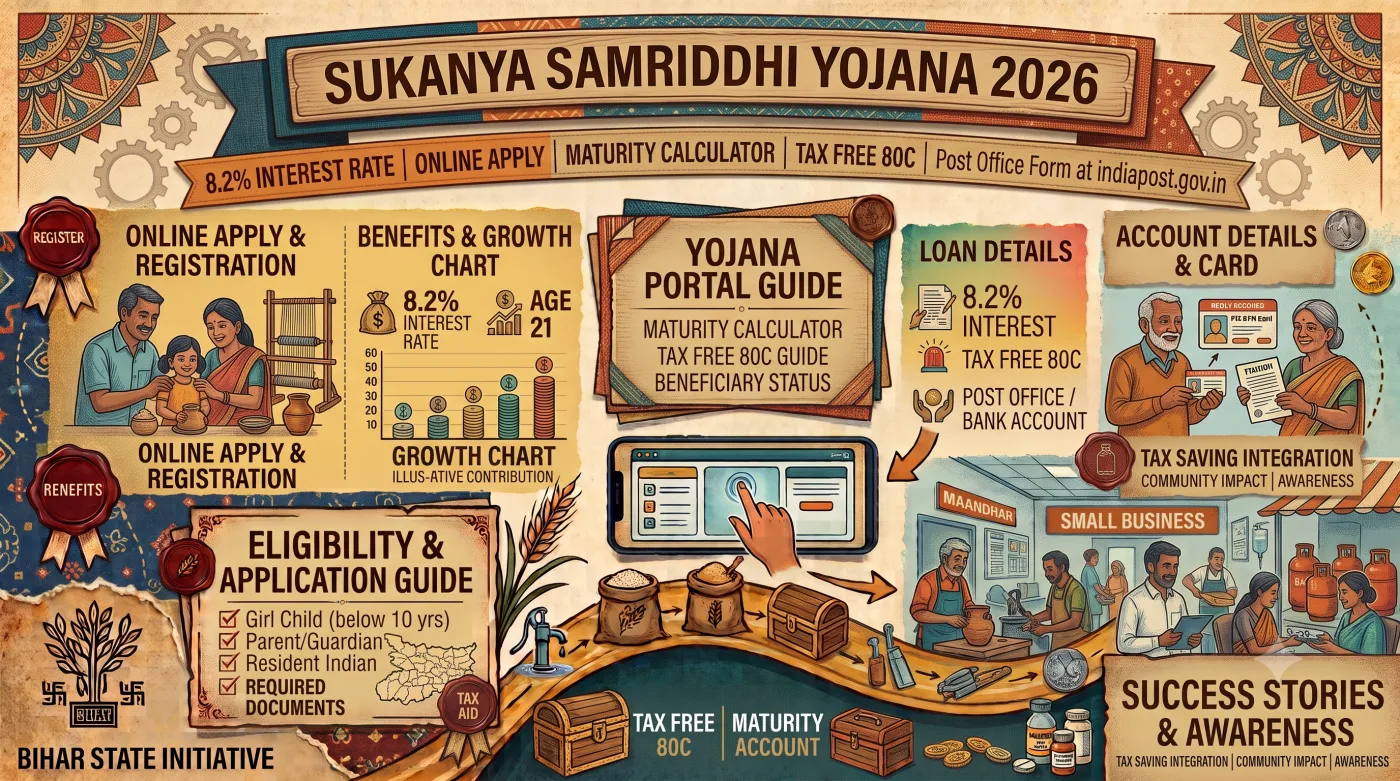
Introduction: Guaranteeing Golden Prosperity for India’s Daughters
The Sukanya Samriddhi Yojana (SSY 2026) represents the premier sovereign financial instrument conceived under the visionary "Beti Bachao, Beti Padhao" (बेटी बचाओ, बेटी पढ़ाओ) national mission spearheaded by the Government of India. Administered by the Department of Economic Affairs, Ministry of Finance, and operationalized across the vast national network of the Department of Posts (India Post) and all authorized public and private commercial banks, this small savings scheme was established with a profound, gender-transformative objective: permanently eliminating the financial anxiety surrounding a girl child’s higher collegiate education, medical aspirations, and dignified matrimonial expenses.
Historically, deeply entrenched patriarchal prejudices and fears of exorbitant future dowry and marriage costs frequently led families to treat the birth of a female infant as a financial liability, resulting in female feticide, high school dropouts, and early child marriages. Sukanya Samriddhi Yojana completely dismantles this negative socioeconomic perception by providing parents with an unbeatable financial wealth-building vehicle. Offering a market-leading sovereign interest rate of 8.2% per annum (compounded annually), paired with an ironclad Exempt-Exempt-Exempt (EEE) Triple Tax Exemption under the Indian Income Tax Act, SSY empowers parents to accumulate a staggering fortune exceeding ₹70 Lakhs on maturity with modest, disciplined monthly deposits, ensuring every Indian daughter embarks upon adulthood with absolute financial autonomy.
📢 सुकन्या समृद्धि योजना 2026: 8.2% उच्चतम ब्याज एवं टैक्स फ्री गारंटी
सुकन्या समृद्धि योजना (SSY) में भारत सरकार द्वारा वर्तमान में 8.2% की वार्षिक चक्रवृद्धि ब्याज दर (Compounded Annually) दी जा रही है, जो पीपीएफ (PPF - 7.1%), बैंक फिक्स्ड डिपॉजिट (FD), तथा राष्ट्रीय बचत पत्र (NSC) से कहीं अधिक है। यह योजना 'EEE' (Exempt-Exempt-Exempt) श्रेणी में आती है—अर्थात इसमें जमा की जाने वाली राशि पर आयकर की धारा 80C के तहत ₹1.5 लाख तक की टैक्स छूट मिलती है, हर साल मिलने वाला ब्याज 100% टैक्स फ्री होता है, तथा 21 वर्ष बाद मिलने वाली पूरी परिपक्वता राशि (Maturity Amount) पर सरकार एक रुपया भी टैक्स नहीं काटती है।
Core Scheme Architecture: Rules, Tenures & Financial Limits
The operational framework of Sukanya Samriddhi Yojana is governed by clear statutory guidelines designed to maximize compounding returns while protecting minor beneficiaries:
| Scheme Parameter | Official Statutory Regulation | Practical Operational Significance |
|---|---|---|
| Current Interest Rate | 8.2% per annum (Notified quarterly by MoF) | Compounded annually; credited on March 31st of every financial year. |
| Eligible Age of Girl Child | From Birth up to 10 Years Completed | Account can be opened on the day of birth up to the girl's 10th birthday. |
| Minimum Deposit Amount | ₹250/- per Financial Year | Extremely accessible for low-income rural daily-wage families. |
| Maximum Deposit Limit | ₹1,50,000/- per Financial Year | Deposits in multiples of ₹50; excess deposits above ₹1.5L earn zero interest and are refunded. |
| Mandatory Deposit Period | 15 Years from Date of Opening | Deposits are required only for the first 15 years; next 6 years earn interest without fresh deposits. |
| Total Maturity Period | 21 Years from Date of Account Opening | Account matures after 21 years (or upon marriage of the girl after age 18). |
| Number of Accounts per Family | Maximum 2 Accounts per family | Exception: 3 accounts permitted in case of twin/triplet daughters in second birth. |
| Income Tax Status | Triple Tax Exemption (EEE) | Section 80C deduction on deposit + Tax-free interest + Tax-free maturity proceeds. |
Maturity Calculator: Comprehensive Deposit vs Wealth Returns Matrix
The magic of uninterrupted 15-year annual compounding at an 8.2% interest rate generates massive terminal wealth. The audited investment table below demonstrates the projected maturity payouts across varying monthly and annual deposit tiers:
| Monthly Deposit (₹) | Annual Deposit (₹) | Total Investment Over 15 Years (₹) | Estimated Interest Earned Over 21 Years (₹) | Guaranteed Maturity Value at 21 Years (₹) |
|---|---|---|---|---|
| ₹500 / month | ₹6,000 / year | ₹90,000/- | ₹1,87,320/- | ₹2,77,320/- |
| ₹1,000 / month | ₹12,000 / year | ₹1,80,000/- | ₹3,74,640/- | ₹5,54,640/- |
| ₹2,500 / month | ₹30,000 / year | ₹4,50,000/- | ₹9,36,600/- | ₹13,86,600/- |
| ₹5,000 / month | ₹60,000 / year | ₹9,00,000/- | ₹18,73,200/- | ₹27,73,200/- |
| ₹8,333 / month | ₹1,00,000 / year | ₹15,00,000/- | ₹31,22,000/- | ₹46,22,000/- |
| ₹10,000 / month | ₹1,20,000 / year | ₹18,00,000/- | ₹37,46,400/- | ₹55,46,400/- |
| ₹12,500 / month (Max) | ₹1,50,000 / year | ₹22,50,000/- | ₹47,85,600/- | ₹70,35,600/- (OVER ₹70 LAKHS TAX-FREE!) |
*Note: Payout calculations assume a constant 8.2% annual interest rate compounded annually over the full 21-year maturity horizon. Actual returns may vary marginally based on future quarterly government interest rate revisions.
⚠️ 15 वर्ष जमा एवं 21 वर्ष परिपक्वता का नियम (Crucial Deposit Duration Rule)
बहुत से अभिभावकों में यह भ्रम होता है कि उन्हें पूरे 21 साल तक पैसा जमा करना होगा। यह पूरी तरह गलत है! आपको खाता खुलने की तिथि से केवल पहले 15 वर्षों तक ही पैसा जमा करना होता है। 15 वर्ष पूरे होने के बाद अगले 6 वर्षों (16वें से 21वें वर्ष तक) तक आपको अपनी जेब से एक भी रुपया जमा नहीं करना पड़ता, फिर भी आपके पूरे संचित कोष पर सरकार का 8.2% का वार्षिक चक्रवृद्धि ब्याज लगातार जुड़ता रहता है। 21 वर्ष पूरे होने पर यह पूरा पैसा परिपक्व होकर आपकी बेटी के बैंक खाते में ट्रांसफर कर दिया जाता है।
Triple Tax Exemption (EEE Status): Maximum Tax Protection
Under the Indian Income Tax Act, 1961, investment instruments are classified under diverse tax categories. Sukanya Samriddhi Yojana enjoys the ultra-rare EEE (Exempt-Exempt-Exempt) sovereign status:
- Exemption 1 (Contribution Deduction under Section 80C): Any deposit made into an SSY account during the financial year (up to a maximum cap of ₹1,50,000/-) qualifies for a 100% tax deduction under Section 80C, directly reducing the taxable income of the parent or legal guardian under the Old Tax Regime.
- Exemption 2 (Annual Interest Accrual Tax Exemption): The annual interest earned on the accumulated corpus (compounded at 8.2%) is completely tax-exempt under Section 10(11A). Unlike bank Fixed Deposits where interest exceeding ₹40,000 attracts Tax Deducted at Source (TDS), zero TDS is deducted on SSY interest earnings.
- Exemption 3 (Final Maturity & Withdrawal Tax Exemption): The entire lump-sum maturity proceeds (principal plus accumulated interest, which can exceed ₹70 Lakhs) paid out after 21 years is 100% tax-free in the hands of the girl child or guardian.
Partial Withdrawal Rules for Higher Education (After Age 18)
To ensure that the accumulated funds effectively serve the girl child’s educational advancement without forcing premature account termination, the scheme permits Partial Education Withdrawals:
- Eligibility Milestone: Permissible once the girl child completes 18 years of age OR successfully passes the 10th Standard (Matriculation) examination.
- Maximum Permissible Withdrawal Quantum: Up to 50% of the total balance standing to the credit of the account at the end of the preceding financial year.
- Documentary Justification: The application must be accompanied by formal documentary proof of collegiate admission—such as a confirmed admission letter from an accredited Indian or foreign university, fee demand challan, or tuition fee invoice.
- Lump-Sum or Annual Installments: The withdrawal can be availed as a single lump-sum or in up to 5 annual installments aligned with the university degree semester payment cycles.
Rules for Premature Account Closure: Special Circumstances
While an SSY account is designed for long-term compounding, the Ministry of Finance permits Premature Account Closure under four compassionate grounds:
| Premature Closure Ground | Statutory Condition | Documentation Required & Settlement Mode |
|---|---|---|
| Marriage of Girl Child (Post-18) | Permitted if the girl child marries after attaining 18 completed years of age. | Age proof (Aadhaar / Matric certificate) and an affidavit affirming the marriage date. Account must be closed within 1 month before marriage or 3 months after marriage. |
| Unfortunate Demise of Girl Child | In the tragic event of the death of the girl child beneficiary. | Certified Death Certificate issued by the municipal registrar. The entire accumulated balance with interest up to the date of death is disbursed to the legal guardian. |
| Extreme Medical Compassionate Grounds | Permitted after 5 years of account operation for life-threatening diseases of the girl child or death of the paying guardian. | Medical certification of terminal illness (cancer, organ failure) from authorized civil surgeon; or death certificate of guardian. |
| Change of Citizenship / NRI Status | If the girl child acquires foreign citizenship or becomes a Non-Resident Indian (NRI). | Passport and foreign visa copy. The account is deemed closed from the date citizenship changes; interest earned post-change is refunded. |
Comparative Analysis: SSY vs PPF vs Mutual Fund SIP vs LIC Kanya Dan
When planning a child’s long-term financial security, parents frequently compare SSY against alternative investment vehicles:
| Investment Vehicle | Current Guaranteed Return | Sovereign Guarantee | Tax Status (EEE) | Risk Profile & Volatility |
|---|---|---|---|---|
| Sukanya Samriddhi Yojana (SSY) | 8.2% Compounded Annually | 100% Sovereign Central Govt. Guarantee | EEE (100% Tax Free) | Zero Risk (Highest safe return in retail market). |
| Public Provident Fund (PPF) | 7.1% Compounded Annually | 100% Sovereign Guarantee | EEE (100% Tax Free) | Zero Risk, but returns are 110 basis points lower than SSY. |
| Equity Mutual Fund SIP | 12% to 15% (Historical Market Average) | Zero Sovereign Guarantee | LTCG Tax @ 12.5% on gains exceeding ₹1.25L | High Market Risk (Subject to equity market corrections and crashes). |
| Traditional Child Insurance (LIC / Private) | 4.5% to 5.5% (Internal Rate of Return) | Subject to Insurance Company Solvency | Section 10(10D) conditional | Low Returns; heavy agent commission deductions eating into corpus. |
Step-by-Step Guide: How to Open an SSY Account at Post Office & Banks
Opening a Sukanya Samriddhi Account requires minimal documentation and can be initiated at any post office or bank branch:
- Step 1: Gather Mandatory KYC Documents:
- Official Birth Certificate of the girl child (issued by Municipal Corporation / Registrar of Births).
- Aadhaar Card of the girl child (if available).
- Aadhaar Card and PAN Card of the biological parent or court-appointed legal guardian.
- Proof of Residence of guardian (electricity bill, passport, voter ID).
- Two recent passport-size photographs of the girl child and guardian.
- Step 2: Collect Form-1: Approach your nearest India Post Office or authorized bank branch (SBI, PNB, Bank of Baroda, Canara Bank, HDFC, ICICI) and obtain Form-1 (Application for Opening Sukanya Samriddhi Account). You can also download it from
indiapost.gov.in. - Step 3: Fill Application Details: Enter the name of the girl child, date of birth, birth certificate registration number, name of father/mother/guardian, permanent residential address, and initial deposit amount (minimum ₹250).
- Step 4: Deposit Initial Amount: Hand over the completed form, self-attested document copies, and the initial deposit (cash, cheque, or demand draft) at the postal or banking counter.
- Step 5: Receive SSY Passbook: The postal or bank officer enters the details into the core banking system (Finacle) and issues an official Sukanya Samriddhi Passbook containing your unique Account Number, CIF ID, and passbook barcode.
How to Deposit Money Online via IPPB Mobile Banking App
For parents holding an SSY account at a Department of Posts branch, visiting the post office branch physically every month is unnecessary. You can transfer money online via the India Post Payments Bank (IPPB) Mobile App:
- Download and activate the IPPB Mobile Banking App on your smartphone.
- On the home dashboard, tap on 'DOP Services' (Department of Posts Services).
- Select 'Sukanya Samriddhi Account'.
- Enter your SSY Account Number and your DOP Customer ID (CIF Number) printed on the front page of your SSY passbook.
- Enter the desired deposit amount (minimum ₹250 up to ₹1,50,000) and click 'Submit'.
- Authenticate via the OTP sent to your registered mobile number. The funds are transferred instantly from your IPPB account to your SSY postal account, generating a digital confirmation receipt.
Mathematical Compounding Mechanics: The '5th of the Month' Rule
Maximizing returns under Sukanya Samriddhi Yojana requires mastering the precise statutory formula utilized by India Post and commercial bank core-banking engines to compute interest:
Monthly Interest = [Lowest Standing Balance Between Close of 5th Day and Month End] × (Annual Rate / 12)
| Deposit Timing Scenario | Monthly Deposit Date | Interest Eligibility for That Calendar Month | 21-Year Compounding Opportunity Cost |
|---|---|---|---|
| Optimal Timing (Before 5th) | Deposited on or before the 5th of the Month (e.g., 3rd or 4th) | 100% Interest Earned on the new deposit for the full month. | Maximum Wealth Accumulation (Over ₹70.35 Lakhs on ₹1.5L annual deposits). |
| Delayed Timing (After 5th) | Deposited on or after the 6th of the Month (e.g., 10th or 15th) | Zero Interest Earned on the newly deposited funds for that month. Interest starts from next month. | Compounding Loss: Losing one month's interest compounding every month over 15 years results in a staggering wealth penalty exceeding ₹2,80,000/- to ₹3,50,000/- at final maturity. |
Therefore, parents setting up automated standing instructions via net banking or IPPB mobile apps should always schedule the monthly auto-debit on the 1st or 2nd day of every calendar month to guarantee that every single rupee generates maximum compound interest from day one.
Strategic Asset Allocation: The Holy Trinity (SSY + PPF + SGB)
Astute financial planners recommend integrating Sukanya Samriddhi Yojana into a diversified, multi-asset sovereign portfolio to protect a daughter's future against both inflation and market volatility:
| Sovereign Asset Class | Role in Daughter’s Financial Plan | Investment Allocation Strategy | Key Strategic Strength |
|---|---|---|---|
| Sukanya Samriddhi (SSY) | Guaranteed High-Yield Fixed Income Anchor | 60% of Monthly Child Allocation (e.g. ₹10,000/month) | Highest risk-free sovereign return (8.2%) with 100% tax-free EEE maturity status. |
| Public Provident Fund (PPF) | Secondary Long-Term Liquidity Buffer | 25% of Monthly Child Allocation (e.g. ₹4,000/month) | Provides 15-year tax-free compounding (7.1%) with flexible loan and partial withdrawal facilities. |
| Sovereign Gold Bonds (SGB / Digital Gold) | Hedge Against Gold Jewelry Inflation | 15% of Monthly Child Allocation (e.g. 1-2 grams gold/quarter) | Protects against escalating wedding jewelry costs while earning 2.5% annual cash interest and 100% tax-free capital gains on maturity. |
💡 वित्तीय नियोजन सूत्र: 60:25:15 का स्वर्णिम अनुपात (Golden Portfolio Ratio)
यदि आप अपनी बेटी के लिए प्रतिमाह ₹15,000 से ₹20,000 की बचत कर सकते हैं, तो सबसे बेहतरीन रणनीति यह है कि 60% पैसा सुकन्या समृद्धि योजना (8.2%) में डालें, 25% पैसा पीपीएफ (PPF - 7.1%) में रखें, और 15% पैसा सॉवरेन गोल्ड बॉन्ड (SGB) में लगाएं। यह संयोजन आपकी बेटी की उच्च शिक्षा (डॉक्टर/इंजीनियर) के लिए करोड़ों रुपये का नकद फंड तैयार करेगा और शादी के समय सोने के आभूषणों के लिए किसी भी प्रकार के कर्ज या तनाव से पूरी तरह मुक्त रखेगा।
Inter-Bank & Inter-State Account Transfer Protocol
Because government employees, military personnel, and private corporate executives frequently transfer across states, the Ministry of Finance has instituted a frictionless Nationwide Portability Framework for SSY accounts:
- Zero Transfer Fee Guarantee: Transferring an SSY account from any post office to any bank branch (or vice versa) anywhere within the territory of India is 100% free of charge under statutory small savings rules.
- Transfer Application Submission: The parent or legal guardian approaches the current home branch (post office or bank) and submits the standardized 'Application for Transfer of Sukanya Samriddhi Account' along with the original passbook and proof of change of residence (e.g. new rental agreement, employer transfer order, or utility bill).
- Finacle Core Banking System Electronic Transmission:
- The transferring office closes the local ledger and generates an official Certificate of Transfer / Cheque of Balance in favor of the transferee office.
- The certified account dossier (containing original Form-1, birth certificate copy, and signature card) is dispatched via insured registered post or transmitted digitally via the Finacle postal-banking network.
- Activation at Destination Branch: The destination bank or post office notifies the guardian via SMS within 15 to 21 working days. The parent submits fresh KYC documents and receives a brand new destination passbook carrying the accumulated balance with uninterrupted interest continuity.
Comparison: SSY vs Private Child ULIPs and Insurance Endowments
Private commercial insurance agents frequently pitch child insurance policies and Unit Linked Insurance Plans (ULIPs). An objective financial comparison reveals why SSY remains vastly superior:
| Evaluating Feature | Sukanya Samriddhi Yojana (SSY) | Private Commercial Child ULIPs / Endowments |
|---|---|---|
| Net Annual Yield | 8.2% Guaranteed Sovereign Compound Return | 4.5% to 5.5% (Traditional Endowments) / Variable market risk (ULIPs). |
| Deductions & Expenses | Zero Expense Ratio (100% of your money is invested). | Heavy front-loaded agent commissions (up to 20-30% in year 1), mortality charges, and fund management fees. |
| Sovereign Backing | 100% Backed by the Government of India. | Subject to private corporate insurer solvency and credit ratings. |
| Tax Status | EEE (100% Tax Free at all stages). | Subject to annual premium caps under Section 10(10D); high premium policies attract capital gains tax. |
| Transparency | Clear passbook entries updated monthly; quarterly interest notifications published by Ministry of Finance. | Complex policy wording, hidden surrender charges, and penalties for early discontinuation. |
🚫 निजी बीमा कंपनियों के भ्रामक विज्ञापनों से सावधान (Consumer Alert)
अक्सर निजी जीवन बीमा कंपनियों के एजेंट 'कन्यादान पॉलिसी' या 'चाइल्ड एजुकेशन प्लान' के नाम पर ऐसी पॉलिसियां बेच देते हैं जिनमें भारी कमीशन कटता है और 20 साल बाद मिलने वाला रिटर्न महंगाई दर (Inflation) से भी कम (मात्र 5%) बैठता है। अपनी बेटी के सुरक्षित भविष्य के लिए हमेशा सरकारी सुकन्या समृद्धि योजना (8.2%) को ही प्राथमिकता दें, जिसमें शून्य कमीशन, शत-प्रतिशत सरकारी गारंटी और अधिकतम रिटर्न मिलता है।
Frequently Encountered Administrative Issues & Solutions
Avoid procedural roadblocks by adhering to standard operational protocols:
| Administrative Issue | Root Cause Analysis | Recommended Corrective Remedy |
|---|---|---|
| Defaulted Account (Forgot to Deposit ₹250) | Account marked as 'Default' if minimum ₹250 not deposited within financial year (by March 31st) | Visit the branch, pay a nominal penalty fee of ₹50/- per defaulted year along with the minimum deposit of ₹250/- to revive the account without loss of interest. |
| Inter-City Relocation / Transfer of Account | Family shifts to a new city or state | SSY possesses 100% nationwide free portability. Submit a transfer request form at your existing branch; your account will be electronically transferred to any post office or bank branch in India free of cost. |
| Excess Deposit Above ₹1.5 Lakh | Guardian deposited more than ₹1,50,000 in a single financial year | Any excess sum above ₹1.5L earns zero interest. The bank automatically credits the excess principal back to the guardian's savings account. |
| Loss of Original Passbook | Passbook misplaced or damaged | Submit a simple written application along with identity proof at your home branch and pay a nominal duplicate passbook fee of ₹50/- to receive a fresh passbook. |
National Toll-Free Helplines & Official Contacts
For official inquiries, interest rate queries, or branch dispute escalation, contact authorized governmental channels:
- Department of Posts (India Post) National Toll-Free Helpline:
1800-266-6868(Available 09:00 AM to 06:00 PM, Monday to Saturday) - State Bank of India (SBI) Customer Support:
1800-1234/1800-2100 - National Savings Institute (NSI) Portal:
https://nsiindia.gov.in/ - India Post Official Web Portal:
https://www.indiapost.gov.in/ - Ministry of Finance (Department of Economic Affairs):
https://dea.gov.in/
💡 बेटी के उज्ज्वल भविष्य हेतु वित्तीय संदेश (Parental Financial Advisory)
अपनी बेटी के जन्म लेते ही सुकन्या समृद्धि खाता खोलना माता-पिता द्वारा अपनी संतान को दिया जाने वाला सबसे बड़ा अमूल्य उपहार है। जितना जल्दी आप खाता खोलेंगे, कंपाउंडिंग (चक्रवृद्धि ब्याज) का प्रभाव उतना ही विशाल होगा। यदि आप अपनी बेटी के 1 वर्ष की उम्र में प्रति माह ₹12,500 (सालाना ₹1.5 लाख) जमा करना शुरू करते हैं, तो जब वह 21 वर्ष की होगी, उसके पास ₹70 लाख से अधिक की टैक्स-फ्री संपत्ति होगी। यह राशि उसकी उच्च शिक्षा (डॉक्टर, इंजीनियर, आईएएस की पढ़ाई) या विदेशों में अध्ययन के सारे सपनों को बिना किसी एजुकेशन लोन के पूरा कर सकती है।
Standard Operating Forms & Statutory Documentation Under Government Savings Promotion Rules 2019
The Ministry of Finance streamlined small savings administration under the Government Savings Promotion General Rules, 2019. Under this statutory mandate, specific standardized operational schedules govern Sukanya Samriddhi Account (SSA) operations across all postal divisions and scheduled commercial bank branches:
| Statutory Form Schedule | Prescribed Purpose & Legal Utility | Mandatory Supporting Documents Required | Designated Approving Authority |
|---|---|---|---|
| Form-1 (Application for Opening SSA) | Initial subscription and formal enrollment of the minor beneficiary girl child. | Official Birth Certificate issued by Municipal Corporation / Gram Panchayat, Guardian Identity Proof (Aadhaar Card and PAN Card), Address Proof, and Initial Cash or Cheque Deposit (minimum INR 250). | Postmaster / Bank Branch Operations Manager |
| Form-2 (Application for Partial Withdrawal) | Sanction of up to 50% partial withdrawal on attaining 18 years of age or passing 10th standard for higher educational expenses. | Proof of confirmed admission, Bonafide Student Certificate, Certified Fee Structure breakdown issued by recognized University or Institute of higher learning. | Senior Postmaster / Bank Chief Manager |
| Form-3 (Application for Final Maturity Closure) | Final account closure and capital disbursement upon maturity after completion of 21 years from the account opening date. | Original physical passbook, identity verification of the now adult female accountholder, bank mandate form and canceled cheque for electronic RTGS or NEFT fund transfer. | Head Post Office (HPO) / Bank Branch Manager |
| Form-4 (Premature Account Closure Application) | Emergency encashment in extraordinary humanitarian contingencies (death of beneficiary child or life-threatening medical treatment). | Original Death Certificate, or Medical Treatment Certification attested by a registered medical specialist from a State or Central Government Super-Speciality Hospital. | Head of Postal Division / Regional Banking Zonal Authority |
| Form-5 (Application for Duplicate Passbook) | Replacement of lost, mutilated, damaged, or completely exhausted physical passbook ledgers. | Written indemnity undertaking, police loss reporting acknowledgment (in case of total theft), and prescribed INR 50 administrative fee payment receipt. | Sub-Postmaster / Branch Operations Head |
⚠️ महत्वपूर्ण विधिक सूचना: एनआरआई (NRI) प्रस्थिति तथा खाता बंद करने के विधिक नियम (Statutory NRI Guidelines)
सुकन्या समृद्धि योजना नियम 2019 के अंतर्गत, यह अत्यंत आवश्यक है कि बालिका तथा उसके अभिभावक भारत के वैध निवासी (Indian Residents) हों। यदि बालिका विवाह अथवा परिवार के स्थानांतरण के कारण भारत की नागरिकता त्याग देती है अथवा गैर-निवासी भारतीय (Non-Resident Indian - NRI) बन जाती है, तो निम्न विधिक परिणाम तत्काल प्रभावी होते हैं:
- नागरिकता अथवा निवास परिवर्तन की पूर्व सूचना: बालिका अथवा उसके अभिभावक को निवास प्रस्थिति (Residential Status) में किसी भी परिवर्तन की सूचना संबंधित बैंक अथवा डाकघर को 1 माह के भीतर लिखित रूप में देना अनिवार्य है।
- ब्याज की समाप्ति: जिस तिथि को बालिका अनिवासी भारतीय (NRI) बनती है, उसी तिथि से खाते पर देय 8.2% की विशेष ब्याज दर पूरी तरह बंद हो जाती है। इसके पश्चात केवल साधारण डाकघर बचत खाता (Post Office Savings Account - POSA) ब्याज दर ही लागू होगी।
- समय-पूर्व विधिक समापन: एनआरआई प्रस्थिति ग्रहण करने पर खाता समय से पूर्व बंद (Deemed Pre-maturely Closed) माना जाएगा तथा संपूर्ण संचित राशि अभिभावक अथवा बालिका के साधारण एनआरओ (NRO) बैंक खाते में अंतरित कर दी जाएगी।
Mathematical Compounding Mechanics: Proof of the Annual Compounding Equation
Unlike monthly compounding instruments or simple interest lending platforms, the Sukanya Samriddhi Account follows an annual compounding convention. However, the exact timing of deposit within the calendar month determines whether interest accrues for that specific monthly cycle.
The Golden 5th-to-End Window Rule: Interest is computed on the lowest balance available in the account between the close of the fifth day of each calendar month and the final calendar day of that month. Consequently, if a guardian deposits INR 1,50,000 on the 6th day of May, no interest is credited on that deposit for the entire month of May. Conversely, if deposited on or before the 5th day of May, the full balance accrues interest for the entire 31 days of May.
🧮 सुकन्या समृद्धि ब्याज गणना सूत्र (Mathematical Compounding Formula)
सुकन्या समृद्धि खाते में 21 वर्ष के पश्चात मिलने वाली परिपक्वता राशि (Maturity Amount) की गणना हेतु चक्रवृद्धि ब्याज का मानक गणितीय सूत्र निम्नवत प्रयुक्त होता है:
A = P × [(1 + r/n)^(nt) - 1] × (1 + r/n) / (r/n)
जहाँ चर राशियों का अर्थ निम्न प्रकार है:
- A: कुल परिपक्वता धनराशि (Total Maturity Proceeds at 21 years)
- P: वार्षिक जमा धनराशि (Annual Contribution, उदाहरणार्थ ₹1,50,000 प्रतिवर्ष)
- r: वार्षिक ब्याज दर (Annual Interest Rate = 8.2% = 0.082)
- n: वार्षिक चक्रवृद्धि आवृत्ति (Compounding Frequency = 1 बार प्रतिवर्ष)
- t: कुल जमा अवधि (Deposit Tenure = 15 वर्ष)
15 वर्ष पश्चात जमा बंद होने के उपरांत भी शेष 6 वर्षों तक संचित धनराशि पर 8.2% वार्षिक दर से स्वचालित चक्रवृद्धि ब्याज जुड़ता रहता है, जिसके कारण अंतिम परिपक्वता राशि में मूलधन से तीन गुना से अधिक की असाधारण वृद्धि दर्ज होती है।
India Post IPPB Mobile App & State Bank of India (SBI) Online Deposit Step-by-Step Flow
Physical visits to post office branches or bank premises are no longer required to make recurring yearly or monthly contributions. The Government has seamlessly integrated digital payment rail networks:
Step-by-Step Deposit Through India Post Payments Bank (IPPB) Mobile Banking
- Open and authenticate your IPPB Mobile Banking App using your MPIN or registered biometrics.
- Navigate to the DOP Services (Department of Posts) icon on the primary application dashboard.
- Select Sukanya Samriddhi Account (SSA) from the service list menu.
- Input your 10-digit SSA Account Number along with your Postal Customer ID (CIF ID) printed on the front page of the physical passbook.
- Specify the deposit sum (Minimum INR 50, maximum cumulative INR 1,50,000 per financial year in multiples of 50).
- Authenticate the instant fund debit transaction using the dynamic 6-digit One-Time Password (OTP) dispatched to your registered Aadhaar-linked mobile phone.
- Save the transaction reference acknowledgment ID and download the official PDF receipt for income tax filing proof.
Step-by-Step Deposit Through State Bank of India (SBI) YONO & NetBanking
- Log into your SBI NetBanking portal or SBI YONO application using your verified personal credentials.
- Navigate to e-Services / Transfers > Government Schemes / PPF & SSA.
- Under the SSA section, select your pre-linked Sukanya Samriddhi minor child account, or register a new beneficiary SSA account using the branch IFSC code.
- Enter the transfer amount and select your primary SBI Savings bank account as the source account.
- Set up an automated monthly or annual Standing Instruction (SI) scheduled on the 1st day of every month to ensure zero default risks and avoid missing the critical 5th-day interest deadline.
- Confirm the transfer via high-security password or SMS OTP. The credit reflects in the SSA ledger within 2 business hours.
User Discussion & Comments (0)
No comments yet. Be the first to leave a comment below!
Leave a Comment / Ask a Question: