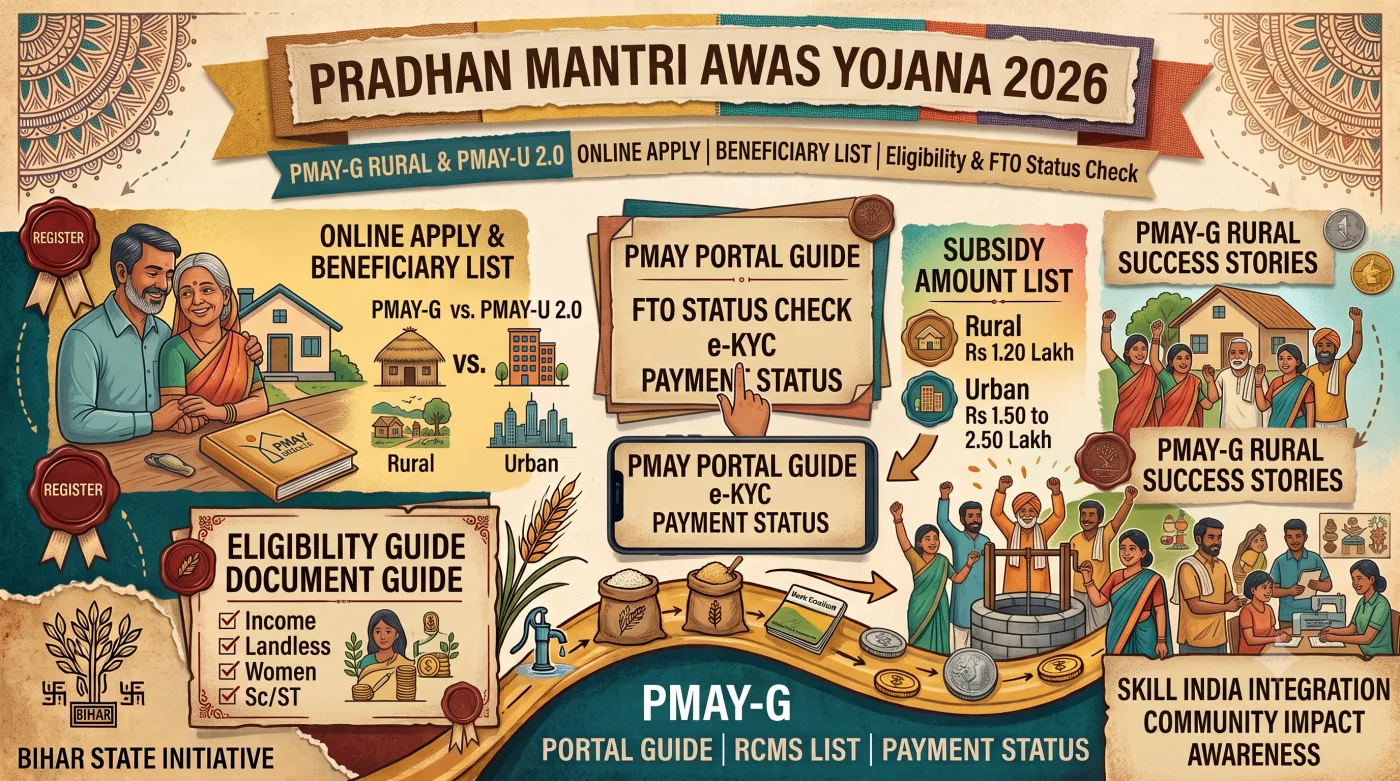
Introduction: Transforming India’s Housing Landscape with PMAY 2026
The Pradhan Mantri Awas Yojana (PMAY 2026) represents the flagship social welfare initiative launched by the Government of India to realize the constitutional vision of "Housing for All" (सबको पक्का मकान). Originally formulated to address the chronic shortage of resilient, permanent shelter among the economically impoverished and marginalized strata, the scheme has achieved unprecedented momentum in 2026 under the Union Cabinet’s historic mandate approving an additional 3 Crore pucca houses (2 Crore houses allocated for rural beneficiaries under PMAY-Gramin and 1 Crore houses sanctioned under the revamped PMAY-Urban 2.0 framework).
Shelter is more than physical brick and mortar; it serves as a foundational catalyst for health, family dignity, gender empowerment, and inter-generational socioeconomic mobility. In rural heartlands and bustling urban municipalities alike, families dwelling in fragile mud huts, thatched roofs, plastic tarpaulins, and unhygienic rented settlements face relentless structural vulnerabilities during monsoon inundations, winter cold waves, and scorching summer heatwaves. PMAY 2026 addresses this profound human necessity by pairing non-repayable direct financial subsidies with structured institutional convergence, ensuring every completed home is equipped with a hygienic toilet under the Swachh Bharat Mission (SBM), clean piped drinking water through the Jal Jeevan Mission, subsidized LPG connectivity via Pradhan Mantri Ujjwala Yojana, and metered electricity connections under the Saubhagya scheme.
📢 महत्वपूर्ण राष्ट्रीय घोषणा (PMAY 2.0 & Rural Expansion Update 2026)
केंद्रीय मंत्रिमंडल ने प्रधानमंत्री आवास योजना (ग्रामीण एवं शहरी 2.0) के तहत वित्तीय वर्ष 2028-2029 तक 3 करोड़ नए पक्के मकानों के निर्माण हेतु ₹4.06 लाख करोड़ के कुल परिव्यय को स्वीकृति प्रदान की है। इस योजना का मुख्य उद्देश्य देश के प्रत्येक बेघर, कच्चे मकान में रहने वाले तथा किराए के मकान में जीवन यापन करने वाले गरीब एवं मध्यम वर्गीय परिवारों को गरिमापूर्ण पक्का आवास उपलब्ध कराना है। किसी भी बिचौलिए या दलाल को एक रुपया भी न दें; योजना का पूरा पैसा डीबीटी (DBT) के माध्यम से सीधे लाभार्थी के बैंक खाते में भेजा जाता है।
Administrative Framework: PMAY-Gramin vs PMAY-Urban 2.0
The implementation of Pradhan Mantri Awas Yojana is bifurcated into two distinct administrative machineries to address the divergent socioeconomic conditions and spatial realities of rural and urban India:
| Parameters | PMAY-Gramin (PMAY-G Rural) | PMAY-Urban 2.0 (PMAY-U 2.0 Urban) |
|---|---|---|
| Nodal Central Ministry | Ministry of Rural Development (MoRD) | Ministry of Housing and Urban Affairs (MoHUA) |
| Target Geography | Rural Gram Panchayats, Villages & Hamlets | Statutory Cities, Municipal Corporations & Notified Towns |
| Direct Cash Subsidy (Grant) | ₹1,20,000 (Plains) / ₹1,30,000 (Hilly & Difficult Areas) | ₹2,50,000 (BLC Component: ₹1.5L Central + ₹1.0L State) |
| Convergence Benefits | ₹12,000 (SBM Toilet) + ₹25,000 (MGNREGA 90-95 Days Wages) | Interest Subsidy up to 4.0% on Home Loans (Max ₹1.80 Lakh) |
| Beneficiary Identification | SECC 2011 Deprivation Data & Awaas+ 2024-2026 Survey | EWS, LIG & MIG Income Assessment & Unified Online Portal |
| Management Information System (MIS) | AwaasSoft & AwaasApp (rhreporting.nic.in) | PMAY-MIS Unified Portal (pmaymis.gov.in) |
| Minimum Built-up Area | 25 Square Meters (including dedicated hygienic cooking space) | 30 Square Meters (Carpet Area with water, toilet & electricity) |
Financial Assistance Structure & Payment Release Tranches
Unlike traditional bureaucratic loan systems that burden impoverished citizens with heavy debt, PMAY financial assistance under the rural BLC and Gramin models is disbursed as a 100% non-repayable capital subsidy directly into the beneficiary's Aadhaar-seeded bank account through the Public Financial Management System (PFMS) and National Automated Clearing House (NACH). Under PMAY-Gramin, funds are intentionally staged across four sequential milestones tied directly to geo-tagged photographic proof of construction progress:
- Tranche 1 (Advance / Mobilization Grant - ₹40,000): Credited immediately after the beneficiary’s registration is verified by the Block Development Officer (BDO) and initial geo-tagging confirms the existing kutcha structure or vacant rural plot. This initial fund enables earth excavation, foundation trenching, and layout setting.
- Tranche 2 (Plinth Level Grant - ₹40,000): Released once the local Gram Panchayat Secretary, VDO, or Rozgar Sevak inspects the completed plinth foundation beam, captures mandatory geo-coordinates via the AwaasApp, and validates structural compliance. This money funds wall masonry up to lintel height.
- Tranche 3 (Roof Casting / Lintel Grant - ₹30,000): Disbursed upon proof of wall completion and preparation for RCC roof casting or durable tin/tiled roof truss installation. Geo-tagging of window lintels and structural reinforcement is recorded on AwaasSoft.
- Tranche 4 (Final Finishing & Toilet Grant - ₹10,000): Released after complete roof casting, wall plastering, door-window installation, mandatory Swachh Bharat Mission (SBM) toilet construction, and installation of the official PMAY logo wall plaque showcasing the beneficiary's name, sanction year, and registration ID.
⚠️ अनिवार्य निर्माण एवं सत्यापन चेतावनी (Mandatory Geo-Tagging & Construction Rule)
प्रधानमंत्री आवास योजना के तहत प्राप्त राशि का उपयोग केवल और केवल मकान निर्माण के लिए ही किया जा सकता है। प्रत्येक किस्त जारी होने से पहले ब्लॉक स्तरीय अधिकारियों द्वारा 'AwaasApp' के माध्यम से जीपीएस-सक्षम फोटो खींची जाती है। यदि कोई लाभार्थी पैसा निकाल कर 6 महीने के भीतर नींव नहीं भरता है, तो उसका नाम 'Non-Starter Beneficiary' सूची में दर्ज कर रिकवरी नोटिस (Recovery Notice) जारी किया जाता है तथा अगली किस्तें रोक दी जाती हैं।
Eligibility Criteria for PMAY-Gramin (Rural Housing 2026)
To ensure transparent, equitable distribution of resources to the most distressed rural households without subjective political bias, PMAY-G employs a stringent, objective methodology anchored on multi-factor deprivation metrics:
- Housing Deprivation: The household must be genuinely houseless or currently surviving in a zero, one, or maximum two-room temporary kutcha structure with unburnt mud walls and thatch, grass, or plastic sheeting.
- Permanent Residency: The applicant must be a bona fide rural resident residing within the jurisdiction of the concerned Gram Panchayat.
- Deprivation Prioritization Hierarchy:
- Households with no adult working-age member between 16 and 59 years.
- Female-headed households with no adult male member between 16 and 59 years.
- Households having members with severe physical or intellectual disabilities (Divyangjan) with no able-bodied adult member.
- Landless households deriving their major income from manual casual labor.
- Scheduled Caste (SC), Scheduled Tribe (ST), Primitive Vulnerable Tribal Groups (PVTG), and minority households.
- Land Ownership: The applicant must possess valid homestead land title (patta), ancestral land rights, or be allotted land under state government landless rehabilitation schemes.
Automatic Exclusion Criteria: Who CANNOT Apply for PMAY-G?
Under the statutory 13-point exclusion rule mandated by the Government of India, any household possessing any one of the following assets or circumstances is disqualified from receiving PMAY-G benefits:
| # | Disqualification Factor (अपात्रता मापदंड) | Verification Authority & Database Match |
|---|---|---|
| 1 | Ownership of motorized two-wheeler, three-wheeler, four-wheeler, or mechanized agricultural boat | Vahan Transport Database Cross-Verification |
| 2 | Ownership of mechanized 3 or 4-wheel agricultural equipment (e.g., Tractor, Harvester) | District Agriculture Department & RTO Registry |
| 3 | Holding Kisan Credit Card (KCC) with credit limit of ₹50,000 or higher | RBI / SLBC Institutional Banking Database |
| 4 | Any household member employed as a regular Government servant (Gazetted, Non-Gazetted, PSUs) | State & Central HRMS / PFMS Payroll Cross-Match |
| 5 | Household members registered with non-agricultural enterprises paying GST | GSTN Portal Integration |
| 6 | Any family member paying Income Tax or Professional Tax | Central Board of Direct Taxes (CBDT) PAN Verification |
| 7 | Household owning land above 2.5 acres of irrigated land with at least one irrigation equipment | State Digital Land Records (Bhulekh / Land Revenue Portal) |
| 8 | Household owning 5 acres or more of un-irrigated land | Tehsildar / Revenue Inspector Cadastral Records |
| 9 | Any member of the family already owning a permanent pucca house anywhere in India | National Family Aadhaar Registry (De-duplication Check) |
PMAY-Urban 2.0 (PMAY-U 2.0): Detailed Four Verticals
The expanded PMAY-Urban 2.0 program addresses the housing crisis across Indian cities through four structured programmatic verticals tailored to distinct urban income brackets and land availability:
1. Beneficiary-Led Construction / Enhancement (BLC / BLE)
Designed for urban EWS families who already own a small piece of land or an existing dilapidated kutcha home within municipal boundaries. Beneficiaries construct their own home with technical design support from the Urban Local Body (ULB). Total financial assistance is ₹2.50 Lakh (₹1.50 Lakh Central share + ₹1.00 Lakh State share), paid in milestone tranches tied to geo-tagged mobile monitoring.
2. Affordable Housing in Partnership (AHP)
Under AHP, State Housing Boards, Development Authorities (such as DDA, MHADA, BDA, etc.), and private developers build multi-story residential apartment complexes where a minimum of 35% of the total units are strictly reserved for the Economically Weaker Section (EWS). Eligible beneficiaries receive subsidized flats at prices significantly lower than prevailing market rates, coupled with an upfront government subsidy of ₹1.50 Lakh to ₹2.50 Lakh.
3. Interest Subsidy Scheme (ISS - Credit Linked Subsidy 2.0)
A flagship market-based intervention supporting urban families availing housing loans from commercial banks, housing finance companies (HFCs), and regional rural banks for constructing or purchasing their first home. For EWS/LIG families availing home loans up to ₹25 Lakh on property valued up to ₹35 Lakh with annual income up to ₹9 Lakh, an upfront interest subsidy of up to 4.0% (maximum net present value of ₹1.80 Lakh) is credited directly to the borrower's loan account across 5 annual tranches, dramatically reducing monthly EMI burdens.
4. Affordable Rental Housing Complexes (ARHCs)
Tailored specifically for urban migrant workers, industrial laborers, hospitality workers, street vendors, and college students. Government-funded vacant housing complexes are converted into operational rental units or newly built through public-private partnerships (PPP), providing secure, dignified, low-cost rental accommodations close to major industrial hubs and workplaces.
Convergence Benefits: The 'Power-Pack' of PMAY 2026
A major design breakthrough of PMAY 2026 is its institutional convergence architecture. A rural beneficiary does not merely receive ₹1.20 Lakh; the household is automatically enrolled in multiple allied central welfare schemes:
- Swachh Bharat Mission - Gramin (SBM-G ₹12,000): Every PMAY home must include an attached twin-pit pour-flush sanitary latrine. An additional incentive of ₹12,000 is directly credited to the beneficiary's bank account upon completion of the toilet unit.
- MGNREGA Unskilled Wage Support (~₹25,000): Beneficiaries or their adult family members are officially sanctioned 90 days (in plain areas) to 95 days (in hilly/difficult terrain) of unskilled manual labor under the Mahatma Gandhi National Rural Employment Guarantee Act (MGNREGA). At daily wage rates ranging between ₹240 and ₹370 depending on the state, this transfers approximately ₹22,000 to ₹35,000 directly into the family’s wage account as construction labor compensation.
- Jal Jeevan Mission (Har Ghar Jal): The village water committee (VWS) prioritizes the connection of functional household tap water to every newly sanctioned PMAY dwelling.
- Pradhan Mantri Ujjwala Yojana 2.0: Automatic eligibility for a free LPG connection, dual-burner gas stove, and the first 14.2 kg LPG cylinder refill with a continued ₹300 central subsidy.
- PM Surya Ghar Muft Bijli Yojana: PMAY beneficiaries are given priority access to install subsidized 1 kW rooftop solar power systems, delivering up to 100-150 units of free clean electricity every month.
Step-by-Step Guide: How to Apply Online for PMAY-Urban 2.0
Urban citizens can apply directly through the official citizen portal without visiting municipal counters:
- Step 1: Access the Unified Portal: Open your web browser and navigate to the official portal at
pmaymis.gov.in. - Step 2: Citizen Assessment Login: On the homepage navigation bar, click on 'Citizen Assessment' and select 'Apply Online'.
- Step 3: Aadhaar Authentication: Enter your 12-digit Aadhaar Number and your full name exactly as spelled on your Aadhaar card. Click 'Check & Verify'. A one-time password (OTP) will be dispatched to your Aadhaar-linked mobile number.
- Step 4: Fill Comprehensive Application Form:
- Select State, District, City, and Urban Local Body (ULB / Municipal Ward).
- Provide Head of Household details, religion, caste category (General/SC/ST/OBC), and Aadhaar numbers of all family members.
- Enter complete present residential address and permanent address.
- Select Housing Vertical (e.g., Beneficiary-Led Construction - BLC).
- Enter Bank Account details (Bank Name, Branch Name, Core Account Number, and IFSC Code).
- Declare total annual household income and current tenancy status (Own Land, Kutcha House, or Rented).
- Step 5: Document Upload: Upload scanned copies of land title deed / registry, municipal tax receipt, bank passbook front page, and family photograph.
- Step 6: Submit & Download Assessment Slip: Verify all fields, check the statutory declaration box, and click 'Submit'. Securely save the generated Application Assessment ID for real-time tracking.
How PMAY-Gramin Beneficiaries are Selected via Awaas+ 2026
In rural areas, applications are primarily handled through institutional field enumeration rather than individual unverified submissions:
- Field Survey via AwaasApp: Gram Panchayat field surveyors, Block Coordinators, and Rozgar Sevaks conduct door-to-door enumeration using the official geo-referenced AwaasApp mobile application.
- Geo-Tagging Existing Kutcha House: The surveyor photographs the applicant family standing in front of their temporary mud or thatched hut, capturing live GPS latitude and longitude coordinates.
- Gram Sabha Approval & Social Audit: The provisional survey list is presented before the open Gram Sabha meeting. Village residents publicly review every listed name to identify and eliminate ineligible affluent families or government employees.
- Appeals & Appellate Committee: If a deserving family was erroneously omitted or an ineligible person included, any villager can file an appeal before the Sub-Divisional Officer (SDO) or District Magistrate (DM) within 15 days.
- Final Priority List Generation: Once ratified by the Gram Sabha and approved by the District Collector, the finalized names are uploaded to the AwaasSoft central database, and Sanction Orders are generated in order of deprivation priority.
How to Check PMAY-G Beneficiary Status & FTO Tracking on AwaasSoft
Beneficiaries can monitor their sanction progress, stage approvals, and Fund Transfer Orders (FTO) online:
- Visit the official rural reporting portal at
rhreporting.nic.in. - Click on the 'Stakeholders' menu tab on the top navigation bar and select 'IAY / PMAYG Beneficiary'.
- Enter your unique Registration Number (e.g.,
BR12345678orUP98765432) provided by your Block office. - Click 'Submit'. The system will display the complete beneficiary dashboard, including:
- Beneficiary personal details, category, and Gram Panchayat name.
- Sanction Order Number and Sanctioned Financial Amount.
- Bank Account Seeding & PFMS Account Validation Status (PFMS Accepted / Verified).
- Installment Payment Details: Tranche number, Amount (₹40,000), FTO Number, Payment Date, and UTR Reference.
- Geo-Tagged Inspection Photos showing the house at foundation, plinth, lintel, and completed stages with GPS stamps.
- Tracking Without Registration Number: If you do not possess your registration number, click on 'Advanced Search', select your State, District, Block, Panchayat, Scheme Name (Pradhan Mantri Awaas Yojana - Gramin), and search by Applicant Name or BPL Family ID.
How to View Village-Wise PMAY Beneficiary List (Gram Panchayat List)
Any citizen can download the complete list of approved PMAY homes for their village:
- Navigate to
rhreporting.nic.in/netiay/PhysicalProgressReports/HighLevelPhysicalProgressReport.aspx. - Under Section A 'Physical Progress Reports', select Report Item 8: 'High Level Physical Progress Report' or Section B 'Analytical Reports'.
- In the interactive filter box on the left, select the financial year (e.g., 2025-2026 or 2026-2027).
- Select Scheme as 'Pradhan Mantri Awaas Yojana Gramin'.
- Click your State Name, then drill down into your District, then select your Block / Tehsil, and finally click on your Gram Panchayat Name.
- A complete tabulated ledger will display every registered villager's Name, Father/Husband's Name, Sanction Date, Amount Released, Current Stage of Construction, and SBM Toilet status.
Mandatory Specifications & Building Norms for PMAY Houses
To guarantee that PMAY houses remain structural safe, weather-resistant, and climate-adaptive for generations, MoRD and MoHUA have laid down strict engineering specifications:
- Minimum Carpet Area: In rural areas, the minimum built-up plinth area must be at least 25 Square Meters (approx. 269 sq. ft.), including an ear-marked hygienic kitchen space with a raised cooking slab. In urban PMAY-U homes, the minimum carpet area is 30 Square Meters.
- Disaster Resilient Construction: Houses constructed in seismic zones IV and V must incorporate earthquake-resistant RCC plinth bands and lintel bands. Homes in coastal cyclone-prone belts (e.g., Odisha, Andhra Pradesh, Tamil Nadu) must utilize reinforced roof slabs capable of resisting high-velocity gales.
- Natural Illumination & Ventilation: Every living room must incorporate at least two openings (windows/ventilators) guaranteeing cross-ventilation and daylight penetration, reducing dependence on artificial daytime lighting.
- Hygienic Sanitation: Open defecation is strictly eradicated; no PMAY home is certified as 'Complete' without an operational sanitary toilet unit linked to an eco-friendly septic tank or twin-pit soakaway.
Common Reasons for PMAY Rejection & How to Fix Them
Understanding potential procedural roadblocks ensures applicants take preemptive corrective action:
| Rejection Reason | Root Cause Analysis | Prescribed Remedial Action |
|---|---|---|
| PFMS Bank Account Rejected | Name spelling mismatch between Aadhaar and Bank Passbook, or bank merger IFSC error | Submit revised bank mandate form with NPCI Aadhaar seeding slip at the Block Development Office to re-validate account on AwaasSoft. |
| Geo-Tagging Rejected / Non-Matching Location | Field inspector captured photographs outside the approved cadastral plot or GPS drift occurred | Request re-inspection from BDO / Mukhiya; surveyor must re-upload fresh geo-coordinates in clear daylight via AwaasApp. |
| Gram Sabha Objection Raised | Neighbor or vigilance member claimed the applicant owns another pucca house or has taxable income | File an official affidavit of non-encumbrance before the Sub-Divisional Magistrate (SDM) with an income certificate from the Tehsildar. |
| Delayed Construction / Non-Starter Status | Beneficiary received 1st installment but failed to construct plinth foundation within 90 days | Immediately begin brickwork foundation and notify Rozgar Sevak to take plinth geo-tagging photo before legal notice is initiated. |
| Landless Status (No Homestead Plot) | Applicant is eligible in SECC but possesses zero ancestral or titled land to construct on | State Government is mandated under PMAY guidelines to allot minimum 3 to 5 decimals of government land or provide financial grant for land purchase. |
Comparative Analysis: SECC 2011 vs Awaas+ 2024-2026 Survey
Understanding the evolutionary transition from the historical Socio-Economic and Caste Census (SECC 2011) to the modern digital Awaas+ 2024-2026 Dynamic Survey is critical for applicants navigating rural housing administration. While SECC 2011 served as the baseline identification metric for the inaugural phase of PMAY-G, it suffered from static data decay, failing to capture newly formed families, nuclear separations, natural disaster victims, and inter-generational poverty emerging over the past decade.
To eliminate these systemic coverage gaps, the Ministry of Rural Development deployed the dynamic Awaas+ Survey methodology. Under this revised framework, village surveyors utilize GPS-enabled tablet devices with biometric Aadhaar authentication to capture real-time living conditions. The Awaas+ system incorporates multi-layered algorithmic checks that cross-reference property ownership against state digital land cadastral records (Bhulekh portals) and electricity billing databases, preventing duplicate allocations while ensuring newly destitute rural households obtain fast-tracked entitlement sanctions.
Rural Mason Training & Certified Construction Quality Norms
A persistent bottleneck in rural housing construction has been the scarcity of trained construction labor, leading to sub-standard brickwork, improper cement-sand mixing ratios, and vulnerable unreinforced roofing structures prone to moisture seepage. Under the aegis of the Rural Mason Training (RMT) Program, certified by the Construction Skill Development Council of India (CSDCI) and the National Skill Development Corporation (NSDC), over 5,00,000 rural artisans and masons have been formally trained and certified across Indian districts.
PMAY-G encourages beneficiaries to engage certified rural masons for their home construction. These masons are educated in climate-resilient construction practices, including bamboo-reinforced concrete plinths in seismic belts, hollow concrete block masonry in arid heat zones, and fly-ash brick bonding techniques that reduce carbon emissions while ensuring thermal comfort. Beneficiaries utilizing certified masons experience significantly faster stage completion, reducing time-to-completion from the historical 314 days down to an average of just 114 days from first tranche sanction.
📋 ग्रामीण राजमिस्त्री प्रशिक्षण एवं गुणवत्ता मानक (Quality Assurance)
प्रधानमंत्री आवास योजना के तहत बनने वाले पक्के मकानों की मजबूती एवं दीर्घकालिक सुरक्षा सुनिश्चित करने के लिए सरकार ने ग्रामीण राजमिस्त्रियों को आधुनिक भूकंपरोधी तकनीक, सही मसाला अनुपात (Cement-Sand Ratio), तथा जल-निकासी तकनीकों का प्रशिक्षण दिया है। लाभार्थी अपने ग्राम पंचायत में प्रमाणित राजमिस्त्री की सेवाएं ले सकते हैं, जिससे निर्माण कार्य मानक गुणवत्ता के अनुसार तेजी से पूरा हो सके।
Women Empowerment: Mandatory Joint or Sole Female Ownership
A transformative hallmark of the Pradhan Mantri Awas Yojana is its statutory mandate regarding property title ownership. Under scheme rules, a PMAY house cannot be sanctioned solely in the name of an adult male member of a family. The title deed, land patta, and scheme sanction order must be registered in the name of the female head of the household or jointly between the husband and wife. Sole male ownership is permitted strictly in extraordinary circumstances where there is no adult female member in the immediate family (e.g., unmarried men, single fathers, or widowers). This policy has conferred formal real estate ownership upon millions of marginalized rural and urban Indian women, elevating their domestic stature, financial autonomy, and social security.
Official Helpdesks, Grievance Redressal & Toll-Free Numbers
Beneficiaries encountering corruption, unauthorized demands for bribes, or technical errors on AwaasSoft can directly contact the central vigilance machineries:
- PMAY-Gramin National Toll-Free Helpline:
1800-11-6446(Toll-Free, 09:30 AM to 06:00 PM, Monday to Saturday) - PMAY-G Alternate National Helpline:
1800-11-8004 - PMAY-G Official Technical Support Email:
support-pmayg@gov.in - PMAY-Urban National Toll-Free Helplines:
1800-11-3377/1800-11-3388 - PMAY-U Official Support Email:
pmaymis-mhupa@gov.in - Central Vigilance & Anti-Corruption Portal (CPGRAMS):
pgportal.gov.in(Lodge direct complaint against any official demanding commission).
💡 लाभार्थी सतर्कता संदेश (Zero Tolerance for Bribes)
प्रधानमंत्री आवास योजना पूर्णतः पारदर्शी और निःशुल्क है। आवास सूची में नाम जोड़ने, जीयो-टैगिंग करने या बैंक खाते में किस्त ट्रांसफर करने के नाम पर यदि कोई भी बिचौलिया, वार्ड सदस्य, मुखिया या ब्लॉक कर्मचारी घूस या कमीशन मांगता है, तो तुरंत अपने जिले के जिलाधिकारी (District Magistrate / Collector) या राज्य के सतर्कता हेल्पलाइन (Vigilance Helpline) पर शिकायत दर्ज करें। आपका पैसा सीधे भारत सरकार के PFMS खाते से आपके बैंक खाते में आता है, इसमें किसी बिचौलिए का कोई रोल नहीं होता है।
User Discussion & Comments (0)
No comments yet. Be the first to leave a comment below!
Leave a Comment / Ask a Question: