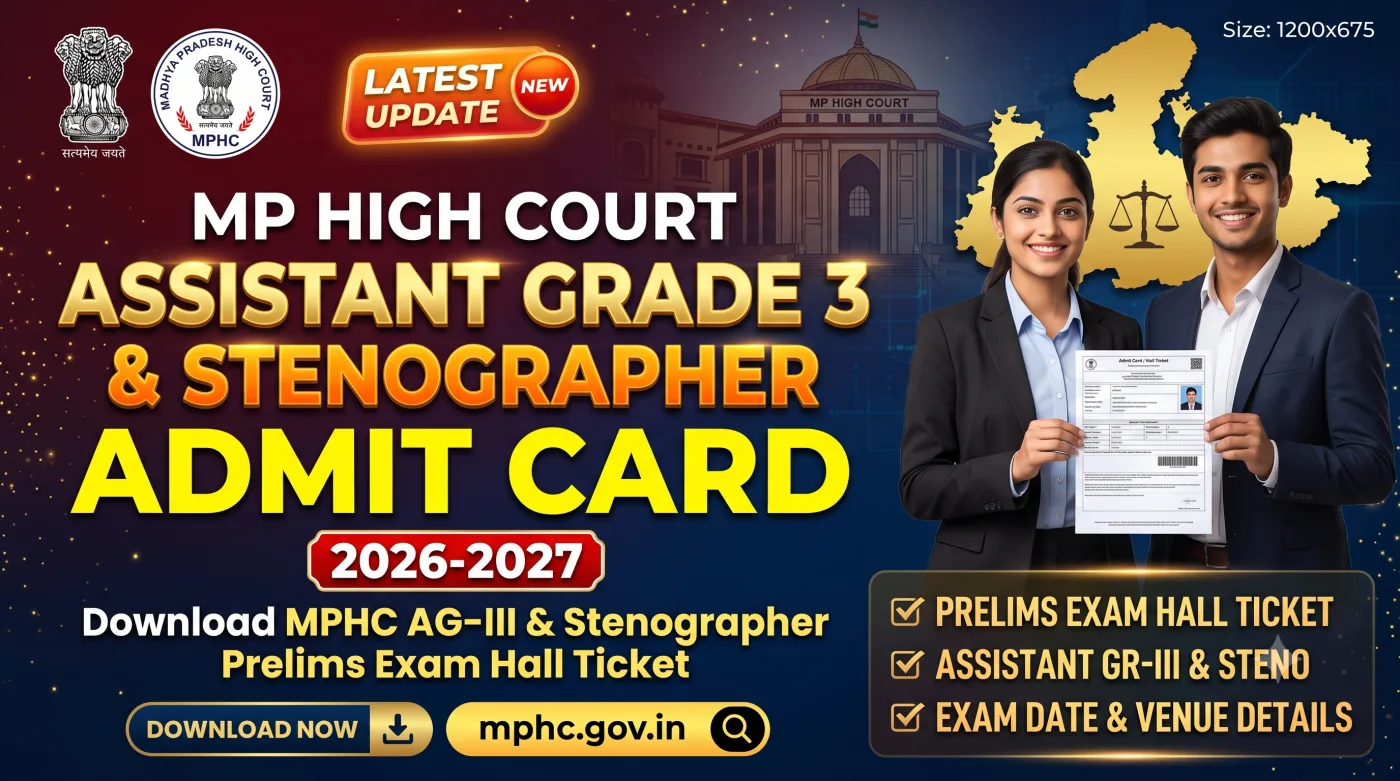
1. Comprehensive Hall Ticket & Examination Overview: MP High Court Assistant Grade 3 Admit Card 2026-2027: Download MPHC AG-III & Stenographer Prelims Exam Hall Ticket at mphc.gov.in
The MP High Court Assistant Grade 3 Admit Card 2026-2027: Download MPHC AG-III & Stenographer Prelims Exam Hall Ticket at mphc.gov.in has been officially announced and published by High Court of Madhya Pradesh, Jabalpur (मध्य प्रदेश उच्च न्यायालय, जबलपुर). The issuance of this digital hall ticket marks the decisive transition into the final examination and assessment phase for registered applicants across India. Candidates who have successfully completed the application form and verified their eligibility credentials can now download their authenticated e-Admit Card to confirm their designated examination venue, shift timings, reporting schedule, and mandatory behavioral protocols.
मध्य प्रदेश उच्च न्यायालय, जबलपुर द्वारा राज्य के जिला एवं सत्र न्यायालयों में सहायक ग्रेड-3 (AG-III) एवं शीघ्रलेखक (Stenographer) के पदों पर भर्ती हेतु ऑनलाइन प्रारंभिक परीक्षा का प्रवेश पत्र जारी कर दिया गया है। इस आधिकारिक व विस्तृत मार्गदर्शिका में हम अभ्यर्थियों को प्रवेश पत्र डाउनलोड करने की चरणबद्ध ऑनलाइन प्रक्रिया (Step-by-Step Download Guide), परीक्षा पाली व रिपोर्टिंग समय (Shift Timings & Gate Closure Rules), ई-एडमिट कार्ड पर उल्लिखित 10 अनिवार्य विवरणों का सत्यापन (Hall Ticket Verification Checklist), परीक्षा केंद्र पर ले जाने हेतु वैध पहचान पत्र (Mandatory Photo ID Proofs), परीक्षा हॉल में प्रतिबंधित वस्तुएं (Banned Items & Security Protocols) तथा परीक्षा में बैठने से संबंधित सभी महत्वपूर्ण नियमों की विस्तृत व प्रामाणिक जानकारी उपलब्ध करा रहे हैं।
Executive Summary & Key Examination Benchmarks
Administered under the strict statutory supervision of High Court of Madhya Pradesh, Jabalpur (मध्य प्रदेश उच्च न्यायालय, जबलपुर), the examination operates under synchronized computerized surveillance, biometric identification standards, and transparent merit governance. Review the foundational parameters below:
| Examination Parameter | Official Directive / Directive Specification |
|---|---|
| Conducting Authority | High Court of Madhya Pradesh, Jabalpur (मध्य प्रदेश उच्च न्यायालय, जबलपुर) |
| Examination Name / Cadre | Assistant Grade-3 (AG-III) & Stenographer Preliminary Online Examination |
| Official Web Portal | mphc.gov.in |
| Shift Schedule & Timings | Shift 1: 10:00 AM to 12:00 Noon (Stenographer Cadre) | Shift 2: 02:30 PM to 04:30 PM (Assistant Grade-3 Cadre) |
| Document Verification Protocol | Digital E-Admit Card + Original Government Photo ID Proof |
| Biometric Identification | Aadhaar-Linked Fingerprint & Facial Recognition Verification |
| Examination Interface | Bilingual Computer Based Test (CBT) / Offline Descriptive / OMR System |
| Official Application Fee | NULL (Not Applicable - Hall Ticket Stage Has Zero Fee) |
2. Examination Calendar, Shift Timings, Entry Gate Closure & Reporting Schedules
Adherence to examination shift timings is absolute. Under statutory examination security guidelines, entry gates close precisely at the designated cutoff time. No candidate, under any circumstances or personal emergencies, is permitted entry once the examination center gate is officially locked:
Shift 1: 10:00 AM to 12:00 Noon (Stenographer Cadre) | Shift 2: 02:30 PM to 04:30 PM (Assistant Grade-3 Cadre)
| Examination Shift | Gate Opening / Reporting Time | Gate Closure Cutoff (Strict) | Examination Commencement & Duration |
|---|---|---|---|
| Morning Shift (Shift 1) | 07:30 AM / 08:00 AM | 08:30 AM / 08:45 AM Sharp | 09:00 AM to 11:00 AM / 12:00 Noon |
| Afternoon Shift (Shift 2) | 11:30 AM / 12:30 PM | 01:00 PM / 01:15 PM Sharp | 01:30 PM to 03:30 PM / 04:30 PM |
| Evening Shift (Shift 3 - If Scheduled) | 03:00 PM | 04:00 PM Sharp | 04:30 PM to 06:00 PM / 06:30 PM |
Crucial Warning: Candidates are strongly advised to physically locate and inspect their allotted examination test center one day prior to the examination date to evaluate traveling routes, traffic bottlenecks, and commuting options.
3. Step-by-Step Official E-Admit Card Download Walkthrough
To avoid portal latency, incorrect download links, or browser crashes during peak access intervals, candidates must follow the authorized download walkthrough below:
- Access the Official Portal: Launch an updated web browser (Google Chrome, Mozilla Firefox, or Microsoft Edge) and navigate to the verified examination portal at mphc.gov.in.
- Locate E-Admit Card Notification: On the homepage under \'Latest Announcements\' or \'Recruitment / Examination Dashboard\', click on the active link titled \'Download E-Admit Card / Hall Ticket for MP High Court Assistant Grade 3 Admit Card 2026-2027: Download MPHC AG-III & Stenographer Prelims Exam Hall Ticket at mphc.gov.in\'.
- Select Authentication Server: If the primary portal exhibits high traffic load, select Server 2 (Alternative Mirror Link) provided on our dedicated action table.
- Input Registration Credentials:
- Enter your Application Number / Registration ID exactly as recorded on your initial confirmation form.
- Enter your Date of Birth (DOB) in DD/MM/YYYY format or your secret account Password.
- Accurately solve the 6-character alphanumeric Security Captcha displayed on the screen.
- Dashboard Access & Admit Card Generation: Click on the \'Login / Submit\' button to access your personalized candidate dashboard. Click on \'Download E-Admit Card\'.
- Verify PDF & Print: Open the downloaded PDF document. Ensure all pages (including the Self-Declaration Undertaking and General Instructions) are intact. Take at least two high-quality, clear printouts on clean white A4 paper (laser color printout recommended for clear photograph visibility).
4. 10 Critical Details to Verify on Your E-Admit Card (Scrutiny Checklist)
Immediately after downloading the digital hall ticket, candidates must cross-examine every data parameter against their original academic certificates and application confirmation slip:
| Data Field on Hall Ticket | Verification Standard & Importance | Action in Case of Discrepancy |
|---|---|---|
| 1. Candidate Full Legal Name | Must match exactly with Class 10th / Matriculation Certificate and Aadhaar Card. | Report immediately to helpdesk; carry Executive Magistrate sworn affidavit. |
| 2. Roll Number & Registration ID | Unique candidate identifier used for seat allocation and OMR/CBT login. | Note down separately in personal notes to prevent loss. |
| 3. Candidate Photograph & Signature | Must be sharp, clearly recognizable, and properly oriented without distortion. | If blank or blurred, carry two identical passport photos attested by Gazetted Officer. |
| 4. Date of Birth (DOB) & Gender | Must conform to school records; determines age verification criteria. | Ensure identity cards reflect identical date of birth details. |
| 5. Applied Cadre / Post Category | Confirms the exact post, technical trade, or stream applied for. | Check that the question paper trade matches applied qualification. |
| 6. Category Tag (UR / OBC / SC / ST / EWS) | Determines qualifying marks threshold and reservation verification. | Verify community allocation against submitted caste certificate. |
| 7. Exact Examination Center Address | Includes Complete Center Name, Building Number, Landmark, and Pin Code. | Verify geolocation on Google Maps prior to travel. |
| 8. Reporting Time & Gate Closure Time | Specifies mandatory arrival deadline; entry strictly barred after gate closure. | Reach examination venue minimum 90 minutes before gate closure. |
| 9. Examination Center Code & Shift | Crucial identification code entered on OMR sheet or computer terminal. | Cross-check with center gate noticeboard on exam morning. |
| 10. Barcode / QR Code Integrity | Used by security scanners at the entrance for digital authentication. | Do not fold, crease, or smudge the barcode portion of the printout. |
5. Authorized Government Photo Identity Proofs & Entry Documentation
The examination center security detail enforces zero-tolerance entry verification. Candidates must produce the printed e-Admit Card along with at least one ORIGINAL, VALID GOVERNMENT PHOTO IDENTITY CARD. Digital soft copies on mobile phones, laminated duplicate cards without security chips, or expired proofs are strictly rejected:
Acceptable Original Photo Identity Documents
- Aadhaar Card (Original Physical Card / e-Aadhaar with clear photograph): Aadhaar with full Date of Birth printed is the most preferred document for real-time biometric and facial recognition verification.
- Voter Identity Card (EPIC): Issued by the Election Commission of India showing complete name and photograph.
- Driving License: Valid permanent driving license issued by Regional Transport Offices (RTO). (Learner licenses are inadmissible).
- Passport: Valid Republic of India Passport.
- PAN Card: Original Permanent Account Number card issued by the Income Tax Department.
- Service Identity Card: For Ex-Servicemen and serving armed forces personnel, the official Military Discharge Book and Armed Forces Identity Card are compulsory.
6. Prohibited Articles, Electronic Frisking & Examination Hall Decor
To preserve complete competitive equity and eradicate modern technological malpractice, examination venues are monitored via electronic radio-frequency (RF) jammers, handheld metal detectors, and 360-degree CCTV webcasting:
| Category of Items | Specific Banned Articles (Strictly Prohibited) | Statutory Consequences of Possession |
|---|---|---|
| Communication & Electronic Devices | Mobile phones, smartwatches, Bluetooth earphones, fitness bands, pagers, micro-cameras, pen drives, electronic health monitors, calculators. | Immediate FIR under Public Examinations (Prevention of Unfair Means) Act + Lifetime Debarment. |
| Stationery & Reading Materials | Textbooks, cheat slips, geometry boxes, clipboards, writing pads, blank rough sheets, log tables, slide rules. | Confiscation and cancellation of current examination session. |
| Metallic Items & Accessories | Metallic belts with large buckles, metallic bracelets, heavy rings, lockets, hairpins with metal, metallic wallets. | Candidates will be instructed to remove items at the main gate. Center management takes zero custody. |
| Bags & Personal Luggage | Handbags, backpacks, laptop bags, briefcases, luggage suitcases. | No departmental cloakrooms guaranteed at test venues; carry minimal personal belongings. |
7. Computer Based Test (CBT) Interface & Navigational Guidelines
For examinations administered on digital computer terminals, candidates should familiarize themselves with the standardized examination screen palette:
- Candidate Login: Upon occupying your designated computer node, verify your roll number and photograph displayed on the screen. Enter your Computer PIN / Password announced by the invigilator 10 minutes prior to exam start.
- Color Palette Indications:
- Gray (Unvisited): You have not visited the question yet.
- Red (Unanswered): You have visited the question but have not answered it.
- Green (Answered): You have answered the question. This question will be evaluated in your final score.
- Purple (Marked for Review): You have marked the question for review without answering.
- Purple with Green Dot: You have answered the question AND marked it for review. This answer will be evaluated in the final merit calculation.
- Countdown Clock: A live digital timer on the top right corner displays remaining time. The examination submits automatically upon reaching 00:00:00.
8. Detailed Examination Pattern & Marking Scheme
Online Preliminary Examination (100 Questions / 100 Marks / 120 Minutes): 1. General Knowledge & Social Science (Including MP GK): 30 Questions / 30 Marks 2. Math & General Science: 10 Questions / 10 Marks 3. General Hindi: 10 Questions / 10 Marks 4. General English: 20 Questions / 20 Marks 5. Computer Knowledge: 20 Questions / 20 Marks 6. General Mental Ability / Reasoning: 10 Questions / 10 Marks. No negative marking in MPHC Preliminary examination.
9. Travel Guidelines, Railway Concessional Passes & Scribe Facilities
Candidates must download admit card with Application Number and Date of Birth. Must carry original photo ID, CPCT scorecard copy, and report 60 minutes prior to shift commencement.
Scribe & Compensatory Time Provisions for PwD Candidates
Persons with Benchmark Disabilities (PwD) in categories of blindness, locomotor disability (both arms affected), or cerebral palsy are entitled to:
- Compensatory Time: Additional 20 minutes per hour of examination (e.g., 40 extra minutes for a 2-hour exam; 30 extra minutes for a 90-minute exam).
- Scribe Allocation: Candidates can opt for a scribe provided by the examination authority or bring their own scribe meeting the requisite educational qualifications (one step below the candidate\'s minimum qualification). Scribes must present valid ID and self-declaration forms during entry.
10. Post-Examination Procedures: Response Sheet, Answer Key & Objection Window
The examination authority adheres to a time-tested post-examination transparency calendar:
- Candidate Response Sheet Release: Within 3 to 7 days post-examination, candidate response sheets displaying question-wise chosen options and official correct answers are published on the portal.
- Provisional Answer Key & Objections: Registered candidates can challenge provisional answer keys by submitting documentary evidence (from standard academic reference literature) and paying an nominal challenge fee per question (refunded if the objection is sustained by the Subject Expert Committee).
- Final Answer Key & Scorecard: Following expert review, the revised final answer key is uploaded, and raw/normalized scores are published.
11. Official Departmental Control Room & Grievance Directory
For urgent candidate support regarding hall ticket download errors, spelling rectifications, or center location queries, candidates should access official control room resources:
- Central Helpline Desk: Dedicated contact numbers operational from 09:30 AM to 06:00 PM on all working days.
- Official Email Support: Lodge technical grievance tickets quoting your Application Registration Number, Roll Number, Candidate Name, and exact screenshot of error messages.
- On-Site Nodal Observers: High Court / Commission appointed Nodal Flying Squads and Center Superintendents are stationed at every test venue to resolve emergency identification discrepancies.
12. City Intimation Slip, Travel Logistics & Exam Center Reachability Blueprint
In accordance with modernized competitive examination protocols, candidates are provided access to an advance Exam City & Date Intimation Slip approximately 7 to 10 days before the commencement of the examination. The primary objective of the City Intimation Slip is to facilitate advance travel bookings, train reservations, and lodging arrangements without compromising examination security:
Distinction Between City Intimation Slip and Final E-Admit Card
- Exam City Intimation Slip: Discloses exclusively the allocated Examination City, State, Test Date, and Shift Timing. It serves purely as an advance travel planning document. Crucial Note: The City Intimation Slip is NOT an Admit Card and CANNOT be used to gain entry into the examination center hall.
- Final E-Admit Card: Issued exactly 4 days prior to the candidate's scheduled examination date. Discloses the precise Examination Centre Name, Complete Venue Address, Landmark, Google Geolocation Coordinates, Computer Lab Number, and Invigilator Stamping Boxes.
Travel Advisory & Safe Commuting Protocols
To eliminate unexpected logistical failures on the examination morning, candidates should adhere to these travel guidelines:
- Advance Venue Reconnaissance: Whenever feasible, visit the examination venue one day prior to the scheduled exam date. Assess traveling time via metro, local trains, state transport buses, or auto-rickshaws during peak morning rush hours.
- Buffer Time Cushion: Plan your journey to arrive at the examination venue at least 90 minutes before the official gate closure time. This buffer accommodates traffic bottlenecks, security check queues, and document verification lines.
- Overnight Lodging Near Center: Candidates traveling from distant rural or inter-district zones should arrange affordable dormitory or hotel accommodation within a 3 to 5 kilometer radius of the test center on the eve of the examination.
13. Detailed Question Paper Anatomy, Time Allocation & Marking Strategies
Competitive success is not solely a measure of academic preparation; it hinges upon disciplined exam-hall time management and intelligent question-selection techniques. Below is an authoritative breakdown of tactical examination strategies:
| Examination Phase | Recommended Time Allocation | Candidate Strategy & Tactical Objectives |
|---|---|---|
| First Pass (Round 1: Rapid Sweep) | First 40% of Total Time | Solve 100% familiar questions that require zero complex calculation. Skip doubtful or lengthy questions immediately without emotional attachment. Secure easy foundational marks. |
| Second Pass (Round 2: Calculated Problem Solving) | Next 45% of Total Time | Tackle moderate-difficulty questions, arithmetic calculations, data interpretation sets, and multi-step reasoning problems marked during Round 1. Verify intermediate calculations carefully. |
| Final Review & Mark Management (Round 3) | Final 15% of Total Time | Review questions marked for review. Verify that all intended answers are properly registered in green on the computer palette. Ensure zero unforced errors. |
Scientific Risk Mitigation Against Negative Marking
Where negative marking applies (e.g., 0.25 marks or 1/3rd marks deduction per wrong answer), blind guessing is mathematically detrimental to candidate ranking. Candidates should follow the Calculated Elimination Rule:
- When 2 Options Are Decisively Eliminated: The statistical probability of a correct choice rises to 50%. In a 4-question set, 2 correct answers earn +2.0 marks while 2 incorrect answers lose -0.50 marks (or -0.66 marks), yielding a positive net gain of +1.34 to +1.50 marks. Calculated risks are justified.
- When 3 or 4 Options Remain Uncertain: Do NOT attempt the question. Blind guessing yields a negative net expected score over multiple instances.
14. Emergency Discrepancy Redressal: Name Spelling, Blurred Photo & Lost Credentials
If an applicant discovers typographical inaccuracies, blurred imagery, or distorted barcodes on their downloaded admit card, immediate corrective measures must be initiated prior to reporting to the test center:
1. Rectification of Typographical Name / Parentage Errors
If minor spelling variations appear between the e-Admit Card and your Class 10th marksheet or Aadhaar Card (e.g., 'Kumar' missing or single-letter typos), follow this authorized legal protocol:
- Visit your local district civil court or sub-divisional magistrate office.
- Execute a Sworn Affidavit on non-judicial stamp paper (₹50 or ₹100 value) attested by an Executive Magistrate or Notary Public, declaring that the applicant named on the admit card and the candidate possessing the academic certificates are one and the same person.
- Carry the original notarized affidavit along with the original Class 10th certificate to the examination center and submit a photocopy to the Center Superintendent.
2. Resolution of Missing / Distorted Photograph or Signature
If the photograph box on your admit card displays a blank white space, inverted orientation, or blurred image:
- Carry two recent, high-definition passport-size color photographs (identical to the photo uploaded during registration).
- Have one photograph attested by a Gazetted Officer or School/College Principal on the physical admit card, while keeping the second photograph loose for the center attendance sheet.
- Report to the Examination Control Room at the venue 90 minutes before gate opening to secure an official Undertaking Clearance Slip from the Nodal Observer.
3. Lost Registration ID / Password Recovery Mechanism
If you misplace your login credentials, utilize the automated self-service recovery system on the official web portal:
- Click on 'Forgot Password / Retrieve Registration ID'.
- Enter your registered 10-digit mobile number, active email ID, and Class 10th Board Roll Number.
- An automated SMS token and email verification link will be dispatched immediately containing your permanent Registration ID and password reset link.
15. Complete OMR Sheet Protocols & Machine-Readable Scanning Rules
For pen-and-paper examinations utilizing Optical Mark Recognition (OMR) answer sheets, candidates must observe the strictest mechanical discipline to avert machine rejection:
| OMR Inscription Element | Mandatory Candidate Compliance | Error Risk & Automatic Rejection Rule |
|---|---|---|
| Writing Instrument | Dark Black or Blue Ballpoint Pen ONLY. Gel pens, fountain pens, and pencils are strictly barred. | Gel pen ink smudges during automated feeder scanning, causing machine ejection. |
| Bubble Darkening Standard | Darken the chosen circle completely and uniformly without stray marks outside the border. | Half-filled, ticked (✓), or crossed (✗) bubbles are ignored by OMR optic sensors. |
| Roll Number & Booklet Series Coding | Write digits in boxes and shade the corresponding circle underneath with extreme accuracy. | Mismatched booklet series results in zero score evaluation or invalid sheet status. |
| Use of Correction Fluid / Eraser | ABSOLUTELY PROHIBITED. No white fluid, eraser, scratching with blade, or pin marks. | Application of white fluid dissolves optical chemical sensors and leads to instant cancellation. |
| Barcode & Alignment Squares | Keep the corners and barcode strips clean, flat, and free from creasing or moisture. | Damaged alignment markers prevent the scanner from calibrating question coordinates. |
16. Post-Examination Lifecycle: Answer Keys, Objections & Transparency Standards
The conclusion of the written examination initiates an established administrative sequence governed by public service commission standards:
1. Provisional Answer Key & Candidate Response Sheet Upload
Within 72 to 120 hours following the completion of all examination shifts, the conducting authority publishes the official Master Question Paper and Provisional Answer Key alongside individual candidate response sheets on the official portal. Candidates can calculate their tentative raw scores before official results.
2. Online Challenge Window & Subject Expert Scrutiny
Candidates identifying factual discrepancies or ambiguous questions can lodge online representations within a designated 3 to 5 day window. Every challenge must cite authoritative standard academic textbooks (e.g., NCERT, University reference volumes, or statutory government acts). Web links from private blogs or coaching guides are rejected. If the Subject Expert Committee sustains the objection, the question is either cancelled (with marks distributed pro-rata) or the revised answer key is applied to all candidates uniformly.
3. Normalized Merit Ranks & Phase-II Call Letters
Following final answer key ratification, raw scores undergo multi-session percentile normalization where applicable. Qualified candidates receive digital call letters for Phase-II assessments—such as Main Descriptive Examinations, Physical Efficiency Tests, Computer Typing Tests, or Document Verification.
17. Biometric Verification Contingency & UIDAI Iris Scan Fallback Protocol
In contemporary computer-based testing, biometric authentication serves as the ultimate safeguard against impersonation and administrative fraud. However, physiological factors such as seasonal dryness, skin peeling, accidental cuts, or applying cosmetic henna (मेहेन्दी) can impair fingerprint ridges, leading to temporary digital sensor rejection. Candidates should familiarize themselves with the statutory contingency protocols:
Step-by-Step Biometric Fallback Sequence
- Multi-Finger Alternative Scanning: If the primary thumbprint (Right or Left Thumb) fails biometric matching after three consecutive sensor attempts, the digital console automatically switches to secondary fingers (Index, Middle, or Ring fingers) recorded during the application enrollment or Aadhaar database.
- High-Definition Dual-Iris Scanning: Where fingerprint verification remains inconclusive, centers equipped with UIDAI-certified iris scanners capture dual-retinal patterns. Iris verification provides 99.98% biometric match accuracy and is completely unaffected by skin conditions or finger injuries.
- Manual Administrative Exception Register: In rare cases where genuine technical or biometric connectivity errors persist, the Center Superintendent, accompanied by the Government Observer, conducts manual photo verification against the master attendance docket. Candidates sign a formal Biometric Exception & Identity Declaration Form, submit an additional passport photograph and thumb impression, and are permitted entry into the examination hall without loss of testing time.
18. Exam Center Security, Radio-Frequency Jammer Operations & CCTV AI Surveillance
Modern recruitment examinations are conducted under rigorous electronic surveillance frameworks to maintain absolute competitive integrity across all test venues:
Advanced Technological Safeguards Implemented at Test Centers
- Radio-Frequency (RF) Jammers: Digital broadband jammers are deployed across all examination labs to suppress wireless cellular networks (2G, 3G, 4G, 5G), Wi-Fi hotspots, Bluetooth frequencies, and clandestine radio signals. Candidates should inform family members that mobile networks will remain completely non-functional within a 100-meter perimeter of the test venue during examination hours.
- AI-Powered CCTV Webcasting: Continuous 360-degree high-definition video feeds from every examination classroom and computer laboratory are streamed live to central monitoring command centers at the Commission / High Court headquarters. Artificial intelligence algorithms analyze video streams in real time to detect suspicious head movements, posture anomalies, or unauthorized whispering.
- Multi-Tier Electronic Frisking: Before accessing testing zones, candidates pass through Door Frame Metal Detectors (DFMD) followed by comprehensive manual body scans utilizing Hand Held Metal Detectors (HHMD) operated by trained security personnel. Segregated, enclosed frisking enclosures are provided for female candidates.
19. Category-Wise Cutoff Forecasting, Raw Score Benchmarking & Safe Attempt Targets
To optimize performance under intense competitive conditions, candidates must formulate realistic target scores based on historical cutoff dynamics, question paper difficulty trends, and category reservation ratios:
| Social / Merit Category | Statutory Minimum Qualifying Marks (%) | Historical Competitive Cutoff Range (%) | Recommended Safe Score Target (%) |
|---|---|---|---|
| Unreserved / General (UR) | 40.0% Minimum Qualifying Benchmark | 68.0% to 76.5% Scaled / Normalized Score | 78.0%+ Marks: Ensures comfortable margin above final cutoff. |
| Economically Weaker Section (EWS) | 40.0% Minimum Qualifying Benchmark | 62.5% to 70.0% Scaled / Normalized Score | 72.0%+ Marks: Protects against multi-shift score normalization shifts. |
| Other Backward Classes (OBC-NCL) | 35.0% to 36.5% Statutory Benchmark | 65.0% to 73.0% Scaled / Normalized Score | 75.0%+ Marks: Critical in highly contested state and central pools. |
| Scheduled Caste (SC) | 30.0% to 32.0% Statutory Benchmark | 56.0% to 64.0% Scaled / Normalized Score | 66.0%+ Marks: Ensures high rank for preferred cadre/district allocation. |
| Scheduled Tribe (ST) | 30.0% to 32.0% Statutory Benchmark | 52.0% to 61.5% Scaled / Normalized Score | 63.0%+ Marks: Guarantees clearance in specialized trade cadres. |
| Divyangjan / PwD (Horizontal) | 30.0% Statutory Benchmark | 45.0% to 55.0% Scaled / Normalized Score | 58.0%+ Marks: Tailored to functional disability category quotas. |
| Ex-Servicemen (ESM) | 30.0% Statutory Benchmark | 42.0% to 52.0% Scaled / Normalized Score | 55.0%+ Marks: Provides decisive competitive buffer. |
20. Final 24-Hour Checklist & Mental Readiness Protocol for Examination Day
The final 24 hours preceding a major competitive examination are vital for consolidating cognitive retention and establishing peak psychological composure:
Pre-Exam Night Preparation Directives
- Document Kit Assembly: Place your printed e-Admit Card (2 copies), original government photo identity proof, two identical passport-size photographs, and authorized ballpoint pens into a transparent plastic pouch. Do not leave document gathering for the morning of the exam.
- Cognitive Tapering & Adequate Sleep: Conclude all intense revisions by 08:00 PM on the evening prior to the exam. Avoid starting new, unfamiliar topics at the last minute. Ensure 7 to 8 hours of restorative sleep to maintain optimal cognitive speed, short-term memory retrieval, and analytical focus during testing.
- Hydration & Balanced Nutrition: Consume light, easily digestible home-cooked meals. Avoid heavy, oily street food or excessive caffeine that could induce gastrointestinal discomfort during examination hours. Carry a clear, transparent water bottle to the venue.
- Positive Mental Rehearsal: Maintain calm confidence in your preparation. Approach the question paper methodically, celebrate easy questions, navigate tricky problems with calculated patience, and execute your strategy with absolute focus.
21. Official Dress Code Directives, Religious Articles & Footwear Guidelines
To eliminate concealment of unauthorized electronic transmitters or micro-earpieces, conducting bodies implement standardized dress code protocols across all test centers:
Recommended Apparel & Permissible Footwear
- Lightweight Half-Sleeve Apparel: Candidates should wear light-colored, half-sleeve shirts, T-shirts, or kurtas without large buttons, metallic brooches, embroidered badges, or excessive external pockets. Full-sleeve shirts are strictly discouraged as they necessitate intensive manual frisking at security checkpoints.
- Footwear Regulations: Wear open-toed slippers (चप्पल), flat sandals, or low-heeled slip-ons. Heavy sports shoes with thick rubber/foam soles, high heels, and boots with concealed metallic eyelets are prohibited or subject to mandatory physical removal during security screening.
- Religious & Customary Attire Protocols: Candidates wearing mandatory religious articles (e.g., Sikh articles of faith including Kirpan and Kara, or traditional headscarves/burqas) are permitted under constitutional protections. However, such candidates must report to the examination center at least 90 minutes prior to gate closure to permit dignified, comprehensive manual frisking in private inspection enclosures.
22. Post-Examination Document Verification & Final Merit Ranking Architecture
Success in the written examination leads directly to Stage-II scrutiny and departmental appointment allocation:
- Preparation of Final Scorecards: Multi-session score normalization equates candidate performance across varied difficulty shifts, establishing transparent scaled percentiles.
- Original Document Authentication: Shortlisted candidates must present all original educational marksheets, category certificates, domicile validations, and character credentials before official selection dockets are finalized.
- Medical Board Clearance & Police Verification: Final appointment orders are issued subject to clear pre-employment medical reports from civil surgeons and positive police character verification reports from local district magistrate offices.
Comprehensive Exam Day Protocols, Biometric Registration & Center Security Standard Operating Procedures
To preserve absolute examination integrity and ensure a fair testing environment for all registered applicants, the examination conducting authority enforces strict computer-based test (CBT) and written examination standard operating procedures:
Mandatory Verification Stages at the Examination Venue
- Multi-Factor Identity Validation: Candidates undergo rigorous physical inspection, high-resolution digital photographing, and continuous automated biometric fingerprint scanning upon initial entry at the test facility.
- Electronic Frisking Protocols: Advanced metal detectors and specialized radio frequency signal detection equipment are deployed at all perimeter gates to identify and confiscate any unauthorized electronic communication instruments.
- Assigned Computer Terminal Security: Each candidate is directed to a randomly assigned workstation pre-configured with secure lockdown browser software that blocks unauthorized network access, keyboard shortcuts, and external data storage modules.
- Continuous CCTV Surveillance: Every examination lab is monitored in real time by centralized institutional control rooms and high-definition CCTV cameras equipped with pan-tilt-zoom capabilities to document candidate conduct throughout the session.
- Rough Sheet Accounting & Return: Candidates are issued serialized rough sheets that must be returned to the invigilator with name, roll number, and signature inscribed at the conclusion of the test session.
Strict observance of these instructions guarantees a seamless and transparent examination administration, safeguarding candidate rights and meritocracy.
User Discussion & Comments (0)
No comments yet. Be the first to leave a comment below!
Leave a Comment / Ask a Question: