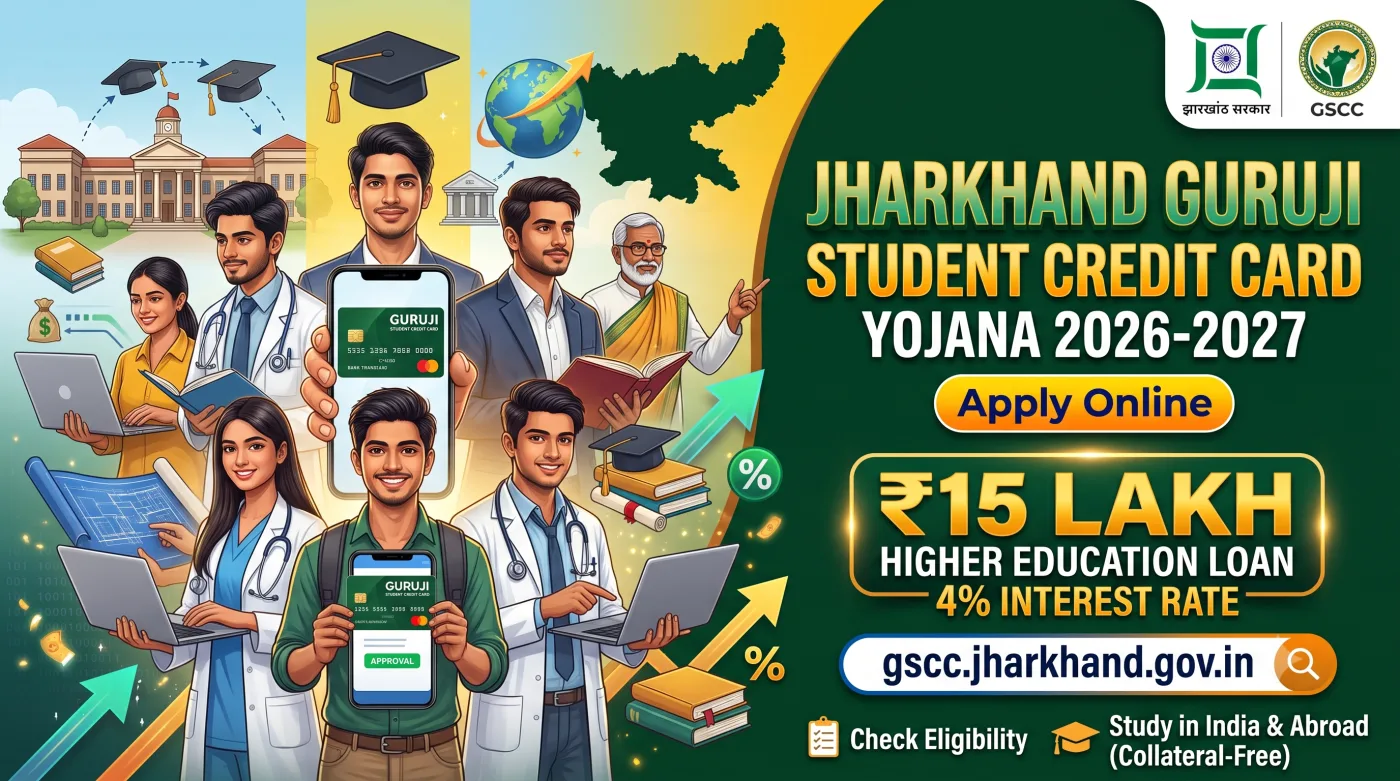
1. Comprehensive Policy Framework & Strategic Objective: Jharkhand Guruji Student Credit Card Yojana 2026-2027: Apply Online, ₹15 Lakh Higher Education Loan at 4%, Eligibility & gscc.jharkhand.gov.in
The Jharkhand Guruji Student Credit Card Yojana 2026-2027: Apply Online, ₹15 Lakh Higher Education Loan at 4%, Eligibility & gscc.jharkhand.gov.in marks an outstanding socio-economic protection initiative formulated and executed by the Department of Higher & Technical Education, Government of Jharkhand (उच्च एवं तकनीकी शिक्षा विभाग, झारखंड सरकार). Designed to deliver targeted financial liquidity, healthcare security, and livelihood resilience to marginalized citizens across Jharkhand (झारखंड), this flagship scheme demonstrates the state commitment to equitable public welfare delivery.
झारखंड सरकार द्वारा राज्य के मेधावी छात्र-छात्राओं को देश के शीर्ष उच्च शिक्षण संस्थानों में इंजीनियरिंग, मेडिकल, लॉ एवं प्रबंधन की पढ़ाई हेतु ₹15 लाख तक का रियायती एजुकेशन लोन प्रदान करने हेतु "गुरुजी स्टूडेंट क्रेडिट कार्ड योजना" शुरू की गई है। इस व्यापक मार्गदर्शिका में हम आपको इस योजना से जुड़ी हर एक बारीक जानकारी जैसे कि पात्रता मापदंड (Eligibility Criteria), वित्तीय सहायता स्लैब (Financial Assistance Slabs), आवश्यक दस्तावेज (Required Documents Checklist), ऑनलाइन/ऑफलाइन आवेदन प्रक्रिया (Step-by-Step Registration Guide), बेनेफिशरी लिस्ट स्टेटस (Beneficiary List & DBT Status) तथा तकनीकी समस्याओं के समाधान (Troubleshooting & Helpline Directory) के बारे में विस्तार से बता रहे हैं।
Statutory Governance & Welfare Architecture
Named in honor of pioneering Jharkhand leader Shibu Soren (Guruji), the Guruji Student Credit Card (GSCC) Scheme dismantles financial barriers that prevent talented students from rural and underprivileged backgrounds from pursuing elite professional degrees. Backed by a 100% credit guarantee from the Government of Jharkhand, the scheme eliminates the need for collateral property or third-party guarantors.
Administrative execution is closely monitored by District Collectors (DM / DC), Sub-Divisional Magistrates (SDM), and Block Development Officers (BDO), ensuring that eligible beneficiaries receive timely Direct Benefit Transfer (DBT) credit without bureaucratic delays or leakages.
| Welfare Governance Parameter | Official Standard / Policy Guideline |
|---|---|
| State & Nodal Authority | Department of Higher & Technical Education, Government of Jharkhand (उच्च एवं तकनीकी शिक्षा विभाग, झारखंड सरकार), Jharkhand (झारखंड) |
| Flagship Scheme Designation | Guruji Student Credit Card Yojana (GSCC - गुरुजी स्टूडेंट क्रेडिट कार्ड योजना) |
| Nature of Financial Assistance | Collateral-Free Education Credit up to ₹15 Lakh at 4% Simple Interest Rate |
| Disbursal Mechanism | 100% Aadhaar-Seeded Direct Benefit Transfer (DBT via APBS / PFMS) |
| Target Demographic Group | Women, Children, Laborers, Youth, Homeless & Marginalized Households |
| Application Mode | Online Citizen Portal, Mobile App & Gram Panchayat / Ward Special Camps |
| Official State Web Portal | https://gscc.jharkhand.gov.in/ |
2. Financial Assistance Structure, Payment Slabs & DBT Disbursal Schedule
Direct Benefit Transfer (DBT) serves as the core financial backbone of this welfare scheme. Funds are credited directly into beneficiary bank accounts, bypassing administrative intermediaries:
Under GSCC, students can avail education loans up to ₹15,00,000/- (Fifteen Lakhs) at a nominal simple interest rate of just 4% per annum. The remaining interest is subsidized directly by the state government. The repayment terms are student-centric: students enjoy a complete moratorium during the course duration plus 1 additional year, followed by flexible 15-year EMI repayment.
Aadhaar Payment Bridge System (APBS) & NPCI Seeding Mandate
To ensure zero transaction bounces and 100% success rates, the nodal department mandates strict adherence to banking protocols:
- NPCI Mapping (National Payments Corporation of India): The beneficiary savings bank account must be actively mapped with the NPCI central mapper. Having an Aadhaar card merely submitted to the bank is insufficient; the bank branch manager must execute active Aadhaar Seeding (आधार सीडिंग) for DBT transfers.
- Zero-Balance Financial Inclusion: Beneficiaries holding zero-balance accounts under Pradhan Mantri Jan Dhan Yojana (PMJDY) or basic savings bank deposit accounts (BSBDA) are fully eligible to receive scheme credits without minimum balance penalties.
- SMS Alert Confirmation: Upon successful treasury transfer, beneficiaries receive automated SMS notifications from the Public Financial Management System (PFMS) and their respective bank.
3. Detailed Beneficiary Eligibility & Strict Ineligibility Conditions
Ensuring complete transparency, the state administration enforces clear eligibility benchmarks alongside statutory disqualification clauses:
The student must be a permanent domicile of Jharkhand who has passed 10th and 12th examinations from recognized educational institutions in Jharkhand. The student must have secured admission in accredited higher educational institutions ranked within top NIRF bands (Engineering, Medical, MBA, Law, Research). Maximum applicant age is 40 years.
| Eligibility Sphere | Mandatory Inclusions | Strict Exclusion & Ineligibility Criteria |
|---|---|---|
| State Domicile | Permanent resident of Jharkhand (झारखंड) with valid Domicile Certificate | Migrant residents without authentic state residential documentation |
| Family Annual Income | Below prescribed state poverty / welfare ceiling | Families with member paying Income Tax (ITR) |
| Government Employment | Unorganized workers, unemployed youth, rural homemakers | Regular, permanent, or pensioned employees of Central/State Govt/PSUs |
| Landholding & Assets | Marginal farmers, landless laborers, pucca-house deprived | Families possessing four-wheeler vehicles or excessive land |
| Concurrent Welfare Scheme | Permissible under state convergence norms | Availing duplicate state benefit of higher monetary value |
4. Comprehensive Document Checklist & Authentication Protocols
To prevent application rejections during digital and field scrutiny, applicants must assemble these verified original documents along with self-attested photocopies:
| Document Type | Issuing Authority & Specific Verification Protocol |
|---|---|
| Aadhaar Card (आधार कार्ड) | UIDAI (Mandatory biometric e-KYC matching name, gender & DOB) |
| State Resident / Domicile Certificate (निवास प्रमाण पत्र) | Sub-Divisional Officer (SDO) / Tehsildar / Revenue Officer (RO) |
| Ration Card (राशन कार्ड) | Food & Civil Supplies Dept (Antyodaya / Priority Household / BPL) |
| Bank Account Passbook (बैंक पासबुक) | Nationalized / Scheduled Commercial Bank (Aadhaar & NPCI Linked) |
| Income Certificate (आय प्रमाण पत्र) | Competent Revenue Authority (Valid for current Financial Year) |
| Caste Certificate (जाति प्रमाण पत्र - SC/ST/OBC) | Tehsildar / SDO via State e-District Public Service Portal |
| Age Proof (आयु प्रमाण पत्र) | Birth Certificate / 10th Board Certificate / Voter ID Card |
| Self-Declaration & Affidavit (स्व-घोषणा पत्र) | Standardized Undertaking confirming non-taxpayer & eligible status |
| Recent Passport Size Photographs | Color passport photographs (3.5cm x 4.5cm, white background) |
5. Step-by-Step Application Guide: Online Portal & Special Camp Walkthrough
The application procedure is designed to be accessible, free of cost, and citizen-friendly across both digital portals and grassroots village camps:
1. Register online at gscc.jharkhand.gov.in with personal, academic, and Aadhaar particulars. 2. Select the admitting university/college and upload the official Admission Offer Letter and Fee Structure. 3. The admitting institution verifies admission online through institutional portal login within 7 days. 4. District Level Committee (DLC) headed by Deputy Commissioner (DC) reviews and approves loan sanction. 5. Partner public sector bank issues the physical Guruji Student Credit Card and disburses tuition fees directly to the institute and living allowances to the student.
Quality Assurance during Application Submission
- Mobile Number Consistency: Use a mobile number permanently linked with your Aadhaar Card to receive critical OTP verifications and DBT transfer alerts.
- Double-Check Bank Account Particulars: Ensure that the bank account is in the single name of the applicant (not a minor or joint account unless explicitly allowed). Verify the 11-digit IFSC code printed on the chequebook or passbook.
- Collect Acknowledgment Receipt: Always insist on collecting the physical or digital acknowledgment receipt bearing your Unique Application Tracking Number (आवेदन क्रमांक).
6. How to Check Beneficiary Status, Rejection List & Payment History
Citizens can track their application progress and monthly installment credits online from their home computer or smartphone:
| Verification Stage | Online Verification Action & Portal Menu | Expected Status Output |
|---|---|---|
| Stage 1: Application Submission | Portal Search by Application ID / Aadhaar Number | "Application Submitted & Forwarded for Field Scrutiny" |
| Stage 2: Inquiry & Verification | Gram Panchayat / Ward Officer Inspection Report | "Inquiry Completed - Eligible / Ineligible with Remarks" |
| Stage 3: Provisional List (अंतिम सूची) | Download Ward / Panchayat-wise Public List | Name listed in Public Objection & Claims Window |
| Stage 4: Final Sanction Order | Issuance of Digital Beneficiary Certificate / Approval Letter | "Approved by Competent Authority - Sanction Number Issued" |
| Stage 5: DBT Payment Credit | Track Payments via PFMS or State Portal DBT Tab | "FTO Generated - Amount Credited (UTR Number & Date)" |
7. Real-World Troubleshooting: Resolving Common Bottlenecks & DBT Bounces
Despite meeting all eligibility criteria, thousands of applicants experience delayed payments due to administrative and banking technical snags. Follow these field-tested remedies:
1. DBT Payment Failure: "Aadhaar Not Seeded to Account / Inactive Account"
This is the single most common cause of scheme benefit rejection. To resolve this, visit your bank branch and submit the official "Aadhaar Seeding and NPCI Mapping Consent Form". Request the branch official to link your account on the central NPCI mapper (not just core banking KYC). You can verify your active status on the official UIDAI portal under the "Check Aadhaar & Bank Account Linking Status" tool.
2. Name Spelling Discrepancy between Aadhaar and Bank Records
If your name spelling on your Aadhaar card differs even slightly from your bank passbook (e.g., "Sunita Devi" vs "Sunita Kumari"), the automated PFMS validation script will reject the payment. Update your bank passbook name to match your Aadhaar card, or visit an Aadhaar Seva Kendra to rectify your Aadhaar particulars.
3. Rejection under "Duplicate Beneficiary / Household Exclusion"
If your application is rejected on grounds of duplicate household registration or misreported income, submit a formal grievance (आपत्ति) to the Sub-Divisional Magistrate (SDM) or Block Development Officer (BDO) within 15 days, enclosing an updated income certificate and sworn affidavit.
8. Comparative Welfare Analysis & Transformative Socio-Economic Impact
Rigorous evaluations of state welfare schemes demonstrate dramatic multi-dimensional benefits across rural and semi-urban communities:
| Socio-Economic Indicator | Pre-Scheme Baseline Conditions | Post-Scheme Transformative Outcomes |
|---|---|---|
| Female Financial Autonomy | Total dependence on male family members for basic personal expenses | Independent cash reserves, direct savings & autonomous spending decisions |
| Child Nutrition & Healthcare | High incidence of childhood stunting, anemia & missed immunizations | Direct allocation towards milk, fruits, nutrition & private medical consultations |
| Rural Micro-Economy | Constrained consumer demand in village markets | Surge in village retail transactions, grocery purchasing & SHG investments |
| Reduction in Predatory Debt | Dependence on informal moneylenders charging 3% to 5% monthly interest | Substantial drop in emergency borrowing for medical and wedding expenses |
9. Citizen Rights, Public Grievance Redressal & Official Helpline Directory
Beneficiaries are legally entitled to prompt grievance redressal under state public service guarantee acts. In case of bribery demands, arbitrary rejections, or unexplained payment halts, register immediate complaints through official channels:
- State Chief Minister Citizen Helpline: Dial toll-free citizen grievance numbers (181 / CM Helpline) for instant telephonic complaint registration with a guaranteed time-bound inquiry.
- Right to Public Services (RTPS / लोक सेवा गारंटी): Inquiries on rejected applications must be officially resolved within 30 working days under statutory penalty provisions for defaulting officials.
- Anti-Corruption Vigilance: Applying for government welfare schemes is 100% free of cost. If any middleman (दलाल), CSC operator, or employee demands money, register a formal complaint with the District Anti-Corruption Bureau.
10. Complete Administrative Field Scrutiny Manual & Inspection Protocols
To eliminate corruption, ghost beneficiaries, and arbitrary rejections, the state government enforces a rigorous four-tier administrative scrutiny framework across all districts of Jharkhand (झारखंड):
1. Tier-1 Digital Validation (National Data Exchange Integration)
Upon form submission, automated digital validation scripts cross-reference the applicant entered demographic identifiers against central databases including UIDAI Aadhaar, Income Tax Department PAN registry, National Food Security Act (NFSA) ration databases, and transport department VAHAN registers. Discrepancies such as active commercial vehicle ownership or annual taxable income filings trigger automated provisional holds before field inquiry.
2. Tier-2 Grassroots Field Inquiry & Socio-Economic Assessment
Field verification officers—including Gram Panchayat Secretaries (पंचायत सचिव), Revenue Patwaris/Lekhpals, Village Employment Assistants (GRS), and Urban Ward Inspectors—conduct mandatory on-site visits. Officers inspect actual residential habitation, verify family living conditions, photograph the dwelling, and verify physical identity with village elders and neighbors.
3. Tier-3 Social Audit & Public Objection Window (दावा एवं आपत्ति)
A provisional list of all scrutinized applicants is published at Gram Panchayat Bhawans and municipal ward offices for a mandatory 7-day public review window. Any citizen holding evidence of ineligible inclusions can lodge formal, confidential objections before the Block Scrutiny Committee.
4. Tier-4 Sub-Divisional Approval & Treasury Direct Benefit Authorization
The Sub-Divisional Officer (SDO) or Sub-Divisional Magistrate (SDM) conducts random sample verifications (minimum 10% of total applications) before issuing final electronic sanction orders. Approved beneficiary data is digitally transmitted to the state integrated treasury management system for automated monthly DBT payment cycles.
| Administrative Level | Designated Inquiry Authority | Statutory Function & Accountability |
|---|---|---|
| Village / Ward Level | Panchayat Secretary / Lekhpal / Anganwadi Worker | Doorstep document collection, physical verification & spot inquiry |
| Block / Taluka Level | Block Development Officer (BDO) / Tehsildar | Desk scrutiny, compilation of provisional lists & objection disposal |
| Sub-Divisional Level | Sub-Divisional Magistrate (SDM / SDO) | Administrative sanction, randomized audit & grievance appellate review |
| District Level | District Collector / District Magistrate (DM / DC) | Budget allocation, treasury monitoring & district-wide scheme governance |
11. Real-World Case Studies & Empirical Success Chronicles
Understanding real-world transformative journeys illustrates the profound grassroots impact of Guruji Student Credit Card Yojana (GSCC - गुरुजी स्टूडेंट क्रेडिट कार्ड योजना) across vulnerable households:
Case Chronicle 1: Rebuilding Livelihood Resilience Post-Crises
Smt. Shanti Devi (Beneficiary from Rural Outskirts): Following the sudden demise of the primary earning family member, Shanti Devi faced severe financial destitution and mounting debt from village moneylenders. Enrolling in the scheme through a local Gram Panchayat camp, she received direct monthly assistance into her Jan Dhan account. Using the predictable liquidity, she eliminated emergency borrowing, secured continuous schooling for her children, and invested a portion of the funds into a local vegetable vending micro-enterprise, achieving sustainable self-reliance.
Case Chronicle 2: Overcoming Severe Administrative Documentation Hurdles
Pooja Bai (Overcoming Technical Rejection through Timely e-KYC): Initially, Pooja Bai encountered repeated payment bounce rejections due to an inactive NPCI mapping error at her rural cooperative bank branch. Guided by the official citizen troubleshooting manual, she visited the nearest nationalized bank, submitted a fresh Aadhaar NPCI consent mandate, and lodged a tracking ticket on the CM Helpline portal. Her bank records were updated within 48 hours, and all previously accrued arrears were credited into her account during the subsequent treasury cycle.
12. Technological Architecture, Digital Security & Mobile App Ecosystem
Modern state welfare administration relies on high-speed digital public infrastructure (DPI) to eliminate leakage, ensure real-time biometric identity authentication, and process millions of direct benefit transactions simultaneously:
1. Microservices-Based Digital Service Architecture
The state web portal and backend databases operate on secure, containerized microservices hosted on high-availability State Data Centres (SDC) with redundant disaster recovery sites (DRS) at the National Data Centre (NDC). The core architecture leverages standardized RESTful APIs connected to the Public Financial Management System (PFMS), National Payments Corporation of India (NPCI), and Unique Identification Authority of India (UIDAI). High-performance load balancers and Content Delivery Networks (CDNs) ensure that even during peak monthly installment disbursal dates when traffic surges past millions of concurrent hits, portal response times remain sub-second.
2. Biometric e-KYC & Zero-Knowledge Security Protocols
To comply with stringent data privacy standards under the Digital Personal Data Protection (DPDP) Act 2023, citizen biometric data is never stored locally on field devices or camp computers. Instead, fingerprint and iris impressions captured at village camps are encrypted via 2048-bit RSA keys at the device level and validated against UIDAI central servers using temporary session tokens. Aadhaar Virtual IDs (VID) and masked Aadhaar numbers are utilized in public records to protect citizens sensitive demographic information against data harvesting and cyber fraud.
3. Mobile Application Ecosystem & Offline Syncing Architecture
Recognizing severe cellular connectivity constraints across remote tribal, hilly, and riverine forest hamlets, the state government deployed mobile applications equipped with local SQLite caching and store-and-forward architecture. Field operators, Anganwadi workers, and village volunteers can record applicant details, capture geo-tagged photographs, and store draft records completely offline. Once the mobile device reconnects to a 4G/5G cellular network or village Wi-Fi hotspot, encrypted batch synchronization automatically uploads the verified records to central servers.
| Technology Layer | Software Framework / Protocol | Operational Function & Benefit |
|---|---|---|
| Identity Authentication | UIDAI Aadhaar e-KYC & Biometric Iris / Facial Auth | 100% Elimination of ghost, duplicate & non-existent claimants |
| Payment Settlement | Aadhaar Payment Bridge System (APBS via NPCI) | Direct, instantaneous bank credit without intermediary delays |
| Spatial Verification | ISRO Bhuvan Geo-Tagging & GPS Time-Stamping | Physical location verification for housing, assets & camp camps |
| Citizen Status Gateway | Automated SMS Gateway (NIC SMS Seva) & WhatsApp Bot | Real-time transaction alerts, installment dates & rejection reasons |
| Audit & Compliance | Public Financial Management System (PFMS) & CAG AuditOnline | Complete public ledger transparency & zero financial leakage |
13. Macro-Fiscal Budget Allocation & Interstate Comparative Welfare Benchmarks
A rigorous comparative analysis of state welfare initiatives highlights how targeted direct cash transfers stimulate rural consumption and drive economic growth across India:
Macro-Fiscal Budgetary Allocation & Economic Multiplier Impact
The state government allocates substantial fiscal outlays in the annual state budget to guarantee that welfare cash transfers remain uninterrupted throughout the financial year. Economists observe a powerful economic multiplier effect: every ₹1,000 disbursed directly to female heads of households generates an estimated ₹1,800 to ₹2,200 in secondary economic activity. Unlike corporate subsidies, cash transferred directly to rural women is immediately spent on local food staples, children healthcare, educational uniforms, and cottage trade supplies, revitalizing local village markets.
| State Welfare Scheme | Conducting State Authority | Monthly / Annual Financial Benefit | Key Distinguishing Feature |
|---|---|---|---|
| MP Ladli Behna Yojana | Madhya Pradesh | ₹1,250 to ₹1,500/Month (Target ₹3,000) | Unconditional cash liquidity for 1.29+ Crore women |
| Jharkhand Maiya Samman (JMMSY) | Jharkhand | ₹1,000 to ₹2,500/Month | Universal social security floor covering 18-50 age bracket |
| UP Kanya Sumangala (MKSY) | Uttar Pradesh | ₹25,000 in 6 Developmental Stages | Conditional cash transfer tied to immunization & higher education |
| Maharashtra Majhi Ladki Bahin | Maharashtra | ₹1,500/Month (₹18,000/Year) | Broad-based coverage with yellow/orange ration card exemption |
| MP Sambal 2.0 | Madhya Pradesh | Up to ₹4 Lakh Ex-Gratia + Hospital Aid | Full-lifecycle social security net for unorganized labor |
| Jharkhand Abua Awas | Jharkhand | ₹2,00,000 in 4 Stages for 3 Rooms | 100% State-funded 3-room pucca homes for homeless families |
14. Long-Term Societal Transformation & Generational Empowerment
The institutionalization of predictable, direct citizen transfers fosters profound societal transformation that extends far beyond immediate fiscal relief:
1. Elimination of Deep-Rooted Gender Inequalities
By establishing financial transfers directly into bank accounts owned by women, the state reconfigures household power dynamics. Women who previously lacked discretionary funds now possess decision-making authority over household investments, children healthcare, and nutrition, dismantling age-old patriarchal dependency structures.
2. Enhanced Institutional Trust & Civic Engagement
When citizens experience transparent, leakage-free public service delivery directly on their mobile phones without having to pay bribes to village middlemen, trust in constitutional institutions expands dramatically. Beneficiaries become active civic participants, demanding accountability in local schools, primary health centers, and Gram Panchayat decision-making forums.
3. Future Expansion & AI-Powered Welfare Delivery Horizons
Looking toward future expansion phases for 2026-2027 and beyond, the state administration is integrating machine learning algorithms to proactively identify eligible citizens who have fallen through bureaucratic cracks. Automated birth-registration triggers, predictive enrollment upon turning 18 or 21, and paperless digital locker integration represent the next frontier in universal social protection.
15. Offline Representation Formats, RTI Application Drafting & Citizen Legal Protections
In instances where digital grievances remain unaddressed or local administrative operators cause undue delays, citizens can exercise their statutory rights through formal written representations and the Right to Information (RTI) Act:
1. Standard Offline Grievance Representation Format
When approaching the Sub-Divisional Officer (SDO / SDM) or District Magistrate (DM) during weekly Janta Darbar (जनता दरबार) or public hearing days, submit a formal written application drafted in clear, respectful Hindi or English:
| Application Section | Prescribed Standard Text & Formatting Guideline |
|---|---|
| Addressing the Competent Authority | सेवा में, श्रीमान अनुमंडल पदाधिकारी / जिला पदाधिकारी महोदय, [जिले का नाम] |
| Subject Line (विषय) | विषय: Jharkhand Guruji Student Credit Card Yojana 2026-2027: Apply Online, ₹15 Lakh Higher Education Loan at 4%, Eligibility & gscc.jharkhand.gov.in के अंतर्गत लंबित आवेदन के त्वरित निष्पादन एवं डीबीटी भुगतान के संबंध में। |
| Applicant Identification | महोदय, सविनय निवेदन है कि मैं [आवेदक का नाम], निवासी ग्राम/वार्ड [नाम], प्रखण्ड [नाम] का/की स्थायी निवासी हूँ। मेरी समग्र/पारिवारिक आईडी [नंबर] तथा आवेदन पावती क्रमांक [नंबर] है। |
| Specific Grievance Description | मैंने दिनांक [तारीख] को योजना हेतु सभी वैध दस्तावेजों के साथ आवेदन किया था। स्थलीय सत्यापन के उपरांत भी मेरा नाम अंतिम सूची में शामिल नहीं किया गया है / मेरी बैंक खाते में डीबीटी किस्त अप्राप्त है। |
| Relief Sought & Enclosures | अतः श्रीमान से करबद्ध प्रार्थना है कि मेरे आवेदन की पुनः जांच करवाकर पात्र पाए जाने पर योजना का लाभ प्रदान करने की कृपा की जाए। संलग्न: आधार कार्ड, बैंक पासबुक, आय व निवास प्रमाण पत्र की छायाप्रति। |
2. Right to Information Act (RTI 2005) Query Drafting
If an application is rejected without specifying concrete legal or documentary grounds, citizens can file an online or postal RTI application with a nominal fee of ₹10, seeking certified administrative records:
- Point 1: Please provide certified copies of the physical verification report, inquiry officer inspection remarks, and geo-tagged photographic evidence recorded against my Application Number.
- Point 2: Please provide the certified name, designation, and official contact details of the competent authority responsible for reviewing and approving my scheme entitlement.
- Point 3: Please provide the certified total number of applications received, sanctioned, rejected, and pending under this scheme in my Gram Panchayat / Ward during the current financial year.
- Point 4: Please state the specific rule, clause, or policy notification under which my application was rejected, along with certified copies of the rejection order.
3. Statutory Whistleblower Protection & Anti-Bribery Redressal
Applying for and receiving benefits under state government welfare schemes is a fundamental citizen entitlement provided 100% free of cost by the state exchequer. Demanding any form of commission, administrative facilitation fee, or bribe constitutes a cognizable criminal offense under the Prevention of Corruption Act 1988 (as amended in 2018). Citizens should never pay cash to middlemen, cyber cafe operators, or village functionaries. In the event of corrupt solicitations, immediately dial the state Anti-Corruption Bureau (ACB) toll-free vigilance helpline or lodge a confidential digital complaint on the state anti-graft citizen portal.
User Discussion & Comments (0)
No comments yet. Be the first to leave a comment below!
Leave a Comment / Ask a Question: