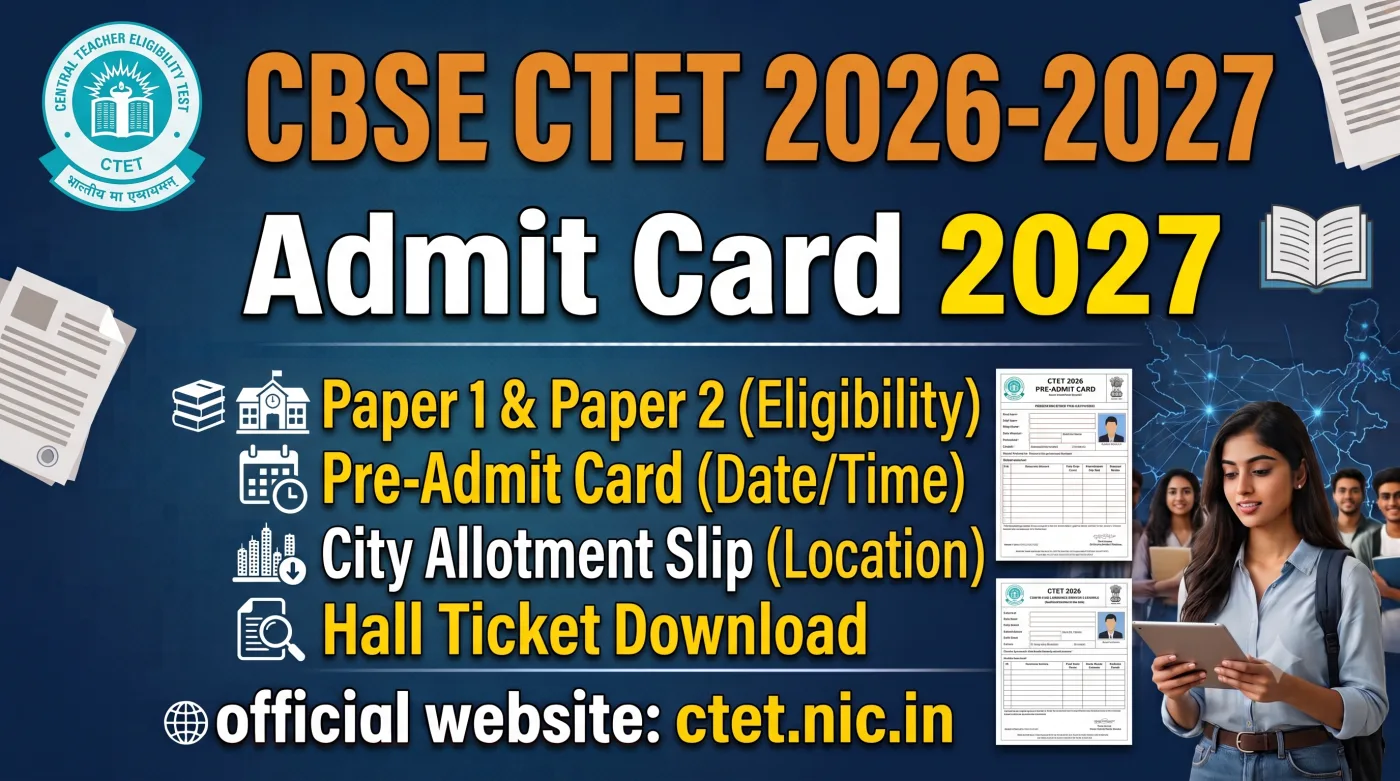
The Central Teacher Eligibility Test (CTET) conducted by the Central Board of Secondary Education (CBSE) is India’s premier national benchmark for teaching appointments in central government schools—including Kendriya Vidyalayas (KVS), Jawahar Navodaya Vidyalayas (NNV), Central Tibetan Schools, army public schools, and schools administered by the Union Territories of Chandigarh, Dadra & Nagar Haveli, Daman & Diu, Andaman & Nicobar Islands, Lakshadweep, and the NCT of Delhi. Every cycle, upwards of 25 to 30 lakh aspiring educators appear for Paper 1 (Primary Teachers for Classes I to V) and Paper 2 (Upper Primary Teachers for Classes VI to VIII). Downloading your authentic CTET Admit Card 2026-2027 is the compulsory first step toward entering the offline examination venue. This master guide provides a comprehensive walkthrough for downloading your e-Admit Card, decoding the shift schedule, mastering OMR bubbling guidelines, and preparing for the 150-question test. (केंद्रीय शिक्षक पात्रता परीक्षा (CTET) 2026-2027 का ई-प्रवेश पत्र, परीक्षा शहर पर्ची, ओएमआर शीट नियम और महत्वपूर्ण दिशा-निर्देशों की संपूर्ण आधिकारिक जानकारी नीचे दी गई है।)
1. Executive Summary: CTET Examination Structure & Framework
The Central Teacher Eligibility Test operates as a national qualifying examination designed to ensure high educational standards and pedagogic competence among educators entering elementary and middle school classrooms. The test architecture comprises two distinct papers:
- Paper 1 (For Classes I to V - Primary Stage): Evaluates foundational pedagogical knowledge across five disciplines: Child Development and Pedagogy, Mathematics, Environmental Studies (EVS), Language I, and Language II (150 Questions, 150 Marks, 150 Minutes).
- Paper 2 (For Classes VI to VIII - Elementary Stage): Evaluates subject-matter specialization across Child Development and Pedagogy, Language I, Language II, and either Mathematics & Science (60 Qs) OR Social Studies / Social Sciences (60 Qs) (150 Questions, 150 Marks, 150 Minutes).
| Examination Dimension | Official Specification & Structural Benchmark |
|---|---|
| Exam Conducting Authority | Central Board of Secondary Education (CBSE / केंद्रीय माध्यमिक शिक्षा बोर्ड) |
| Examination Name | Central Teacher Eligibility Test (CTET / केंद्रीय शिक्षक पात्रता परीक्षा) |
| Testing Mode | Pen and Paper Based (OMR Sheet Offline Examination) |
| Total Questions & Marks | 150 Questions | 150 Marks (1 Mark per Question) |
| Exam Duration | 2 Hours and 30 Minutes (150 Minutes) per Paper |
| Negative Marking | Strictly NO Negative Marking (Zero penalty for wrong answers) |
| Certificate Validity | Lifetime Validity for all categories across India |
| Official Web Portal | https://ctet.nic.in/ |
2. Two-Stage Digital Rollout: Pre-Admit Card vs. Final e-Admit Card
To facilitate long-distance travel arrangements and preserve security, CBSE implements a calibrated, two-tier digital document release:
- Tier 1: Pre-Admit Card / Exam City Intimation Slip (10 to 14 Days in Advance): Discloses the candidate's allotted **Exam City**, **Exam State**, and **Assigned Paper Shifts**. It allows adequate time for railway reservations, bus bookings, and hotel arrangements. It does NOT disclose the specific school venue name or roll number.
- Tier 2: Final Printable e-Admit Card (Strictly 2 Days in Advance): Unlocks on the portal exactly two days before the examination date. It discloses the precise school/institution name, street address, candidate roll number, invigilator signature boxes, and security barcode.
| Document Type | Release Schedule | Information Disclosed | Center Entry Validity |
|---|---|---|---|
| Pre-Admit Card | 10 to 14 Days Before Exam | Allotted Exam City & Date | No (Information Only) |
| Final e-Admit Card | 2 Days Before Exam Date | Exact School Name, Address, Roll Number, Barcode | Yes (Mandatory Entry Ticket) |
3. Step-by-Step Walkthrough: How to Download CTET Admit Card 2026
Follow these verified steps on the official CBSE CTET portal (ctet.nic.in):
- Visit the Official Portal: Open your browser and navigate to https://ctet.nic.in/.
- Click on "Download Admit Card for CTET": Locate the active notification link prominently displayed on the homepage.
- Enter Your Login Credentials: Input your:
- Application Number: 12-digit numeric code received during registration.
- Date of Birth: Selected in Day - Month - Year dropdown format.
- Solve the Security Pin: Accurately enter the case-sensitive security pin displayed on the screen.
- Click Submit: Your personalized candidate dashboard will appear.
- Review Details & Download PDF: Click on "Download Admit Card". Verify all printed particulars and save the high-definition PDF to your smartphone and computer.
- Print Physical Copies: Take two clear printouts on standard A4 paper, ensuring that the barcode, candidate photograph, and signature are sharp and legible.
4. Examination Shift Timings & Strict Gate Closure Regulations
CBSE strictly conducts Paper 2 in the morning shift and Paper 1 in the afternoon shift. Note the exact reporting windows:
| Examination Paper | Reporting Time | Strict Gate Closure | Examination Window |
|---|---|---|---|
| Paper 2 (Elementary Classes VI-VIII) | 07:30 AM IST | 09:30 AM IST (Sharp) | 09:30 AM to 12:00 PM Noon (2.5 Hours) |
| Paper 1 (Primary Classes I-V) | 12:30 PM IST | 02:30 PM IST (Sharp) | 02:30 PM to 05:00 PM (2.5 Hours) |
5. Mandatory Documents Checklist for CTET Examination Center
Every candidate must carry the following mandatory documents in original format:
- Printed CTET e-Admit Card: Clean A4 printout with clear barcode, photograph, and candidate particulars.
- Original Government-Issued Photo Identity Proof: PAN Card, Aadhaar Card, Passport, Driving License, or Voter ID.
- Good Quality Ballpoint Pen (Blue or Black): Transparent barrel ballpoint pen for bubbling the OMR sheet.
- Candidate Self-Declaration Form: Printed from the admit card, filled in your running handwriting and signed.
6. CTET Paper 1 & Paper 2 Examination Pattern & Marks Distribution
The offline examination evaluates pedagogical and academic competencies across standard modules:
A. Paper 1 (Classes I to V - Primary Stage)
| Subject Area | Questions | Marks | Time Allowed |
|---|---|---|---|
| Child Development and Pedagogy | 30 Questions | 30 Marks | Part of 150 Minutes |
| Mathematics | 30 Questions | 30 Marks | Part of 150 Minutes |
| Environmental Studies (EVS) | 30 Questions | 30 Marks | Part of 150 Minutes |
| Language I (Compulsory) | 30 Questions | 30 Marks | Part of 150 Minutes |
| Language II (Compulsory) | 30 Questions | 30 Marks | Part of 150 Minutes |
| Total Paper 1 | 150 Questions | 150 Marks | 2 Hours 30 Minutes |
B. Paper 2 (Classes VI to VIII - Elementary Stage)
| Subject Area | Questions | Marks | Time Allowed |
|---|---|---|---|
| Child Development and Pedagogy | 30 Questions | 30 Marks | Part of 150 Minutes |
| Mathematics & Science (For Maths/Science Teachers) OR Social Studies (For Social Science Teachers) | 60 Questions | 60 Marks | Part of 150 Minutes |
| Language I (Compulsory) | 30 Questions | 30 Marks | Part of 150 Minutes |
| Language II (Compulsory) | 30 Questions | 30 Marks | Part of 150 Minutes |
| Total Paper 2 | 150 Questions | 150 Marks | 2 Hours 30 Minutes |
7. Critical OMR Sheet Darkening Guidelines
Follow these strict instructions to ensure your OMR answer sheet is evaluated without scanner rejection:
- Darken Circles Completely: Use a black or blue ballpoint pen to darken the circle completely. Avoid tick marks, crosses, or faint pencil dots.
- Careful Roll Number & Booklet Code Bubbling: Ensure that your Roll Number, Main Test Booklet Number, and Language Booklet Code are darkened accurately.
- Zero Liquid / Whitener: Do not use correcting fluid, eraser, or blade on the OMR sheet. Damaged or chemically treated sheets are rejected by the computerized scanning machine.
8. Prohibited Items Checklist & Candidate Dress Code
Adhere strictly to these security parameters:
- Strictly Prohibited Electronic Items: Mobile phones, pagers, digital watches, smart wristbands, calculators, Bluetooth earpieces, microphones, wireless transmitters, and pen drives.
- Personal Effects: Belts with heavy metallic buckles, wallets, handbags, ornaments, bangles, rings, and loose paper. Testing centers provide zero storage or locker facilities.
- Recommended Dress Code: Wear light, simple cotton clothes without heavy embroidery, metallic studs, or oversized buttons. Half-sleeve T-shirts or kurtas paired with simple slippers or flat sandals are strongly recommended to expedite metal detector screening.
CTET Paper 1 vs. Paper 2: Structural Architecture & Pedagogical Blueprint
The Central Teacher Eligibility Test (CTET) conducted by the Central Board of Secondary Education (CBSE) is the premier national benchmark determining eligibility for appointment as teachers in Central Government schools (Kendriya Vidyalaya Sangathan, Navodaya Vidyalaya Samiti, Eklavya Model Residential Schools, Central Tibetan Schools) and schools under the administrative control of UTs:
| Test Segment | Paper 1 (Primary Stage: Classes I to V) | Paper 2 (Elementary Stage: Classes VI to VIII) |
|---|---|---|
| Child Development & Pedagogy (CDP) | 30 MCQs / 30 Marks (Focus: Child development age 6-11, inclusive education, learning concepts) | 30 MCQs / 30 Marks (Focus: Educational psychology of adolescence age 11-14, cognitive development) |
| Language I (Compulsory Medium) | 30 MCQs / 30 Marks (Proficiency in chosen medium of instruction + pedagogy of language development) | 30 MCQs / 30 Marks (Unseen prose/poetry passages, linguistic comprehension, pedagogical principles) |
| Language II (Second Language) | 30 MCQs / 30 Marks (Must be distinct from Language I; tests basic communication, grammar, and vocabulary) | 30 MCQs / 30 Marks (Must be different from Language I; unseen prose passages and language pedagogy) |
| Mathematics / Domain Discipline | 30 MCQs / 30 Marks (Numbers, geometry, measurement, weight, time, data handling, and pedagogical math issues) |
For Math & Science Teachers: Mathematics (30 Qs) + Science (30 Qs) = 60 MCQs / 60 Marks For Social Studies / Social Science Teachers: History, Geography, Social & Political Life + Pedagogy = 60 MCQs / 60 Marks |
| Environmental Studies (EVS) | 30 MCQs / 30 Marks (Family & friends, food, shelter, water, travel, things we make & do, EVS concepts) | |
| Total Evaluation Scale | 150 Questions | 150 Marks | 150 Minutes (No Negative Marking) | 150 Questions | 150 Marks | 150 Minutes (No Negative Marking) |
Pre-Admit Card vs. Final Admit Card: Dual-Stage Issuance Framework
CBSE executes a systematic two-tier release strategy to balance candidate convenience with examination security:
- Phase 1: Pre-Admit Card (Exam City Allotment Slip): Released approximately 10 to 14 days prior to the examination. It informs the candidate of their assigned examination city, state, exam date, and allotted paper shift. This allows candidates from rural or distant areas to book bus or train tickets in advance. Crucial Note: The Pre-Admit Card does NOT mention the school or testing center name and CANNOT be used for examination center entry.
- Phase 2: Final Printable e-Admit Card: Unlocked on the official portal (
ctet.nic.in) exactly 2 days prior to the examination date. It carries the complete name and street address of the allotted examination school, center code, reporting time, roll number, and candidate barcode.
DigiLocker Integration & Lifetime Validity Regulations
In adherence to National Council for Teacher Education (NCTE) statutory notifications, the validity and storage of CTET credentials have been revolutionized:
📜 आजीवन वैधता एवं डिजिलॉकर डिजिटल प्रमाणपत्र (DigiLocker Lifetime Validity)
एनसीटीई (NCTE) के संशोधित नियमों के अनुसार सीटीईटी उत्तीर्ण प्रमाणपत्र (CTET Certificate) की वैधता अवधि अब आजीवन (Lifetime Validity) कर दी गई है। इसके अलावा:
- सीबीएसई अब भौतिक हार्डकॉपी प्रमाणपत्र डाक द्वारा नहीं भेजता है। परिणाम घोषित होने के बाद सभी सफल अभ्यर्थियों की डिजिटल अंकतालिका (Marksheet) एवं प्रमाणपत्र (Certificate) उनके डिजिलॉकर (DigiLocker) खाते में सीधे अपलोड किए जाते हैं।
- डिजिलॉकर में उपलब्ध प्रमाणपत्र पर सीबीएसई परीक्षा नियंत्रक के क्रिप्टोग्राफिक रूप से सत्यापित डिजिटल हस्ताक्षर होते हैं, जो सूचना प्रौद्योगिकी अधिनियम (IT Act 2000) के तहत सभी सरकारी एवं निजी शिक्षक भर्तियों में कानूनी रूप से पूर्णतः मान्य हैं।
Qualifying Marks Benchmark & Social Reservation Cutoffs
The National Council for Teacher Education (NCTE) establishes clear benchmark cutoffs to be certified as a qualified teacher:
| Candidate Category | Prescribed Percentage Cutoff | Minimum Qualifying Score (Out of 150) | Certification Status |
|---|---|---|---|
| General (Unreserved / Open) | 60% Qualifying Benchmark | 90 Marks | Issued CTET Eligibility Certificate |
| OBC (Non-Creamy Layer) | 55% Qualifying Benchmark | 82.5 Marks (Rounded off to 82 Marks) | Issued CTET Eligibility Certificate |
| Scheduled Castes (SC) | 55% Qualifying Benchmark | 82 Marks | Issued CTET Eligibility Certificate |
| Scheduled Tribes (ST) | 55% Qualifying Benchmark | 82 Marks | Issued CTET Eligibility Certificate |
| Differently Abled (PwD / CwSN) | 55% Qualifying Benchmark | 82 Marks | Issued CTET Eligibility Certificate |
Examination Hall Guidelines & OMR Sheet Bubble Instructions
The examination uses OMR response sheets evaluated by optical scanners. Candidates must adhere to strict bubbling standards:
- Blue or Black Ballpoint Pen Only: Bubbles must be darkened completely with a solid black or royal blue ballpoint pen. Fountain pens, gel pens, sketch pens, and pencils are strictly banned.
- Language Supplement Booklet Verification: Candidates who have opted for regional languages (e.g., Urdu, Sanskrit, Bengali, Punjabi) receive a separate supplementary language booklet. Ensure that the Code of the Language Supplement Booklet matches the Question Booklet Code of the main paper.
- Zero Negative Marking Strategy: Because there is no penalty for incorrect answers in CTET, candidates must attempt all 150 questions. Unanswered questions result in guaranteed zero marks, whereas an educated attempt retains a 25% statistical probability of gaining marks.
CTET Pedagogical Master Blueprint: Paper 1 & Paper 2 Detailed Syllabus
The Central Teacher Eligibility Test is renowned for its application-based, analytical pedagogical framing. Success requires deep theoretical grounding in educational psychology combined with practical classroom situational judgment:
| Curricular Domain | High-Yield Pedagogical Concepts & Thinkers | Classroom Application Weightage |
|---|---|---|
| Child Development & Psychology | Jean Piaget's 4 stages of cognitive development (Sensorimotor, Preoperational, Concrete, Formal Operational), Lev Vygotsky's Socio-Cultural Theory (ZPD, Scaffolding, MKO), Lawrence Kohlberg's stages of moral development, Erik Erikson's psychosocial stages, Howard Gardner's Multiple Intelligences theory. | 15 Questions in CDP module |
| Inclusive Education & Special Needs | Addressing learners from diverse backgrounds, disadvantaged and deprived groups, learning difficulties (Dyslexia, Dyscalculia, Dysgraphia, ADHD, Autism Spectrum), identifying gifted, creative, and specially-abled learners. Rights of Persons with Disabilities Act, 2016. | 5 Questions in CDP module |
| Learning & Pedagogy | How children think and learn; reasons for student failure; teaching as a social activity; child as a problem solver and scientific investigator; alternative conceptions of learning in children; cognition and emotions; motivation and learning; factors contributing to learning (personal and environmental). | 10 Questions in CDP module |
| Language Acquisition & Pedagogy | Noam Chomsky's Universal Grammar & Language Acquisition Device (LAD), Stephen Krashen's Second Language Acquisition Hypotheses, B.F. Skinner's operant conditioning, Principles of language teaching, Role of listening and speaking, Challenges of teaching language in diverse classrooms, Language skills (LSRW: Listening, Speaking, Reading, Writing), Remedial teaching. | 15 Questions per language paper |
| Environmental Studies (EVS) Themes | 6 Core Primary Themes: Family and Friends (Relationships, Work & Play, Animals, Plants), Food, Shelter, Water, Travel, Things We Make and Do. Integrated EVS approach under NEP 2020, Activity-based learning, Environmental sensitization. | 30 Questions in Paper 1 |
DigiLocker Step-by-Step Certificate Download Guide
CBSE automatically deposits cryptographically signed digital marksheets and eligibility certificates onto the DigiLocker platform upon official result declaration:
- Download DigiLocker App or Visit Portal: Download the DigiLocker mobile application from Google Play Store or visit digilocker.gov.in.
- Sign In / Register: Click on "Sign In". Enter your mobile number registered with CBSE during CTET application or your 12-digit Aadhaar number.
- Enter Security PIN: Enter your 6-digit security PIN provided via SMS by CBSE or your custom PIN created during Aadhaar e-KYC.
- Search Document: Navigate to the search bar and type "Central Board of Secondary Education" or "CTET".
- Select Document Type: Choose either "Teacher Eligibility Test Certificate" or "Teacher Eligibility Test Marksheet".
- Enter Roll Number & Year: Enter your exact 8-digit or 9-digit CTET Roll Number and select the examination session month and year from the dropdown menu.
- Fetch Document: Click "Get Document". The certificate is downloaded into your "Issued Documents" repository, featuring the green tick digitally verified stamp of CBSE.
CTET Career Scope & Applicability Across National Teaching Cadres
Holding a CTET qualifying certificate with lifetime validity unlocks teaching vacancies across major state and national educational authorities:
- Kendriya Vidyalaya Sangathan (KVS): Mandatory prerequisite for Primary Teacher (PRT - Pay Level 6) and Trained Graduate Teacher (TGT - Pay Level 7) recruitments across 1,250+ Kendriya Vidyalayas nationwide.
- Navodaya Vidyalaya Samiti (NVS): Essential eligibility criterion for TGT faculty recruitment across 650+ Jawahar Navodaya Vidyalayas located across rural India.
- Delhi Subordinate Services Selection Board (DSSSB): Compulsory qualification for PRT and TGT appointments across Directorate of Education (DoE) and Municipal Corporation of Delhi (MCD) schools.
- Eklavya Model Residential Schools (EMRS): Mandatory requirement for teacher recruitments across tribal residential schools under the Ministry of Tribal Affairs.
- State Government Recruitments: Several states including Haryana, Uttar Pradesh, Bihar, and Jharkhand accept CTET certification in lieu of State TET examinations for primary and upper primary teacher recruitment drives.
🎯 सीटीईटी परीक्षा में 130+ अंक प्राप्त करने की स्वर्णिम तकनीक
सीटीईटी में केवल 90 अंकों पर पास होने के बजाय 130+ का उत्कृष्ट स्कोर पाने हेतु निम्न रणनीतिक नियमों का पालन करें:
- बाल-केंद्रित दृष्टिकोण (Child-Centered Approach): किसी भी शिक्षण पद्धति संबंधी प्रश्न का उत्तर देते समय हमेशा उस विकल्प को चुनें जिसमें विद्यार्थी सक्रिय (Active), अन्वेषक (Explorer) तथा केंद्र में हो, और शिक्षक केवल एक सुगमकर्ता (Facilitator) की भूमिका में हो।
- रटंत प्रणाली का निषेध: दंड, रटना (Rote Memorization), परिभाषाएं याद कराना, तथा पृथक्करण (Segregation) वाले विकल्पों को तुरंत खारिज कर दें।
- एनसीईआरटी की पाठ्यपुस्तकें: कक्षा 3 से 5 तक की एनसीईआरटी पर्यावरण (आस-पास) तथा कक्षा 6 से 8 तक की विज्ञान/सामाजिक विज्ञान की मूल पुस्तकों का गहन अध्ययन करें। 80% विषयगत प्रश्न सीधे एनसीईआरटी पाठों से पूछे जाते हैं।
National Education Policy (NEP 2020) Alignment & Continuous Evaluation
In accordance with the National Education Policy (NEP 2020), the Central Board of Secondary Education has restructured CTET pedagogical frameworks to focus on 21st-century competencies, experiential learning, and holistic child development:
| NEP 2020 Curricular Stage | Target Age Group & Classes | Pedagogical Framework Tested in CTET |
|---|---|---|
| Foundational Stage (5 Years) | Ages 3 to 8 (Balvatika to Class 2) | Play-based, activity-based, inquiry-based learning. Development of Foundational Literacy and Numeracy (FLN / NIPUN Bharat mission). |
| Preparatory Stage (3 Years) | Ages 8 to 11 (Classes 3 to 5 / Paper 1) | Gradual transition from play to structured classroom learning, introduction of light textbooks in languages, math, and general sciences. |
| Middle Stage (3 Years) | Ages 11 to 14 (Classes 6 to 8 / Paper 2) | Subject-oriented pedagogical methodology, experiential learning in sciences and social sciences, vocational education exposure. |
Continuous & Comprehensive Evaluation (CCE) and Assessment Paradigms
Modern CTET questions test prospective teachers on distinguishing between assessment modalities:
- Assessment FOR Learning (Formative Assessment): Ongoing, diagnostic evaluations during the instructional process to identify learning gaps and adapt teaching methods. Includes quizzes, peer reviews, portfolios, and observation rubrics.
- Assessment OF Learning (Summative Assessment): Conducted at the end of an instructional period (term exams, annual assessments) to grade or certify achievement benchmarks against standardized criteria.
- Assessment AS Learning: Active self-monitoring and reflection by students to assess their own cognitive understanding and set individual academic goals.
Right to Education (RTE) Act 2009 Statutory Provisions
Every CTET paper features questions derived from the Right of Children to Free and Compulsory Education Act, 2009:
- Pupil-Teacher Ratio (PTR): 30:1 for Primary Schools (Classes 1 to 5) and 35:1 for Upper Primary Schools (Classes 6 to 8).
- Working Days & Instructional Hours: Minimum 200 working days / 800 instructional hours per academic year for Primary; Minimum 220 working days / 1000 instructional hours for Upper Primary.
- Teacher Weekly Hours: Minimum 45 teaching hours including preparation hours per week for teachers.
- Prohibitions: Absolute statutory ban on physical punishment, mental harassment, screening procedures for admission, capitation fees, private tuition by teachers, and running un-recognized schools.
Foundational Pedagogical Thinkers & Theoretical Frameworks
Mastery of core pedagogical theories ensures consistent accuracy in CTET Child Development & Pedagogy:
| Theorist & Core Concept | Fundamental Educational Hypothesis | Direct CTET Question Formulation |
|---|---|---|
| Jean Piaget (Constructivism) | Children are "Little Scientists" who actively construct knowledge through Schema, Assimilation, Accommodation, and Equilibration. | Conservation of liquid volume, Egocentrism in pre-operational stage, Object permanence in infancy. |
| Lev Vygotsky (Socio-Cultural) | Cognitive development is mediated by language, culture, and social interaction. Zone of Proximal Development (ZPD) and Scaffolding. | Peer collaboration, Role of More Knowledgeable Other (MKO), Private speech directing behavior. |
| Lawrence Kohlberg (Moral Development) | 6 stages across 3 levels: Pre-conventional (Punishment/Obedience, Instrumental Relativist), Conventional (Good boy/nice girl, Law and Order), Post-conventional (Social contract, Universal ethical principles). | Heinz Dilemma scenarios, Carol Gilligan's critique of gender bias in Kohlberg's theory. |
| Howard Gardner (Multiple Intelligences) | Intelligence is not a single unitary entity, but 8 distinct competencies: Linguistic, Logical-Mathematical, Spatial, Bodily-Kinesthetic, Musical, Interpersonal, Intrapersonal, Naturalistic. | Differentiating instruction based on diverse student intelligence profiles in inclusive classrooms. |
Supreme Court Landmark Judgments on Teacher Eligibility (B.Ed vs D.El.Ed)
Candidates must take note of the statutory legal framework governing teacher eligibility:
- Devesh Sharma vs. Union of India (2023): The Supreme Court of India upheld that Diploma in Elementary Education (D.El.Ed / BTC) holders possess exclusive eligibility for Primary Teacher (Classes 1 to 5 / Paper 1) appointments. B.Ed degree holders are legally eligible for Upper Primary / TGT (Paper 2) and PGT positions.
- CTET Paper Selection Guideline: Candidates with D.El.Ed can appear for Paper 1 (and Paper 2 if they possess graduation). Candidates with B.Ed should focus strategically on Paper 2.
In-Depth 20-Point Pedagogical Concept Map for CTET Exam Excellence
Master these core psychological terms to rapidly identify correct answers in the Child Development & Pedagogy section:
| Pedagogical Concept | Core Psychological Definition | Target Classroom Teacher Action |
|---|---|---|
| Scaffolding (मचान / पाड़) | Temporary support provided by adult/peer until child achieves independent competence. | Providing hints, prompts, breaking problems into manageable sub-steps. |
| Schema (स्कीमा) | Mental building blocks or cognitive frameworks that organize and interpret information. | Connecting new lesson content with prior knowledge schema of learners. |
| Private Speech (निजी वार्ता) | Children speaking aloud to themselves to guide their actions and solve tasks (Vygotsky). | Encouraging self-talk as a legitimate cognitive self-regulation mechanism. |
| Metacognition (परासंज्ञान) | Knowledge and awareness of one's own cognitive processes ("Thinking about thinking"). | Encouraging students to evaluate their own problem-solving approaches and study habits. |
Language I vs. Language II Selection Strategy
Candidates must select Language I as the medium in which they have maximum literary fluency, because Language I features unseen poetry requiring nuanced emotional and figurative interpretation. Language II features unseen prose passages focusing primarily on factual comprehension and grammar.
Comprehensive 30-Item Language Pedagogy Lexicon for CTET Aspirants
Linguistic pedagogy constitutes 30 marks across Language I and Language II. Master these core terminology concepts:
| Linguistic Term | Technical Pedagogical Definition | Classroom Demonstration Scenario |
|---|---|---|
| Phoneme (स्वनिम्) | The smallest distinct sound unit in a spoken language (/k/, /p/, /t/). | Phonics instruction and sound segmentation in kindergarten and primary classes. |
| Morpheme (रूपिम्) | The smallest meaningful grammatical unit in language (words, prefixes, suffixes). | Prefix and suffix addition exercises to teach vocabulary expansion. |
| BICS vs CALP (Cummins) | BICS: Basic Interpersonal Communicative Skills (Social talk); CALP: Cognitive Academic Language Proficiency (Textbook discourse). | Transitioning students from playground conversation to complex academic essay writing. |
National Curriculum Framework for Foundational Stage (NCF-FS) Guidelines
The NCF-FS focuses on mother-tongue instruction in early childhood care and education (ECCE). CTET questions emphasize that home language should serve as the natural bridge for introducing standard language registers in primary schools.
Pedagogical Assessment Tools & Rubrics for Inclusive Classrooms
Modern teacher recruitment frameworks place heavy emphasis on diverse evaluation instruments:
| Evaluation Tool | Pedagogical Purpose | Classroom Usage Example |
|---|---|---|
| Portfolio (पोर्टफोलियो) | Systematic collection of a student's work over time demonstrating academic growth and effort. | Drawings, essays, project reports, and self-assessment reflections compiled across term. |
| Anecdotal Record (उपाख्यानात्मक अभिलेख) | Factual, objective narrative recording of specific significant child behaviors or incidents. | Documenting how a withdrawn student actively cooperated with peers during science experiments. |
| Rating Scale & Rubrics | Structured assessment scales rating qualitative performance against predefined criteria. | Scoring oral recitation on pronunciation, fluency, voice modulation, and confidence. |
Universal Design for Learning (UDL) in Indian Classrooms
CTET questions increasingly test the 3 core principles of Universal Design for Learning (UDL): (1) Multiple Means of Representation: Presenting information in diverse formats (visual, auditory, tactile), (2) Multiple Means of Action and Expression: Allowing learners to demonstrate knowledge through writing, speaking, or models, and (3) Multiple Means of Engagement: Cultivating learner motivation through collaborative and independent challenges.
CTET Mathematics Pedagogy: Cognitive Obstacles & Remedial Teaching
Teaching mathematics at primary and upper primary levels requires overcoming student math anxiety through conceptual pedagogical strategies:
- Van Hiele Theory of Geometric Thinking: 5 hierarchical levels: Level 0 (Visualization / Recognition), Level 1 (Analysis), Level 2 (Abstraction / Informal Deduction), Level 3 (Deduction), Level 4 (Rigor). Understanding which level primary students occupy guides appropriate geometric lesson planning.
- Error Analysis & Newman's Error Analysis: 5 stages: (1) Reading the problem, (2) Comprehending the meaning, (3) Mathematical transformation, (4) Process skills execution, (5) Encoding the answer. CTET evaluates whether candidate teachers can pinpoint exact student breakdown stages.
- Concrete Teaching Aids & Math Lab Tools: Utilizing Dienes Blocks for place value and base-10 operations, Geoboards for 2D geometric shapes, Abacus for counting and addition, and Dot Paper for symmetry and reflection.
Environmental Studies (EVS) Pedagogy: Spiral Curriculum & Constructivism
EVS is framed around a spiral curriculum where core concepts re-emerge at increasing levels of complexity. Teachers facilitate student inquiry through field trips, nature walks, community interviews, and experimental documentation rather than textbook lectures.
CTET Social Science & Science Pedagogy: Inquiry-Based Learning Models
For Upper Primary candidates (Paper 2), teaching methodology questions assess experiential and inquiry-driven classroom techniques:
- 5E Instructional Model in Science: Engage (capturing attention), Explore (hands-on investigation), Explain (defining concepts), Elaborate (applying knowledge to novel situations), and Evaluate (self-assessment and rubric grading).
- Source-Based Learning in History: Teaching historical empathy by analyzing primary historical sources (inscriptions, coins, traveler accounts, architectural ruins) rather than memorizing chronological dates.
- Social Inquiry & Democratic Values in Civics: Facilitating mock youth parliaments, role-playing local panchayat meetings, and critically examining media bias and social inequalities in modern Indian society.
CTET Constructivist Pedagogy: The 7E Instructional Model in Primary Classes
Modern pedagogical frameworks expand the traditional 5E model into the comprehensive 7E Model: Elicit (drawing out prior conceptions), Engage, Explore, Explain, Elaborate, Extend (applying concepts across cross-curricular disciplines), and Evaluate. CTET questions emphasize that conceptual understanding blossoms when students actively construct their own mental models rather than receiving passive lecture instruction.
Inclusive Education: Multi-Sensory Teaching Strategies
To support children with diverse sensory processing profiles, teachers implement VAKT (Visual, Auditory, Kinesthetic, Tactile) instructional materials. Incorporating tactile flashcards, interactive audio stories, and physical manipulatives ensures that no child is left behind in the foundational years of learning.
CTET Experiential Learning: Kolb's Learning Cycle in Elementary Classes
Modern progressive education questions in CTET evaluate David Kolb's Experiential Learning Theory comprising four cyclic stages: (1) Concrete Experience (Doing / Having an experience): Engaging in hands-on science or social experiments, (2) Reflective Observation (Reviewing / Reflecting on the experience): Discussing what occurred during the activity, (3) Abstract Conceptualization (Concluding / Learning from the experience): Deriving generalizable rules and principles, and (4) Active Experimentation (Planning / Trying out what you learned): Applying the concept to novel real-world situations.
CTET Pre-Admit Card Discrepancy & Verification Support Cell
If an applicant observes that their photograph or signature has rendered illegibly on the CTET portal, or if their chosen optional languages (Language 1 / Language 2) appear inverted, an urgent email with scanned proof of confirmation page must be dispatched to ctet.cbse@nic.in. The CBSE examination wing reconciles the portal database before issuing final center admit cards.
Teacher Eligibility Certificate Digital Verification via QR Code
Every certificate stored in DigiLocker features an ISO-compliant dynamic QR code. Prospective employers (KVS, NVS, State School Boards) verify candidate authenticity simply by scanning the QR code using the DigiLocker verification application, eliminating manual verification delays.
CTET Verification of Candidate Identity & Biometric Audit at Examination Centers
CBSE deploys automated biometric fingerprint and digital facial scanners across all test venues. Candidates must ensure their hands are clean and devoid of ink, mehndi, or grease to prevent biometric recognition mismatch on examination morning. Any mismatch warrants secondary review by the Center Superintendent before entry.
National Professional Standards for Teachers (NPST) & Lifelong Pedagogical Growth
Under the framework of National Education Policy 2020, qualifying the CTET serves as the foundational milestone in a teacher's professional journey. The National Professional Standards for Teachers (NPST) outline continuous professional development (CPD) benchmarks, mandating at least 50 hours of structured training per year. Modern educators are evaluated not merely on syllabus coverage but on their pedagogical capability to cultivate 21st-century critical thinking, computational problem solving, environmental ethics, and democratic citizenship values among diverse young minds in contemporary Indian classrooms.
User Discussion & Comments (0)
No comments yet. Be the first to leave a comment below!
Leave a Comment / Ask a Question: