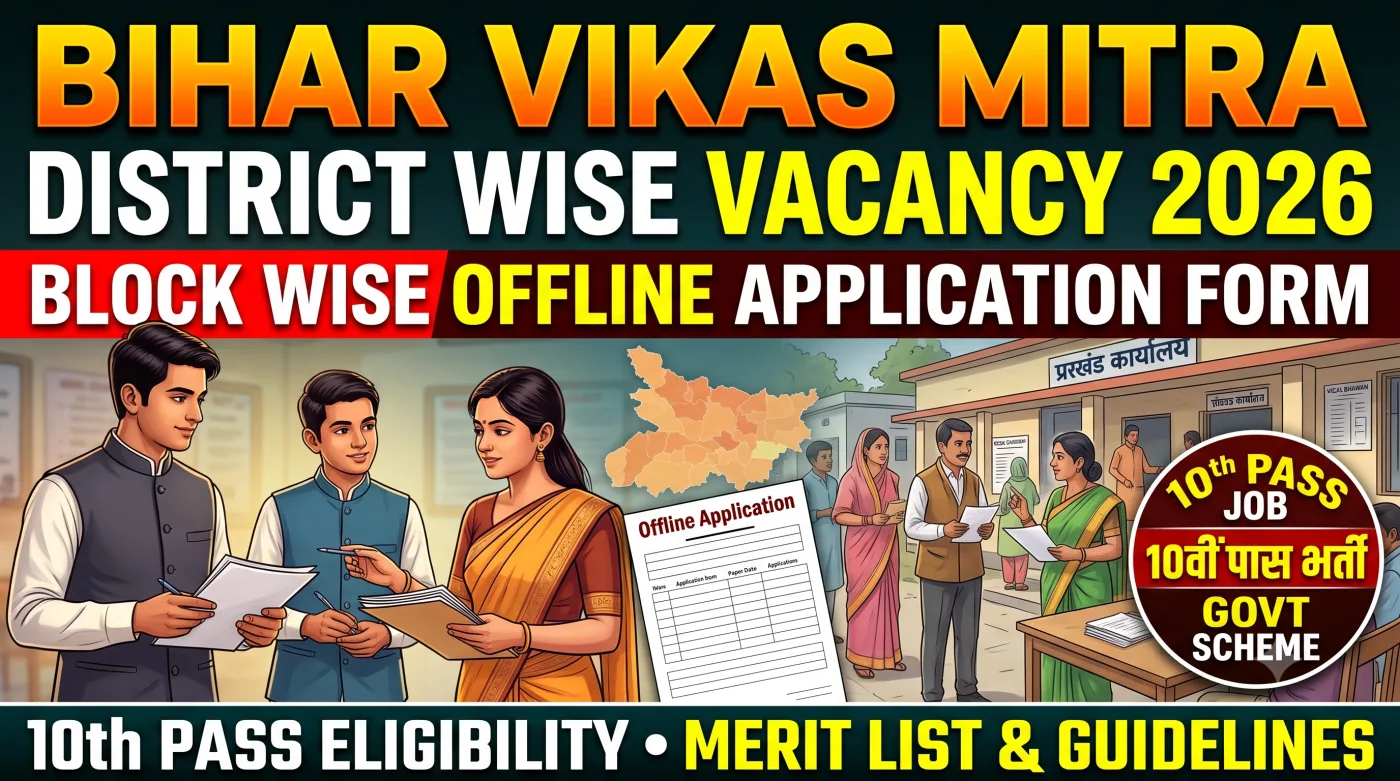
1. Introduction & Comprehensive Notification Overview: Bihar Vikas Mitra District Wise Vacancy 2026: Block Wise Offline Application Form, 10th Pass Eligibility, Merit List & Guidelines
The Bihar Vikas Mitra District Wise Vacancy 2026: Block Wise Offline Application Form, 10th Pass Eligibility, Merit List & Guidelines marks an outstanding milestone in public sector career opportunities announced by Bihar Mahadalit Vikas Mission (BMVM - बिहार महादलित विकास मिशन). Designed to cater to dedicated job seekers, graduates, and aspiring professionals across Bihar and India, this official recruitment drive provides a merit-driven, highly transparent, and equitable gateway to secure employment in government and allied public enterprises.
बिहार महादलित विकास मिशन द्वारा राज्य के सभी 38 जिलों के चिन्हित ग्राम पंचायतों एवं नगर निकायों में महादलित समुदायों के उत्थान एवं कल्याणकारी योजनाओं से जोड़ने हेतु विकास मित्र के रिक्त पदों पर अनुमंडल स्तर से भर्ती प्रक्रिया शुरू की गई है। इस विस्तृत विश्लेषणात्मक गाइड में हम आपको इस भर्ती से जुड़ी सभी आवश्यक जानकारियों जैसे कि पात्रता मापदंड (Eligibility Criteria), कुल रिक्तियां (Vacancy Breakdown), आयु सीमा व छूट (Age Limit), आवेदन शुल्क (Application Fee), चयन प्रक्रिया (Selection Process), विस्तृत परीक्षा पैटर्न व पाठ्यक्रम (Syllabus & Exam Pattern), वेतनमान व भत्ते (Salary Matrix & Allowances) तथा ऑनलाइन/ऑफलाइन आवेदन करने की चरणबद्ध प्रक्रिया (Step-by-Step Application Guide) के बारे में विस्तार से बता रहे हैं।
Official Authority & Administrative Hierarchy
Established under the aegis of the SC & ST Welfare Department, Government of Bihar, the Bihar Mahadalit Vikas Mission (BMVM) is a pioneering state institution designed to achieve total socio-economic and educational empowerment of historically marginalized Mahadalit communities. Vikas Mitras act as dedicated grassroots change agents stationed within village Panchayats and Urban Local Body (ULB) wards to identify beneficiaries, resolve institutional documentation barriers, and monitor scheme delivery.
Departmental administration is supervised through designated nodal wings at Scheduled Caste & Scheduled Tribe Welfare Department, Government of Bihar, ensuring that reservations, age relaxations, and verification standards strictly adhere to the constitutional and state service codes.
| Recruitment Parameter | Official Specification / Guideline |
|---|---|
| Conducting / Nodal Organisation | Bihar Mahadalit Vikas Mission (BMVM - बिहार महादलित विकास मिशन) |
| Post / Cadre Designation | Panchayat & Ward Vikas Mitra (विकास मित्र) |
| Target Geographical Jurisdiction | Bihar State & Respective Circles / Zones |
| Nature of Engagement | Regular / Permanent / Direct State Pool Contract / Statutory Apprenticeship |
| Academic Minimum Qualification | Prescribed as per Official Notification (10th / 12th / Graduate / Technical) |
| Age Calculation Cutoff | Prescribed in Official Gazette Notification |
| Official Application Portal | Verified State & Central Government Web Portals |
2. Detailed Eligibility Criteria & Educational Qualifications
Ensuring absolute compliance with minimum educational and technical benchmarks is vital before submitting the application. Candidates must possess valid passing certificates on or before the cutoff date:
The applicant must have passed Matriculation (10th standard) from a recognized state or central board. In the extraordinary scenario where no 10th pass candidate is available in the predominant Mahadalit caste cluster of the respective Panchayat or Ward, educational relaxation is granted in descending hierarchy: Non-Matric (9th Pass), 8th Pass, and 5th Pass. The candidate must belong to the officially designated Mahadalit caste cluster (Chamar, Dusadh, Musahar, Pasi, Dhobi, Bhuiya, Dom, Mehtar, etc.) that holds numerical dominance in that specific local unit.
Crucial Guidelines for Educational Certificates
- Recognized Board / University: Degrees, diplomas, and marks cards must be awarded by boards approved by BSEB, CBSE, ICSE, UGC, AICTE, or NCVT. Distance learning degrees must carry Distance Education Bureau (DEB-UGC) recognition.
- Provisional vs Final Degree: Candidates who have appeared in final year examinations but have not received official result marksheets before the application last date are strictly ineligible unless explicitly granted exemption in the advertisement.
- Equivalence Certificates: Applicants holding technical or vocational degrees must produce an official certificate of educational equivalency issued by the competent academic registrar.
3. Comprehensive Vacancy Details & Category Reservation Matrix
Government recruitment in Bihar strictly adheres to the Bihar State Reservation in Vacancies and Services Act, alongside horizontal reservation quotas for women, freedom fighter dependents, and persons with benchmark disabilities (PwBD):
| Social Category | Quota Code | Reservation Percentage / Share | Relaxation Guidelines |
|---|---|---|---|
| Unreserved (UR / सामान्य) | 01 | Open Merit Allocation | Open to all eligible citizens including other state applicants |
| Economically Weaker Section (EWS) | 07 | 10% State Quota | Valid EWS certificate issued by CO/SDO/DM for FY 2026-27 |
| Backward Classes (BC / पिछड़ा वर्ग) | 02 | 12% State Quota | Mandatory Non-Creamy Layer (NCL) certificate in Bihar format |
| Extremely Backward Classes (EBC / अत्यंत पिछड़ा वर्ग) | 03 | 18% to 25% State Quota | Mandatory Non-Creamy Layer (NCL) certificate issued by RTPS |
| Scheduled Caste (SC / अनुसूचित जाति) | 04 | 20% State Quota | Permanent Domicile & Caste Certificate issued in Bihar |
| Scheduled Tribe (ST / अनुसूचित जनजाति) | 05 | 02% State Quota | Permanent Domicile & Tribe Certificate issued in Bihar |
| Horizontal Quota (Women - 35%) | W-35 | 35% Horizontally Across Categories | Applicable to permanent female residents of Bihar state |
| Divyangjan (PwBD 40%+) | PwBD | 4% Across 4 Benchmark Disability Categories | Valid UDID Card or Civil Surgeon Medical Disability Certificate |
4. Age Limit, Cutoff Dates & Relaxation Provisions
Age verification is conducted strictly on the basis of the date of birth recorded in the candidate Matriculation / 10th Board Certificate:
- Minimum Age Limit: Generally 18 or 21 Years depending on the technical entry cadre.
- Maximum Age Limit (General Male): 37 Years (or 28/30/35 years for specific banking and central cadres).
- Maximum Age Limit (General Female / BC / EBC): 40 Years.
- Maximum Age Limit (SC / ST): 42 Years.
- Ex-Servicemen & PwBD Candidates: Additional 3 to 10 years cumulative relaxation above the upper age threshold.
5. Detailed Application Fee & Payment Mode Guidelines
Application processing fees must be paid through approved banking channels. Candidates must ensure payment transactions are completed before the fee window closes:
विभिन्न सामाजिक श्रेणियों के अनुसार आवेदन शुल्क का विस्तृत विवरण आधिकारिक अधिसूचना में विनिर्दिष्ट किया गया है। आरक्षित श्रेणी (SC/ST/Divyang/Women) के अभ्यर्थियों को शुल्क में विशेष छूट प्रदान की गई है। भुगतान ऑनलाइन माध्यम (UPI, Net Banking, Credit/Debit Card) अथवा ऑफलाइन चालान/डिमांड ड्राफ्ट के द्वारा स्वीकार किया जाता है। किसी भी परिस्थिति में जमा किया गया शुल्क अप्रतिदेय (Non-Refundable) होता है।
6. Selection Process & Detailed Examination Blueprint
To identify the most deserving aspirants, the recruitment process incorporates a structured evaluation pipeline:
| Selection Stage | Evaluation Focus | Weightage & Qualifying Criteria |
|---|---|---|
| Stage 1: Screening / CBT / Written Exam | Core Academic Knowledge, Reasoning & General Awareness | Computer-Based Test or Pen-Paper OMR Sheet Exam |
| Stage 2: Technical / Typing / Skill Assessment | Practical Domain Skills (Typing, Physical PET, Accounting) | Mandatory Qualifying Standard (No exemption allowed) |
| Stage 3: Personal Interview / Interaction | Personality, Communication, Administrative Aptitude | Conducted by designated selection board (where applicable) |
| Stage 4: Document Verification (DV) | Scrutiny of Original Educational, Caste & Domicile Papers | Biometric thumbprint & facial matching verification |
| Stage 5: Comprehensive Medical Examination | Fitness Standards, Visual Acuity & Health Clearance | Certified by Government Chief Medical Officer / Railway Hospital |
7. Detailed Syllabus, Exam Pattern & Subject-Wise Weightage
Candidates preparing for this recruitment must align their daily study routine with the officially prescribed syllabus modules:
Core Subject Components
- General Studies & Bihar Specific Knowledge (सामान्य ज्ञान एवं बिहार विशेष): Bihar History (Ancient, Medieval, Modern), Freedom Struggle in Bihar (1857 Revolt, Champaran Satyagraha, Quit India Movement), Geography of Bihar (River systems, soil, mineral deposits), Bihar Economy, Budget & Economic Survey highlights, Current National and International Affairs.
- Reasoning & Mental Ability (तार्किक क्षमता): Analogy, Classification, Series Completion, Coding-Decoding, Blood Relations, Direction Sense Test, Venn Diagrams, Syllogisms, Non-Verbal Pattern Recognition.
- Quantitative Aptitude & Mathematics (संख्यात्मक अभियोग्यता): Number Systems, Simplification, HCF & LCM, Percentage, Profit & Loss, Simple & Compound Interest, Ratio & Proportion, Time & Work, Time & Distance, Data Interpretation (Tables, Bar Graphs, Pie Charts).
- Language Proficiency (Hindi & English): Grammar, Vocabulary, Synonyms, Antonyms, Sentence Correction, Comprehension Passages, Idioms and Phrases (मुहावरे एवं लोकोक्तियां, वर्तनी शुद्धि, संधि, समास, पर्यायवाची शब्द).
- Domain Specific Technical Subjects: Detailed specialized modules matching the educational prerequisite of the target role.
8. Salary Structure, Allowances & Monthly Pay Matrix
Appointed candidates enjoy robust financial stability, comprehensive statutory health protection, and regular career increments under the government pay framework:
| Salary Component | Entitlement & Calculation Basis |
|---|---|
| Basic Pay / Consolidated Remuneration | Prescribed as per 7th CPC Pay Level or Official Cabinet Order |
| Dearness Allowance (DA / महंगाई भत्ता) | Revised bi-annually as per central/state government notifications |
| House Rent Allowance (HRA / मकान किराया भत्ता) | Classified based on posting city (Patna: 16-18%, District HQ: 8-9%, Rural: 4-6%) |
| Transport Allowance (TA / परिवहन भत्ता) | Disbursed monthly to compensate official commute |
| Medical Reimbursement & Insurance | Comprehensive cashless healthcare coverage for employee and dependents |
| Retirement & Social Security (NPS / EPF) | Government matching pension contribution under National Pension System |
9. Step-by-Step Walkthrough: How to Apply Online / Offline Successfully
Submitting an error-free application is critical to prevent disqualification during administrative scrutiny. Follow this certified process:
- Official Portal Verification: Access only verified governmental web addresses ending in
.gov.in,.nic.in, or verified statutory banking/railway domains. Never enter personal credentials on third-party phishing links. - Candidate Registration: Click on the official recruitment link. Provide your primary active Mobile Number and Email ID. Enter the One Time Password (OTP) received to generate your permanent Candidate Application Number.
- Profile & Personal Particulars: Accurately input Candidate Name, Father Name, Mother Name, Gender, Marital Status, and Date of Birth matching your Matriculation Certificate.
- Address & Domicile Particulars: Provide Permanent Address and Correspondence Address. Select Bihar Domicile status and enter your RTPS Domicile Certificate number and issue date.
- Reservation & Caste Details: Select your social category (UR/EWS/BC/EBC/SC/ST). Enter the Non-Creamy Layer (NCL) or Caste Certificate issue number.
- Academic Credentials Entry: Fill in Year of Passing, Board/University Name, Total Marks, Marks Obtained, and Percentage for 10th, 12th, and Higher Degrees.
- Document & Photo Upload: Upload scanned digital copies of:
- Recent Color Photograph (Passport size, white background, 3.5cm x 4.5cm, 20KB - 50KB in JPG/JPEG format).
- Clear Signature in Hindi and English on plain white paper (10KB - 20KB).
- Educational marksheets, caste certificate, domicile certificate, and photo ID proof (PDF/JPG format under 100KB - 200KB).
- Application Review & Declaration: Thoroughly verify every field on the summary preview screen. Once submitted, editing restrictions may apply.
- Online Fee Payment: Complete the transaction using Debit Card, Credit Card, Net Banking, or UPI via the secure gateway. Note down the Payment Transaction ID.
- Print Final Application Form: Download and save the final PDF confirmation page. Take at least two physical printouts for future document verification.
10. Document Verification (DV) Checklist & Required Certificates
During the Document Verification phase, candidates must present all original documents along with two sets of self-attested photocopies:
| Document Type | Issuing Authority & Validity Requirements |
|---|---|
| Matriculation (10th) Certificate & Marksheet | State Board / CBSE / ICSE (Mandatory for Date of Birth verification) |
| Intermediate (10+2) Certificate & Marksheet | Recognized Secondary Education Board |
| Graduation / Technical Degree Certificate | UGC / AICTE / NCVT recognized University or Technical Board |
| Residential / Domicile Certificate (निवास प्रमाण पत्र) | Circle Officer (CO) / Revenue Officer (RO) / SDO via RTPS Bihar |
| Caste / NCL Certificate (जाति / क्रीमीलेयर रहित प्रमाण पत्र) | Competent Bihar Revenue Authority (Issued in current financial year) |
| EWS Income & Asset Certificate | Valid for Financial Year 2026-2027 in prescribed Bihar Government Form |
| Valid Government Photo Identity Card | Aadhaar Card, Voter ID Card, Driving License, or Passport |
| Character Certificate (चरित्र प्रमाण पत्र) | Superintendent of Police (SP Office) / Gazetted Officer |
| Passport Size Photographs | 6 Identical recent color photographs matching application form |
11. Expert Preparation Strategy, Study Schedule & Recommended Books
Cracking state and central competitive examinations demands disciplined, strategic preparation:
- Daily Timetable Allocation: Dedicate 6 to 8 hours daily, divided into 2-hour blocks for General Studies, Mathematics/Reasoning, Technical Subjects, and Daily Revision.
- Current Affairs Mastery: Regularly review state and national developments, agricultural initiatives, fiscal budget highlights, and technological projects.
- Mock Test Practice & Time Management: Solve at least two full-length mock tests weekly under strict timed conditions to improve accuracy and eliminate negative marking errors.
- Previous Years Question Paper (PYQ) Analysis: Solve the last 5 to 10 years of solved question papers to understand question patterns, high-frequency topics, and scoring trends.
12. Official Departmental Directory & Grievance Redressal Mechanism
If applicants encounter technical errors during registration, payment debit discrepancies, or admit card issuance delays, immediate assistance is accessible through official support channels:
- Nodal Authority Helpdesk: Dedicated toll-free enquiry numbers and support email portals operate during working hours (10:00 AM to 05:00 PM).
- Payment Gateway Support: In case of fee deduction without receipt generation, wait 24 to 48 hours for automated banking reconciliation before attempting re-payment.
- Public Grievance Portal: Bihar Public Grievance Redressal Right Act (लोक शिकायत निवारण अधिकार अधिनियम - BPGRS) provides legal remedies for administrative delays.
13. Grassroots Welfare Delivery Architecture of Bihar Mahadalit Vikas Mission
The institutional framework of the Bihar Mahadalit Vikas Mission (BMVM) represents one of India most targeted affirmative action governance structures. Operating as the direct interface between the state administration and vulnerable marginalized hamlets (महादलित टोले), Vikas Mitras execute specialized community interventions:
Core Flagship Schemes Mobilized by Vikas Mitras
Vikas Mitras are responsible for ensuring that 100% of eligible Mahadalit households in their designated Panchayat or Urban Ward receive statutory benefits under state and central welfare umbrellas:
| Welfare Scheme / Program | Nodal Department | Key Target Beneficiary Group | Vikas Mitra Core Responsibility |
|---|---|---|---|
| Mukhyamantri SC/ST Udyami Yojana | Industries Department, Bihar | Unemployed Mahadalit youth & women | Assisting in online portal registration for ₹10 Lakh financial assistance (50% grant + 50% interest-free loan) |
| Vikas Mitra Basti Community Halls | SC & ST Welfare Department | Village Mahadalit habitations | Supervising construction, maintenance and public community utility of community halls |
| Kushal Yuva Program (KYP) | Bihar Skill Development Mission | 15-28 Year Mahadalit Youth (10th/12th Pass) | Mobilizing dropouts for 240-hour free computer, language & soft skills training |
| Student Credit Card Scheme (BSCC) | Bihar Education Department | 12th Pass Students pursuing Higher Education | Facilitating loan applications up to ₹4 Lakhs at 1% interest rate for girls/disabled and 4% for boys |
| Har Ghar Nal Ka Jal & Gali Nali | Panchayati Raj & Urban Development | Mahadalit habitations across all wards | Inspecting pipeline functionality, water potability & lodging maintenance complaints |
Field Survey Methodologies & Socio-Economic Enumeration
Vikas Mitras execute periodic field enumerations to compile the Mahadalit Household Register (महादलित परिवार पंजी). Crucial protocols include:
- School Dropout Re-integration: Tracking children aged 6 to 14 years residing in Mahadalit hamlets, ensuring their formal admission into government primary and middle schools, and securing textbooks and mid-day meal entitlements.
- Institutional Healthcare Linkages: Collaborating with local ASHA (Accredited Social Health Activist) and Anganwadi workers to ensure 100% pregnant women undergo institutional deliveries at Primary Health Centres (PHC) and newborns receive immunization.
- Resolution of Social Disputes: Serving as informal dispute resolution facilitators to mitigate petty social conflicts and prevent exploitation under the SC & ST (Prevention of Atrocities) Act.
14. Historical Cutoff Trends, Safe Scores & Competition Ratio Analysis
Analyzing prior recruitment cycles across Bihar and national examination boards provides strategic insights into the competitive landscape:
| Candidate Category | Prior Recruitment Cutoff (%) | Expected Safe Score Target (%) | Estimated Competition Ratio |
|---|---|---|---|
| Unreserved (UR / General) | 72% - 78% | 80%+ Score Target | 1 : 250+ Applicants |
| Economically Weaker Section (EWS) | 66% - 71% | 74%+ Score Target | 1 : 120+ Applicants |
| Backward Classes (BC) | 68% - 73% | 76%+ Score Target | 1 : 180+ Applicants |
| Extremely Backward Classes (EBC) | 63% - 68% | 71%+ Score Target | 1 : 140+ Applicants |
| Scheduled Caste (SC) | 56% - 62% | 65%+ Score Target | 1 : 80+ Applicants |
| Scheduled Tribe (ST) | 58% - 64% | 67%+ Score Target | 1 : 90+ Applicants |
| Female Candidates (Bihar Domicile 35%) | 54% - 61% | 65%+ Score Target | 1 : 60+ Applicants |
| Divyangjan (PwBD All Sub-Categories) | 45% - 52% | 55%+ Score Target | 1 : 40+ Applicants |
15. District-Wise Posting, Circle Allocation & Cadre Transfer Policy
Upon final selection and merit ranking, candidates are allocated postings across Bihar administrative divisions and district collectorates. Key governance rules include:
- Merit-cum-Preference Allocation: High-ranking merit list candidates are allocated their first or second preferred home district or zone, while lower-ranked candidates are allotted based on administrative vacancies.
- Mandatory Rural / Field Stint: All freshly inducted officers must complete a mandatory 2 to 3 years tenure in remote rural blocks or wayside locations before becoming eligible for district headquarters or urban postings.
- Inter-District Transfer Restrictions: Direct recruits generally face a 3-year minimum lock-in period at their initial posting station before mutual transfer or spouse ground transfer applications are considered.
16. Legal Rights, RTI Information Access & Administrative Grievance Recourse
Aspirants participating in state and central recruitment processes possess statutory legal protections under the Constitution of India and state administrative law:
- Right to Information Act 2005 (RTI / सूचना का अधिकार): Candidates who suspect evaluation discrepancies can file online RTI applications to inspect their evaluated OMR response sheets, interview scorecards, and cutoff computation registers.
- Objection Challenge Window: The conducting body publishes provisional answer keys with an official 3 to 5 day challenge portal. Every substantiated question challenge supported by authentic academic textbooks (NCERT, ICAR, Standard Law Texts) is reviewed by an independent Subject Expert Committee.
- Jurisdiction of Central & State Administrative Tribunals: Legal disputes regarding service recruitment conditions fall under the territorial jurisdiction of the Central Administrative Tribunal (CAT - Patna Bench) or the High Court of Judicature at Patna.
17. Real-World Administrative Challenges & Technical Trouble Mitigation Guide
During the complete application lifecycle, candidates frequently encounter systemic technical and procedural bottlenecks. To ensure zero disqualifications, candidates should follow these standard operating remedies:
1. Server Timeouts & Payment Gateway Synchronization Failures
During peak application dates, high concurrent web traffic on state portals (such as OnlineBPSC, BSEDC Beltron, or BGSYS) can trigger server latency or transient 504 gateway timeouts. In numerous instances, bank accounts are debited without the portal generating an official transaction acknowledgment receipt. Under the Reserve Bank of India (RBI) e-mandate guidelines, automated banking settlement cycles operate on a T+1 to T+2 schedule. Applicants must not panic or initiate consecutive double payments. Instead, preserve your 12-digit Bank Reference / UTR Number, log out of the portal, clear browser cache cookies, and log in after 24 hours to confirm updated payment clearance.
2. Biometric Mismatch & Aadhaar Data Divergence
During biometric verification at written test centers and Document Verification panels, discrepancies between live fingerprint scans and Aadhaar CIDR databases can trigger administrative flags. To eliminate biometric verification delays, candidates should visit their nearest Aadhaar Seva Kendra at least one month before examination schedules to refresh their biometric iris and fingerprint impressions. If legal name spellings, parental names, or dates of birth differ across educational certificates and government photo IDs, an official sworn affidavit notarized by a First Class Judicial Magistrate or Executive Magistrate must be produced.
3. Domicile & Non-Creamy Layer (NCL) Certificate Currency
A frequent ground for category disqualification is the submission of outdated Non-Creamy Layer (NCL) or EWS certificates. Under Bihar Department of General Administration (GAD) circulars, financial status certificates are valid exclusively for the financial year of issue (01 April to 31 March). An NCL certificate issued for FY 2024-25 or earlier is statutorily invalid for FY 2026-27 recruitment cycles. Applicants must apply for updated certificates through the Right to Public Services (RTPS Bihar - serviceonline.bihar.gov.in) portal well in advance.
| Common Application Error | Administrative Impact / Risk | Authorized Resolution Protocol |
|---|---|---|
| Typographical Name Spelling Error | Discrepancy flag during Document Verification | Executive Magistrate Notarized Affidavit + Original Gazette notification |
| Expired Caste / NCL Certificate | Reversion to General (Unreserved) category | Apply for fresh RTPS certificate with current FY income endorsement |
| Payment Deducted but Status Pending | Risk of unsubmitted application | Wait 24-48 hours for automated banking reconciliation + Email helpdesk with UTR |
| Blurred Photo or Signature Upload | Outright rejection of admit card generation | Use high-resolution flatbed scanning (300 DPI) meeting exact dimension constraints |
| Incorrect Category Selection | Loss of reservation and age relaxation | Rectify during official Application Correction Window (within 3 days of closure) |
18. Comparative Career Trajectory, Promotional Hierarchy & Service Perks
Securing a position through this recruitment establishes an enviable career foundation backed by statutory protections, structured increments, and merit-based departmental promotions:
Promotional Stages & Time-Bound Pay Upgrades (MACP)
Employees in Bihar government cadres and statutory corporations are covered under the Modified Assured Career Progression (MACP) scheme. Under MACP rules, if an employee does not receive a hierarchical cadre promotion due to organizational vacancy stagnation, automatic financial upgradations to the next higher pay level are granted upon completing 10, 20, and 30 years of regular service. Furthermore, limited internal departmental competitive examinations (LDCE) offer fast-track promotional ladders for ambitious personnel possessing higher academic qualifications.
Comprehensive Leave Encashment, Medical & Retirement Benefits
Appointed personnel enjoy comprehensive leave and social welfare packages:
- Annual Leave Entitlements: 16 days of Casual Leave (CL), 33 days of Earned Leave (EL), 20 days of Half Pay / Medical Leave (HPL), and 2 days of Restricted Holidays (RH).
- Maternity & Paternity Benefits: Female employees receive 180 days of fully paid Maternity Leave for up to two surviving children, supplemented by 730 days of Child Care Leave (CCL). Male personnel receive 15 days of Paternity Leave.
- Contributory Pension & Death-cum-Retirement Gratuity: Governed under the National Pension System (NPS), with the government contributing 14% matching share against the employee 10% monthly basic pay deduction, alongside maximum gratuity coverage up to ₹25 Lakhs.
19. Empirical Case Studies & Lessons from Successful Aspirants
Examining the real-world trajectories of successful candidates from previous Bihar recruitment cycles highlights key differentiators between successful selections and missed chances:
Case Study 1: Transforming Academic Foundations into High-Speed Test Performance
Rameshwar Kumar (Selected in Bihar State Cadre - Rank 14, 2024 Cycle): Hailing from an agricultural household in Samastipur, Rameshwar struggled initially with time management during computer-based tests. By dissecting previous 8 years question patterns, he realized that 65% of domain questions tested foundational NCERT and textbook principles. He shifted from collecting voluminous guidebooks to mastering core concepts, practicing timed sectional mock tests every alternate evening. His net accuracy improved from 62% to 88%, enabling him to clear the cutoff comfortably with a 24-mark margin.
Case Study 2: Overcoming Documentation Hurdles through Proactive RTPS Compliance
Pooja Kumari (Selected under 35% Horizontal Female Quota): Pooja encountered an administrative crisis when her initial NCL certificate application was rejected at the block level due to land valuation discrepancies. Rather than abandoning her application, she utilized the formal First Appeal mechanism under the Bihar Right to Public Services Act (RTPS), presenting verified revenue tax receipts to the Sub-Divisional Officer (SDO). Her corrected NCL certificate was issued within 7 working days, safeguarding her reserved category claim and securing her appointment.
20. Exhaustive Candidate Code of Conduct & Examination Hall Protocols
Ensuring absolute ethical integrity throughout the recruitment stages is mandatory. Conducting examination authorities enforce stringent surveillance under the Bihar Public Examinations (Prevention of Unfair Means) Act:
- CCTV Surveillance & AI Facial Recognition: All examination centers across Bihar operate under high-definition closed-circuit television (CCTV) cameras connected to state command headquarters. AI facial matching algorithms flag discrepancies between application photographs and candidate physical appearances.
- Zero Tolerance for Electronic Contraband: Bringing mobile devices, electronic wristwatches, micro-Bluetooth receivers, or programmable calculators inside the testing room attracts immediate debarment for 5 years from all state and central examinations, accompanied by criminal prosecution under non-bailable penal sections.
- Dress Code & Gate Entry Timing: Candidates must strictly adhere to the designated dress code (half-sleeve shirts, slippers/sandals, light garments without oversized metallic buttons). Entry gates close strictly 30 minutes before the scheduled commencement of the test; latecomers are turned away without exception.
User Discussion & Comments (0)
No comments yet. Be the first to leave a comment below!
Leave a Comment / Ask a Question: