1. Executive Overview: Bihar Police Constable Selection Architecture
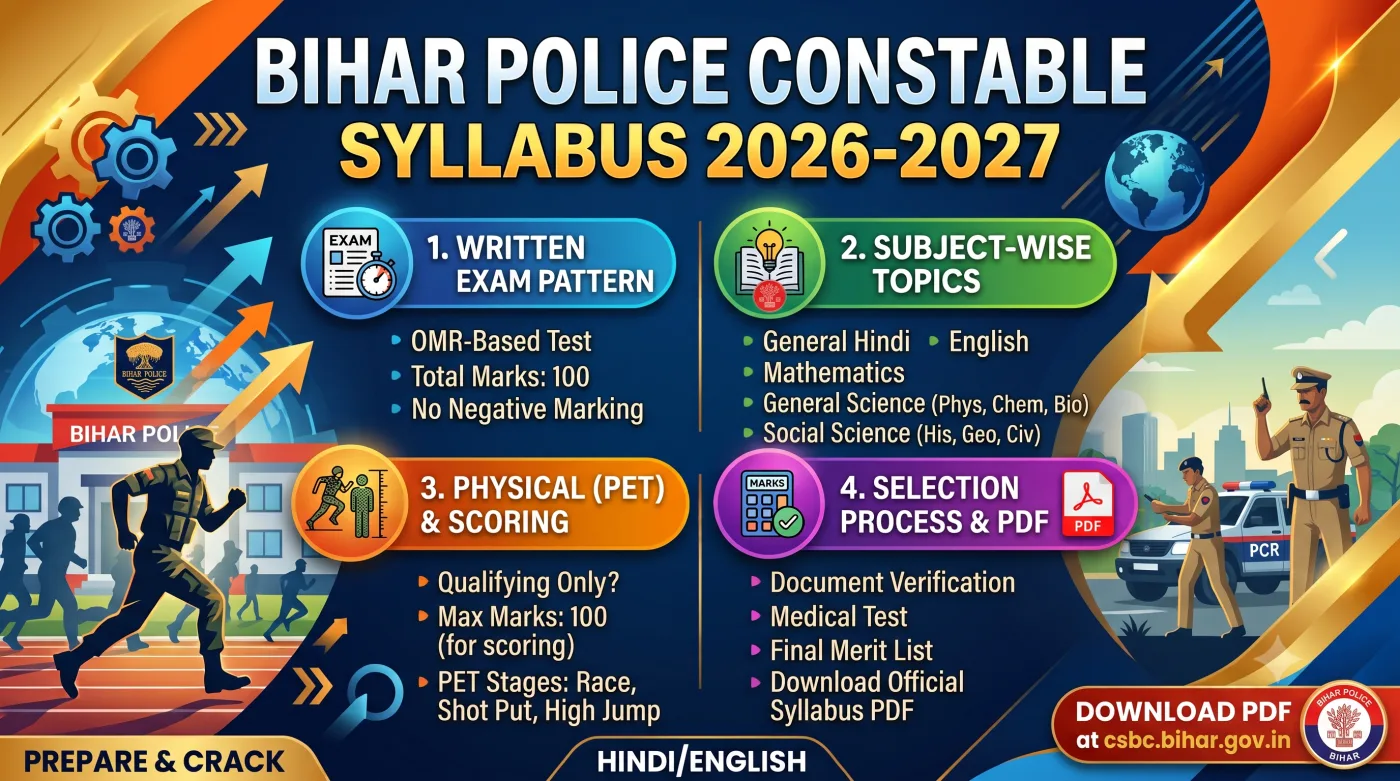
The Central Selection Board of Constable (CSBC / केन्द्रीय चयन पर्षद) conducts the state-wide recruitment examination for Constables in the Bihar Police, Bihar Special Armed Police (BSAP / पूर्व बीएमपी), and other specialized security wings. Understanding the distinctive two-tier architecture of this examination is paramount: while Stage 1 (Written Examination) acts strictly as a screening filter, Stage 2 (Physical Efficiency Test - PET) alone determines 100% of the candidate's final merit ranking and appointment.
- Stage 1: Written Screening Examination (OMR Based - 100 Marks): A 2-hour offline objective test following BSEB Class 10 (Matric) curriculum. Securing a minimum of 30% marks is mandatory, and approximately 5 times the category-wise vacancies are shortlisted for the physical examination based on written merit.
- Stage 2: Physical Standard Test (PST) & Document Verification (DV): Height, chest (for males), and weight measurements (minimum 48 kg for females) along with scrutiny of educational certificates, caste, and permanent domicile credentials.
- Stage 3: Physical Efficiency Test (PET - 100 Marks): The decisive stage where marks are credited across three events:
- Running (दौड़): 50 Marks (1.6 km for males; 1.0 km for females).
- Shot Put (गोला फेंक): 25 Marks (16-lb iron ball for males; 12-lb for females).
- High Jump (ऊंची कूद): 25 Marks (Scored between 4 feet to 5 feet for males; 3 feet to 4 feet for females).
- Stage 4: Detailed Medical Examination (DME) & Character Scrutiny: Clinical fitness checkup conducted at district civil hospitals under the presidency of Chief Medical Officers (CMO) and antecedent verification by local police intelligence.
| Recruitment Parameter | Official Specification & Examination Details |
|---|---|
| Exam Conducting Authority | Central Selection Board of Constable (CSBC / केन्द्रीय चयन पर्षद, पटना) |
| Cadre Posts | Constable in District Police, Bihar Special Armed Police (BSAP), & Reserve Battalions |
| Educational Qualification | 10+2 Intermediate Pass from BSEB, CBSE, ICSE or State Sanskrit/Madrasa Board |
| Mode of Written Examination | Offline Pen-Paper OMR Sheet Based (ऑफलाइन ओएमआर शीट) |
| Standard / Level of Questions | Strictly Class 10th (Matriculation Level / मैट्रिक स्तर) of Bihar School Examination Board |
| Total Questions & Marks | 100 Questions carrying 100 Marks (1 Mark per correct answer) |
| Examination Duration | 120 Minutes (2 Hours / 120 मिनट) |
| Negative Marking Penalty | NO Negative Marking (शून्य नकारात्मक अंकन) |
| Nature of Written Test | Qualifying / Screening Only (न्यूनतम 30% अंक अनिवार्य; 5 गुना अभ्यर्थी शारीरिक परीक्षा हेतु चयनित) |
| Final Merit List Basis | 100% Based on Physical Efficiency Test (PET - 100 Marks) |
| Official Board Portal | csbc.bihar.gov.in |
2. Written Examination Pattern & Subject-Wise Marks Distribution
The single-shift offline written test consists of 100 objective multiple-choice questions. Because there is zero negative marking, candidates must attempt all 100 questions. The subject-wise weightage distributed across linguistic, scientific, and socio-economic disciplines is structured as follows:
| Subject Domain | Prescribed Curriculum Standard | Approximate Questions | Maximum Marks | Optimal Time Allotment |
|---|---|---|---|---|
| 1. General Hindi (सामान्य हिन्दी) | BSEB Matric Standard Grammar & Literature | 8 - 10 Questions | 8 - 10 Marks | 10 - 12 Minutes |
| 2. General English (सामान्य अंग्रेजी) | Class 10th Functional Grammar & Vocabulary | 7 - 8 Questions | 7 - 8 Marks | 8 - 10 Minutes |
| 3. Mathematics (गणित) | Class 10 Arithmetic, Algebra, Geometry & Mensuration | 10 Questions | 10 Marks | 20 - 25 Minutes |
| 4. Social Science (सामाजिक विज्ञान) (History, Geography, Civics, Economics) |
Class 10 NCERT / Bihar Board Social Studies | 30 - 32 Questions | 30 - 32 Marks | 25 - 30 Minutes |
| 5. Science (सामान्य विज्ञान) (Physics, Chemistry, Biology) |
Class 10 NCERT / Bihar Board Everyday Science | 30 - 32 Questions | 30 - 32 Marks | 25 - 30 Minutes |
| 6. Bihar GK & Current Affairs (समसामयिक घटनाएं) | Bihar Special History, Culture, Geography & National News | 10 - 12 Questions | 10 - 12 Marks | 10 - 12 Minutes |
| Total Combined Paper | Composite 100 Objective Questions | 100 Questions | 100 Marks | 120 Minutes (2 Hours) |
3. Comprehensive Subject-Wise Syllabus Breakdown (Class 10th Standard)
The CSBC revised syllabus strictly aligns with the Bihar State Textbook Publishing Corporation and NCERT 10th standard curricula. Every aspirant must thoroughly study the following micro-topics:
Section 1: General Hindi (सामान्य हिन्दी - 8 to 10 Marks)
- ध्वनि एवं वर्ण विचार (Phonetics & Alphabet): स्वर एवं व्यंजन वर्ण, उच्चारण स्थान (कंठ्य, तालव्य, मूर्धन्य, दंत्य, ओष्ठ्य), अल्पप्राण, महाप्राण, घोष और अघोष ध्वनियां।
- शब्द विचार एवं वर्तनी शुद्धि (Orthography & Word Formation): तत्सम, तद्भव, देशज और विदेशी शब्द; वर्तनी की सामान्य अशुद्धियां और उनका शुद्धिकरण।
- संज्ञा से अव्यय तक पद परिचय (Parts of Speech):
- संज्ञा, सर्वनाम (निजवाचक, संबंधवाचक, अनिश्चयवाचक भेद)।
- विशेषण (गुणवाचक, परिमाणवाचक, संख्यावाचक, सार्वनामिक)।
- क्रिया (सकर्मक एवं अकर्मक क्रिया, प्रेरणार्थक क्रिया)।
- काल (वर्तमान, भूत, भविष्य काल) एवं वाच्य (कर्तृवाच्य, कर्मवाच्य, भाववाच्य)।
- लिंग, वचन एवं कारक (कारक के 8 भेद व उनकी विभक्तियां)।
- संधि एवं समास (Sandhi & Compound Words): स्वर संधि (दीर्घ, गुण, वृद्धि, यण, अयादि), व्यंजन संधि, विसर्ग संधि; समास के 6 प्रमुख भेद।
- शब्द संपदा (Vocabulary): पर्यायवाची शब्द, विलोम शब्द, अनेकार्थक शब्द, वाक्यांश के लिए एक शब्द, समश्रुत भिन्नार्थक शब्द।
- मुहावरे एवं लोकोक्तियां: बिहार लोकजीवन में प्रचलित कहावतें और मुहावरों का व्यावहारिक प्रयोग।
- साहित्यिक परिचय (Hindi Authors & Literature): कबीर, तुलसीदास, सूरदास, भारतेंदु हरिश्चंद्र, रामधारी सिंह 'दिनकर', फणीश्वरनाथ 'रेणु' (मैला आंचल), नागार्जुन, प्रेमचंद की प्रमुख रचनाएं।
Section 2: General English (7 to 8 Marks)
- Grammatical Fundamentals: Parts of Speech, Common Errors in Nouns, Pronouns, and Adjectives.
- Verb Forms & Subject-Verb Agreement: Singular and plural verb agreements, auxiliary and modal verbs.
- Tenses & Sequence of Tenses: Simple, continuous, perfect, and perfect continuous tense structures.
- Voice & Narration: Conversion of Active to Passive voice and Direct to Indirect speech of assertive and interrogative sentences.
- Prepositions & Conjunctions: Correct usage of tricky prepositions (between, among, since, for, across, through).
- Vocabulary Building: Synonyms, Antonyms, One Word Substitution, Common English Idioms and Phrasal Verbs.
- Sentence Correction: Spotting the error in complex sentences and sentence rearrangement.
Section 3: Mathematics (गणित - 10 Marks)
- Number System (संख्या पद्धति): Rational and irrational numbers, Real numbers, Divisibility rules, Prime factorization, Unit digit calculation.
- HCF & LCM (ल.स. और म.स.): Prime factorization method, word problems on circular bells and synchronized running tracks.
- Simplification & Roots (सरलीकरण): BODMAS rule, Surds and Indices ($a^m \times a^n = a^{m+n}$), Square roots and Cube roots.
- Arithmetic Applications:
- Percentage (प्रतिशत): Income-expenditure problems, voting and election questions, population growth.
- Profit, Loss & Discount (लाभ, हानि एवं बट्टा): Cost price, selling price, marked price, successive discount formula ($A + B - \frac{AB}{100}$).
- Simple & Compound Interest (ब्याज): Direct formula applications, annual and half-yearly compounding.
- Ratio, Proportion & Partnership (अनुपात एवं साझेदारी): Mean and fourth proportion, capital sharing in business.
- Averages (औसत): Age problems, cricket batting averages, replacement of elements in groups.
- Time & Work (कार्य और समय): Unitary method, men-days formula ($M_1 D_1 H_1 = M_2 D_2 H_2$), alternate work schedule.
- Speed, Time & Distance (चाल, समय और दूरी): Train crossing poles and bridges, relative speed, boats and streams.
- Mensuration (क्षेत्रमिति - 2D & 3D): Perimeter and area of Triangle, Rectangle, Circle, Rhombus; Surface area and volume of Cylinder, Cone, Sphere, and Cuboid.
- Elementary Statistics: Calculation of Mean, Median, and Mode from grouped and ungrouped data sets.
Section 4: Social Science (सामाजिक विज्ञान - 30 to 32 Marks)
Part (A): History (इतिहास):
- प्राचीन एवं मध्यकालीन भारत: सिंधु घाटी सभ्यता, वैदिक काल, बौद्ध एवं जैन धर्म, मगध साम्राज्य का उदय, मौर्य वंश (चंद्रगुप्त, अशोक), गुप्त साम्राज्य (स्वर्ण युग), दिल्ली सल्तनत एवं मुगल साम्राज्य।
- आधुनिक भारत एवं राष्ट्रीय आंदोलन: 1857 का प्रथम स्वतंत्रता संग्राम (बिहार में बाबू कुंवर सिंह की भूमिका), भारतीय राष्ट्रीय कांग्रेस की स्थापना, बंगाल विभाजन, असहयोग आंदोलन, सविनय अवज्ञा आंदोलन, 1942 का भारत छोड़ो आंदोलन (जयप्रकाश नारायण व आजाद दस्ता)।
- विश्व इतिहास की प्रमुख घटनाएं: अमेरिकी स्वतंत्रता संग्राम, फ्रांसीसी क्रांति (1789), रूसी क्रांति (1917), प्रथम एवं द्वितीय विश्व युद्ध के कारण व परिणाम।
Part (B): Geography (भूगोल):
- भौतिक भूगोल: सौरमंडल, पृथ्वी की आंतरिक संरचना, भूकंप एवं ज्वालामुखी, वायुमंडल की परतें (क्षोभमंडल, समतापमंडल), वर्षा एवं चक्रवात।
- भारत का भूगोल: भारत की भौगोलिक स्थिति, भौतिक प्रदेश (हिमालय, प्रायद्वीपीय पठार, तटीय मैदान), अपवाह तंत्र (गंगा, ब्रह्मपुत्र, सिंधु, गोदावरी, कावेरी), मानसून प्रणाली, वनस्पति, मृदा प्रकार, प्रमुख खनिज एवं ऊर्जा संसाधन।
- बिहार का भूगोल: बिहार की नदियां (गंगा, कोसी, गंडक, बूढ़ी गंडक, सोन, फल्गु), बाढ़ एवं सूखा संकट, कृषि जलवायु क्षेत्र (Agro-Climatic Zones), प्रमुख फसलें (धान, गेहूं, मक्का, जूट), वन आवरण (वाल्मीकि राष्ट्रीय उद्यान, कैमूर अभयारण्य)।
Part (C): Civics & Indian Polity (नागरिक शास्त्र एवं भारतीय राजव्यवस्था):
- संविधान निर्माण एवं प्रस्तावना: संविधान सभा, प्रारूप समिति, प्रस्तावना के आदर्श शब्द (संप्रभु, समाजवादी, पंथनिरपेक्ष, लोकतांत्रिक गणराज्य)।
- मौलिक अधिकार एवं कर्तव्य: अनुच्छेद 12 से 35 तक मौलिक अधिकार, अनुच्छेद 51(क) में वर्णित 11 मौलिक कर्तव्य, राज्य के नीति निदेशक तत्व (DPSP - अनुच्छेद 36 से 51)।
- कार्यपालिका, विधायिका एवं न्यायपालिका: राष्ट्रपति, उपराष्ट्रपति, प्रधानमंत्री, केंद्रीय मंत्रिपरिषद, संसद (लोकसभा एवं राज्यसभा), राज्यपाल, मुख्यमंत्री, विधानमंडल, सर्वोच्च न्यायालय एवं पटना उच्च न्यायालय।
- स्थानीय स्वशासन (Panchayati Raj): 73वां एवं 74वां संविधान संशोधन, त्रिस्तरीय पंचायती राज व्यवस्था (बिहार में महिलाओं को 50% आरक्षण)।
Part (D): Economics (अर्थशास्त्र):
- भारतीय अर्थव्यवस्था के क्षेत्रक (प्राथमिक, द्वितीयक, तृतीयक क्षेत्र), राष्ट्रीय आय एवं प्रति व्यक्ति आय।
- मुद्रा एवं साख, भारतीय रिजर्व बैंक (RBI) के कार्य, वाणिज्यिक बैंक, मुद्रास्फीति (Inflation)।
- गरीबी, बेरोजगारी (प्रच्छन्न, मौसमी), खाद्य सुरक्षा, सार्वजनिक वितरण प्रणाली (PDS)।
Section 5: General Science (सामान्य विज्ञान - 30 to 32 Marks)
Part (A): Physics (भौतिकी):
- मात्रक एवं गति (Units & Motion): SI मात्रक, सदिश एवं अदिश राशियां, न्यूटन के गति के तीनों नियम, संवेग संरक्षण का सिद्धांत।
- गुरुत्वाकर्षण, कार्य, शक्ति एवं ऊर्जा: सार्वत्रिक गुरुत्वाकर्षण नियम ($G$), गुरुत्वीय त्वरण ($g$), गतिज ऊर्जा ($\frac{1}{2}mv^2$), स्थितिज ऊर्जा ($mgh$), शक्ति ($P = W/t$)।
- तरंग एवं ध्वनि: अनुप्रस्थ एवं अनुदैर्ध्य तरंगें, ध्वनि की चाल, पराश्रव्य तरंगें, प्रतिध्वनि (Echo), रडार एवं सोनार प्रणाली।
- प्रकाश (Light): प्रकाश का परावर्तन एवं अपवर्तन, दर्पण सूत्र, लेंस सूत्र, मानव नेत्र एवं दृष्टि दोष (निकट दृष्टि दोष, दूर दृष्टि दोष व उनके निवारण), पूर्ण आंतरिक परावर्तन (मरीचिका, ऑप्टिकल फाइबर)।
- विद्युत एवं चुंबकत्व: ओम का नियम ($V = IR$), प्रतिरोधों का श्रेणी व समांतर क्रम, विद्युत धारा का ऊष्मीय प्रभाव (जूल का नियम), चुंबकीय क्षेत्र रेखाएं।
Part (B): Chemistry (रसायन विज्ञान):
- पदार्थ की अवस्थाएं एवं परमाणु संरचना: ठोस, द्रव, गैस, प्लाज्मा, बोस-आइंस्टीन कंडेनसेट; डाल्टन का परमाणु सिद्धांत, इलेक्ट्रॉन, प्रोटॉन, न्यूट्रॉन, समस्थानिक (Isotopes) एवं समभारिक (Isobars)।
- रासायनिक अभिक्रियाएं एवं समीकरण: संयोजन, वियोजन, विस्थापन, द्विविस्थापन, ऑक्सीकरण एवं अपचयन (Redox) अभिक्रियाएं।
- अम्ल, क्षार एवं लवण (Acids, Bases & Salts): pH पैमाना, लिटमस पत्र, बेकिंग सोडा, धावन सोडा, प्लास्टर ऑफ पेरिस, ब्लीचिंग पाउडर के रासायनिक सूत्र व उपयोग।
- धातु एवं अधातु: सक्रियता श्रेणी, अयस्क एवं उनका सांद्रण, जंग लगना एवं उसका निवारण, मिश्र धातुएं (पीतल, कांसा, स्टेनलेस स्टील)।
- कार्बन एवं उसके यौगिक: हाइड्रोकार्बन (एल्केन, एल्कीन, एल्काइन), अपररूप (हीरा, ग्रेफाइट, फुलरीन)।
Part (C): Biology (जीव विज्ञान):
- कोशिका विज्ञान (Cytology): पादप एवं जंतु कोशिका में अंतर, माइटोकॉन्ड्रिया (पावरहाउस), राइबोसोम, लाइसोसोम (आत्मघाती थैली), डीएनए एवं आरएनए।
- मानव शरीर क्रिया विज्ञान (Human Physiology):
- पाचन तंत्र (एंजाइम: टायलिन, पेप्सिन, ट्रिप्सिन, पित्त रस)।
- श्वसन तंत्र एवं परिसंचरण तंत्र (हृदय की संरचना, रक्त समूह A, B, AB, O, Rh कारक, हीमोग्लोबिन)।
- उत्सर्जन तंत्र (वृक्क/किडनी, नेफ्रॉन की कार्यप्रणाली)।
- तंत्रिका तंत्र एवं अंतःस्रावी ग्रंथियां (थायरॉयड, पीयूष ग्रंथि, इंसुलिन, एड्रीनलिन हार्मोन)।
- पादप कार्यिकी: प्रकाश संश्लेषण (Photosynthesis), जाइलम एवं फ्लोएम ऊतक, पादप हार्मोन (ऑक्सिन, जिबरेलिन, साइटोकाइनिन)।
- मानव रोग एवं पोषण: जीवाणु (Bacteria), विषाणु (Virus), प्रोटोजोआ एवं कवक जनित रोग; विटामिन (A, B-Complex, C, D, E, K) के रासायनिक नाम एवं कमी से होने वाले रोग।
Section 6: Bihar GK & Current Affairs (10 to 12 Marks)
- बिहार का इतिहास: चंपारण सत्याग्रह (1917), किसान आंदोलन (स्वामी सहजानंद सरस्वती), बिहार प्रांतीय किसान सभा, 1942 भारत छोड़ो आंदोलन में बिहार का योगदान।
- बिहार जनगणना 2011 (Census Data): कुल जनसंख्या, जनसंख्या घनत्व (1,106 प्रति वर्ग किमी - देश में सर्वाधिक), साक्षरता दर (61.8%), लिंगानुपात (918/1000), सर्वाधिक एवं न्यूनतम साक्षरता वाले जिले (रोहतास एवं पूर्णिया)।
- बिहार की प्रमुख योजनाएं: मुख्यमंत्री सात निश्चय योजना (भाग-1 एवं भाग-2), मुख्यमंत्री कन्या उत्थान योजना, हर घर नल का जल, स्टूडेंट क्रेडिट कार्ड योजना।
- राष्ट्रीय एवं अंतरराष्ट्रीय समसामयिकी: प्रमुख पुरस्कार (भारत रत्न, पद्म पुरस्कार), खेल आयोजन (ओलंपिक, एशियाई खेल, क्रिकेट विश्व कप), प्रमुख सैन्य अभ्यास, शिखर सम्मेलन (G20, BRICS), प्रमुख नियुक्तियां एवं पुस्तकें।
4. Physical Standard Test (PST) Eligibility Matrix
Before participating in the physical efficiency events, candidates must strictly satisfy the following minimum height, chest, and weight benchmarks. PST is qualifying in nature:
| Candidate Category | Minimum Height (ऊंचाई) | Chest Measurement (Male Only) | Minimum Body Weight |
|---|---|---|---|
| General (UR) & Backward Class (BC) Male | Minimum 165 cms | 81 cms unexpanded; Minimum 5 cms expansion (81 - 86 cms) | Not Prescribed (Physical fitness evaluated) |
| Extremely Backward Class (EBC) Male | Minimum 160 cms | 81 cms unexpanded; Minimum 5 cms expansion (81 - 86 cms) | Not Prescribed |
| Scheduled Caste (SC) & Scheduled Tribe (ST) Male | Minimum 160 cms | 79 cms unexpanded; Minimum 5 cms expansion (79 - 84 cms) | Not Prescribed |
| Gorkha Battalions (BSAP-1) Male | Minimum 160 cms | 79 cms unexpanded; Minimum 5 cms expansion (79 - 84 cms) | Not Prescribed |
| Female Candidates (All Social Categories) | Minimum 155 cms | Exempt (सीना मापन लागू नहीं) | Mandatory Minimum 48 Kilograms (48 किग्रा) |
| Transgender / Third Gender (तृतीय लिंग) Candidates | Minimum 155 cms (Evaluated as per female standards) | Exempt | Mandatory Minimum 48 Kilograms |
5. Decisive 100 Marks Physical Efficiency Test (PET) Scoring Chart
This is the single most important chapter of Bihar Police selection. Because written exam marks do not count towards the final ranking, every single extra second shaved off in running, every extra inch jumped, and every extra foot of shot put thrown directly translates to higher marks out of 100:
Event 1: Running (दौड़) - Maximum 50 Marks
(A) Male Running Benchmark (1.6 km / 1,600 Meters in Max 6 Minutes):
| Completion Time Window (Male Running) | Marks Awarded | Merit Competitiveness Level |
|---|---|---|
| Less than 5 Minutes (5 मिनट से कम) | 50 Marks (Full Score) | Supreme Elite Level (Guarantees top merit ranking) |
| 5 Minutes to 5 Minutes 20 Seconds | 40 Marks | High Merit Bracket |
| 5 Minutes 21 Seconds to 5 Minutes 40 Seconds | 30 Marks | Average Merit Bracket |
| 5 Minutes 41 Seconds to 6 Minutes | 20 Marks | Borderline Qualifying Bracket |
| More than 6 Minutes (6 मिनट से अधिक) | Disqualified (असफल) | Eliminated from recruitment drive |
(B) Female Running Benchmark (1.0 km / 1,000 Meters in Max 5 Minutes):
| Completion Time Window (Female Running) | Marks Awarded | Merit Competitiveness Level |
|---|---|---|
| Less than 4 Minutes (4 मिनट से कम) | 50 Marks (Full Score) | Supreme Elite Level (Guarantees top rank) |
| 4 Minutes to 4 Minutes 20 Seconds | 40 Marks | High Merit Bracket |
| 4 Minutes 21 Seconds to 4 Minutes 40 Seconds | 30 Marks | Average Merit Bracket |
| 4 Minutes 41 Seconds to 5 Minutes | 20 Marks | Borderline Qualifying Bracket |
| More than 5 Minutes (5 मिनट से अधिक) | Disqualified (असफल) | Eliminated from recruitment drive |
Event 2: Shot Put (गोला फेंक) - Maximum 25 Marks
(A) Male Shot Put (16-Pound Iron Ball - Minimum 16 Feet):
| Throwing Distance Achieved (Male) | Marks Awarded | Number of Attempts Allowed |
|---|---|---|
| 16 Feet to 17 Feet | 09 Marks | Maximum 3 Attempts |
| More than 17 Feet up to 18 Feet | 13 Marks | Maximum 3 Attempts |
| More than 18 Feet up to 19 Feet | 17 Marks | Maximum 3 Attempts |
| More than 19 Feet up to 20 Feet | 21 Marks | Maximum 3 Attempts |
| More than 20 Feet (20 फीट से अधिक) | 25 Marks (Full Score) | Maximum 3 Attempts |
| Less than 16 Feet (16 फीट से कम) | Disqualified (असफल) | Immediate elimination |
(B) Female Shot Put (12-Pound Iron Ball - Minimum 12 Feet):
| Throwing Distance Achieved (Female) | Marks Awarded | Number of Attempts Allowed |
|---|---|---|
| 12 Feet to 13 Feet | 09 Marks | Maximum 3 Attempts |
| More than 13 Feet up to 14 Feet | 13 Marks | Maximum 3 Attempts |
| More than 14 Feet up to 15 Feet | 17 Marks | Maximum 3 Attempts |
| More than 15 Feet up to 16 Feet | 21 Marks | Maximum 3 Attempts |
| More than 16 Feet (16 फीट से अधिक) | 25 Marks (Full Score) | Maximum 3 Attempts |
| Less than 12 Feet (12 फीट से कम) | Disqualified (असफल) | Immediate elimination |
Event 3: High Jump (ऊंची कूद) - Maximum 25 Marks
(A) Male High Jump (Minimum Qualifying 4 Feet):
| Height Cleared (Male High Jump) | Marks Awarded | Attempts Allowed |
|---|---|---|
| 4 Feet (4 फीट) | 13 Marks | Maximum 3 Attempts |
| 4 Feet 4 Inches (4 फीट 4 इंच) | 17 Marks | Maximum 3 Attempts |
| 4 Feet 8 Inches (4 फीट 8 इंच) | 21 Marks | Maximum 3 Attempts |
| 5 Feet and Above (5 फीट या अधिक) | 25 Marks (Full Score) | Maximum 3 Attempts |
| Less than 4 Feet (4 फीट से कम) | Disqualified (असफल) | Immediate elimination |
(B) Female High Jump (Minimum Qualifying 3 Feet):
| Height Cleared (Female High Jump) | Marks Awarded | Attempts Allowed |
|---|---|---|
| 3 Feet (3 फीट) | 13 Marks | Maximum 3 Attempts |
| 3 Feet 4 Inches (3 फीट 4 इंच) | 17 Marks | Maximum 3 Attempts |
| 3 Feet 8 Inches (3 फीट 8 इंच) | 21 Marks | Maximum 3 Attempts |
| 4 Feet and Above (4 फीट या अधिक) | 25 Marks (Full Score) | Maximum 3 Attempts |
| Less than 3 Feet (3 फीट से कम) | Disqualified (असफल) | Immediate elimination |
6. Historical PET Cut-Off Trends & Ideal Score Blueprint
To secure your name in the final recommendation list published by CSBC, here is the realistic score combination that successful candidates have achieved in recent recruitments:
| Social Category | Male Final Cut-Off (Out of 100 PET Marks) | Female Final Cut-Off (Out of 100 PET Marks) | Ideal Event Combination for Selection |
|---|---|---|---|
| General / Unreserved (UR) | 76 - 82 Marks | 68 - 74 Marks | Running: 40 + High Jump: 21 + Shot Put: 17 = 78 Marks |
| Economically Weaker Section (EWS) | 68 - 72 Marks | 56 - 62 Marks | Running: 30 + High Jump: 21 + Shot Put: 21 = 72 Marks |
| Backward Class (BC) | 72 - 76 Marks | 64 - 68 Marks | Running: 40 + High Jump: 17 + Shot Put: 17 = 74 Marks |
| Extremely Backward Class (EBC) | 68 - 72 Marks | 60 - 64 Marks | Running: 30 + High Jump: 21 + Shot Put: 17 = 68 Marks |
| Scheduled Caste (SC) | 60 - 64 Marks | 46 - 52 Marks | Running: 30 + High Jump: 17 + Shot Put: 17 = 64 Marks |
| Scheduled Tribe (ST) | 60 - 64 Marks | 50 - 54 Marks | Running: 30 + High Jump: 17 + Shot Put: 17 = 64 Marks |
| Backward Class Women (BCW - 3% Quota) | N/A | 58 - 62 Marks | Running: 30 + High Jump: 17 + Shot Put: 13 = 60 Marks |
| Freedom Fighter Grandchildren | 54 - 58 Marks | 46 - 50 Marks | Running: 30 + High Jump: 13 + Shot Put: 13 = 56 Marks |
7. Standard Reference Books & Preparation Strategy
| Subject Domain | Standard Recommended Books | Author / Publication | Strategic Objective |
|---|---|---|---|
| General Science | Lucent Samanya Vigyan (सामान्य विज्ञान) | Lucent Publications | Class 10 Physics, Chemistry, and Biology concept mastery (30 marks) |
| Social Science | NCERT Class 9-10 Saar Sangrah / Ghatna Chakra | Mahesh Kumar Barnwal / Ghatna Chakra | Consolidated history, geography, polity, and economics points |
| General Hindi | Samanya Hindi (सामान्य हिन्दी) | Lucent / Dr. Vasudeo Nandan Shukla | High scoring grammar rules, vocabulary, sandhi, samas, and authors |
| Mathematics | Class 10 RS Aggarwal / Fast Track Arithmetic | Dr. R.S. Aggarwal / Rajesh Verma | Arithmetic shortcuts, percentages, profit-loss, and mensuration formulas |
| Bihar Special GK | Bihar Ek Parichay / Imtiaz Ahmad Bihar GK | Dr. Imtiaz Ahmad / Crown Publications | Complete history of Bihar, census data, rivers, and state schemes |
| Previous Solved Papers | Bihar Police Constable Solved Papers & Practice Sets | Youth Competition Times (YCT) / Spark | Practicing previous shift question papers with detailed OMR analysis |
8. Dual-Phase 90-Day Study & Physical Workout Routine
- Phase 1: Academic Written Mastery (Days 1 to 60):
- Devote 2.5 hours every morning to General Science (Physics, Chemistry, Biology) and prepare short one-line revision notes.
- Spend 2 hours in the afternoon on Social Science (History, Geography, Polity) with a strong focus on the 1857 Revolt in Bihar and Indian Constitution.
- Spend 1.5 hours in the evening practicing 30 Mathematics and Hindi grammar questions daily.
- Begin morning jogging (3 km) to build basic cardiovascular endurance without exhausting yourself for studies.
- Phase 2: High-Intensity Physical Training & Full Mock Tests (Days 61 to 90):
- Shift to serious track workouts: 5 days a week running sessions. Practice 400-meter repetitions to bring your 1.6 km timing under 5 minutes 20 seconds.
- Shot Put practice: Train with standard 16-pound (males) / 12-pound (females) balls 3 times weekly to master shoulder thrust techniques to exceed 20 feet.
- High Jump practice: Learn the 'Belly Roll' or 'Scissors' style on soft sand pits with proper ankle support to consistently clear 4'8" or 5 feet.
- Attempt one 100-question written OMR mock test every alternate day in 110 minutes to verify that your written score remains comfortably above 75 marks.
9. Comparison: District Civil Police vs Bihar Special Armed Police (BSAP)
Aspirants filling the CSBC application form are offered preference choices between District Police (जिला पुलिस) and Bihar Special Armed Police (BSAP / पूर्व में बिहार सैन्य पुलिस - BMP). Understanding their operational differences helps in setting informed cadre preferences:
| Comparison Dimension | District Civil Police (जिला पुलिस) | Bihar Special Armed Police (BSAP / बीएमपी) |
|---|---|---|
| Primary Operational Role | Thana beat policing, law and order, criminal investigations, FIR assistance, traffic control. | Armed tactical response, riot control, counter-insurgency, VIP and vital installation security. |
| Posting & Mobility | Stationed within designated police stations across allotted districts; public-facing interactions. | Stationed in battalion headquarters (e.g., BSAP-5 Patna, BSAP-10 Begusarai); deployed dynamically across Bihar during emergencies. |
| Weapons & Training | Standard service pistols, INSAS rifles, crowd-control lathi drills. | Advanced tactical combat training, specialized weaponry, jungle warfare, anti-terror drills. |
| Promotional Prospects | Promotions to Head Constable, ASI, and Thana SI are relatively frequent due to vast cadre strength. | Promotions follow battalion hierarchy (Havildar, Jamadar, Subedar Major) with specialized allowances. |
10. Medical Fitness Standards & PMCH Appeal Protocol
Passing the grueling PET is followed by clinical fitness testing by a Medical Board at District Civil Hospitals under the supervision of the Civil Surgeon / Chief Medical Officer (CMO):
- Visual Acuity (दृष्टि मानक): Distant vision must be 6/6 in one eye and not less than 6/9 in the other eye without corrective lenses or glasses. Color vision must be completely normal (no Ishihara plate defect).
- Orthopedic Examination: Immediate disqualification occurs for severe knock-knees (जब दोनों घुटने दौड़ते या खड़े होते समय टकराएं), flat foot (सपाट तलवा), hammer toes, and severe varicose veins.
- Auditory & Speech Acuity: Normal hearing in whisper tests at 6 meters; absence of chronic stammering or stuttering that hinders radio wireless communication.
- Appeal Mechanism (अपील प्रक्रिया): Candidates declared medically unfit by the District Civil Hospital board may file an appeal before the Apex Appellate Medical Board at Patna Medical College and Hospital (PMCH, Patna) within the stipulated 7-day window.
11. Document Verification (DV) Checklist & Non-Creamy Layer Rules
To ensure your candidacy is not rejected during Stage 2 document verification, assemble the following original documents along with two sets of self-attested photocopies:
- 10th Matriculation Marksheet & Certificate: Compulsory for proof of age (DOB) and candidate's name matching the CSBC online form.
- 10+2 Intermediate Passing Certificate: Must be issued by a recognized board on or before the application cutoff date.
- Bihar State Permanent Residence / Domicile Certificate (आवासीय प्रमाण पत्र): Mandatory for claiming reservations under BC, EBC, SC, ST, EWS, or Female quotas.
- Creamy Layer Free (NCL) Certificate (क्रीमीलेयर रहित प्रमाण पत्र): Candidates belonging to BC and EBC categories must produce an NCL certificate issued in the name of their father (not husband) by the designated Revenue Officer / Sub-Divisional Officer (SDO).
- EWS Income & Asset Certificate: Must be valid for the recruitment financial year issued by a competent circle officer or SDO.
- Biometric Aadhaar Card & 6 Photographs: Matching the photographs uploaded during online registration.
12. Concluding Strategic Advice for Bihar Police Aspirants
The road to wearing the khaki uniform of the Bihar Police requires a unique combination of sharp academic acumen and exceptional athletic endurance. Clearing the written exam opens the gates, but your performance on the track and in the jump pit crowns you as a Police Constable. Respect the training routine, protect your knees from injuries on concrete roads, maintain strict dietary nutrition, and train with unyielding resolve. (बिहार पुलिस में चयन केवल पढ़ाई से नहीं, बल्कि मैदान में बहाए गए पसीने से तय होता है। आज से ही लिखित परीक्षा और शारीरिक दक्षता दोनों की तैयारी में जुट जाएं और सफलता सुनिश्चित करें!)
User Discussion & Comments (0)
No comments yet. Be the first to leave a comment below!
Leave a Comment / Ask a Question: