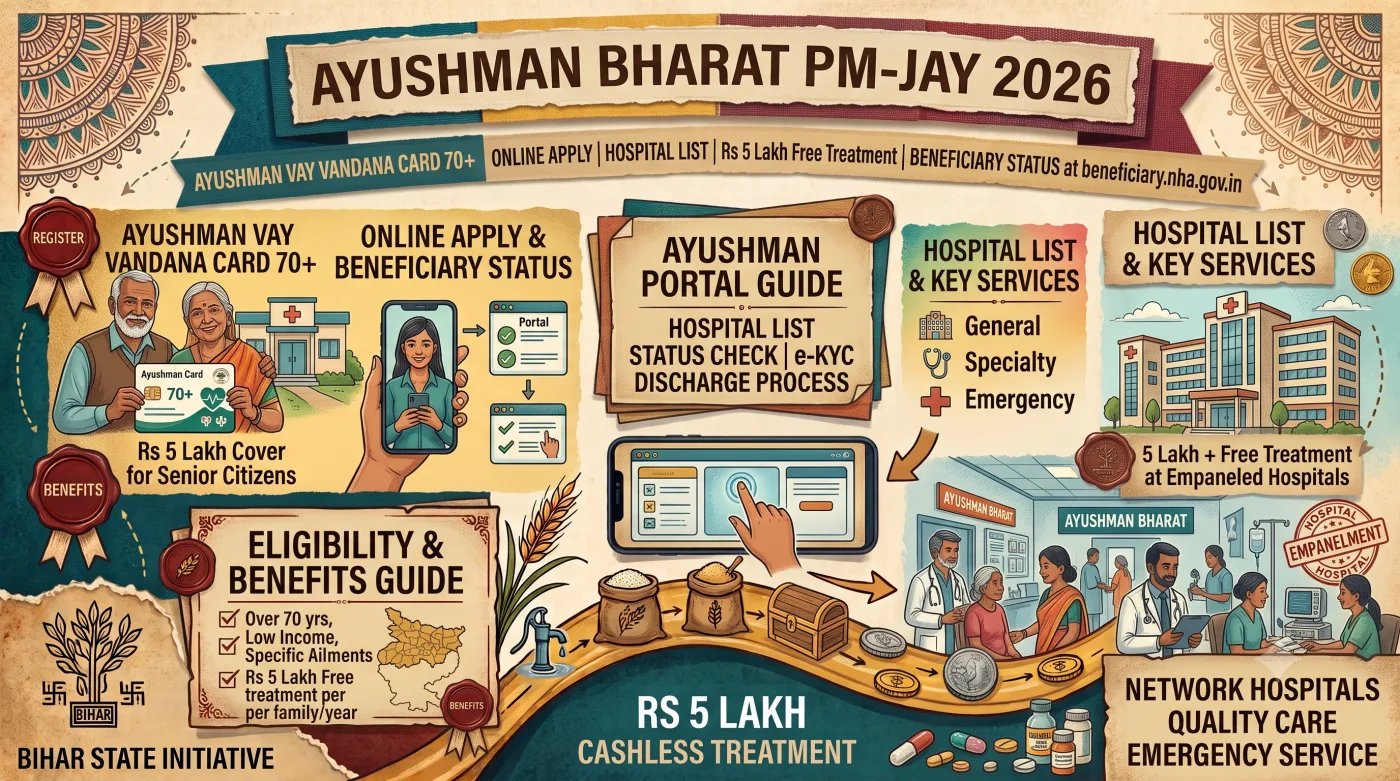
Introduction: The World’s Largest Publicly Funded Health Assurance Program
The Ayushman Bharat Pradhan Mantri Jan Arogya Yojana (AB-PMJAY 2026) stands as a colossal watershed in the history of global healthcare architecture. Administered by the National Health Authority (NHA) under the Ministry of Health and Family Welfare, Government of India, this flagship entitlement scheme protects over 12 Crore impoverished and economically vulnerable families—encompassing upwards of 55 Crore individual citizens—from the catastrophic, debt-inducing financial shocks of serious illness and medical emergencies. By conferring an unalterable annual health guarantee of ₹5,00,000/- per family per year for secondary and tertiary care hospitalization, PM-JAY dismantles the cruel barrier that historically forced poor families to sell agricultural land, pawn family jewelry, or mortgage ancestral assets to pay for life-saving surgeries.
In 2026, the scope of Ayushman Bharat has expanded even further under a monumental Union Cabinet decision that inaugurated the Ayushman Vay Vandana Card. This landmark expansion extends universal healthcare assurance to every Indian citizen aged 70 years and above, completely irrespective of income, wealth, pension status, or social caste. As India witnesses significant demographic shifts toward an aging populace, this transformative safety net ensures that our senior citizens can navigate their golden years with dignified access to advanced geriatric medical care, bypass surgeries, joint replacements, and cancer treatments without becoming a financial liability to their children.
📢 ऐतिहासिक राष्ट्रीय घोषणा: 70 वर्ष से अधिक आयु के सभी बुजुर्गों हेतु आयुष्मान वय वंदना कार्ड
केंद्रीय मंत्रिमंडल द्वारा स्वीकृत नई नीति के अनुसार, भारत में रहने वाले 70 वर्ष या उससे अधिक आयु के प्रत्येक वरिष्ठ नागरिक को आयुष्मान वय वंदना योजना के अंतर्गत ₹5 लाख का स्वतंत्र वार्षिक स्वास्थ्य बीमा सुरक्षा कवर प्रदान किया जा रहा है। इस योजना में कोई आय सीमा (Income Ceiling) नहीं है—चाहे परिवार गरीब हो या अमीर, केवल आधार कार्ड में दर्ज जन्मतिथि के आधार पर 70 वर्ष की आयु पूरी होने पर यह कार्ड तत्काल ऑनलाइन जारी किया जाता है। यदि परिवार पहले से आयुष्मान योजना में शामिल है, तो 70+ बुजुर्ग को अतिरिक्त ₹5 लाख का टॉप-अप मिलेगा जो केवल उन्हीं के इलाज पर खर्च होगा।
Core Architecture: How the ₹5 Lakh Health Guarantee Works
To fully grasp the scope of AB-PMJAY, it is vital to understand the foundational operational principles governing this public health entitlement:
| Feature Component | Standard PM-JAY (Vulnerable Families) | Ayushman Vay Vandana (70+ Seniors) |
|---|---|---|
| Annual Coverage Limit | ₹5,00,000 per family per financial year | ₹5,00,000 independent cover for 70+ individual/couple |
| Floater vs Exclusive Cover | Family Floater (Shared among all family members) | Exclusive Top-up (Not diluted by younger family members) |
| Income / Asset Criteria | SECC 2011 Deprivation / NFSA Ration Card Criteria | Zero Income Restriction (Universal Entitlement) |
| Pre-Existing Illnesses | Covered from Day 1 (No waiting period) | Covered from Day 1 (Hypertension, Diabetes, Cancer, etc.) |
| Family Size & Age Cap | No limitation on family size, gender, or age | Available to every person aged 70+ independently |
| Empanelled Network | 29,000+ Public & Private Empanelled Hospitals | 29,000+ Public & Private Empanelled Hospitals |
| Payment Mechanism | 100% Cashless & Paperless via NHA TMS Portal | 100% Cashless & Paperless via NHA TMS Portal |
Health Benefit Packages (HBP 2026): What Treatments are Covered?
Under the revised Health Benefit Packages (HBP 2026), the National Health Authority provides coverage for over 1,949 high-end clinical procedures across 27 distinct medical and surgical specialties. This comprehensive package includes:
- Cardiovascular Specialties: Coronary artery bypass grafting (CABG), coronary angioplasty with drug-eluting stents, pacemaker implantation, cardiac valve replacements, and congenital heart defect repairs.
- Oncology & Cancer Therapies: Surgical tumor resections, medical chemotherapy regimens, targeted biological therapies, intensity-modulated radiation therapy (IMRT), and bone marrow transplants.
- Orthopedics & Joint Care: Total knee arthroplasty (knee replacement), total hip replacement, complex trauma fracture fixations, spinal decompression, and fusion surgeries.
- Nephrology & Urology: Renal hemodialysis cycles, peritoneal dialysis, kidney transplantation surgery (including donor workup expenses), and lithotripsy for urinary tract calculi.
- Neurology & Neurosurgery: Craniotomy for traumatic brain hematomas, aneurysm clipping, neuro-endoscopy, and deep brain stimulation evaluation.
- General & Pediatric Surgery: Laparoscopic cholecystectomy, hernia mesh repairs, appendectomy, pediatric congenital anomaly reconstructions, and burn contracture releases.
- In-Hospital Intensive Care: Full coverage for Intensive Care Unit (ICU), Coronary Care Unit (CCU), ventilator support, life-saving blood products, oxygen delivery, and specialized diagnostics (MRI, CT scans, Doppler, biopsy).
⚠️ कैशलेस इलाज एवं अस्पताल नियम (Zero Cash Payment Guarantee)
आयुष्मान भारत के तहत सूचीबद्ध किसी भी सरकारी या निजी अस्पताल में भर्ती होने पर मरीज से एक भी रुपया नकद या सिक्योरिटी डिपॉजिट के रूप में नहीं लिया जा सकता। अस्पताल में डॉक्टर की फीस, सर्जरी, दवाइयां, जांच (Blood Tests, CT Scan, X-Ray), भोजन, और भर्ती से 3 दिन पहले तथा डिस्चार्ज के 15 दिन बाद तक की दवाइयों का खर्च योजना के पैकेज में शामिल होता है। यदि कोई अस्पताल कैश मांगता है, तो तुरंत 'आयुष्मान मित्र' (Ayushman Mitra) या राष्ट्रीय हेल्पलाइन 14555 पर शिकायत दर्ज करें।
Eligibility Criteria: Who is Entitled to Ayushman Bharat in 2026?
Entitlement under Ayushman Bharat is determined through statutory governmental databases to prevent exclusion of genuine beneficiaries:
1. Rural Beneficiaries (SECC 2011 Rural Deprivation Indicators)
Rural families possessing at least one of the following deprivation parameters (D1 to D7) automatically qualify:
- D1: Only one room with kuccha walls and kuccha roof.
- D2: No adult member between ages 16 and 59.
- D3: Female-headed households with no adult male member between 16 and 59.
- D4: Households with disabled member and no able-bodied adult member.
- D5: Scheduled Caste (SC) and Scheduled Tribe (ST) households.
- D7: Landless households deriving a major part of their income from manual casual labor.
- Destitute Households: Automatically included categories (households without shelter, destitute, living on alms, manual scavengers, primitive tribal groups, and legally released bonded laborers).
2. Urban Beneficiaries (SECC 2011 Urban Occupational Categories)
Urban workers engaged in 11 vulnerable occupational trades:
- Ragpickers, waste collectors, and manual scavengers.
- Beggars, domestic helpers, and home-based artisans.
- Street vendors, cobblers, hawkers, and other service providers working on streets.
- Construction workers, plumbers, masons, painters, and security guards.
- Transport workers, auto-rickshaw drivers, conductor helpers, and cart pullers.
- Sweepers, sanitation workers, and mali (gardeners).
3. NFSA Ration Card Holders (Priority Household & Antyodaya Anna Yojana)
In an effort to achieve saturation, the central government and participating states have integrated National Food Security Act (NFSA) ration cards. If your family holds an active Antyodaya Anna Yojana (AAY) Pink Ration Card or eligible Priority Household (PHH) Ration Card with 6 or more members, your family is directly mapped on the NHA Beneficiary Identification System (BIS 2.0).
4. Universal Senior Citizens (Aged 70+ Vay Vandana Category)
Any Indian citizen who has completed 70 years of age (as verified on Aadhaar card) is entitled to the Ayushman Vay Vandana Card without checking poverty line indicators, property ownership, or annual income.
Comparison: Existing Government Health Schemes vs Vay Vandana 70+
Many senior citizens already possess coverage under other government programs. The table below outlines how options interact:
| Existing Scheme | Interaction with Ayushman Vay Vandana 70+ | Recommended Strategic Action |
|---|---|---|
| Central Government Health Scheme (CGHS) | Senior citizens enrolled in CGHS must exercise a one-time choice: either retain CGHS benefits OR opt for Ayushman Vay Vandana Card. Dual claim is not permitted. | Pensioners residing in metro cities with CGHS wellness centers typically retain CGHS; those moving to tier-2/rural towns often prefer Ayushman's vast 29,000 hospital network. |
| Ex-Servicemen Contributory Health Scheme (ECHS) | Military defense veterans under ECHS must choose between ECHS or PM-JAY. | Retaining ECHS is generally optimal for defense veterans due to dedicated military hospitals. |
| Employees' State Insurance (ESIC) | Beneficiaries eligible for ESIC senior healthcare must choose between ESIC and PM-JAY. | Ayushman provides significantly wider private hospital access across national boundaries. |
| Private Commercial Health Insurance | Allowed Simultaneously! Seniors holding private insurance can also generate an Ayushman Vay Vandana Card. | Beneficiaries can utilize Ayushman for baseline ₹5 Lakh cover and use private policies for top-up claims without conflict. |
Step-by-Step Guide: How to Apply Online at beneficiary.nha.gov.in
Applying for your Ayushman Bharat Card or Ayushman Vay Vandana Card can be executed from home on any smartphone or computer:
- Step 1: Access the Portal: Open your browser and navigate to the official portal at
beneficiary.nha.gov.in. - Step 2: Select Beneficiary Login: On the right-hand login box, select 'Beneficiary' (do NOT click Operator). Enter your 10-digit mobile number and click 'Verify'. Enter the 6-digit OTP received via SMS and input the captcha code.
- Step 3: Search Your Record:
- Select Scheme: PM-JAY (or select PM-JAY-VAY VANDANA for 70+ seniors).
- Select your State and Sub-Scheme (e.g., PMJAY, NFSA, or VAY_VANDANA).
- Select your District.
- Search By: Choose Aadhaar Number (most reliable), Family ID / Ration Card Number, PMJAY ID, or Location (Rural/Urban).
- Enter the search detail and click the magnifying glass search icon.
- Step 4: Review Family Household Grid: A tabulated list of all registered family members will appear. Members with completed verification show 'Verified' (Green badge); members awaiting verification show 'Action / e-KYC' (Orange badge).
- Step 5: Perform Aadhaar OTP e-KYC:
- Click the e-KYC icon next to the applicant's name.
- Select Authentication Mode: Aadhaar OTP (or Biometric Fingerprint / IRIS / Face Auth).
- Enter the Aadhaar OTP received on the registered mobile number.
- The system will match your name, gender, and birth date against the UIDAI database.
- Capture a live webcam or mobile camera photo (plain white background, smiling neutral expression).
- Step 6: Instant Approval & Download: Once the matching score exceeds 80%, the status immediately shifts to 'Approved'. Click the Download Card icon to save the high-resolution, secure digital Ayushman Card PDF containing your AB-PMJAY QR code and 14-digit ABHA ID.
How to Apply Using the Official Ayushman Mobile App (Face Auth Method)
For elderly citizens whose fingertips have worn down due to age or manual labor, making fingerprint sensors fail, the National Health Authority’s official mobile app offers instant facial recognition authentication:
- Download the official Ayushman App from Google Play Store. Simultaneously install the Aadhaar FaceRD app developed by UIDAI.
- Open the Ayushman App, select 'Beneficiary', enter your mobile number, and authenticate via OTP.
- Search by Aadhaar Number. Click on the 'e-KYC' button next to the senior citizen's name.
- Under authentication options, select 'Face Auth'.
- The phone camera will activate through the Aadhaar FaceRD application. Position the senior citizen's face within the on-screen oval guide in well-lit ambient light.
- Ask the beneficiary to blink their eyes naturally. The facial recognition algorithm automatically captures the biometrics and authenticates against UIDAI servers.
- The Ayushman Card is generated instantly and can be downloaded as a PDF or printed at any local Common Service Center (CSC).
Treatment Workflow: How to Avail Cashless Treatment at Hospitals
When an illness or emergency arises, follow this exact hospital procedure to ensure completely cashless service:
- Locate Empanelled Hospital: Visit
hospitals.pmjay.gov.inor ask the emergency desk whether the hospital is empanelled under PM-JAY for the required clinical specialty (e.g., Cardiology, Oncology, Orthopedics). - Meet the Ayushman Mitra: Upon reaching the hospital, proceed directly to the designated 'Ayushman Bharat Helpdesk' (आयुष्मान मित्र हेल्पडेस्क) located in the reception foyer.
- Identity Verification: Present the patient's Ayushman Card (or digital copy on smartphone) along with their original Aadhaar Card or Ration Card. The Ayushman Mitra logs into the hospital TMS portal and validates patient identity.
- Pre-Authorization Request: The treating doctor prepares an admission diagnosis and medical package recommendation. The hospital submits an electronic Pre-Authorization Request to the State Health Agency (SHA) / Implementation Support Agency (ISA).
- Pre-Auth Approval: Once approved (typically within 1 to 4 hours, and immediately in critical trauma/emergency cases), cashless admission is formalized.
- Inpatient Care & Surgery: The patient undergoes necessary surgeries, medications, diagnostic tests, ICU care, and food without disbursing any payment.
- Discharge & Post-Hospitalization Care: At discharge, the hospital provides a complete summary and dispenses 15 days of take-home medications free of cost. The patient signs an electronic discharge voucher verifying zero payments were demanded.
How to Search Empanelled Cashless Hospitals Online
Never rely on word-of-mouth; verify hospital empanelment directly through official servers:
- Visit
hospitals.pmjay.gov.in/Search/empnlHosSearch.htm. - Select your State (e.g., Uttar Pradesh, Bihar, Madhya Pradesh, Maharashtra).
- Select your District.
- Hospital Type: Filter by 'Public' (Government Medical Colleges/Civil Hospitals) or 'Private For-Profit / Not-for-Profit'.
- Specialty: Select the specific department required (e.g., Cardiology, Neuro-Surgery, Nephrology, General Surgery).
- Click 'Search'. The portal displays the full name of the hospital, physical street address, empanelment status (Active), contact phone number, and name of the dedicated Ayushman Nodal Officer.
ABHA Health ID (Ayushman Bharat Health Account) Integration
Every Ayushman Card is intrinsically linked with the Ayushman Bharat Digital Mission (ABDM) through a unique 14-digit ABHA Number. ABHA serves as the digital backbone of Indian healthcare:
- Unified Electronic Health Records (EHR): All lab diagnostic reports, discharge summaries, surgical notes, and prescription histories are digitally consolidated into your secure ABHA cloud repository.
- Interoperability Across Hospitals: If a patient is transferred from a district hospital to AIIMS New Delhi or a premier private medical center, doctors can instantly view the historical treatment trajectory with the patient's digital OTP consent.
- Paperless Consultations: Eliminates the physical burden of carrying bulky medical files, X-ray films, and prescription booklets during follow-up hospital visits.
Common Rejections, Technical Grievances & Instant Solutions
Ensure seamless access to treatment by understanding how to address common administrative hitches:
| Technical Problem | Root Cause Analysis | Official Redressal Mechanism |
|---|---|---|
| "No Data Found" on Portal | Aadhaar number not yet linked to SECC / Ration Card database | Search using NFSA Ration Card number, or visit nearest CSC center with all family members' Aadhaar cards to submit linkage request on BIS 2.0. |
| e-KYC Photo Match Score Below 80% | Current facial appearance changed drastically compared to childhood Aadhaar photo | Update facial photo and mobile number at the nearest UIDAI Aadhaar Seva Kendra, or use Biometric IRIS / Fingerprint scanner at hospital Ayushman desk. |
| Hospital Demands Cash for Stent / Medicines | Unscrupulous private hospital attempting fraudulent out-of-pocket billing | Immediately contact National Helpline 14555 or file instant complaint on cgrms.pmjay.gov.in. State Health Agency audits hospital and forces full refund. |
| Name Spelling Discrepancy (Aadhaar vs Ration Card) | Clerical typographical errors during historical ration card digitization | The NHA portal allows 'Demographic Verification' where slight phonetic spelling variations are approved if relative relationships and village match. |
| Senior Citizen 70+ Card Not Appearing | Year of birth on Aadhaar indicates less than 70 years completed | Verify exact date of birth on Aadhaar. If Aadhaar displays only birth year, the individual is deemed to complete 70 years on 1st January of that calendar year. |
In-Depth Economic Analysis: Private Hospital Costs vs Ayushman Coverage
To appreciate the life-altering financial shield provided by Ayushman Bharat PM-JAY, it is instructive to compare the out-of-pocket costs of premier medical interventions in unregulated private commercial hospitals against the fully covered financial packages under NHA guidelines:
| Major Medical / Surgical Procedure | Typical Private Hospital Cost (Out-of-Pocket) | Cost to Patient Under PM-JAY | Standard Package Inclusions Covered |
|---|---|---|---|
| Coronary Artery Bypass Grafting (CABG Open Heart) | ₹2,50,000 to ₹4,50,000 | ₹0 (100% Cashless) | Surgeon fee, bypass machine, ICU stay, coronary grafts, post-op angiography & 15 days cardiac medicines. |
| Total Knee Arthroplasty (Bilateral Knee Replacement) | ₹3,00,000 to ₹5,00,000 | ₹0 (100% Cashless) | FDA/CDSCO-approved high-flex knee implants, orthopedic surgeon team, OT charges, physiotherapy & post-op antibiotics. |
| Medical Oncology (Chemotherapy Regimen for Breast/Lung Cancer) | ₹1,50,000 to ₹3,50,000 per cycle series | ₹0 (100% Cashless) | Targeted cytotoxic chemotherapy drugs, premedications, oncology daycare bed, blood tests, and medical oncologist review. |
| Renal Hemodialysis (Chronic Kidney Disease Stage 5) | ₹25,000 to ₹40,000 per month (~₹3.5L/year) | ₹0 (100% Cashless) | 2 to 3 weekly hemodialysis sessions, dialyzer filter reuse/replacement, heparin, erythropoietin injections & nephrologist monitoring. |
| Craniotomy for Brain Hemorrhage / Trauma Decompression | ₹2,00,000 to ₹4,00,000 | ₹0 (100% Cashless) | Emergency neuro-surgical operation theater, intracranial monitoring, mechanical ventilation ICU stay, and cranial bone flap preservation. |
State Implementation Architectures: Trust vs Insurance vs Hybrid Models
Under India’s cooperative federalism, public health is a State subject. Consequently, the National Health Authority implements PM-JAY in operational partnership with State Governments, which adopt one of three distinct institutional architectures:
1. The Trust Model (Direct State Health Agency Implementation)
Employed by states such as Uttar Pradesh, Bihar, Andhra Pradesh, and Karnataka. In this architecture, there is no commercial third-party insurance company. The State Government establishes an autonomous State Health Agency (SHA) / State Health Society that manages the central and state subsidy funds directly in an escrow corpus. Hospital pre-authorizations and medical claims are audited and settled directly by in-house SHA medical doctors and claim executives. This model eliminates corporate insurer profit margins, ensuring that 100% of public healthcare funds are channeled directly into patient care and hospital reimbursements.
2. The Insurance Company Model
Under this framework, the State Health Agency floats a competitive public tender to empanel public or private general insurance companies (such as New India Assurance, National Insurance, or ICICI Lombard). The insurer collects an actuarially determined per-family annual premium funded jointly by the Central Government (60%) and State Government (40%). The empanelled insurance provider manages the Third-Party Administrator (TPA) network, conducts hospital pre-authorization approvals, and disburses claim settlements within statutory Turnaround Times (TAT).
3. The Mixed / Hybrid Model
Implemented in states like Gujarat and Maharashtra, this hybrid framework divides claims based on financial quantum. Standard surgical and medical claims up to a defined threshold (e.g., ₹1,00,000) are managed directly through the Trust mechanism, whereas catastrophic, high-value tertiary procedures (such as organ transplants, open-heart surgeries, and neurosurgeries up to ₹5,00,000) are underwritten through an institutional insurance consortium.
🏛️ राज्यवार सहभागिता एवं 60:40 वित्तीय अनुपात (Funding Ratio)
आयुष्मान भारत योजना के प्रीमियम और इलाज खर्च का 60% हिस्सा केंद्र सरकार द्वारा और 40% हिस्सा संबंधित राज्य सरकार द्वारा वहन किया जाता है। पूर्वोत्तर (North-Eastern) राज्यों तथा हिमालयी राज्यों (उत्तराखंड, हिमाचल प्रदेश, जम्मू-कश्मीर) के लिए यह अनुपात 90:10 होता है, जबकि बिना विधानसभा वाले केंद्र शासित प्रदेशों में 100% खर्च केंद्र सरकार देती है। पश्चिम बंगाल और दिल्ली को छोड़कर देश के अधिकांश राज्यों और केंद्र शासित प्रदेशों में यह योजना पूरी तरह सक्रिय है।
Emergency Green Corridor & Inter-District Critical Patient Transfers
Medical emergencies do not respect administrative boundaries or office working hours. When a critical patient covered under PM-JAY requires tertiary intensive care unavailable at a rural Community Health Center (CHC) or Sub-Divisional Hospital (SDH), the NHA framework prescribes an expedited Inter-Facility Transfer and Green Corridor Protocol:
- Referral Generation via NHA TMS: The rural government hospital issues a formal electronic Referral Voucher through the Transaction Management System (TMS), automatically tagging the patient's Ayushman Card ID.
- Emergency Pre-Authorization Window: While standard elective procedures require prior pre-authorization approval before surgery, emergency conditions (such as acute myocardial infarction, polytrauma crush injuries, obstetric hemorrhages, or acute appendicitis with perforation) permit Emergency Pre-Auth. The treating empanelled hospital must admit the patient immediately and can submit clinical documents within 24 hours of admission.
- Zero Out-of-Pocket Ambulance Expense: Many state health agencies integrate their national 108 Emergency Medical Services (EMS) ambulance fleets with the Ayushman network, guaranteeing free critical care transport equipped with advanced life support (ALS) oxygen and cardiac monitoring.
Anti-Fraud Surveillance: How NAFU and AI Algorithms Prevent Abuse
Managing the medical records and financial claims of over 55 Crore citizens demands impregnable data integrity. The National Health Authority has deployed the National Anti-Fraud Unit (NAFU) at the central level, mirrored by State Anti-Fraud Units (SAFU) in every state capital, empowered by cutting-edge machine learning and artificial intelligence surveillance algorithms:
- Trigger-Based Automated Anomaly Detection: Machine learning models continuously analyze hospital claim streams to detect statistical outliers—such as a single private hospital performing an improbable number of hysterectomies in a single week, or billing multiple surgeries simultaneously on the same patient.
- Biometric De-Duplication & Geo-Fencing: The TMS portal incorporates biometric facial and fingerprint verification at both admission and discharge. A patient cannot be virtually admitted in two distant hospitals concurrently.
- Mystery Audits & Field Patient Physical Inspections: Medical audit teams conduct unannounced physical inspections of empanelled hospital ICUs and wards to verify that admitted patients match digital claims, checking vital signs, surgical incisions, and confirming that no out-of-pocket money was extorted.
- Penal Consequences & De-Empanelment: Any medical establishment caught billing phantom procedures, demanding illegal cash bribes, or implanting substandard surgical devices faces immediate de-empanelment, recovery of fraudulently claimed funds with compound interest, permanent blacklisting, and criminal prosecution under IPC / Bharatiya Nyaya Sanhita anti-corruption provisions.
⚖️ भ्रष्टाचार एवं अवैध वसूली पर दंडात्मक प्रावधान (Strict Anti-Fraud Warning)
राष्ट्रीय स्वास्थ्य प्राधिकरण (NHA) धोखाधड़ी और रिश्वतखोरी के प्रति शून्य-सहनशीलता (Zero Tolerance) की नीति अपनाता है। किसी भी अस्पताल द्वारा आयुष्मान योजना के नाम पर फर्जी बिलिंग करना या गरीब मरीज से जबरन पैसे वसूलना कानूनी अपराध है। शिकायत मिलने पर राज्य स्वास्थ्य एजेंसी द्वारा अस्पताल का लाइसेंस रद्द किया जा सकता है तथा दोषी चिकित्सकों पर मेडिकल काउंसिल द्वारा कानूनी कार्रवाई की जाती है।
National Toll-Free Helplines, Grievance Portals & Emergency Contacts
If you encounter difficulties during hospital admission or online registration, utilize these authorized governmental channels:
- National PM-JAY Toll-Free Helpline:
14555(Available 24 hours a day, 7 days a week in 12 languages) - Alternate National Toll-Free Helpline:
1800-111-565 - Centralized Grievance Redressal Management System (CGRMS):
cgrms.pmjay.gov.in - National Health Authority Official Email:
pmjay@nha.gov.in - Emergency WhatsApp Chatbot: Send 'Hi' to
+91 99999 70000for hospital locator and entitlement check.
💡 जनहित में स्वास्थ्य सलाह (Public Health Advisory)
आयुष्मान भारत योजना किसी भी प्रकार के प्रीमियम भुगतान की मांग नहीं करती है। यह पूर्णतः केंद्र व राज्य सरकार द्वारा संपोषित निःशुल्क योजना है। किसी भी फर्जी वेबसाइट, व्हाट्सएप लिंक या अनधिकृत एजेंट के झांसे में न आएं जो पैसे लेकर 'आयुष्मान कार्ड' बनाने का दावा करते हों। केवल आधिकारिक सरकारी पोर्टल beneficiary.nha.gov.in या अपने नजदीकी सरकारी अस्पताल के 'आयुष्मान मित्र' केंद्र पर जाकर ही अपना कार्ड बनवाएं।
User Discussion & Comments (0)
No comments yet. Be the first to leave a comment below!
Leave a Comment / Ask a Question: